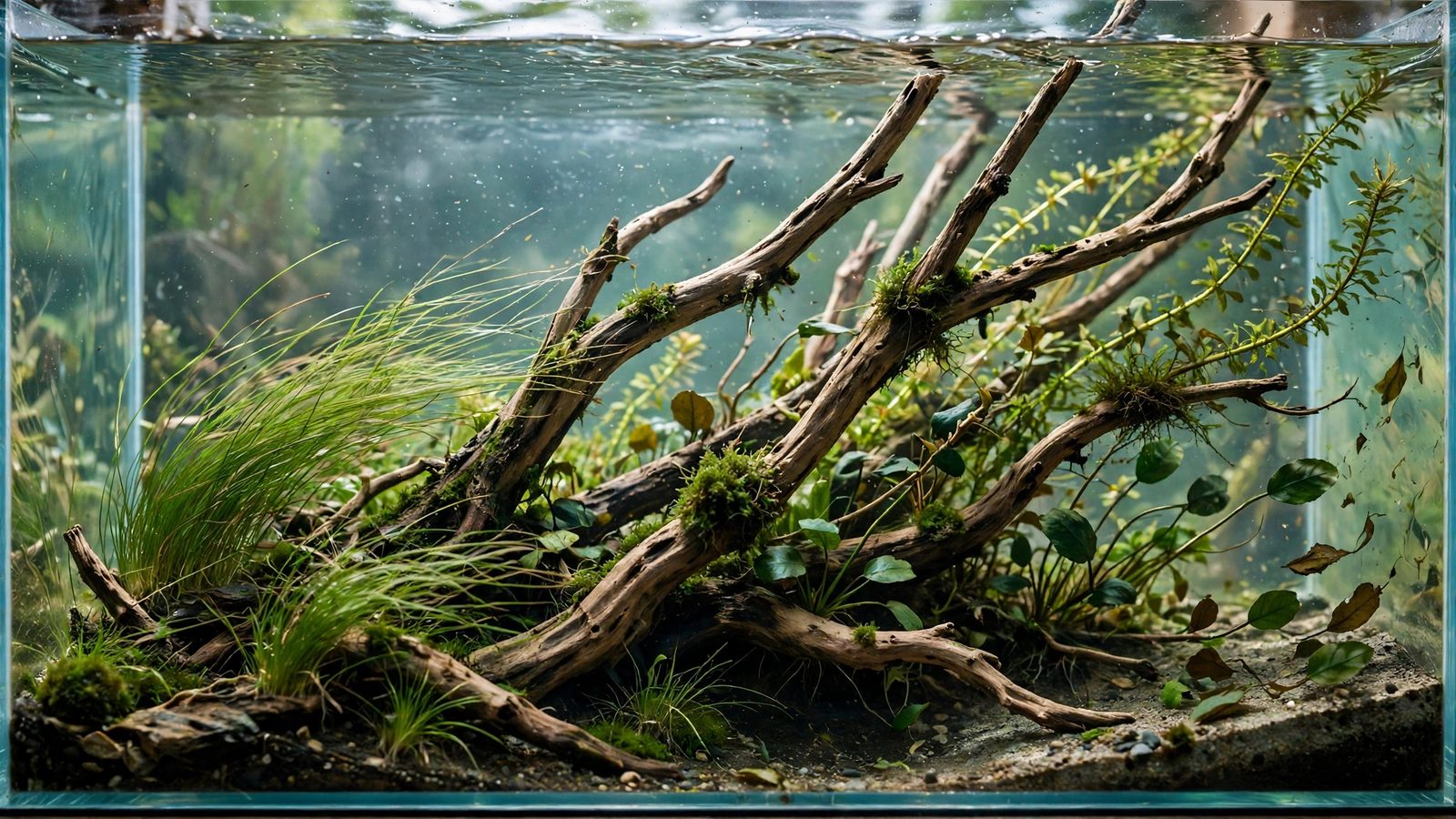
One of the most striking aquascapes of 2026 — Green Aqua's windblown 60P build, a 60P tank with Seiryu stone and driftwood under a flawless Monte Carlo carpet — didn't just look beautiful. It looked like it had weather. Every branch leaned the same way, every plant streamed in one direction, and the whole scene read as a single gust of wind frozen mid-blow. A windblown aquascape commits to that illusion completely: one dominant wind direction that every piece of hardscape and every trim cut obeys. In this guide, you'll choose your wind direction, angle branchy driftwood to lean with it, plant a flowing carpet, and keep the gust alive with a trimming discipline that protects the illusion for years.
What Makes a Windblown Aquascape Different
Aquascaping already has directional styles — the diagonal composition style uses leading lines to pull the eye, and single-driftwood layouts build a scene around one trunk. The windblown style borrows from both but adds a rule neither imposes: direction is physics, not composition. Every element isn't just pointed somewhere attractive — it's being pushed by the same invisible force.
That constraint is what makes the style so readable at a glance. Viewers don't need to understand aquascaping to feel it — the brain recognizes "wind" instantly because it matches real wind-shaped landscapes: coastal pines, dune grass, prairie blowouts. The style works when three layers agree: hardscape leaning one way, plants growing or trimmed one way, livestock moving one way. If one layer contradicts the others, the illusion collapses into a regular nature-style tank.
The practical difference: most layouts let you compose the hardscape first and plant later. Here, you declare the wind direction — say, "blowing left to right" — and let it veto choices. That branch leaning right instead? Gone. Symmetrical stones? Rebuilt. The discipline is the style.
Step 1: Declare Your Wind Direction
Before you buy wood, stand at your tank's viewing position and pick the direction the wind blows across it. Left-to-right suits most rooms because viewers scan left to right and schoolers get a natural patrol path; right-to-left works when a wall sits on the right, so fish enter from "nowhere."
Mark the direction physically: sketch a rectangle on paper, draw a big arrow through it, and judge every decision against that arrow. Place your focal point at the thirds intersection opposite the wind's origin — if wind blows left to right, the visual anchor sits right of center, reading as "wind has been pushing this scene toward the right for years."
Step 2: Hardscape That Leans With the Wind
Choosing branchy wood
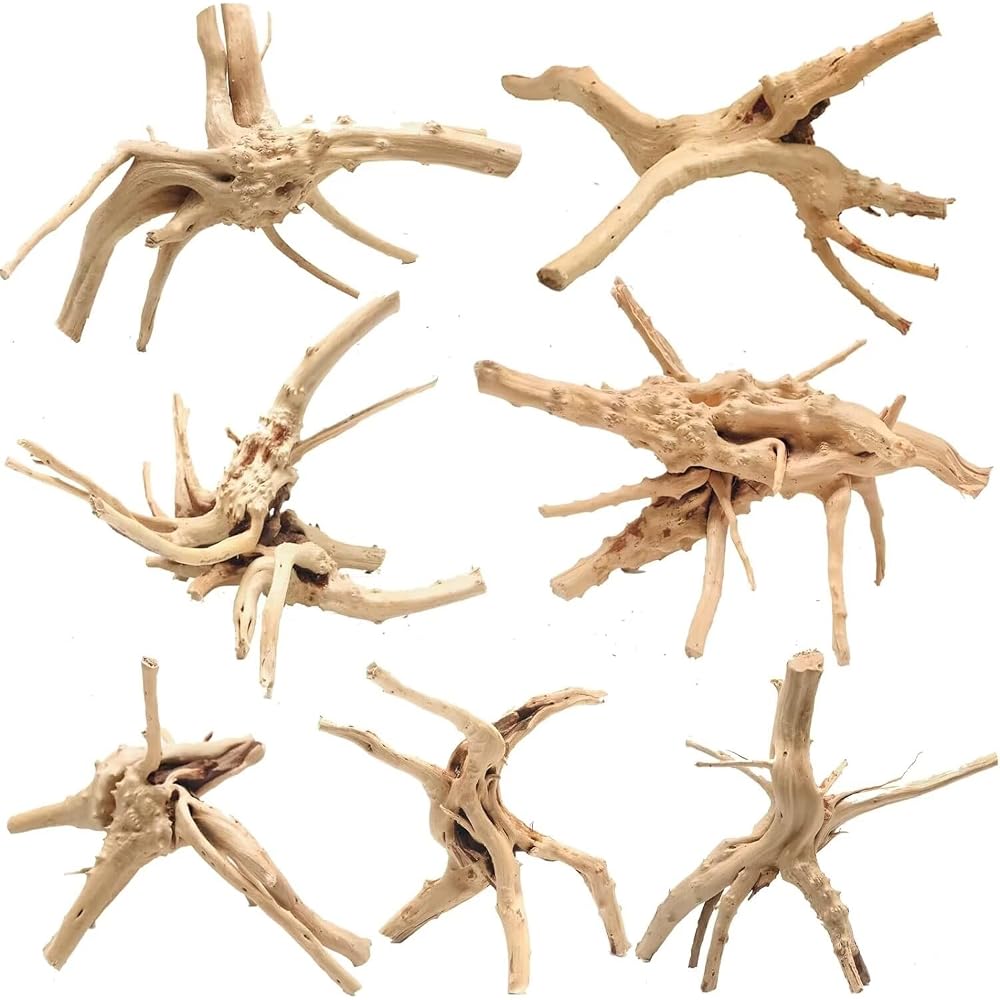
The hero of a windblown aquascape is branchy driftwood — red moor wood, manzanita, or spiderwood — with multiple tapering branches you can fan into the wind. You need 3–5 pieces that can share one orientation, so shop for pieces that agree with each other, not the prettiest single piece. Prefer branches with a natural lean already; straight vertical trunks have to be buried at awkward angles to comply.
 ★4.2
Hamiledyi Natural Spider Wood Driftwood
Check Price on Amazon ★4.2Scale matters more here than in most layouts. A single statement piece at 40–50% of tank length anchors the scene, with 2–3 supporting pieces descending in size downwind — like wind-bent trees on a cliff, the largest where the wind hits hardest, everything behind it hugging lower. If you're building around one trunk, one-driftwood layout principles still apply — just add the lean.
Angling the wood
Mount every piece leaning 15–30° off vertical in the wind direction. Under 15° reads as accidental; over 30° looks like the tank tipped over. The highest branch tips should point toward the downwind glass, as if dragged by the wind. Bury the butt end 5–7 cm deep in substrate so the lean holds while the wood waterlogs; zip-tie it to a flat stone base during the first month if the piece is buoyant.
Windward stone
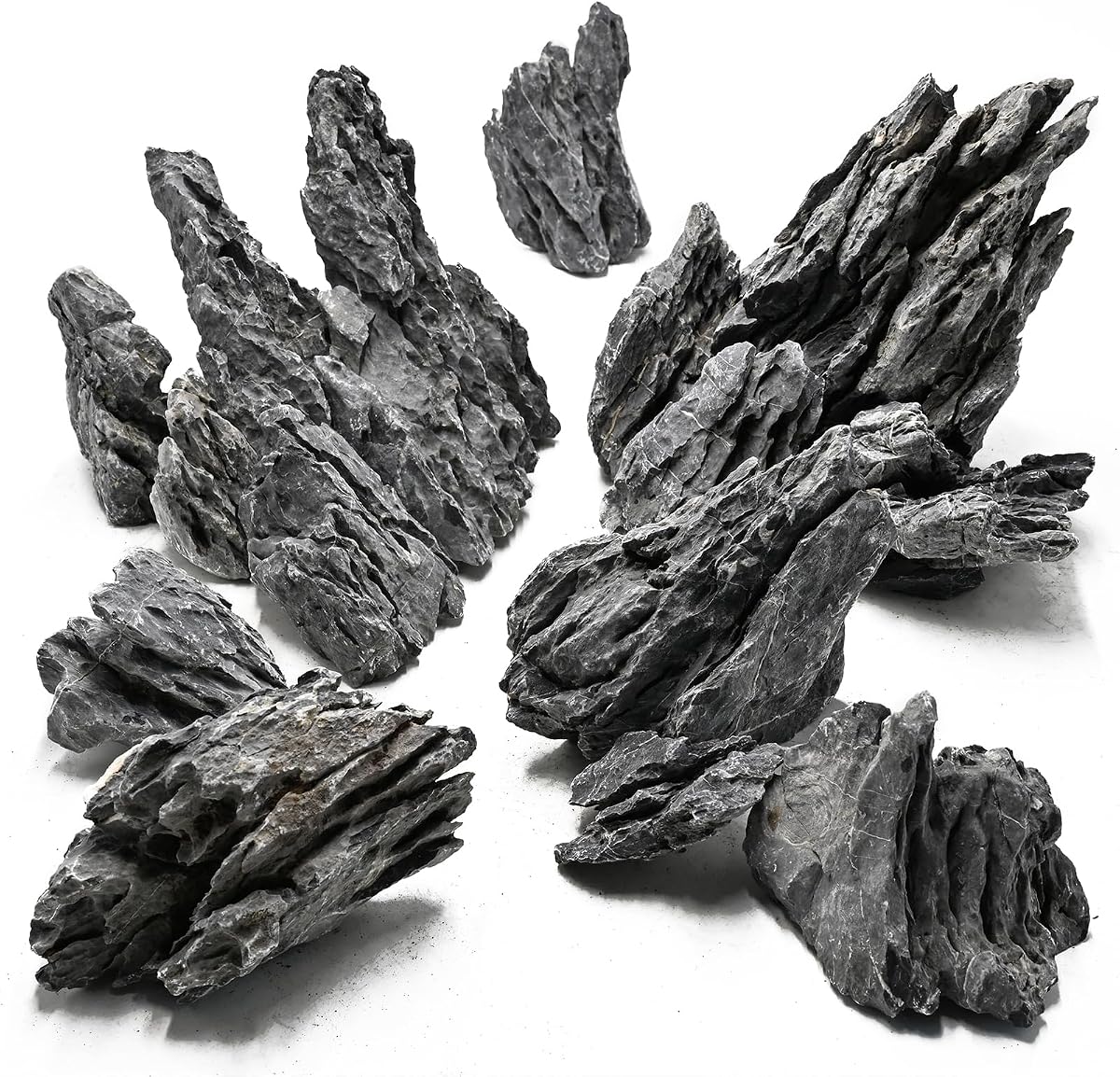
Seiryu stone (or grey mountain stone) belongs on the windward side — where the wind "enters" — in a low cluster. These are the rocks the wind is weathering: they protect the composition's exposed edge and give the eye a starting point before it follows the branches downwind. Keep stones low (a third of the tallest wood) so they read as ground, not competition. For gluing stones and wood under lean stress, attaching plants and hardscape securely covers the cyanoacrylate-and-tissue method.
 ★4.5
Eorbow Natural Seiryu Stone Rocks
Check Price on Amazon ★4.5Step 3: The Windblown Plant Palette
Windblown planting is cast in three acts: a carpet that streams, mid-ground plants that bow, and moss on leeward branches that trails. Every plant either hugs low or leans; tall vertical growers are the style's natural enemy:
| Plant | Role | Why it fits the wind look |
|---|---|---|
| Monte Carlo (Micranthemum tweedii) | Foreground carpet | Round leaves comb into visible flow lines; stays 3–5 cm when trimmed |
| Eleocharis acicularis 'Mini' | Alternative carpet | Hairgrass blades literally look like wind-blown grass; excellent for smaller tanks |
| Hydrocotyle tripartita | Mid-ground runner | Low runners creep one way naturally; trained directionally with trimming |
| Weeping moss (Vesicularia ferriei) | Branch accent | Teardrop strands hang downwind off leaning branches — pure wind signage |
| Rotala rotundifolia 'H'ra' | Background | Fine stems you can lean and trim into a flowing hedge; color contrast |
| Staurogyne repens | Mid-ground anchor | Compact, rooty; holds down the transition between stone and carpet |
The single biggest selling point of the style is the carpet: a Monte Carlo mat whose runners are visibly combed downwind. For the full method, growing a carpet without CO2 covers the low-tech Monte Carlo approach end to end. The windblown difference is directional planting: insert each plug with its runners pointing downwind, and in high-tech setups consider dry-starting the carpet — a rooted mat resists being ruffled when you flood.
Tie small tufts of weeping moss along the leeward (downwind) faces of branches with cotton thread — the strands dangle off the branches exactly the way wind strips branches of everything on the exposed side. This single detail does more for the "weathered" read than anything else in the tank. Moss on the windward face reads wrong: in nature, windward bark stays bare.
Step 4: Planting and Combing Directionally
Plant with the wind arrow in view. Every foreground plug goes in with its longest runners pointed downwind; every background stem leans slightly downwind. At flooding time, a freshly planted windblown tank should already read as windy — before a single trim.
After flooding, comb the carpet: run a fine-tooth aquascaping brush (or a clean toothbrush) across the Monte Carlo in the wind direction once a week for the first month. This trains runners along the grain. Brush hairgrass the same way — the blades lock into a lean within weeks.
Step 5: Trimming Discipline — Holding the Direction
Windblown aquascapes fail slowly, and trimming is where they fail. Every stem that grows straight up is a tiny vote against the illusion; unchecked for a month, the votes add up and the tank becomes an ordinary jungle. The rule is simple and non-negotiable: every cut enforces the direction.
- Carpet: mow Monte Carlo every 3–4 weeks at 3 cm height, finishing strokes moving downwind so loose leaves settle along the grain.
- Background stems: trim Rotala on a slant — lower windward, higher downwind — so the hedge slopes with the wind. Replant tops downwind of their mothers to march the hedge forward.
- Moss: shear weeping moss into tapered flags pointing downwind; never cut it into a ball.
- Hydrocotyle: redirect runners weekly by pressing them into the substrate downwind; pinch vertical shoots.
For clean cuts and healthy regrowth, aquascape trimming maintenance is the in-depth companion — read it once, then apply its techniques inside the wind-direction rule. Most windblown tanks need 20–30 minutes of directional trimming every two to three weeks: less than a Dutch tank, more than a jungle tank.
 ★4.7
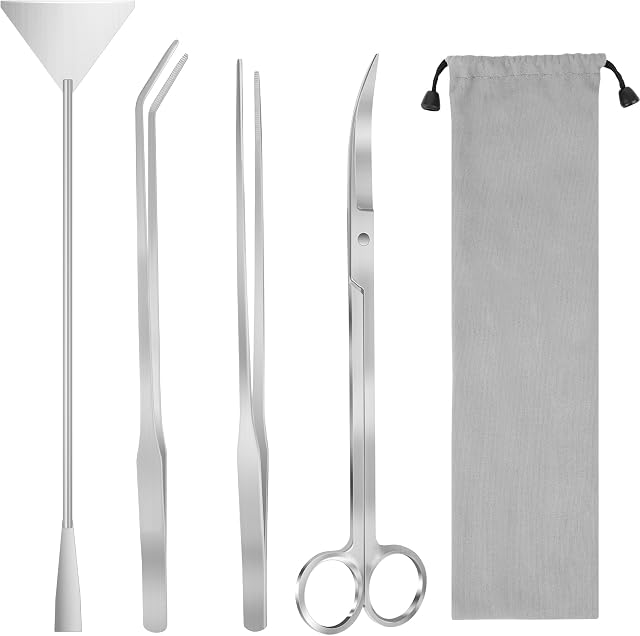
Liveek 4-in-1 Aquascaping Tool Kit
Check Price on Amazon ★4.7Step 6: Livestock That Rides the Wind
Fish are the only thing in the tank that moves, so they're the only thing that can confirm — or deny — your wind direction every second. Schooling fish that patrol horizontally are ideal: a school moving downwind with the branches feels like the whole scene breathing. The best picks:
- Ruby or ember tetras (12–20): small, tight-schooling, orange-red color pops against green carpet — the classic choice for this style.
- Green neon tetras (12–15): slower, elegant patrols for calm windblown layouts.
- Chili rasboras (15–20): for nano windblown tanks; they drift in one direction rather than darting.
- Amano shrimp + nerite snails: the cleanup crew that doesn't disturb the carpet grain.
Avoid large solo swimmers — angelfish, gouramis, bettas — that cruise against the grain and shatter the effect. For stocking logic matched to design rather than biotope, best fish for aquascaped tanks explains the design-first approach this style demands. One bottom-dwelling accent — pygmy corydoras or otos — is fine; they live under the wind, not in it.
Step 7: Maintenance Schedule
A windblown tank's maintenance is ordinary planted-tank work plus one extra layer: direction audits.
| Frequency | Task | Wind-specific note |
|---|---|---|
| Daily (first month) | Check CO2 drop checker, equipment | Re-lean any branch that shifted; wood settles as it waterlogs |
| Weekly | 30–50% water change, glass, parameter test | Comb carpet downwind after the water change, while plants are pliable |
| Every 2–3 weeks | Directional trim session | Cut with the wind: strokes, slants, and replanted tops all obey the arrow |
| Monthly | Filter maintenance, hardscape scrub | Scrub the windward stone face hardest — algae lands there first |
| Quarterly | Direction audit | Stand back, squint: does the whole tank read as one gust? Fix whatever doesn't |
Expect the layout to peak from month 3 to month 18. After that, carpets thicken vertically and stems go leggy; a yearly carpet replant keeps the grain crisp. If the style stops being fun to maintain, rescaping without tearing the tank down lets you pivot — a windblown hardscape converts beautifully into a nature aquarium style layout with one season of free growth.
Frequently Asked Questions
What tank size is best for a windblown aquascape?
Any tank from a 45 cm (roughly 10–15 gallon) nano up to 60–90 cm works, because the style needs horizontal runway for the wind to read. Below 45 cm the branches crowd and the lean has nowhere to go; above 90 cm you need several wood groupings or the wind feels thin. A 60P (60 × 30 × 36 cm) is the sweet spot — it's the format the viral reference layouts were built in.
Does a windblown aquascape need CO2 injection?
Not necessarily. Monte Carlo carpets grow low-tech with good light and patience, and the lean reads fine without injected CO2 — you just get slower fill-in (8–12 weeks instead of 4–6). What you do need is enough light: medium intensity at the substrate, roughly 6–8 hours daily. CO2 speeds fill-in and deepens carpet density, which strengthens the wind grain — but direction discipline matters far more than gas.
How do I stop the driftwood from floating or shifting its lean?
Waterlog first: soak new wood 2–4 weeks until it sinks, then mount it at your 15–30° lean on a flat stone base with cyanoacrylate gel and tissue-paper joints. Bury the butt end deep in substrate as a second anchor and check the lean weekly during month one — wood relaxes as it saturates. If a piece is stubborn, keep the zip-tie-and-stone rigging until month two; nobody sees it behind the planting.
Can I use hairgrass instead of Monte Carlo for the carpet?
Absolutely — Eleocharis acicularis 'Mini' is arguably the more natural fit, since individual blades visibly lean like prairie grass. It's also hardier low-tech than Monte Carlo. The trade-off: hairgrass takes longer to close and shows patchiness longer, and trimming a directional lean into it needs a steady hand. Comb the blades downwind weekly and mow at 4 cm; the grain sets within a month.
What plants should I avoid in a windblown layout?
Anything that insists on growing straight up and can't be trained: tall swords (Echinodorus), big Vallisneria thickets, and stiff rosette plants fight the wind concept. Also avoid other styles' signature moves — a bonsai tree crown rising vertically in the middle reads as the wind "stopping," which breaks the story. Keep verticals out, or relegate them to the far downwind edge as the "windbreak."
How is this different from a diagonal composition aquascape?
Diagonal composition uses angled lines for visual energy — the angles can point any direction that pleases the eye. A windblown layout adds a physical story: all lines must agree with one wind vector. A diagonal layout can use two opposing diagonals for tension; a windblown tank with opposing leans just looks like a mistake. Think of it as diagonal composition with a weather system.
Bringing the Gust Home
The windblown aquascape is one of the rare styles where constraint is the entire aesthetic. Pick one direction, lean your wood into it, plant your carpet along it, trim with it for a year — and strangers will notice the tank from across the room without knowing why. Wind is a language every human already reads. Start with the arrow, let it veto your shopping, and your Monte Carlo will be flowing downwind within three months if your trimming hand stays honest.