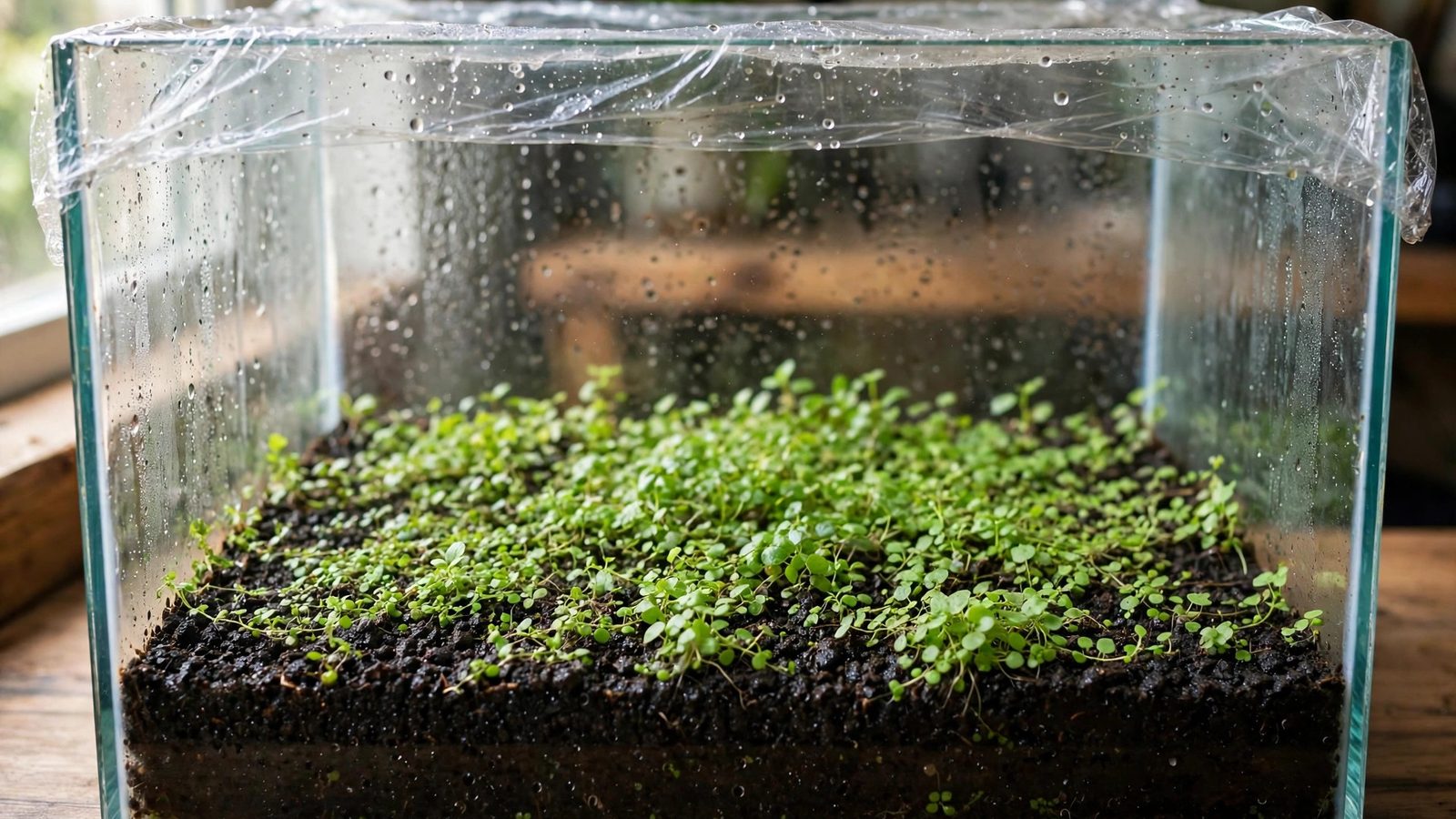
The dry start method (DSM) is beautifully counterintuitive: to grow an underwater carpet faster, don't add water. By growing carpeting plants emersed — in humid air, with their roots in damp substrate — for 4 to 8 weeks before flooding, you exploit a simple fact: plants grow dramatically faster with access to atmospheric CO2 than submerged with injected CO2. The result is a dense, deeply rooted carpet on flooding day instead of a few struggling plantlets. Here's the complete step-by-step.
Why Dry Start Works: The CO2 Advantage
Underwater, CO2 is scarce — even injected tanks max out around 30 ppm, and diffusion through water is slow. In air, CO2 sits at ~400 ppm and diffuses freely to every leaf. Emersed plants also get full, unfiltered light (no water column absorbing it) and zero algae competition on their leaves. The growth rate difference is staggering: a Hemianthus callitrichoides carpet that takes 3–4 months to establish submerged can fully carpet in 4–6 weeks via dry start.
The second advantage is root establishment. Dry-started plants develop deep, extensive root systems anchoring them firmly. When you flood, there's no melting-and-floating phase — the #1 carpet killer in conventional setups. The carpet is already a mat; flooding just changes its growing medium.
The trade-off: DSM only works for plants with viable emersed forms (most carpeting species qualify), and the transition to submerged growth still takes 1–2 weeks of adjustment after flooding. It's a technique for carpets and foregrounds, not whole-tank planting.
Best Plants for the Dry Start Method
- Hemianthus callitrichoides (HC Cuba / dwarf baby tears): the DSM poster child. Explosive emersed growth, carpets densely, transitions well. The reason most people try this method.
- Micranthemum 'Monte Carlo': slightly larger leaves, very forgiving emersed, arguably easier than HC Cuba for beginners.
- Glossostigma elatinoides: fast emersed spreader; needs strong light to stay compact.
- Eleocharis parvula / acicularis (dwarf hairgrass): excellent DSM candidate — sends runners aggressively in humid air.
- Staurogyne repens: creeps and roots firmly; great for foreground slopes.
- Mosses (Taxiphyllum, Vesicularia): attach to hardscape during DSM; they establish firmly before water arrives.
- Cryptocoryne parva: slow but steady; plant during DSM so it's established at flood.
Skip DSM for: stem plants (they grow leggy emersed and melt hard on flooding — plant these after flooding), Anubias/ferns (they're fine emersed but gain little from it; attach them anytime), and anything you can't keep humid.
The Setup: Building Your Dry Start
Step 1: Hardscape and substrate first
Complete your entire hardscape and substrate slope before planting — you won't want to rearrange once the carpet is growing. This is pure hardscape-first discipline: stone, wood, soil contours, all finalized. Mist the substrate as you shape it so slopes settle now, not later.
Step 2: Plant densely into damp substrate
Divide tissue-culture or potted carpets into small portions (pea-sized clumps for HC Cuba, 1cm plugs for Monte Carlo) and plant them 1–2 cm apart using tweezers. Small portions spread faster than big clumps — more growing edges. Push each portion firmly into the damp aquasoil so it contacts moisture. Cover the target area generously; DSM rewards heavy initial planting.
For mosses on hardscape: blend moss with yogurt or buttermilk (the traditional "moss milkshake"), paint it onto wood and stone, and it'll colonize during the dry phase. It looks absurd for a week; then it greens up.
Step 3: Mist, cover, and light
- Mist thoroughly with dechlorinated water — the substrate surface should glisten, with no puddles. Puddles = too wet = mold and rot.
- Cover with cling film (or a glass lid), leaving a small gap or a few holes for slight air exchange. You're building a greenhouse: near-100% humidity.
- Light 10–12 hours daily at the intensity you'd use for the flooded tank. Emersed plants want strong light; weak light grows leggy, pale spread.
- Temperature: normal room temp (70–78°F). Avoid heat mats and direct sun — a sealed tank in sun becomes an oven.
Step 4: The waiting game (4–8 weeks)
Daily: peek through the cover. Every 2–3 days: mist if the substrate surface looks dry, and air out the tank for 15–30 minutes (remove the cover) to exchange air and discourage mold. Weekly: check for mold spots (dab with hydrogen peroxide on a cotton swab; increase airing if persistent).
You'll see: week 1–2, plantlets establish and new tiny leaves appear; week 3–4, runners visibly spread; week 5–8, portions merge into a continuous mat. Don't flood early. The #1 DSM failure is impatience — flooding a patchy carpet gives you a patchy submerged carpet that then melts. Wait until coverage is 80%+ and you can't easily see substrate between plantlets.
Step 5: Flood slowly and carefully
When the carpet is dense:
- Fill very slowly — pour over a plate, plastic bag, or your hand to avoid cratering the carpet. Siphon water in if you're cautious (recommended).
- Fill to the top in one session; don't half-fill and wait days.
- Plant your stem plants and background now, into the flooded tank.
- Start CO2 and filtration immediately; begin your normal photoperiod (consider starting at 6 hours and ramping to 8 over two weeks).
- Do a 50% water change on day 2–3 — aquasoil releases ammonia when first flooded, and the established carpet plus water changes handle it.
Step 6: The transition (1–3 weeks post-flood)
Expect some melting of emersed leaves as the carpet grows submerged replacements — this is normal and far less severe than planting submerged-grown stock, because the root system is already massive. Don't uproot melting patches; trim away mush and let the roots push new growth. Within 2–3 weeks the carpet greens up in submerged form and resumes spreading. Our fill-in timeline guide covers what to expect week by week.
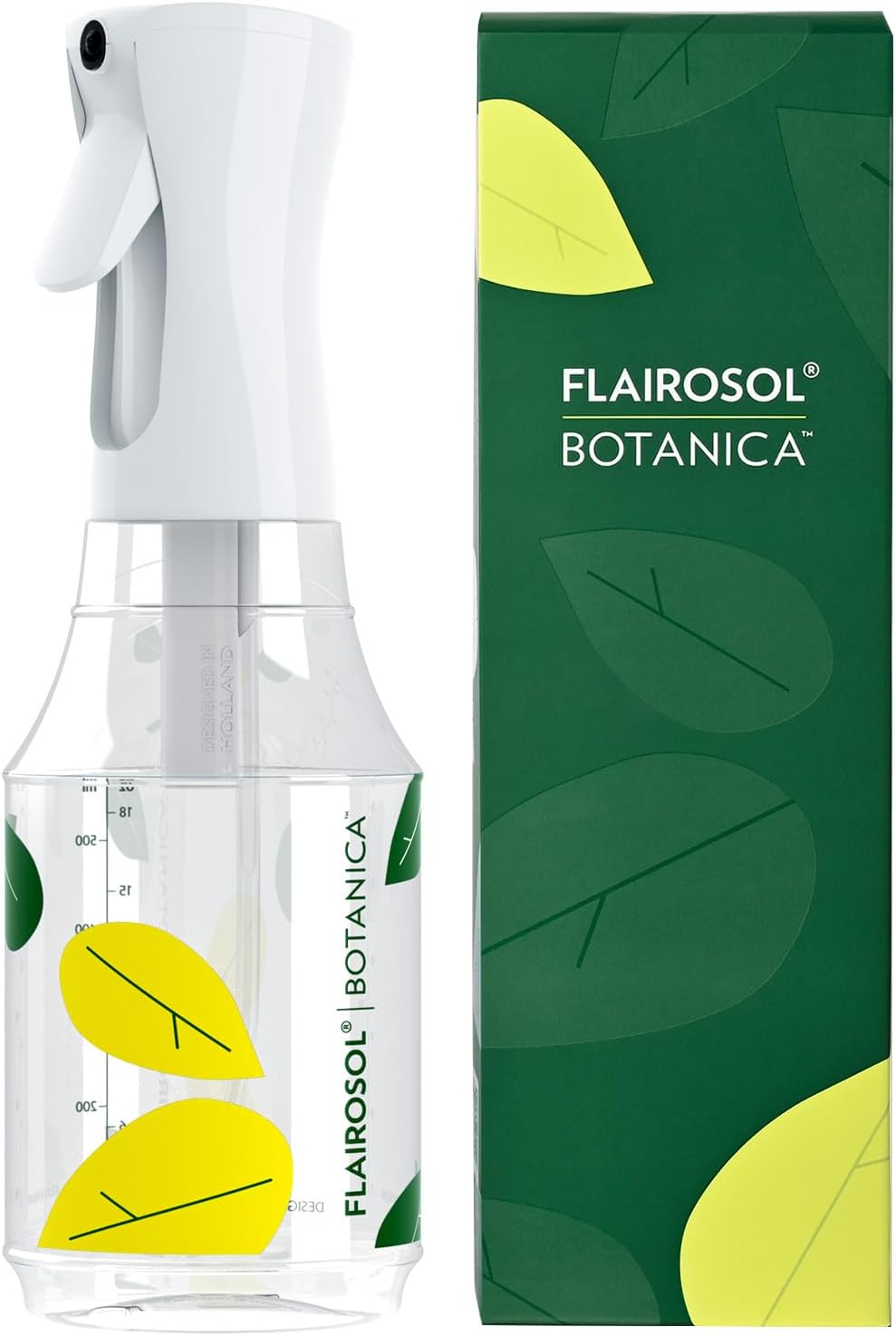
A reliable pick here is fine-mist plant mister.
 ★4.4
FLAIROSOL Botanica Plant Mister
Check Price on Amazon ★4.4A reliable pick here is Fluval Plant and Shrimp Stratum.
DSM Variations and Pro Tips
- DSM for slopes: the method's hidden superpower. A dry-started carpet's roots lock sloped substrate in place better than any retaining wall. If you're building hills, DSM isn't optional — it's structural.
- Fertilize the mist: after week 3, mist occasionally with heavily diluted all-in-one fertilizer (1/10 strength) to fuel the explosive growth phase.
- Dark start alternative: some aquascapers flood first, then run 2–3 weeks of no light with filtration (letting the cycle establish and soil settle) before planting and lighting. Different technique, similar patience payoff — but it doesn't give you the emersed growth boost.
- Partial DSM: dry-start only the foreground carpet area (dam the back with plastic wrap), then flood and plant the back normally. Useful when background stems can't wait.
- Photograph the process: weekly top-down photos of the spreading carpet are deeply satisfying and great for our aquascape photography practice.
Troubleshooting
- White mold on substrate: too wet, too sealed. Air out longer, mist less, dab mold with peroxide. Usually harmless to plants.
- Plants drying out: cover isn't sealed enough or misting too infrequent. Seal gaps; mist daily. Crispy plantlets rarely recover — replant those spots.
- No spreading after 3 weeks: usually insufficient light or the portions were planted too large. Increase light; divide remaining clumps smaller.
- Massive melt after flooding: flooded too early (sparse carpet), or CO2/light not started promptly. Keep CO2 strong, lights moderate, and wait — rooted carpets recover.
- Algae on the carpet post-flood: the transition window is vulnerable. Keep photoperiod short initially, maintain CO2, and let the established root mass outcompete it.
Frequently Asked Questions
Can I dry start without CO2 equipment for the flooded phase?
Yes — that's actually a major DSM use case. The emersed phase needs no CO2 system (the air provides it), and a densely rooted carpet transitions to low-tech submerged life far better than fresh plantlets. Pair DSM with our carpeting without CO2 guide for a genuinely achievable low-tech carpet.
How do I know when it's ready to flood?
Coverage test: look straight down — if you see more plant than substrate (80%+ coverage) and the portions have merged into a continuous mat that resists gentle tugging, it's ready. Time is secondary; some carpets take 4 weeks, some take 10. Coverage is the metric.
Can I dry start stem plants too?
Technically yes, practically no. Stems grow tall and leggy emersed, then melt dramatically on flooding — you gain little and risk a mess. DSM is for carpets, foregrounds, and mosses. Plant stems after flooding; they'll catch up fast in a mature tank.
Will the cling film cover cause problems?
Only if fully sealed with zero air exchange — then mold thrives and CO2 depletes. Leave a corner gap or poke holes, and air out 15–30 minutes every couple of days. Think greenhouse, not vacuum chamber.
Can I do DSM in a tank that already has water and fish?
No — DSM requires an empty, unfilled tank. It's a setup-stage technique. For established tanks, the alternative is planting heavily with tissue-culture carpets and managing the transition submerged, or doing a full rescape with a dry-start phase built in.
Does DSM work for Monte Carlo / hairgrass / Glosso specifically?
All three are excellent DSM candidates — Monte Carlo is arguably the most forgiving, hairgrass runners spread aggressively emersed, and Glosso carpets fast given strong light. HC Cuba gives the most dramatic before/after but is the fussiest about humidity consistency during the dry phase.
Patience, Compounded
The dry start method is delayed gratification as technique: two months of staring at a plastic-wrapped tank, then a flooding day where you unveil a lawn that would have taken four months the conventional way. For Nature Aquarium carpets, Iwagumi foregrounds, and any serious slope build, it's the closest thing to a cheat code the hobby offers — no extra equipment, just humidity, light, and the discipline to wait until the mat is truly ready.