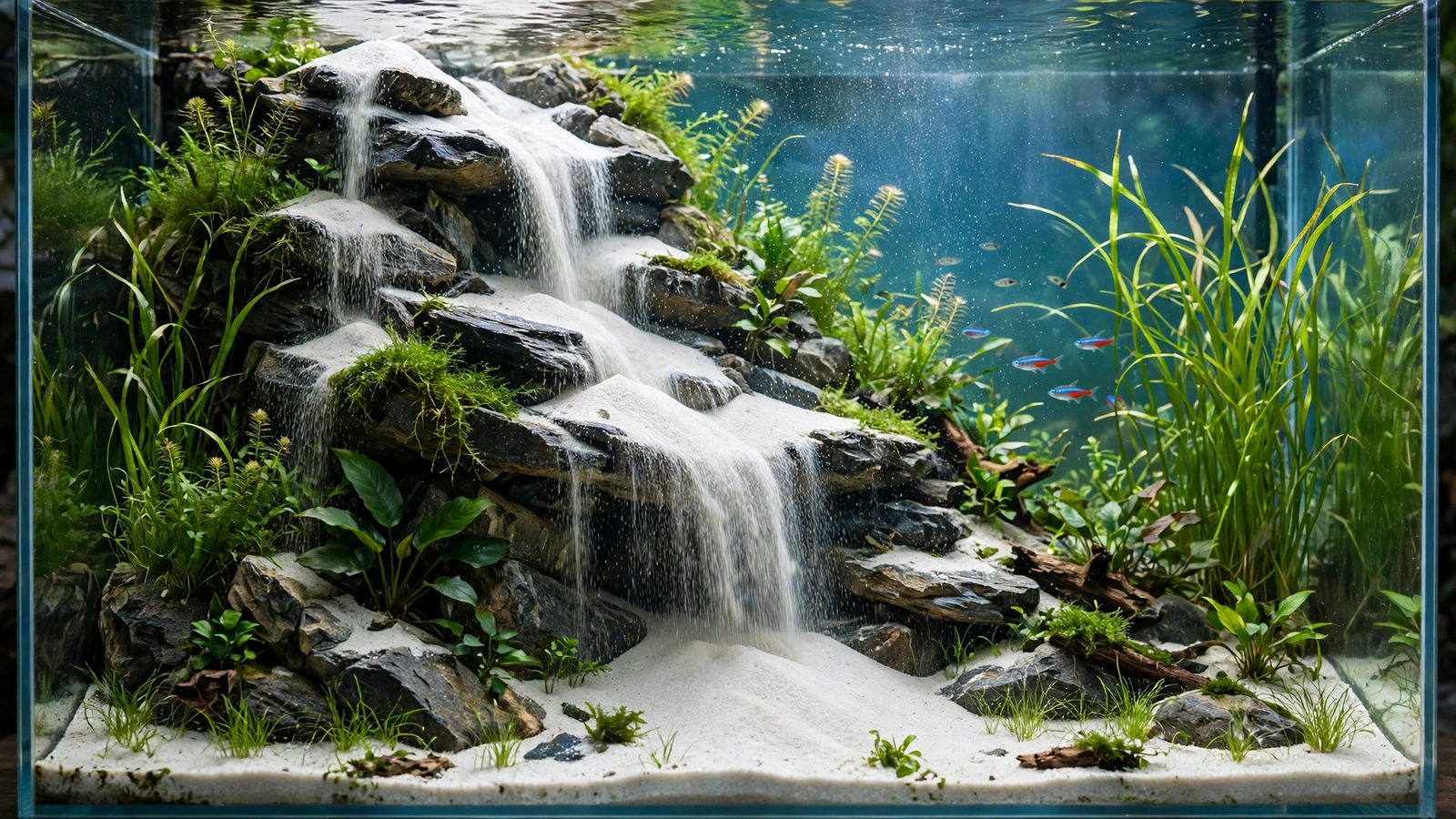
A sand waterfall aquarium creates one of the most hypnotic effects in aquascaping: a continuous curtain of pale sand cascading down a rock face, looking for all the world like water flowing underwater. There is no pump pushing anything downhill and no camera trick. The illusion runs on an air-lift riser hidden inside your hardscape — a tube of rising bubbles that carries sand grains upward, then lets gravity pour them back down. Get the grain size or air flow wrong, and you will watch a tube do nothing — or a blizzard of sand blast across your tank.
I learned this the expensive way. My first build used glittery play sand because it looked luminous under the shop lights, and I cranked the air pump wide open "for maximum effect." The result was not a waterfall. It was a sandstorm that stripped my foreground carpet and wedged grit into my filter impeller. The second attempt, with a finer round grain and a throttled bleed valve, poured like milk. A sand waterfall is an instrument, and the sand, the tube, and the air are one tuning problem.
How the Sand Waterfall Actually Works
The trick rests on the airlift effect, the same physics behind sponge filters. Inside a vertical tube, a stream of rising bubbles reduces the density of the water column, so tank water rushes in at the bottom to replace it. That upward surge drags loose sand grains with it, carrying them up the riser and spilling them out at the top. The principle is the airlift pump, long used in aquaculture and wastewater treatment, shrunk down to aquarium scale.
The riser tube
The riser is usually a rigid tube 12–20 mm in internal diameter, running from a low collection point at the foot of the fall up to the top of the drop. An air line feeds the bottom of the riser through a diffuser or a bare airline tip. Internal diameter matters more than length: too narrow and grains jam; too wide and the water column loses its lifting punch.
The spill channel
At the top, sand exits the riser onto a shaped lip that guides it over the rock face, and gravity takes over. A rough, slightly stepped rock surface — Seiryu, lava rock, or stacked slate — slows the fall into that flowing, liquid look. Smooth stone lets sand slide off in a thin, less convincing sheet. Fallen sand collects in a catch basin at the bottom, where the airlift sweeps it back up, closing the loop.
Planning the Layout Before You Build
The drop is the visual anchor of the tank, so everything else should frame it. Sketch first: decide where the riser enters the hardscape and where the fall lands, because repositioning the tube after rock and substrate go in is a teardown. Place the fall off-center — a golden-ratio placement reads as art instead of a gimmick. Since the rocks must hide a tube and still look unforced, the hardscape-first method is the right workflow here.
Depth sells the illusion. A foreground sloping gently up toward the rock face gives the falling sand a longer apparent journey and hides the catch basin, so review how to slope substrate for depth first. In a low tank the compressed proportions change what the fall can do — shallow-tank aquascaping has specific tricks for keeping tall features believable in a short box.
Choosing the Sand: Grain Size Makes or Breaks the Flow
Sand choice is the single biggest variable, and where most first builds fail. The grains must be heavy enough to fall in a dense curtain, light enough for the airlift to carry, round enough not to jam, and uniform enough that fines do not clog the works.
| Grain size | Example | Verdict for waterfalls |
|---|---|---|
| 0.1–0.3 mm (very fine) | Play sand, silica flour | Clumps when wet, stalls in the riser, clouds water. Avoid. |
| 0.4–0.8 mm (fine-medium) | White silica sand, pool-filter sand | The sweet spot. Flows smoothly, lifts easily, falls dense. |
| 0.8–1.5 mm (coarse) | Coarse river sand | Works but needs more air; the curtain looks gappier. |
| 2 mm+ (gravel) | Standard aquarium gravel | Too heavy for normal airlift risers. Will not flow. |
Pick a naturally pale or white sand — the contrast against dark rock is what makes the fall read as "water." Rinse it thoroughly, then rinse it again; residual dust is the number one cause of a hazy tank on day one. Round grains beat angular ones because they roll instead of interlocking inside the tube. Waterfall sand lives in its own separate channel by design, but if you are planting the rest of the tank, the best sands for planted aquariums cover grains that root well elsewhere in the scape.
Avoid coated, dyed, or glittery sands. Cheap colored sand leaches tint, glitter strips contain foil flakes that jam risers, and coated grains roughen the inside of the tube over time. Natural white silica or pale river sand has kept running in established builds for years.
Uniform grain size is everything for a smooth fall: pool filter sand like AquaQuartz.
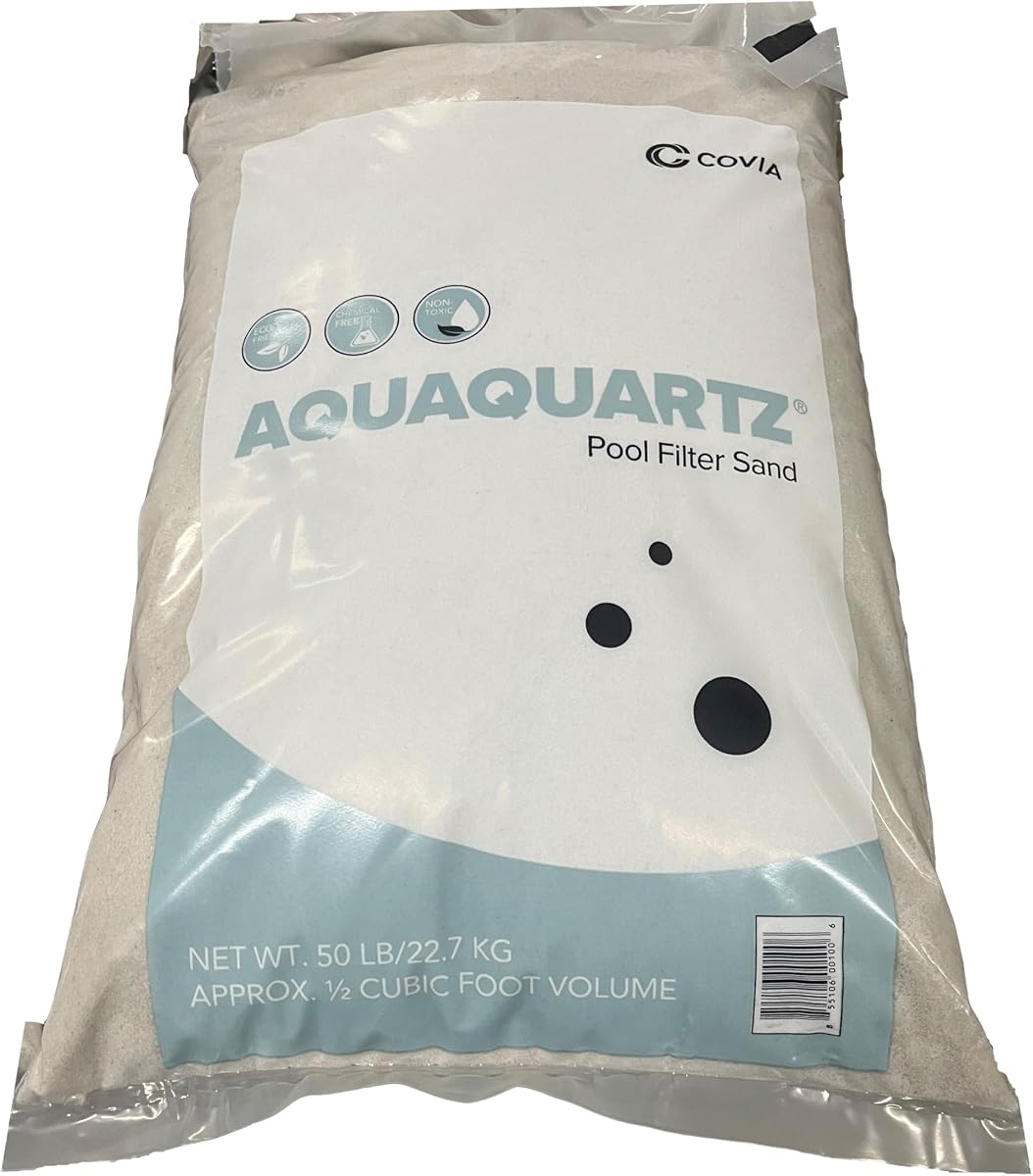
Covia AquaQuartz Pool Filter Sand
Check Price on AmazonBuilding the Sand Waterfall Aquarium: Step-by-Step
- Mock it up dry. Lay out the rocks and hold the riser tube in position before anything is wet. Mark where the tube enters the catch basin and exits at the top of the fall. Every gap visible in daylight will be obvious in the tank.
- Set the catch basin. At the foot of the fall, create a small sunken pocket — a shallow ring of rock, or a cut-down bottle section buried in substrate — that catches falling sand and feeds it to the riser's intake. This is the heart of the loop: sand that spills past the basin starves the fall.
- Run the riser. Use rigid PVC or acrylic tubing (12–16 mm inner diameter is the workhorse range), routed up through the rock pile so it is completely hidden, exiting just below the top of the rock face. Keep bends gentle; every sharp elbow is a place where sand stalls. Notch the top so sand spreads across the fall's width instead of pouring in one stripe.
- Attach the air line. Run airline tubing from the pump to the bottom of the riser, terminating in an airstone or a bare tip angled upward into the tube. A check valve on the airline is mandatory — if the pump stops, tank water back-siphons into it and floods the pump.
- Shape the fall face. Stack or carve the rock so it has small ledges and roughness. The sand should hesitate and fan out as it descends, not shoot off a cliff. A silicone-glued lip at the top sets the exact starting line.
- Test before planting. Fill the tank, load sand into the basin, and run the air for a full day before a single plant goes in. You are checking for a smooth loop, zero clouding, and sand that returns to the basin instead of migrating.
Concealing the Plumbing Inside the Hardscape
A visible tube kills the illusion, so the hardscape build and the plumbing build are one job. Plan the rock pile as a shell around the riser: three or four large stones forming a natural canyon wall, with the tube threaded through the interior gap, smaller stones wedging the gaps shut.
The airline is the sneaky one — it must travel from outside the tank to the riser bottom, and a dangling transparent tube reads as loudly as the riser itself. Bury it under the substrate along the back glass, emerging directly into the rock pile. If you are running a sand pathway through the foreground, route the airline underneath it so both features share one concealed corridor.
Think about the rest of your gear while you are at it. A waterfall build already hides one tube; hiding the filter and heater the same way keeps the tank from looking like a laboratory. The techniques in hiding equipment inside hardscape pair perfectly with this build, since the rock pile you raise for the fall can swallow a canister intake without anyone noticing. Then check your work from every viewing angle — the classic beginner error is a build that looks seamless from the front and shows a fat white riser from the left corner.
Tuning the Air Flow: Finding the Sweet Spot
Too little air and the riser lifts nothing — sand sits in the basin while the tube gurgles apologetically. Too much air and the bubbles blast sand past the spill channel, spray it across the tank, and turn the water milky. Start with the pump at roughly half power and watch the fall for ten minutes: you want an even sheet that breaks over the lip without gaps and without sand landing more than a few centimeters past the basin. Adjust in small steps — a bleed valve on the airline gives finer control than the pump's own dial — and mark the valve position once you find it, because valves drift.
Pump noise is the hidden cost of this feature. A buzzy pump in the stand will remind you of the waterfall every quiet evening. Run the airline through a loop of slack and sit the pump on foam, and keep runs short — the cleaner plumbing ethos of lily pipes in planted tanks applies to airflow plumbing too.
A steady, adjustable air supply drives the whole effect: a reliable air pump like the Tetra Whisper.
Troubleshooting the Usual Failures
The sand stalls in the riser
Almost always grain size or moisture clumping. Very fine sand packs when damp and refuses to fluidize — switch to the 0.4–0.8 mm range. Also check for a kinked airline or an algae-clogged airstone; lift drops off gradually, so a waterfall that worked in March and stalls in June usually has a starving air supply, not a sand problem.
Sand blows everywhere
Over-aeration, plain and simple. Dial the bleed valve back in quarter-turns, giving the fall five minutes to settle between adjustments. If it is still violent at the lowest usable setting, the tube is too narrow for your sand — step up a size in diameter rather than starving the lift.
The basin keeps emptying
Sand is escaping the loop. Watch the fall's base: grains that bounce past the basin rim are lost to the substrate. Widen the basin, deepen its rim, or shorten the drop height so sand arrives with less energy. Top the basin up periodically regardless — a spoonful of fresh sand every few months keeps the curtain dense, since a fraction of grains always migrates.
Cloudy water near the fall
Fresh sand sheds dust for weeks. Rinse before loading and polish the water with fine filter floss for the first month. If cloudiness persists long-term, suspect dyed or low-grade sand breaking down, and replace it with a quality natural grain.
Here is the mistake I promised to own: on my first build I "fixed" a stalled riser by upgrading to a bigger air pump instead of checking the sand. The stronger pump lifted the ultra-fine play sand just fine — then blasted it in a white plume across my brand-new monte carlo carpet. I spent a week vacuuming sand out of moss with tweezers. Check the grain before you touch the pump. Always the grain first.
Living With It: Maintenance and Planting Around the Fall
A tuned waterfall needs surprisingly little: top up the basin sand every month or two, clean the airstone when lift weakens, and siphon stray grains from the foreground during water changes.
Planting around the fall deserves restraint. The splash zone at the base accumulates drifting sand, which smothers delicate carpets, so keep the landing area unplanted or anchor it with epiphytes on the rocks. Mosses on the rock face above the fall add a lovely overgrown-canyon feel. For the broader composition, a single bold stone arrangement keeps the eye on the fall — one-rock layouts and waterfall features share the same "one hero, no clutter" discipline. If the drama tempts you further, a diorama-style forced-perspective build can make the fall look twice its height — but master the plain version first.
Frequently Asked Questions
How long does a sand waterfall take to build?
Budget a full weekend: one day for dry mocking, rock work, and plumbing, and a second day for filling, sand loading, and the all-important tuning run. The right aquascaping tools — long tweezers, a substrate spatula, and good shears — make the rock-and-tube wrestling match much shorter. Rushing the tuning phase is the top reason builds fail.
Does the falling sand hurt fish or shrimp?
Not when it is tuned. The grains fall in a gentle curtain and most livestock ignores it or treats it as enrichment — shrimp will happily pick through the catch basin. Problems only arise from an over-blasted fall that sandblasts resting fish, which is a tuning failure, not a feature flaw. Keep the curtain soft and everyone gets along.
Can I run a waterfall in a planted tank?
Yes, with zoning. Keep the basin and landing zone unplanted, since drifting sand smothers carpets. Plant the midground and background normally and let the fall occupy its own canyon. Waterfall sand is a separate decorative loop, not part of your substrate system, so your nutrient layers underneath stay untouched.
How much sand does the loop need?
Less than you think — a typical 60-liter build needs roughly 1–2 kilograms total, most of it living in the catch basin and the riser at any moment. Keep a small bag of matching sand on hand for monthly top-ups, because a little always escapes.
Will the sand wear out or dissolve?
Quality natural silica sand does not dissolve and barely abrades over years of looping; the grains stay round and flowing. What degrades is cheap dyed sand — the coating flakes, the grains roughen, and the flow gets sluggish.
Do I need a special air pump?
No — any reliable aquarium air pump sized for your tank works. The trick is control, not power: an inline bleed valve or flow adjuster lets you dial the exact lift the riser needs. A check valve on the airline is the one non-negotiable accessory, protecting the pump from back-siphoning if power fails.
Bringing the Fall to Life
A sand waterfall is one of those rare aquascaping features that looks like sorcery and runs on plumbing you can explain to a ten-year-old. The physics is forgiving, the materials are cheap, and the payoff — a luminous curtain of sand pouring down a dark rock face while shrimp graze at its base — never quite gets old. Build the rock around the tube, choose round pale grains in the 0.4–0.8 mm range, tune the air with patience, and test everything before a single plant goes in. Wondering how the whole build fits into real life? Plan on a realistic aquascape build timeline and give your waterfall the unhurried weekend it deserves.