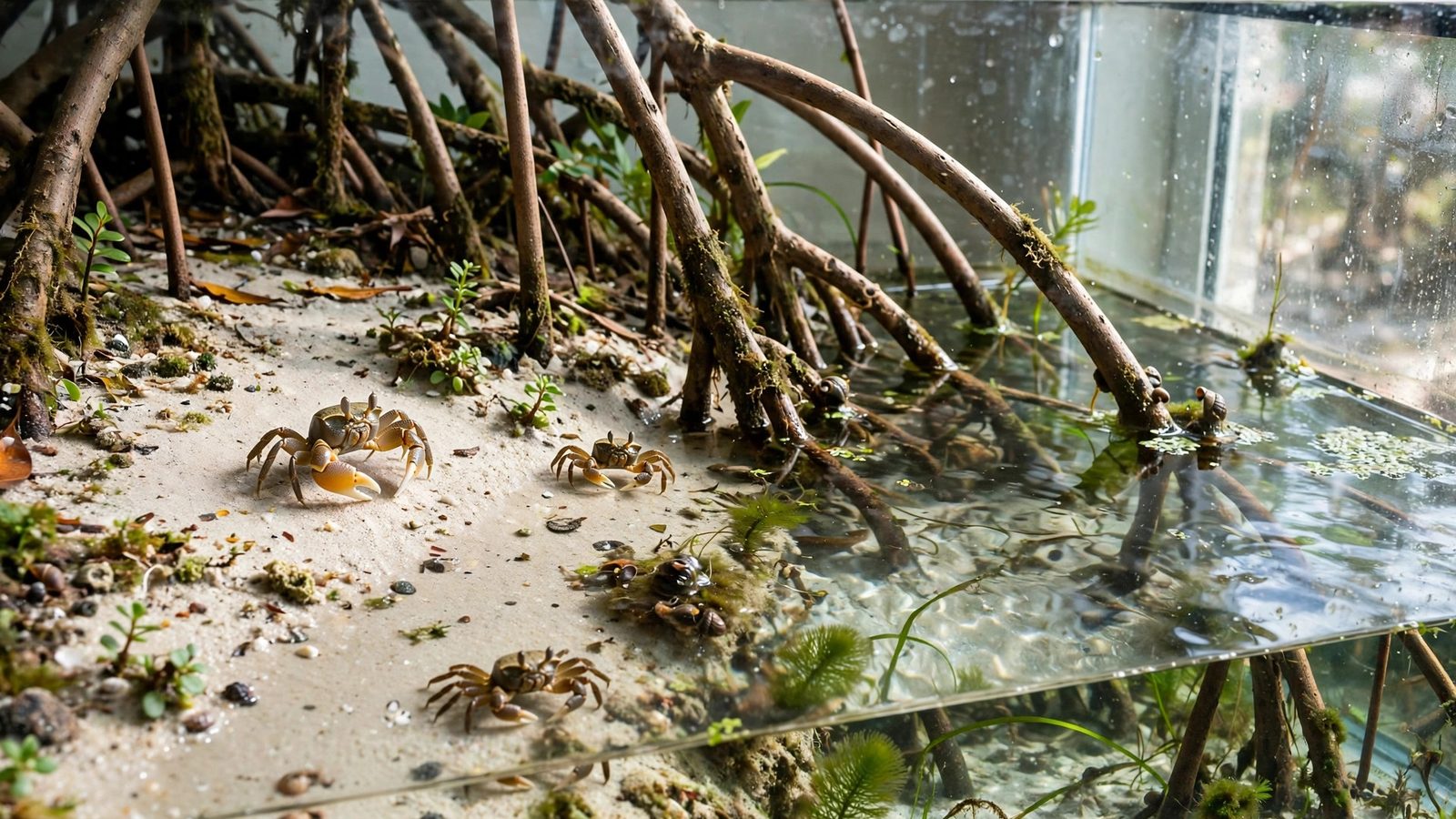
Most pet stores display fiddler crabs fully submerged in plain freshwater. Most of those crabs are dead within months — not because they are fragile, but because they are semi-terrestrial crabs from brackish mudflats, and a fish-tank setup denies them both land and salt. A proper fiddler crab brackish tank setup is a tiny mangrove shoreline: a sloped sand beach, a shallow lagoon of lightly salted water, and a tight lid. If you enjoyed our freshwater vampire crab paludarium build, think of this as its brackish-water cousin.
Why most fiddler crab setups fail
The biggest killer of pet fiddler crabs is the setup they are sold in. In the wild they live on tidal mudflats, spending most of the day on damp land and dipping into brackish water to moisten their gills. A fully submerged tank forces an animal built for two worlds to live in one, and the decline is slow enough that keepers blame bad luck instead of bad design.
The second killer is freshwater. Fiddler crabs regulate their body fluids against mild salinity; pure freshwater leaches minerals and suppresses molting. Crabs kept in freshwater stop feeding, fail a molt, and die within months. If yours came from a salt-free, beach-free store tank, correct it now.
Fiddler crab brackish tank setup: the build
Start with a 20-gallon long rather than a tall tank — floor space matters more than volume when half of it becomes beach. A 10-gallon works for a male and two females, but the 20-long gives the gradual slope a real shoreline has.
The lid is non-negotiable. Fiddler crabs climb heater cords, airline tubing, filter pipes, and silicone corner seams. Use a tight glass canopy or mesh reptile lid with every cable notch plugged: a crab dried on the floor is the classic beginner ending, and it is entirely preventable.
Keep the hardscape simple — driftwood roots, smooth stones, one mangrove root. Most common aquascaping mistakes beginners make come from overcomplicating a layout, and a crab beach, bulldozed nightly by its residents, is the opposite of a show tank.
Building the mangrove beach
Pile damp sand high on one end and slope it into the lagoon so roughly half the footprint sits above the waterline. The deep end should be 3–5 inches thick — enough for a real burrow — tapering to nothing at the water's edge. Use aragonite or coral sand: it buffers pH alkaline and holds burrow shape without collapsing. For grain types and buffering behavior, see our guide to the best substrate for planted tanks. Rinse thoroughly; dusty sand clouds brackish water for days.
Stabilize the slope with driftwood roots and flat stones. In the wild, mangrove roots are the scaffolding of the mudflat; here they double as climbing routes and territory boundaries.
Mixing brackish water the right way
Brackish water is a specific, measurable salinity — not guesswork. Make it with a reef-tank marine salt mix plus a hydrometer to verify. Aquarium and table salt are mostly sodium chloride and lack the calcium, magnesium, and trace elements brackish water needs.
Mix in a separate bucket, never in the tank. Stir the marine mix into dechlorinated water, let it dissolve for several hours, then measure: SG 1.005–1.008 at ~77°F, roughly 9 grams per litre, about a quarter of full seawater.
| Parameter | Target |
|---|---|
| Specific gravity | 1.005–1.008, marine mix only |
| Temperature | 75–82°F (24–28°C) |
| pH | 8.0–8.3 |
| Ammonia / nitrite | 0 ppm — cycle before adding crabs |
| Nitrate | Below 40 ppm |
| Water changes | 25% weekly, pre-mixed |
Filtration can be modest: a small internal or sponge filter in the deepest part of the lagoon. Skip hang-on-back filters — any intake breaching the waterline becomes a ladder.
Article stresses marine salt only, never aquarium/table salt; the salt mix is the central buying decision for this setup: a marine salt mix such as Instant Ocean ★4.8.
Plants and décor for the lagoon
Plants turn a sand pit into a shoreline, but salt is the constraint: most freshwater plants melt above SG 1.005. Java fern and anubias tied to driftwood tolerate low-end brackish water — see how to attach aquarium plants to driftwood for the technique that survives crab traffic. A red mangrove propagule wedged at the waterline grows into a genuine miniature mangrove. Run it as a low-tech planted tank setup: modest light, no CO2, hardy species.
Feeding and molting
Wild fiddler crabs sift detritus from mud with their small feeding claw; in the tank they are unfussy omnivores. Staple: sinking crab pellets or algae wafers. Extras: blanched zucchini or peas a few times a week, frozen bloodworms for protein. Feed on the damp sand, not in the water — it keeps the shallow lagoon cleaner. Offer what they finish in a few hours, once daily.
When a crab vanishes into its burrow for days and emerges pale and soft, it has molted. Leave the shed shell in place — the crab eats it to reclaim calcium — and never handle a freshly molted crab.
Stocking and tank mates
Males carry the famous oversized claw, waved in territorial displays — the behavior that makes a colony worth keeping. Males fight, so stock one male per two to three females per 20 gallons. For deeper brackish-crab background, WetWebMedia's brackish crab FAQ draws on decades of keeper correspondence. Proven companions are few: mollies stay in the water column, nerite snails make a brackish-proof algae crew, and ghost shrimp may become midnight snacks. The hard rule stands — never add fiddler crabs to a freshwater community tank.
Frequently Asked Questions
Can fiddler crabs live fully underwater?
No. They are semi-terrestrial: they burrow, feed, court, and molt on land, visiting water mainly to keep their gills moist. A permanently submerged crab cannot molt properly and usually declines within months. The beach is not decoration — it is the majority of their habitat.
Can I use aquarium salt instead of a marine salt mix?
No. Aquarium salt is essentially plain sodium chloride, while a marine mix replicates seawater's full mineral profile — calcium, magnesium, carbonates, and trace elements needed for shell building. Mix a reef-style marine salt to SG 1.005–1.008, roughly 9 grams per litre, verified with a hydrometer.
How many fiddler crabs can I keep together?
In a 20-gallon long, one male with two or three females is the sweet spot. Males fight claw-to-claw in cramped quarters, so skip multiple males unless you upgrade to 40 gallons with widely separated burrowing zones. Females are peaceful in larger groups.
Do fiddler crabs need a heater?
Usually yes — they do best at 75–82°F (24–28°C). If your room stays below 72°F, put a small heater in the deepest part of the lagoon; warm water plus a tight lid keeps the beach air humid. Size it small — shallow water overheats quickly.
Will fiddler crabs bother fish or plants?
They nibble soft plants, so stick to tough species like Java fern, anubias, and mangrove propagules. Never mix them with a freshwater community — the chemistry is wrong for one side. Brackish-tolerant mollies and nerite snails are the safe, proven companions.
A shoreline, not a fish tank
Stop thinking of it as an aquarium and start thinking of it as a beach: sand to dig, salt to molt in, a lid that respects their climbing. Build the shoreline and the crabs do the rest.