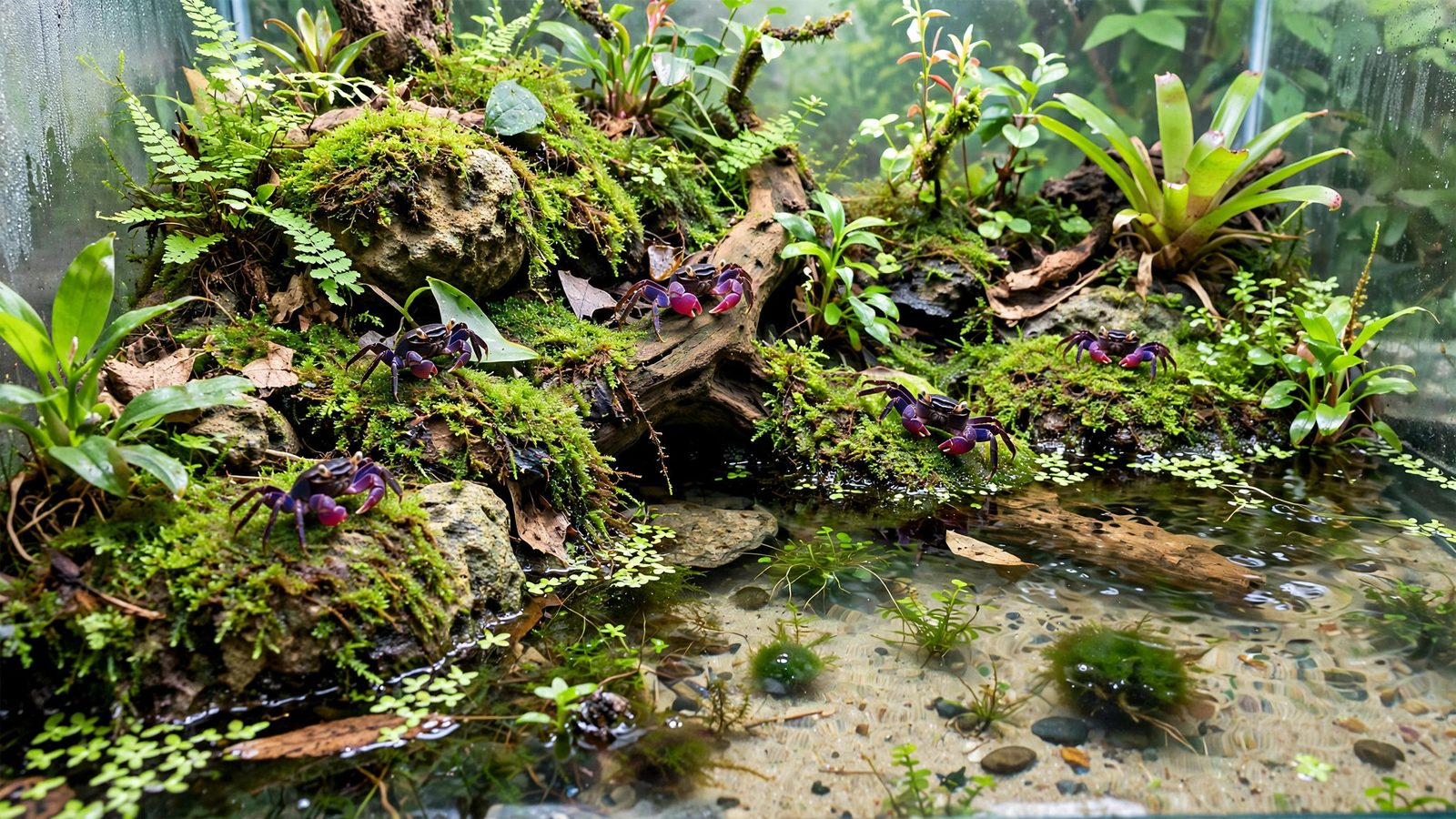
The costliest mistake beginners make with vampire crabs is treating them like aquarium animals. A fully aquatic tank slowly drowns Geosesarma — these thumb-sized crabs are semi-terrestrial burrowers from Southeast Asian rainforest streams. A proper vampire crab paludarium setup flips the aquarium logic: roughly 70% land, 30% shallow water, humid air, and an escape-proof lid. This guide walks you through the build.
Your Vampire Crab Paludarium Setup: The Core Plan
Choose a tank with more floor area than height — a 60 cm (24") aquarium or purpose-built paludarium enclosure. Plan the footprint first: two-thirds land, one-third pool, plus vertical climbing space. A solid step-by-step paludarium build guide helps you design the false bottom, drainage layer, and land barrier together. Stock one male to two or three females — calm, and your best shot at breeding behavior.
The 70/30 Rule: Land-to-Water Ratio
Think of the water section as a pond, not a lake. Build a false bottom of egg crate or expanded clay balls, hold the land above it, and contain the pool with a curved barrier of cork bark or stone. Give the pool a sloping "beach" on at least one side so crabs can walk out instead of climbing a wall.
The pool only needs to be 3–5 cm deep — enough to molt and soak, since crabs live, rest, and feed on land. A small sponge filter with a pre-filter sponge keeps the pool clean without endangering babies; keep the intake where crabs can't reach it. One useful crossover: the hardy species in any guide to aquarium plants for fish tanks tolerate the shallow, disturbed margins of a crab pool.
Building the Land: Substrate, Moss, and Leaf Litter
Use a coconut fiber base mixed with sphagnum moss, 8–12 cm deep, capped with 2–3 cm of leaf litter (Indian almond, oak, or magnolia). The leaves aren't decoration: crabs hide under them, graze them as they soften, and females carry babies through them. Refresh a handful every two weeks.
Carpet open land with live moss — java moss, pillow moss, or vivarium mosses all root onto coconut fiber in humid air. An established moss mat buffers humidity and shelters the springtails and isopods that form your clean-up crew. If you've never grown moss above the waterline, the techniques in a wabi-kusa moss guide translate directly: damp substrate, high humidity, patience.
Humidity and Temperature
Humidity decides whether your colony thrives or merely survives. Below 70%, vampire crabs turn lethargic and molt badly; at 75–90%, they patrol, dig, and breed. A digital hygrometer with a probe is non-negotiable — place it at crab level, not on the lid, because humidity stratifies. Hand-misting twice daily works for small tanks; a mister on a timer is steadier.
Keep temperature at 24–28°C and never let it sit above 30°C — a paludarium in direct sunlight cooks the colony. A small heat mat on the side glass, wired to a thermostat, handles cold rooms; skip under-tank mats that bake the burrowing zone.
Hardscape and Escape-Proofing
Use cork bark flats as ramps between land and water, and stack driftwood and stones into burrow entrances and boundaries — males squabble over the best crevices, so give each male a cave-like hide on land.
Now the serious part: vampire crabs climb filter tubing, heater cords, and silicone seams, and once out they desiccate within hours. Use a tight-fitting lid with cables routed through drilled, plugged holes, and run a 5–8 cm strip of petroleum jelly around the inside rim. Check the lid weekly — warping creates gaps.
At the waterline, plant anubias, bucephalandra, and crypts; on land, ferns and creeping fig — species from paludarium plants that tolerate damp soil and water margins. If you feed the pool plants, dose liquid fertilizer at half aquarium strength and check the label for copper — it's worth knowing whether aquarium plants really need fertilizer before anything dosed goes near copper-sensitive crabs.
Feeding
In the wild, Geosesarma species scavenge fruit, detritus, and insects along stream banks. In captivity they're unfussy omnivores — but variety keeps colors bright and breeding active:
| Day | Food | Notes |
|---|---|---|
| Mon / Thu | Sinking crab or shrimp pellets | Protein base; 2–3 pellets per crab |
| Wed | Blanched vegetables | Zucchini, spinach, or carrot slices |
| Sat | Protein treat | Bloodworms or daphnia |
| Daily | Leaf litter + cuttlebone | Always available; calcium for molts |
Place food on a flat stone on land — never in the pool, where it fouls shallow water in hours. Remove uneaten fresh food after 12 hours, check pellet labels for copper compounds, and keep a thumbnail-sized piece of cuttlebone on the land side permanently; crabs nibble it before molting.
Tank Mates: Less Is More
Vampire crabs are peaceful with their own species but their claws make them poor tank mates for most small animals. Anything that fits in their claws — cherry shrimp, small fish — is at risk at night when the crabs are active. The safe list is short: other vampire crabs, a springtail/isopod clean-up crew, and hardy nerite snails. Experienced keepers usually run the crabs alone.
Breeding: Fully Freshwater, Surprisingly Simple
Here's the surprise: vampire crabs have direct development. Females carry 20–60 eggs for 3–4 weeks, then release fully formed miniature crabs — no marine or brackish larval stage. A colony can complete its entire life cycle in your paludarium.
No special trigger is needed: stable humidity, warmth, and a protein-rich diet are enough. Berried females retreat to burrows and eat less — leave them undisturbed. Babies are pinhead-sized and live in the leaf litter and pool margins; wrap any filter intake in fine foam, because they're helpless against suction. Juveniles reach breeding size around 8–10 months, and a 60 cm tank supports one breeding colony for years.
What to Buy (and What to Skip)
You can build from a standard aquarium plus DIY materials, or start from a paludarium kit with a built-in land platform — kits save you the trickiest construction step, the water/land barrier. Don't skip: a tight-fitting lid, a hygrometer with probe, a misting system, coconut fiber and sphagnum moss, leaf litter, cork bark, and a sponge filter with pre-filter foam. For food, buy sinking crab pellets for freshwater invertebrates and check the label for copper. Skip colored gravel, deep-water decor, and copper additives — spend the money on humidity control and the lid instead.
Frequently Asked Questions
How deep should the water be in a vampire crab paludarium?
Only 3–5 cm — deep enough to submerge fully and molt, shallow enough to stand in with feet planted. Deeper water wastes precious land area and can drown weakened or freshly molted crabs that can't climb out. The pool is for soaking and breeding, not swimming — treat it as a shallow pond with at least one sloping beach for easy exit.
Can vampire crabs live with fish or shrimp?
Not safely. Vampire crabs are nocturnal foragers with strong claws, and they will catch cherry shrimp, dwarf shrimp, and small sleeping fish after dark. The only genuinely safe tank mates are other vampire crabs, a springtail-and-isopod clean-up crew, and hardy nerite snails. Most experienced keepers run a crabs-only colony and skip the risk entirely.
Why do my vampire crabs keep trying to escape?
Low humidity or dirty water drives them out — crabs climb toward better conditions, so an escape attempt is a husbandry signal. Check humidity at crab level with a probe (it should read 75–90%), clean the pool, and seal every lid gap with plugged cable holes. Run a 5–8 cm strip of petroleum jelly around the inside rim as a climbing barrier, and recheck for warping weekly.
Do vampire crabs need brackish water to breed?
No — this is their best feature. Geosesarma has direct development: after 3–4 weeks of carrying 20–60 eggs, the female releases fully formed miniature crabs straight into freshwater, with no larval or zoea stage at all. No brackish water, no special trigger, no planktonic phase. Keep humidity high and protein-rich foods coming, and a stable colony breeds on its own indefinitely.
How many vampire crabs can live in one tank?
Four to eight crabs suit a 60 cm tank — stock one male to two or three females for the calmest colony and the best shot at breeding. Give each male his own cave-like hide or burrow entrance on land, since males squabble over the best crevices. Larger colonies need more land area and more hides, not more water; a 60 cm tank supports one breeding colony for years.
Start With Land, Not Water
Every thriving vampire crab setup inverts the aquarium instinct: build the forest floor first, add the pond second, and seal the lid like you mean it. Get humidity right, feed a varied diet, and these jewel-toned crabs will dig, patrol, and breed in a living rainforest fragment on your desk.