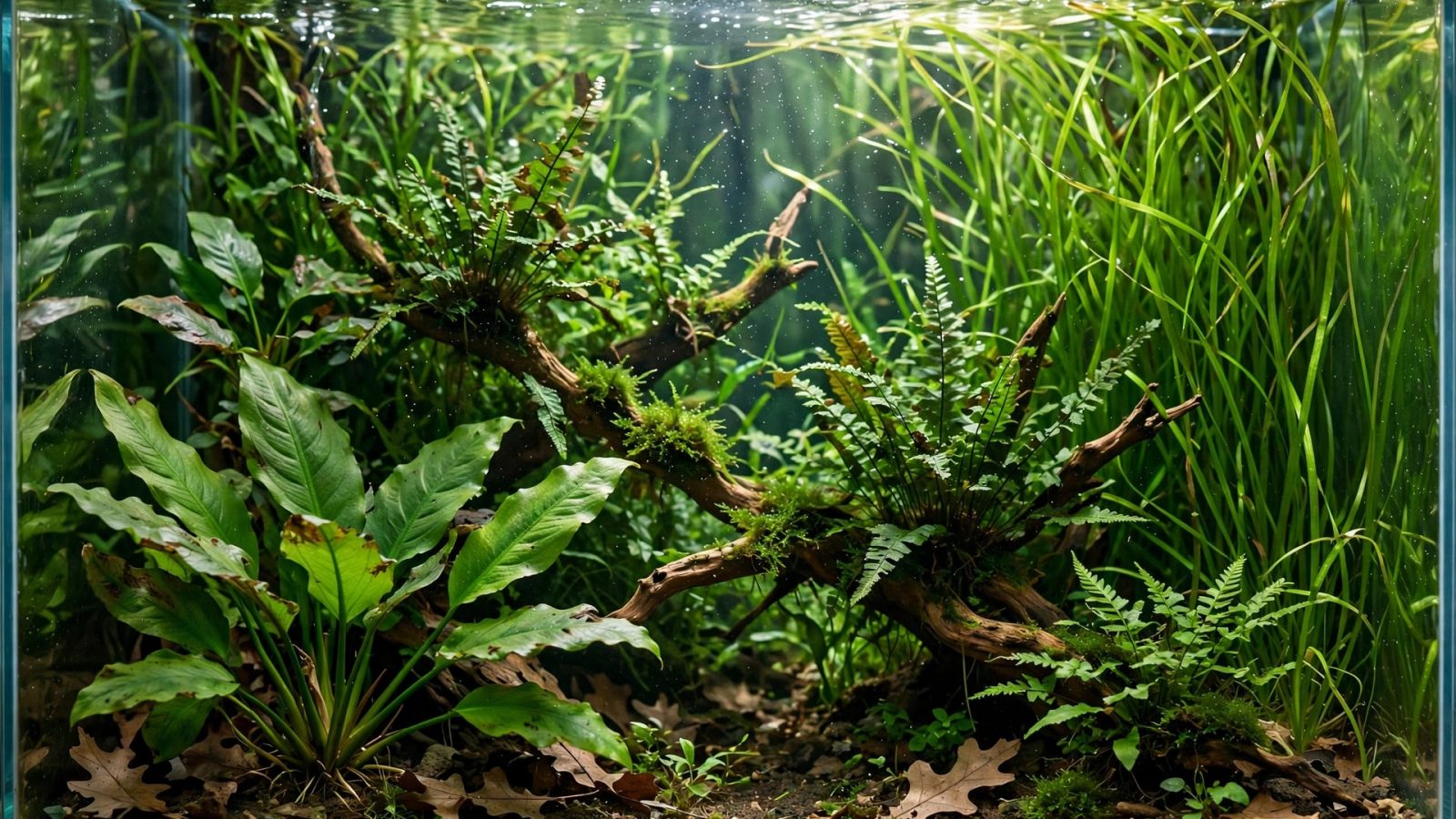
A jungle aquascape is the wild, overgrown look: tall plants reaching the surface, leaves spilling across the waterline, dappled light filtering through layers of green. It’s the lowest-pressure aquascaping style in the hobby — no strict rules, no weekly trimming marathons, no CO2 required. If the iwagumi is a zen garden and the Dutch tank is a botanical garden, the jungle tank is a rainforest: lush, a little chaotic, and gloriously alive.
This guide covers how to build a jungle aquascape that looks intentional rather than neglected: the plant palette that defines the style, layout principles for controlled wildness, low-tech equipment that works, and the overgrowth management routine that keeps “jungle” from tipping into “swamp.”
What Defines Jungle Style?
- Height and density over composition. Plants grow tall and full; the tank reads as deep vegetation rather than arranged design.
- Low-tech friendly. Jungle style was practically invented for low-tech tanks — most classic jungle plants thrive without CO2.
- Minimal hardscape. Wood and rock exist but disappear under plant mass; they’re structure, not focal points.
- Surface growth encouraged. Plants breaching the surface and spreading across it is a feature, not a failure.
- Forgiving. A slightly overgrown jungle tank still looks like a jungle tank. The same can’t be said for iwagumi.
Jungle vs. Dutch: Know the Difference
Both styles are plant-heavy, but the philosophy is opposite. Dutch is formal: one species per street, terraces, weekly trimming, high-tech. Jungle is informal: mixed plantings, naturalistic layering, monthly maintenance, low-tech. Dutch celebrates the gardener’s control; jungle celebrates the plants’ exuberance. If you want the lush look without the Dutch maintenance contract, jungle is your style.
The Jungle Plant Palette
Jungle tanks need fast, tall, bulletproof plants — species that grow vigorously in low-tech conditions and fill vertical space. The classics:
Background giants (the jungle canopy)
- Vallisneria (spiralis, americana/gigantea) — the quintessential jungle plant. Long ribbon leaves arc to the surface and spread across it. V. americana can hit 1 m+ in deep tanks; V. spiralis stays more manageable.
- Amazon sword (Echinodorus amazonicus/bleheri) — huge broad rosettes; a single specimen can anchor a corner. Heavy root feeder — give it root tabs.
- Giant hygrophila (Hygrophila corymbosa) — fast, tall, broad leaves; trims easily and regrows from stumps.
- Water sprite (Ceratopteris thalictroides) — feathery, fast, and happy planted or floating; brilliant fry cover.
Midground fillers
- Java fern (Micranthemum pterotoides) — tie to wood and let it go; our full Java Fern care guide covers it. Slow but indestructible.
- Anubias barteri varieties — broad dark leaves for contrast against feathery stems. See anubias yellowing fixes if leaves pale.
- Cryptocoryne wendtii / balansae — C. balansae‘s long crinkled leaves are pure jungle; crypts hate being moved, so plant once and leave them.
- Bolbitis heudelotii (African water fern) — dark, textured, slow; beautiful on wood in shaded midground spots.
Foreground (keep it simple)
Jungle foregrounds stay simple — the eye should travel up into the canopy. Low carpets of Monte Carlo, dwarf sagittaria, or just open sand with scattered Cryptocoryne parva all work. Don’t fight for a manicured carpet here; a slightly wild foreground suits the style.
Floaters (the ceiling)
Floating plants complete the jungle: they diffuse the light, shelter shy fish, and suck up excess nutrients. Amazon frogbit, water lettuce, and red root floaters are the top picks. Contain them with airline tubing rings so they don’t cover 100% of the surface and starve the plants below of light.
Layout: Controlled Wildness
Jungle has no formal rules, but “no rules” still benefits from structure. Use these loose principles:
- Tall at the back and corners, shorter toward the front-center. Keep one viewing corridor of lower plants so the tank doesn’t read as a solid green wall.
- Odd-numbered specimen plants. One or three Amazon swords, not two — the same focal-point logic applies even in wild layouts.
- Texture contrast. Pair feathery (water sprite, Limnophila) with broad (swords, Anubias) with grassy (Vallisneria). Three textures minimum keeps the mass interesting.
- Let one plant dominate. A jungle tank with a clear “hero” species — a Vallisneria forest, say — looks designed. Ten species in equal amounts looks accidental.
- Hardscape as skeleton. Place driftwood early; within months it’ll be mostly hidden, but it gives epiphytes anchor points and creates the shaded pockets that add depth. Our guide to attaching plants to driftwood covers the technique.
Equipment: The Low-Tech Jungle
The jungle style shines on a low-tech setup: stock or moderate LED lighting (20–35 PAR at substrate), no CO2 injection, a nutrient-rich substrate or inert substrate with root tabs, and a gentle filter. This is the same philosophy as our no-CO2 plant growing guide — and jungle plants are the best candidates for it.
Photoperiod: 7–8 hours on a timer. Longer photoperiods in a low-tech jungle mostly grow algae, since the plants can’t use the extra light without CO2. Dose a complete liquid fertilizer once or twice weekly — leaner than high-tech, but jungle biomass still eats.
Overgrowth Management (Don’t Skip This)
“Low maintenance” doesn’t mean “no maintenance.” A jungle tank left entirely alone becomes a light-blocking mat. Monthly routine:
- Thin the canopy. Remove the oldest Vallisneria runners and a third of floating plants so light reaches the lower levels. If the substrate-level plants are all dying back, you’re overdue.
- Trim stems hard. Hygrophila and Limnophila get leggy; cut back to stumps and replant tops. One hard session monthly beats weekly fiddling.
- Clear the surface. Keep floaters to 30–50% coverage max. A fully covered surface suffocates gas exchange and shades everything below.
- Vacuum lightly. Dense plant mass traps detritus; a gentle gravel vac around (not through) plant bases during water changes prevents anaerobic dead spots.
- Re-home runners. Vallisneria and chain swords send runners across the tank — pull and replant or compost the extras before they take over the foreground.
Stocking a Jungle Tank
Jungle tanks are fish paradise: broken sightlines reduce aggression, surface cover comforts shy species, and fry survive in the thicket. Great matches: tetras and rasboras (color pops against green), angelfish (the classic jungle-tank centerpiece), gouramis (bubble-nesters love floaters), livebearers, and shrimp colonies (grazing heaven). Avoid dedicated plant-eaters — silver dollars and large cichlids will deforest a jungle tank in weeks.
Common Jungle Mistakes
- Too many species, no hero. Pick 5–8 species with one dominant; more than that reads as clutter.
- Letting floaters cover everything. The #1 jungle killer — 100% surface coverage starves submerged plants.
- Never thinning. “Low maintenance” still means monthly thinning sessions.
- High light + no CO2. Jungle is a low-to-medium light style; blasting high light without CO2 just grows algae in the canopy.
- Plant-eating livestock. Check compatibility before adding that beautiful severum.
Frequently Asked Questions
What is the easiest aquascaping style for beginners?
Jungle style, by a wide margin. It tolerates low-tech setups, infrequent trimming, and beginner mistakes — and still looks lush. Start here if you’re new; try iwagumi when you want a challenge.
Do jungle aquascapes need CO2?
No. The classic jungle palette (Vallisneria, swords, Java fern, Anubias, crypts) thrives without CO2. That’s the style’s biggest advantage.
How do you keep a jungle tank from looking messy?
Three things: one dominant hero species, monthly thinning so light penetrates, and floaters kept under 50% surface coverage. Controlled wildness, not abandonment.
Three Jungle Layout Templates
Template 1 — The Corner Jungle (beginner)
Fill the back-left corner with Vallisneria and Amazon swords, let water sprite float across the top, Anubias on a single wood piece midground-right, dwarf sagittaria foreground. One corner of wilderness, open swimming space elsewhere. The easiest jungle to maintain — thinning is confined to one zone.
Template 2 — The Valley Jungle (intermediate)
Dense planting on both sides, a low foreground corridor down the middle — the “valley” from our depth techniques. Crypts and swords left, Hygrophila and Limnophila right, Monte Carlo or sand in the valley. More dramatic than the corner version, still manageable.
Template 3 — The Canopy Jungle (committed)
Full-tank density: background giants wall-to-wall, midground epiphytes on multiple wood pieces, 40% floater cover, foreground of dwarf sagittaria. Maximum lushness, maximum monthly thinning. The reward is a tank that looks like a slice of the Amazon — the price is a solid hour of maintenance monthly.
Algae in Low-Tech Jungle Tanks
Jungle tanks get algae like any tank; the dense planting just hides it better. Prevention hierarchy:
- Photoperiod discipline — 7–8 hours, timer-controlled. The #1 lever.
- Floater management — 30–50% coverage; full coverage kills submerged plants and the resulting decay feeds algae.
- Weekly water changes — 30%, especially in the first 3 months.
- Cleanup crew — Amano shrimp (the best all-rounders), nerite snails (glass and hardscape), otocinclus (soft algae on leaves).
- Spot treatment — hydrogen peroxide or Excel-type carbon on affected areas during water changes for stubborn patches.
Green dust on glass, some thread algae in fast growers — normal background noise in a jungle tank. Black beard algae taking over Anubias leaves signals a real imbalance (usually too much light or organics); fix the cause, don’t just scrub the symptom. Our plant problem guides cover diagnosis in depth.
Propagating the Jungle: Free Plants Forever
A healthy jungle tank is a plant factory. Monthly thinning yields propagation material:
- Vallisneria runners — snap off daughter plants, replant or trade.
- Stem tops — replant Hygrophila/Limnophila tops; they root in days.
- Sword plantlets — adventitious plantlets on flower spikes; pin to substrate until rooted.
- Java fern plantlets — tiny ferns on leaf tips; detach and tie to new wood.
- Floaters — scoop excess; local clubs and forums always want them.
Within a year, a single jungle tank can plant two more tanks and supply your local fish club. The style literally pays for itself in plants.
Seasonal Jungle Rhythms
Jungle tanks have seasons, even indoors. Recognizing the cycle prevents panic:
- Spring surge (months 2–4): explosive growth as everything establishes. Thin aggressively — this is when the tank sets its long-term structure.
- Summer peak (months 4–8): maximum density. The tank looks its best and demands the most thinning. Propagate the excess.
- Autumn settling (months 8–12): growth steadies; the layout develops character. Older leaves on slow growers may need pruning.
- Winter rejuvenation (month 12+): substrate depletes, older plant mass gets tired. A hard reset — major thin, root tabs, maybe replanting tired sections — starts the cycle fresh.
Work with the cycle, not against it. The spring surge is for shaping; the summer peak is for enjoying; the winter reset is for renewing. Tanks that get their annual hard prune in month 12 look better in year two than tanks that just accumulate.
Jungle Tank Mates: Building the Community
The dense cover of a jungle tank changes fish behavior — shy species become bold, aggressive species calm down (broken sightlines), and fry survive. Stock to exploit it:
- Top level: hatchetfish or gouramis under the floaters — the surface cover makes them feel secure and display natural behavior.
- Midwater: a large tetra or rasbora school (20+) — the classic jungle-tank river of fish weaving through Vallisneria.
- Bottom: corydoras shoals and kuhli loaches — the plant litter and shaded floor is their natural habitat.
- Cleanup: Amano shrimp colonies and nerite snails — the dense planting feeds them constantly.
- Centerpiece: angelfish pair or dwarf cichlids (apistogramma) — the broken sightlines let even mildly territorial species coexist.
The jungle’s carrying capacity for behavioral richness exceeds a sparse tank’s — more species coexist peacefully when everyone has cover. It’s the best style for a true community tank.