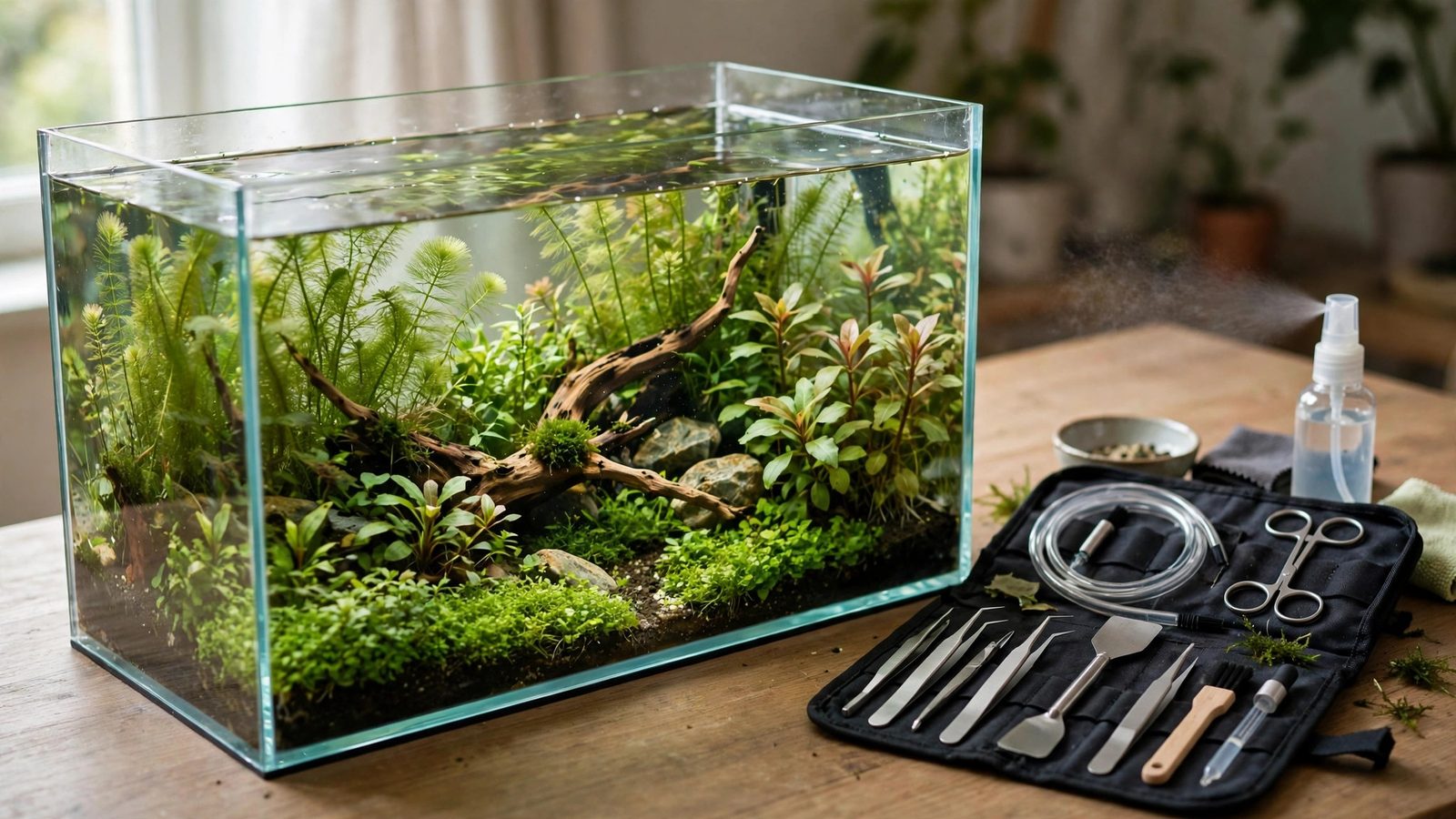
If you have ever tried to trim a carpet of Monte Carlo with household scissors while wrist-deep in tank water, you already know why an aquascaping tools kit for planted tanks exists. The right kit turns the fiddly jobs — planting hair-thin stems, trimming foregrounds without uprooting everything, levelling substrate into a clean slope — into calm, five-minute tasks. This guide breaks down exactly which tools a planted-tank keeper needs, what to look for when buying them, and which "extras" you can safely skip until your aquascapes demand them.
Why Specialized Tools Matter So Much
A planted aquarium is an underwater garden, and gardeners do not plant seedlings with kitchen knives. Standard tweezers are too short and clumsy to reach the back of a 60 cm tank without dunking your hand in past the wrist. Blunt household scissors crush plant stems instead of cutting them, and crushed stems rot — which is how one quick trim turns into a melting disaster.
Aquascaping tools are long, slim, and corrosion-resistant by design. Long handles keep your hands and arms out of the water, which means less substrate disturbance, fewer temperature shocks for sensitive livestock, and no sunscreen or soap residue washing off your skin into the tank. Corrugated grip tips on tweezers hold delicate stems without crushing them, and true scissor-sharp blades make clean cuts that heal fast.
There is also a compounding benefit: once trimming and replanting become easy, you will do them on schedule instead of dreading them. That discipline is what separates a tank that slowly overgrows into a jungle from one that holds its composition for months, which is the same lesson behind our guide on aquascape trimming and maintenance.
The Essential Aquascaping Tools Kit for Planted Tanks: Four Tools You Will Use Every Week
Most beginners need exactly four tools. Everything else is a specialist that earns its place later. Buy these four well — quality stainless steel versions last years — and you will cover 95% of planted-tank maintenance.
1. Straight Aquascaping Scissors (25–30 cm)
The workhorse. Straight scissors handle the vast majority of cutting jobs: topping stem plants, trimming foreground carpets, cutting moss and fern rhizomes, and snipping off damaged leaves. For a standard 60 cm tank, the 25–30 cm length gives you enough reach without the tips becoming hard to control.
Look for scissors with short, stout blades and smooth hinges. Cheap long-handled scissors often have long thin blades that flex and bend mid-cut, leaving ragged stems. Stainless steel rated for continuous underwater use (304-grade or better) is worth the small premium — cheaper plated scissors can develop rust spots within months, and rust near living plants and livestock is something you simply do not want.
2. Curved Aquascaping Scissors
Curved scissors are the carpet specialist. Their hooked blades let you skim along the substrate in one continuous motion, trimming a foreground carpet evenly without jabbing the tips into the soil. If you grow any carpeting plant — Monte Carlo, dwarf hairgrass, Glossostigma — curved scissors are not optional; they are the difference between a flat, manicured lawn and a choppy patchwork.
They also reach into tight spots between rocks and wood where straight scissors cannot angle properly. Buy them together with your straight pair: most quality kits sell the two as a set for barely more than the cost of one.
3. Aquascaping Tweezers (25–30 cm, with angled tips)
Tweezers are your hands in the tank. You will use them to plant every stem, every carpeting plug, and every small epiphyte. Long pinsettes with fine, serrated tips grip stems firmly enough to push them 2–3 cm into substrate without the plant popping back out when you release.
The angled (45-degree) variant is the single most-used tool in most aquascapers' kits, because the bend gives you leverage and visibility when planting at the front glass or under an overhang. Straight tweezers are better for deep back-corner work. If you can only buy one pair, get the angled 25 cm — and read up on planting technique alongside our guide to attaching aquarium plants to driftwood, since tweezers are how you seat rhizome plants into crevices too.
4. Substrate Spatula / Flattener
The most underestimated tool in the kit. A wide, flat spatula lets you level aquasoil into a clean front-to-back slope, smooth out dents after planting, and tuck substrate around newly planted plugs — all without stirring up a mud storm. It is also perfect for cleaning a strip of bare glass along the front edge, which gives any layout that crisp, professional finish.
Many spatulas have a pointed tip on the opposite end, which doubles as a fine planting tool for carpeting plugs and for pressing down individual stems. If your kit includes one, you will use it far more than you expect.
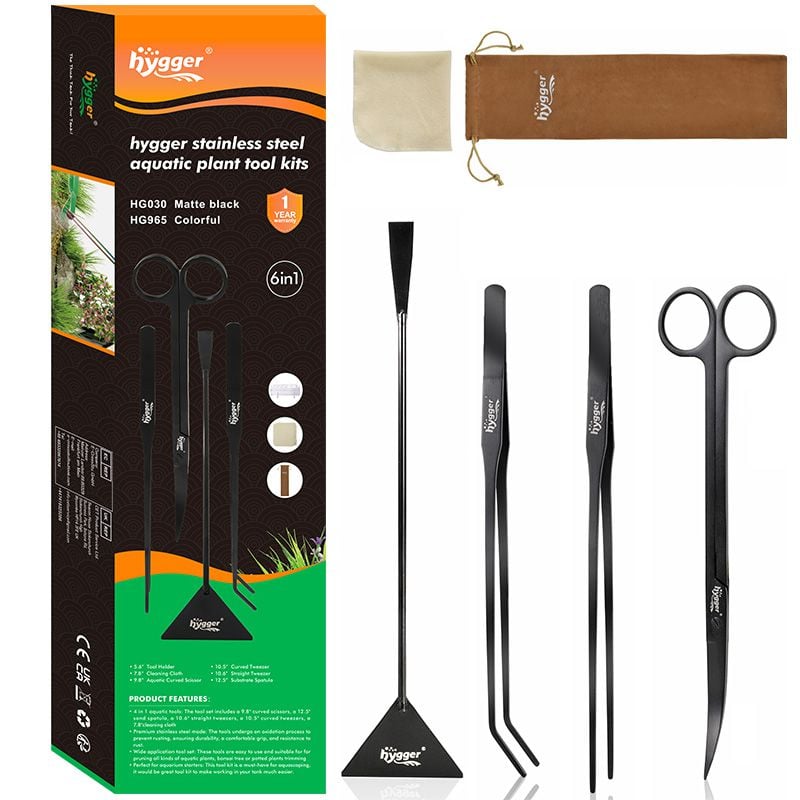
A reliable pick here is hygger 6-in-1 aquascaping tools kit.
 ★4.6
hygger 6-in-1 Long Aquarium Aquascaping Tools Kit
Check Price on Amazon ★4.6Specialty Tools Worth Adding Later
Once the core kit is in your hands and your tanks are growing, these specialists solve specific problems. Add them one at a time as the need appears in your actual maintenance routine.
Wave Scissors (Spring Scissors)
Spring-loaded scissors that open on their own between cuts — you just squeeze. Brilliant for detail trimming around hardscape and for long carpet-mowing sessions, since your hand fatigues far less. The blades are usually shorter and finer than standard scissors, so they are less suited to thick stem work. If you keep finicky carpets or dense moss, these are worth adding early; otherwise, wait.
Trimming Tongs and Substrate Shovels
Trimming tongs (essentially scissors with long thin handles and a trigger grip) reach spots your arm cannot get to cleanly in deep tanks. Substrate shovels — small angled spoons — make moving and shaping aquasoil during a rescape or when sloping substrate for depth dramatically easier than pushing soil around with your fingers.
Algae Scrapers and Glass Tools
While not strictly aquascaping tools, a good long-handled algae scraper with replaceable blades keeps viewing glass clean without scratching it. Plastic blades for acrylic, metal for glass — and never mix them up. Magnetic cleaners handle daily wipe-downs, but for the green-spot algae that creeps in along plant lines and wood edges, nothing beats a proper scraper.
Planting Tweezers for Nano Tanks
If you run nano aquariums, shorter 15–20 cm tweezers with extra-fine tips give you precision the standard lengths cannot. Nano scaping is fingertip work, and oversized tools will crush neighbouring plants every time you plant one plug. Our guide to plants for nano tanks pairs well with the right small-scale toolkit.
Buce and Moss Tools: Pin Vise and Thread
Attaching epiphytes is a tweezer-and-thread job. A pin vise (tiny hand drill) lets you drill precise holes in driftwood for wedging rhizomes — a trick from competition scapers — while cotton thread or gel super glue fixes moss and ferns to hardscape until roots take hold. No dedicated purchase is required beyond what a basic craft kit provides.
Suggest aquarium plant glue as the specialty add-on for epiphyte work: Seachem Flourish Glue.
Buying Guide: Materials, Lengths, and What Separates Good from Garbage
Aquascaping tools are sold everywhere from budget marketplaces to premium Japanese brands, and the price spread is enormous. Here is how to judge quality without overspending.
| Feature | What to Look For | Red Flag |
|---|---|---|
| Material | 304 or 316 stainless steel; should feel solid and cold to the touch | Lightweight, plated, or unspecified "metal" — rust risk |
| Length | Match to tank depth: 25 cm tools for 30–40 cm tall tanks, 30–32 cm for deeper setups | One-size-fits-all kits with 15 cm tools for a 60 cm tank |
| Scissor action | Short blades, smooth hinge, cuts printer paper cleanly with no tearing | Long floppy blades, stiff or wobbly pivot |
| Tweezer tips | Fine, serrated/corugated tips that meet perfectly and hold a stem without slipping | Tips that cross over or have a visible gap when closed |
| Finish | Matte or sandblasted; reflections in the tank glass distract less | Mirror polish that glares under aquarium lights |
| Kit completeness | Straight scissors + curved scissors + angled tweezers + spatula, ideally in a case | Bloated 12-piece kits full of duplicate or flimsy pieces |
Price-wise, a decent four-piece starter set typically costs about the same as one bag of quality aquasoil — a modest investment against the lifetime of the tank. Premium Japanese and European tools (the ADA-style end of the market) are beautifully made but are luxuries, not requirements; mid-range stainless sets from reputable aquarium brands perform identically for most keepers. Avoid the very cheapest unbranded kits: rusting tweezers that bleed iron into the water are a recurring cause of unexplained plant and shrimp problems.
When buying, also check the aquascaping on a budget guide — a good tools kit is one of the purchases worth making early, while other parts of a build can safely be economized.
Caring for Your Tools: Cleaning, Rust Prevention, and Storage
Stainless tools are low-maintenance, not no-maintenance. After each session, rinse them in fresh water and dry them thoroughly — most rust on "stainless" tools starts where water sat in a hinge or under a grip. A quick wipe with a clean cloth takes ten seconds and adds years to a kit's life.
Store tools dry, in a case or on a magnetic strip, never loose in a damp cabinet. If you use the same tools across multiple tanks, rinse them between tanks to avoid cross-contaminating algae or pathogens — especially important if any tank has had livestock disease. Occasionally a drop of food-safe mineral oil on scissor pivots keeps the action smooth.
If rust spots do appear on a quality stainless tool, a gentle rub with fine steel wool usually removes them. If rust returns in the same spot, retire the tool — once pitting starts, it will keep bleeding into the water.
Tools You Probably Do Not Need Yet
Honest kits stop at the core four plus one or two specialists. Skip the rest until your maintenance proves otherwise:
- CO2 drop checkers, syringes, and dosing gadgets — these belong to the fertilization and CO2 side of the hobby, not your tools kit.
- Electric trimmers — gimmicky and dangerous around water; hand scissors give you far more control.
- Huge multi-piece "professional" sets — the extras are almost always low quality and will rust or break first.
- Plastic "aquascaping tools" — fine for a child's starter tank, useless for real planted-tank work; they flex, break, and cannot hold a stem.
The most common beginner mistake is buying too many tools before understanding the workflow, as covered in our roundup of beginner aquascaping mistakes. Start with the core four, add specialists when a real job demands them, and you will spend less while building a kit you actually use.
Frequently Asked Questions
What is the minimum aquascaping tools kit for a beginner with one planted tank?
Four tools cover everything: straight scissors, curved scissors, angled tweezers (25 cm), and a substrate spatula. With those you can plant stems, trim carpets, replant trimmings, and keep substrate shaped. Add wave scissors and an algae scraper after a few months if your maintenance routine calls for them. Anything beyond that is a specialist purchase.
Can I use normal kitchen scissors and household tweezers instead?
You can in a pinch, but it costs you precision and plant health. Kitchen scissors are too short for most tanks, so your arm goes in the water and disturbs substrate and livestock. Their blades crush stems rather than cutting cleanly, which leads to rot. Household tweezers lack the length and serrated tips that grip delicate stems without crushing them. A basic dedicated kit is inexpensive and dramatically better.
Straight or angled tweezers — which should I buy first?
Buy the angled (45-degree) pair first. The bend gives you a clear view of the planting point and natural leverage when working along the front glass or around hardscape, which is where most planting happens. Add straight tweezers later if you find yourself working deep into back corners regularly, particularly in tall tanks where the angle works against you.
How do I stop my aquascaping tools from rusting?
Buy genuine stainless steel (304-grade or better) rather than plated tools, rinse tools in fresh water after every use, and dry them completely before storage — especially around hinges and joints where water hides. Store them in a dry case, not a damp cabinet. Rinse tools between tanks to avoid spreading algae or disease, and retire any tool that develops recurring rust pits, since it will keep leaching into the water.
Do I need different tools for nano tanks?
Mostly the same kit, just shorter. Standard 25–30 cm tools feel clumsy in a 20 cm cube, so add a shorter pair of fine-tipped tweezers (15–20 cm) for precision planting in nano setups. Your curved scissors and spatula work fine at any scale. Keep one dedicated set of tools for nano tanks if you can, since the fine tips are easy to bend on heavier work.
Buy Once, Maintain Forever
A good aquascaping tools kit is one of the few purchases in this hobby where buying right the first time genuinely saves money. Four quality stainless tools — straight scissors, curved scissors, angled tweezers, and a spatula — handle nearly all the planting, trimming, and shaping a planted tank asks of you, and they will still be going strong years later if you rinse and dry them. Resist the bloated multi-piece sets and the gimmicks, add specialists only when a real maintenance job demands them, and put the savings toward plants and hardscape. The tools are just enablers — but enablers this good quietly decide whether your tank looks like a hobby or a craft.
For broader technique, explore the Tropica plant and layout resources and the maintenance approach used by ADA (Aqua Design Amano), whose tools defined the modern standard.