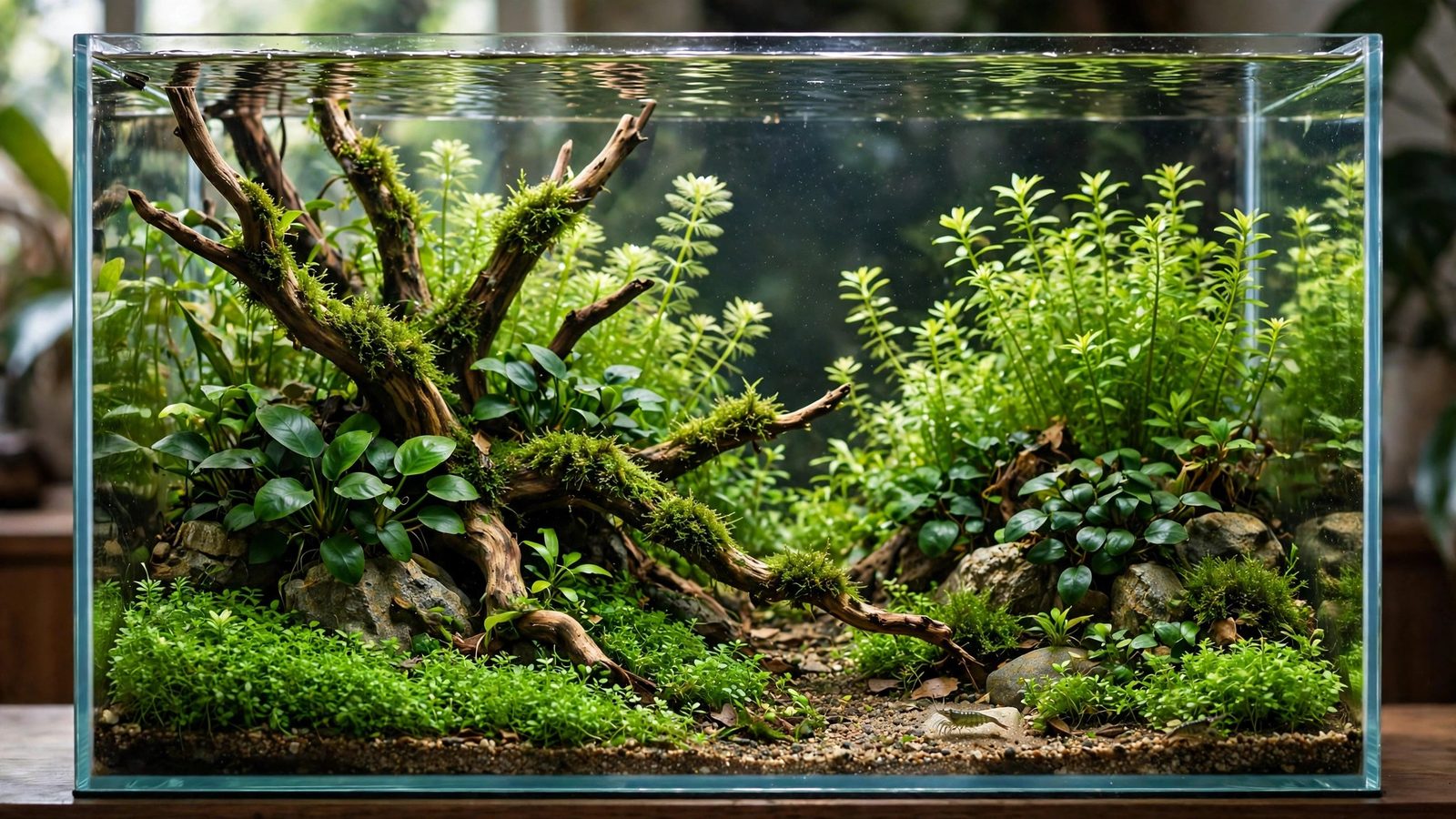
Five gallons is the ultimate constraint — and constraints make artists. A 5-gallon aquascape (roughly 16"×8"×10") forces every decision to earn its place: one hardscape idea, three or four plant species, a single livestock choice. Done thoughtlessly it's a cluttered jar; done deliberately it's a jewel box — some of the most photographed aquascapes in the world are 5 gallons and under. These ideas treat the nano format as a discipline, not a limitation.
The 5-Gallon Commandments
- One idea per tank. A 5-gallon holds a single concept: one stone, one wood piece, one carpet, one school. Two ideas = clutter.
- 3–4 plant species maximum. Fewer than the 10-gallon's already strict limit. Every species must justify its footprint.
- Scale everything down: nano stone (3–7 cm), twig wood, small-leaf plants (Monte Carlo over Amazon swords, Anubias 'Petite' over full-size). Standard-size materials look absurd here.
- 50%+ negative space. Half the tank should be open — carpet, sand, or water. Density reads as mess at this volume.
- Equipment must vanish: sponge filter or nano HOB hidden behind hardscape, slim 25W heater, clip-on light. Visible gear ruins nano compositions.
- Stability is the hidden boss: 5 gallons swing temperature and parameters fast. A lid, a reliable heater, and consistent routine matter more than in bigger tanks.
Layout Ideas
1. The pebble garden (Iwagumi micro)
Three tiny stones (the largest ~7 cm), Marsilea hirsuta or Monte Carlo carpet, nothing else. Our Iwagumi guide's essence at the smallest viable scale. The dry start method is nearly mandatory — planting a carpet this small submerged invites every problem at once.
2. Twig tree
One 15–20 cm twiggy manzanita or spider-wood piece (single-wood), java or peacock moss on the branches, Anubias 'Petite' at the base, hairgrass fringe. A bonsai in a box — the most popular 5-gallon layout ever, because it works.
3. Betta studio
Designed around one betta: floating plants overhead, Anubias on a small wood piece, leaf litter, gentle sponge filter. See our betta layout ideas — the 5-gallon is the classic betta footprint, and a well-scaped one transforms the fish's behavior.
4. Shrimp cube farm
Cholla wood, moss clumps, subwassertang, leaf litter, buffering soil — our shrimp scaping guide's nursery template. A 5-gallon breeds a self-sustaining Neocaridina colony; Caridina keepers use them as dedicated breeding cubes with RO water.
5. The single-stone meditation
One 8–10 cm Seiryu or dragon-stone fragment off-center (one-rock principles), hairgrass carpet, open sand foreground. Zen minimalism — the stone's texture does all the talking.
6. Emersed island (wabi-kusa tank)
A planted wabi-kusa ball as a central island in 3–4" of water, shrimp grazing around it. The emersed dome flowers above the waterline; the island's submerged roots shelter shrimplets. Maximum novelty per gallon.
7. Blackwater puddle
Leaf litter bed, one twisted root, tannin tint, 8–10 chili rasboras or ember tetras — our blackwater guide in miniature. Small water volume makes tint control trivial: two catappa leaves maintain it.
8. Moss wall grotto
Moss mesh panel on the back glass, small stone cave structure, carpet foreground. The living wall doubles the perceived depth — you look into green rather than at a back panel. Superb for shrimp and nano fish that graze the wall.
Equipment for 5 Gallons
- Filtration: small sponge filter (airline-driven) is the default — gentle, baby-safe, doubles as grazing surface. Nano HOBs work but baffle the outflow; even "nano" HOBs can blast a 5-gallon.
- Heater: 25W adjustable, slim profile. Preset heaters are tempting but inaccurate; in 5 gallons, a 2-degree swing is a big swing — spend the extra $10 on adjustable.
- Light: clip-on LED or 12–16" bar. The ~10" height means even modest lights deliver ample PAR — you can grow Monte Carlo under a $25 clip-on here.
- Lid: non-negotiable. Evaporation in 5 gallons concentrates minerals fast (topping off matters weekly), and bettas, killifish, and shrimp all exit through open tops.
- CO2: usually skipped — the plant lists above are low-tech friendly. If you must, a nano citric-acid kit suffices; pressurized is overkill.
A reliable pick here is NICREW ClassicLED Plus.
A reliable pick here is Fluval Stratum.
Stocking: The Short List
Five gallons supports one of the following — not combinations:
- One betta (the classic).
- 6–10 nano schooling fish: chili rasboras, ember tetras, celestial pearl danios — pick one species, keep it a real school.
- 10–20 Neocaridina shrimp (they'll become 100+).
- One dwarf crayfish (CPO) + snails — entertaining, plant-safe-ish (may clip delicate stems).
- Scarlet badis or pea puffer (single): personality fish for species tanks; pea puffers need snail-heavy diets — research first.
What doesn't work: community mixes (no room for territories), anything over 1.5" adult size, and "a few of each" schooling fish — a proper school of one species beats fragments of three.
Maintenance: Small Tank, Sharp Routine
- 20–30% water change weekly — non-negotiable; nitrates climb fast in 5 gallons. Use a small siphon (airline tubing works) to avoid uprooting nano plantings.
- Top off evaporation mid-week with dechlorinated or RO water — a half-inch of evaporation in 5 gallons is a 5%+ concentration swing.
- Trim little and often: nano plants outgrow the scale in weeks. Pinch stem tops every 1–2 weeks, thin moss monthly — see trimming maintenance for nano technique.
- Clean the glass: a razor or small magnetic cleaner weekly — algae is hyper-visible at this scale.
- Test monthly (weekly while new): pH, ammonia, nitrite, nitrate. Small tanks hide nothing; testing catches drifts before livestock does.
The whole routine takes 15–20 minutes weekly — the 5-gallon's great virtue. It's the lowest-maintenance real aquascape in the hobby.
Common 5-Gallon Failures
- Too much stuff: the universal killer. If you're unsure whether to add that second stone — don't.
- Full-size plants: an Amazon sword in a 5-gallon is a joke the tank tells about you. Check mature sizes; buy the nano cultivar.
- No lid + evaporation: parameters drift, fish jump, heaters get exposed. Lid it.
- Overstocking: "it's just a few more tetras" crashes small tanks. Respect the one-school rule.
- Judging at week two: nano carpets need 6–10 weeks even with dry start. Our fill-in timeline applies — impatience kills more nano scapes than algae.
Nano Photography Bonus
Five gallons is a macro photographer's playground — everything is within inches of the glass. A clip-on phone macro lens ($15) turns shrimp into landscapes and carpet pearling into art. Shoot with the lens nearly touching the glass, tank lights as the only illumination, and burst mode for livestock. The small scale means even modest phones produce stunning close-ups; some of the hobby's most-shared images are 5-gallon macros. Document your nano's growth monthly — the before/after transformation of a tiny tank is dramatic precisely because the scale is so intimate.
Frequently Asked Questions
Is 5 gallons enough for a betta?
Yes — it's the widely accepted practical minimum, and a well-scaped 5-gallon (plants, hiding spots, gentle filter, heater, lid) is a genuinely good betta home. Bigger is better (see our 10-gallon ideas for the upgrade), but 5 gallons with proper scaping beats 10 bare gallons every time. Below 5 gallons, don't — the stability math stops working.
Can I do a water change with a regular siphon in 5 gallons?
Use airline tubing instead — a standard gravel vac drains 5 gallons in seconds and uproots everything. Airline tubing gives you precise, gentle control; start the siphon, hover over the substrate, and take your time. A 2-gallon bucket is your water-change vessel.
Do I need a filter in a planted 5-gallon?
Yes. Plants help but don't replace filtration at this bioload-to-volume ratio. A small sponge filter costs $10, runs silently on an air pump, and provides biological filtration plus gentle circulation. "No-filter" 5-gallons work only as Walstad-style experiments with very light stocking — not as general advice.
What's the cheapest way to scape a 5-gallon well?
Our budget guide covers this, but the 5-gallon cheat sheet: secondhand tank ($10), clip-on light ($25), sponge filter + air pump ($15), one bag of aquasoil ($20), one wood piece or 3 small stones ($15), tissue-culture plants ($20). Under $110 for a complete, beautiful setup — the cheapest real aquascape in the hobby.
How do I keep temperature stable in 5 gallons?
Adjustable 25W heater (not preset), a lid to retain heat, and placement away from windows, doors, and AC vents. In cold rooms, a heater controller ($30) is cheap insurance — small tanks are where heater failures kill fastest, because there's no thermal buffer.
Can shrimp and a betta coexist in 5 gallons?
Risky — 5 gallons gives shrimp nowhere to escape a hunter. Some placid bettas ignore shrimp; others eradicate colonies in days. If you try it, plant extremely densely (moss, floaters, litter), start with cheap culls as a temperament test, and accept that shrimplets will be snacks regardless. A dedicated shrimp cube is the safer, more productive choice.
The Jewel Box
Five gallons teaches the purest aquascaping lesson: limitation is a material. One stone, three plants, one fish — and the discipline to stop there. Master the nano format and every larger tank gets easier, because you've learned what each element must earn. Photograph your jewel box with our aquascape photography tips — nano tanks are macro-photography playgrounds where a single shrimp becomes a landscape. And when the constraint starts feeling tight instead of inspiring, our 10-gallon layouts are the natural next canvas.