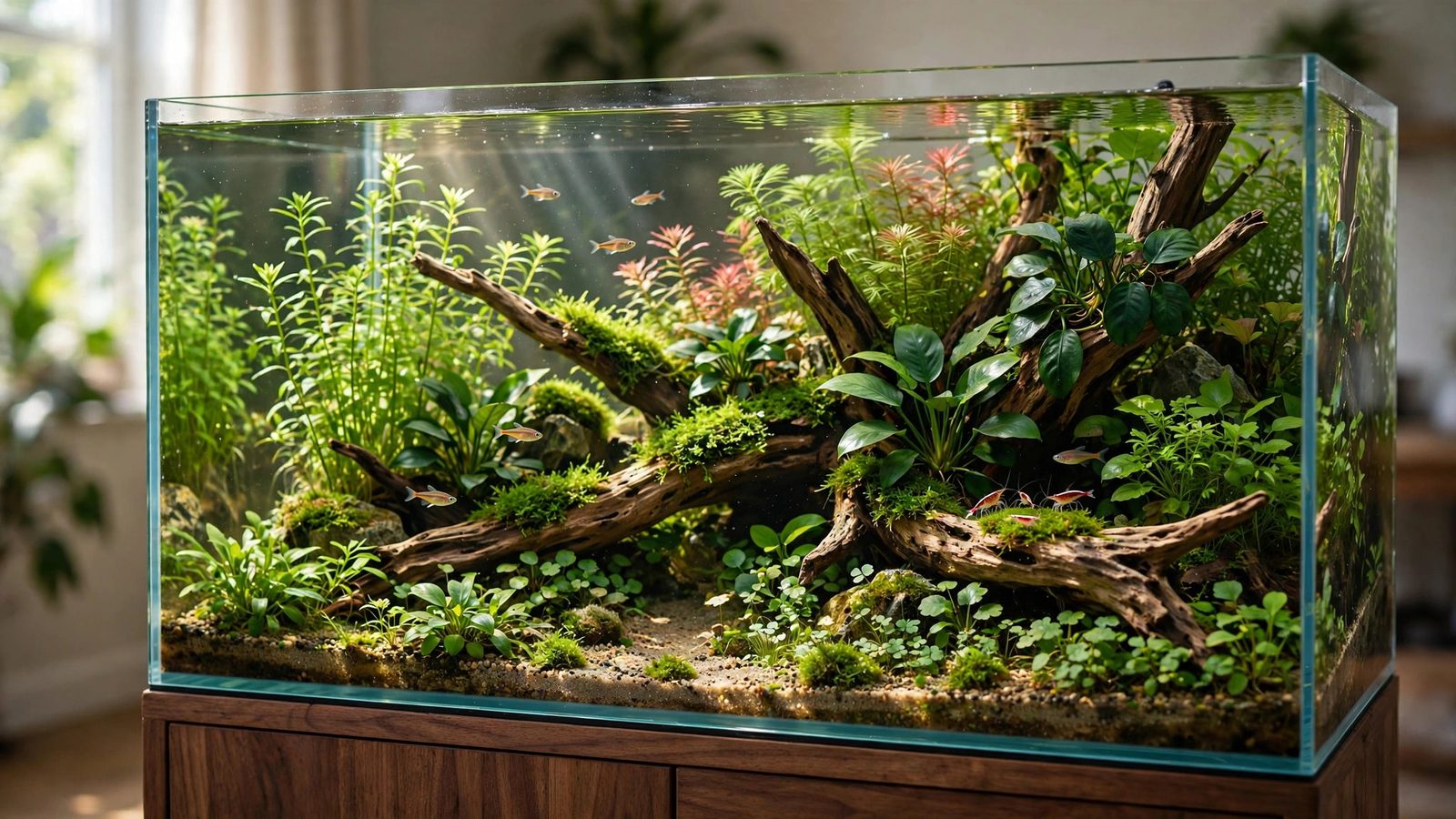
The 10-gallon (20"×10"×12") is where most aquascapers are born — affordable, apartment-friendly, and just big enough for real compositions. It's also where most aquascaping mistakes happen, because beginners try to cram 20-gallon ideas into half the space. These 12 layout ideas are designed specifically for the 10-gallon's proportions: every one respects its limits while exploiting its surprising versatility.
The 10-Gallon's Rules
Before the ideas, the constraints that shape all of them:
- 3–5 plant species maximum. The #1 10-gallon mistake is species soup. Restraint reads as design; variety reads as clutter at this scale.
- One hardscape material dominant. Stone or wood as the lead; the other only as a minor accent if at all.
- Small-scale everything: nano stones, twiggy wood, small-leaf plants. Full-size Amazon swords and dinner-plate Anubias overwhelm 10 gallons.
- Negative space is mandatory: at least 30% open — carpet, sand, or water. A packed 10-gallon looks like a storage box.
- Equipment hides or minimizes: nano HOB or sponge filter, slim heater, clip-on or 20" LED. Bulky gear eats the composition.
12 Layouts for 10 Gallons
1. Nano Iwagumi
Three small stones (5–9 cm), one carpet (Monte Carlo or Marsilea), nothing else. Our Iwagumi guide's discipline in miniature — the purest 10-gallon layout and a rite of passage. The dry start method gives the carpet its best shot.
2. The moss tree
One twiggy spider-wood piece (single-wood), weeping moss canopy, Anubias 'Petite' in the forks, carpet below. The iconic desktop aquascape — looks like a bonsai park and fits anywhere.
3. Jungle corner (low-tech)
Crypt wendtii + java fern + Anubias massed in one back corner per our low-tech jungle guide, open swimming space elsewhere. No CO2, forgiving, lush — the beginner's best friend.
4. Betta palace
Floating plants, Anubias, gentle wood, leaf litter — a 10-gallon gives a betta genuine territory. See our betta layout ideas for the full treatment including the biotope variant.
5. Shrimp metropolis
Dragon stone + moss everywhere + cholla wood + leaf litter — our shrimp scaping guide's moss-mountain template. A 10-gallon breeds hundreds of Neocaridina once the biofilm matures.
6. Diagonal ridge
A substrate ridge running front-left to back-right (diagonal composition), planted with Staurogyne and crypts, carpet on the low side. Maximum depth illusion in minimum space.
7. Dutch nano-streets
Four stem species in tight rows with narrow streets — Dutch discipline at 10 gallons. Demanding trimmer's tank (see trimming maintenance), spectacular payoff.
8. Blackwater cube-ish
Twisted roots, leaf litter, tannin tint, ember tetras — our blackwater guide compressed. The 10-gallon's small water volume makes the tint easy to control with a few catappa leaves.
9. The single stone
One 12–15 cm character stone off-center (one-rock principles), hairgrass or Monte Carlo carpet, one crypt cluster at the base. Minimalist, photogenic, cheap.
10. Wabi-kusa island
A planted wabi-kusa ball as a central island in shallow water — emersed dome, shrimp or a betta around it. The most unusual 10-gallon on this list; the island's flowering top is the focal point.
11. Concave micro-valley
Two low stone/wood walls, carpeted center — our valley technique at the smallest viable scale. Keep walls modest (1/3 height); the valley reads as a grotto. Nano fish (chili rasboras) for scale.
12. The breeder's jungle
Wall-to-wall easy plants (guppy grass, hornwort, java moss, floaters), sponge filter, no pretense of composition — a functional layout optimized for fry survival. Honest, lush, and the most biologically productive tank on this list.
Equipment That Fits
- Filter: nano HOB (with pre-filter sponge) or sponge filter. Gentle flow; 10 gallons forgive little in the way of dead spots or blasting current.
- Light: 18–20" LED or quality clip-on. The 12" height means moderate lights grow most plants; reserve high-PAR fixtures for demanding carpets.
- Heater: 50W slim/flat heater, hidden behind hardscape. In small volumes, heater accuracy matters more — cheap heaters swing temperatures in 10 gallons.
- CO2 (optional): paintball or nano CO2 kits suit 10 gallons; one small diffuser suffices. Or skip it — half the layouts above are low-tech by design.
- Lid: yes, always — evaporation swings parameters fast in 10 gallons, and jumpers (bettas, killifish, shrimp) exploit open tops.
A reliable pick here is NICREW ClassicLED Plus (18-24 in).
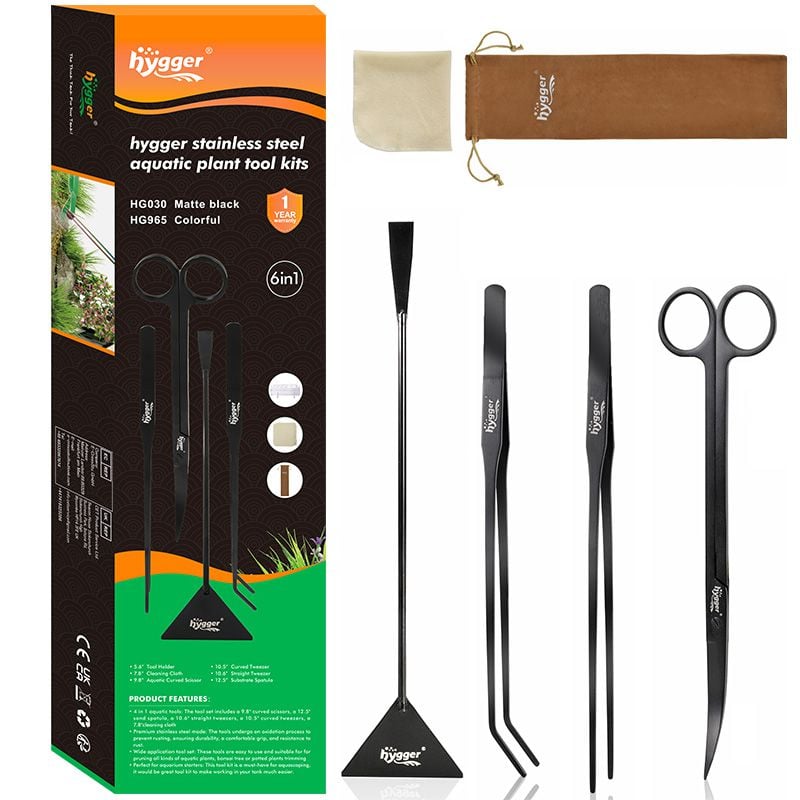
A reliable pick here is aquascaping tweezers kit.
 ★4.6
hygger 6-in-1 Long Aquarium Aquascaping Tools Kit
Check Price on Amazon ★4.6Stocking: Less Is More
- One school (8–12): ember tetras, chili rasboras, green neons, celestial pearl danios — nano species that suit the scale.
- OR one centerpiece: a betta, a pair of honey gouramis, a pair of Apistogramma (borderline — needs the jungle layouts' cover).
- Cleanup: 3–4 otos or a handful of Neocaridina shrimp; one nerite snail.
- Avoid: anything over 2" adult size, anything hyperactive (zebra danios pace miserably), and overstocking — 10 gallons punish bioload mistakes fast.
Week by Week: The First Two Months
Knowing what's normal prevents panic. Week 1: everything looks sparse and the water may be hazy — normal. Run lights 6 hours, do a 30% water change mid-week, don't touch the plants. Week 2: diatoms (brown dusty algae) likely coat glass and leaves — normal in new tanks; otos and snails handle it, and it fades as silicates deplete. Wipe the front glass, leave the rest. Week 3: first real growth — stem tips extend, carpet sends runners, crypts may melt old leaves (they recover; don't uproot them). Test water: ammonia/nitrite should hit zero — now you can add your cleanup crew. Week 4: add your main livestock (school or centerpiece) — drip-acclimate, feed lightly. Increase light to 7–8 hours. Weeks 5–6: the "ugly middle" — some algae on slow growers, plants looking gangly. Stay the course: weekly water changes, remove algae manually, resist rescaping. Weeks 7–8: the turn — carpet knits together, stems bush out from the first trim (cut tops, replant them), the tank starts looking like the picture in your head. From here it's refinement: trim every 1–2 weeks per our trimming guide, and by month three you have a mature aquascape. The hobby's hardest skill isn't planting — it's leaving a week-3 tank alone.
What Transfers When You Upgrade
Almost everything you learn on a 10-gallon scales up: the trimming skills, the compositional eye, the maintenance discipline, the plant knowledge. Physically, hardscape transfers — good stone and wood work in bigger tanks (supplemented with larger pieces), and filters, heaters, and lights can seed a quarantine or second tank. What doesn't transfer is the layout itself: compositions are designed for specific proportions, so expect to rescape rather than transplant. Many aquascapers keep their first 10-gallon running as a shrimp or quarantine tank long after upgrading — it's the most useful spare tank size in the hobby. And the plants? Trimmed stems from your 10-gallon become the free planting stock for the 20-long. The hobby compounds.
Frequently Asked Questions
Is 10 gallons too small for a "real" aquascape?
No — it's the most popular aquascaping size in the world for good reason. Iwagumi, nano jungle, shrimp metropolis, and Dutch nano-streets all win contests at this size. What's too small is trying to fit big-tank ideas (valleys, forests, schools of 30) into it. Respect the scale and 10 gallons is a complete canvas.
How much does it cost to scape a 10-gallon?
$80–$200 depending on ambition: tank ($15–50), light ($25–60), filter ($15–30), substrate ($20–30), hardscape ($15–40), plants ($20–40). Our budget aquascaping guide squeezes this under $100 without sacrificing the result. CO2 adds $60–150 if you go high-tech.
Can I keep a betta with shrimp in 10 gallons?
Sometimes — heavily planted 10-gallons (layouts 3, 5, 8) give shrimp enough cover to sustain a colony alongside a chill betta. But betta temperament varies; some hunt shrimp relentlessly. Start with cheap ghost shrimp as a temperament test before adding a $50 Caridina colony. Always have a backup tank.
How often do water changes in a 10-gallon?
25–30% weekly — small volumes accumulate nitrates and swing parameters faster than big tanks, so the weekly change is non-negotiable. Top off evaporation mid-week with plain dechlorinated (or RO) water. The whole routine takes 15 minutes; see trimming maintenance for the full weekly checklist.
What's the easiest 10-gallon layout for a total beginner?
Layout 3, the jungle corner: crypts + Anubias + java fern, sponge filter, moderate light, no CO2. It's nearly unkillable, looks lush within two months, teaches planting and maintenance fundamentals, and forgives every beginner mistake except total neglect. Start there; attempt Iwagumi second.
Should I use aquasoil or gravel in a 10-gallon?
Aquasoil if you're planting heavily (it feeds plants and buffers pH); inert sand/gravel with root tabs if you're doing hardscape-focused or budget layouts. In 10 gallons the cost difference is one bag — $20–30 — so most scapers choose aquasoil. Rinse nothing; aquasoil goes in unrinsed and unwashed.
Small Tank, Complete Art
The 10-gallon rewards the aquascaper who edits: fewer species, one material, protected negative space, and equipment that disappears. Pick the layout that matches your ambition and patience — jungle corner for beginners, Iwagumi for minimalists, Dutch streets for trimmers, shrimp metropolis for breeders — and give it the same four-month maturation any scape deserves. Photograph it with our aquascape photography guide when it's grown in; small tanks photograph beautifully because every detail is within reach. And when you're ready for more water, our 20-gallon long ideas await.