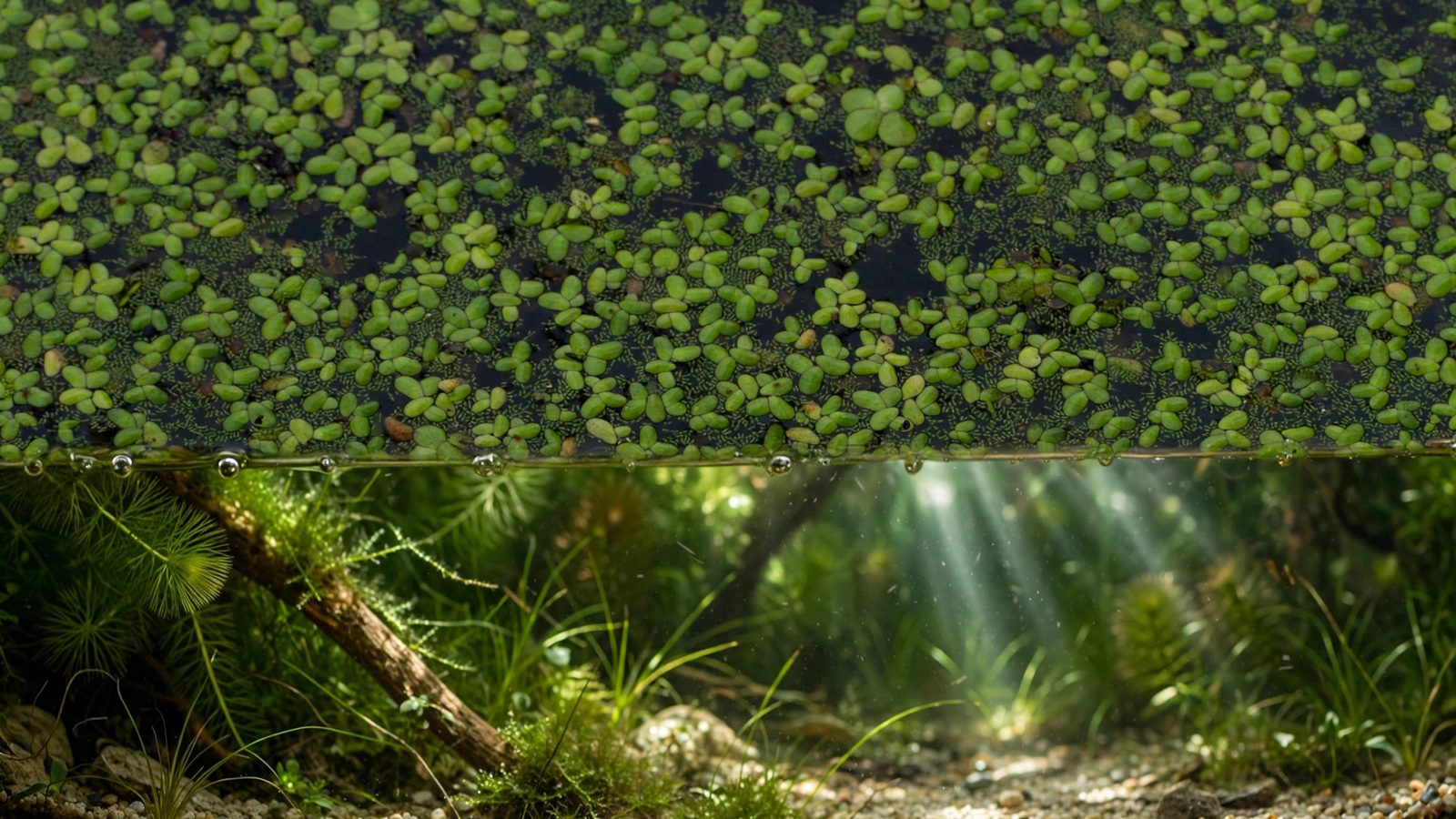
The smallest flowering plant on Earth is a single green grain floating on your aquarium's surface: Wolffia globosa, just 0.5–1.5 mm long — about the size of a pinhead, one rootless frond per plant, nothing more. This complete wolffia care aquarium guide covers growing watermeal deliberately for fry food and green-water synergy — and containing it, because a plant this small is famously almost impossible to remove once it settles in.
Direct answer: Yes — Wolffia (watermeal) thrives in aquariums with bright light 10–14 hours a day, still water, and modest nutrients; it multiplies by budding, doubling its mass in days. Unlike common duckweed it has no roots at all, and each W. globosa frond is just 0.5–1.5 mm long — these species are the world's smallest flowering plants, per the Mississippi State University Extension's watermeal profile. Treat it as permanent livestock: never release it into local waterways.
Wolffia Care Aquarium Guide: Growing Watermeal on Purpose
Watermeal's reputation is mostly accidental: it rides in on new plants and, weeks later, the surface is a green film you cannot net out. Deliberate culture flips that script — you grow it like breeder trays grow green water, as a renewable resource rather than a pest.
Most floating-plant advice is written for duckweed. Our duckweed care guide covers Lemna and Spirodela — rooted floaters with 2–10 mm fronds. Wolffia is a different organism: no roots, no leaves, no stems, just one oval frond per plant, gritty like cornmeal between your fingers.
| Trait | Wolffia (watermeal) | Duckweed (Lemna) | Azolla |
|---|---|---|---|
| Frond size | 0.5–1.5 mm | 2–10 mm | 1–2 mm clusters |
| Roots | None | One short root | Fine roots |
| Feel | Gritty, like cornmeal | Smooth | Fuzzy |
| Handling | Nearly impossible to net fully | Easy to corral | Clumps, easy to scoop |
| Best use | Fry food, nutrient sponge | Shade, nitrate export | Ornamental floater |
Want a decorative floater you can rearrange? See the best floating aquarium plants for beginners — the azolla mosquito fern guide covers one that behaves itself. Wolffia is a culture, not decor.
Light and Water Conditions
As a surface plant, wolffia gets first claim on your light — its advantage and the main risk to everything below it. Give it moderate to bright light 10–14 hours a day; past 12 hours the doubling rate takes off, while growth stalls under roughly 8 hours or beneath taller floaters.
Keep the surface still — aim filter outflow at the glass. Warm, nutrient-rich water suits it best (20–30 °C); pH roughly 6.0–7.8 is fine, hard water included. Since a full mat blocks nearly all light, float a feeding ring or airline-tubing loop from day one: it keeps a clear window for feeding and gas exchange, and doubles as your simplest containment tool.
Feeding Wolffia: Nutrients That Keep It Multiplying
Wolffia feeds from the water column through its underside. In a stocked tank, fish waste and uneaten food usually supply enough nitrogen and phosphate — one reason it explodes in breeding tanks. In a livestock-free tray, dose a complete liquid fertilizer at one-quarter strength weekly, keeping nitrate at 5–20 ppm. Start low, observe livestock before increasing. Full strength just feeds the algae film competing for light.
A starter recipe for a 20-litre tub: dechlorinated water, a tablespoon of fronds, bright light 12+ hours, quarter-dose all-in-one weekly. The surface films over in two to three weeks, a harvestable mat within a month — skim half for feeding and let the rest regrow, per this step-by-step Wolffia arrhiza cultivation guide.
Containment: The Honest Part
Plain truth: wolffia is nearly impossible to remove once established. One frond on a net, a tube, or your finger restarts the colony. Extension services call watermeal a wild nuisance and advise eradicating infestations on sight — a full mat starves everything below it of light.
So culture it deliberately: one vessel or one corner of one tank, never scattered across a display. Rinse tools after contact, quarantine new plants (watermeal is the classic hitchhiker), and bin or feed the excess when thinning — never pour culture water down an outdoor drain.
If it invades an unintended tank, accept that eradication is a project: weeks of daily skimming with a fine brine-shrimp net, wiped-down equipment, no leaves to hide under. Most keepers find restarting the hardscape easier than winning that war.
Wolffia as Fry Food and Green-Water Companion
This is where wolffia earns its keep. The fronds are among the most protein-dense plant matter in the hobby — small enough for newly free-swimming fry to graze, soft enough to crush into paste for the tiniest mouths. Guppy, platy, betta, and killifish fry pick at a mat all day between powdered feeds.
Skim a corner with a fine net, rinse in tank water, and feed fresh — uneaten fronds keep growing instead of fouling the water. Our guide to using duckweed as fish food covers the same harvest-and-feed logic, with wolffia's smaller size suiting even younger fry. In breeding setups a mat thinned to a third of the surface doubles as calming shade and nitrate sponge — see the complete freshwater aquarium plants guide for how the floater layer fits your scheme.
 ★4.6
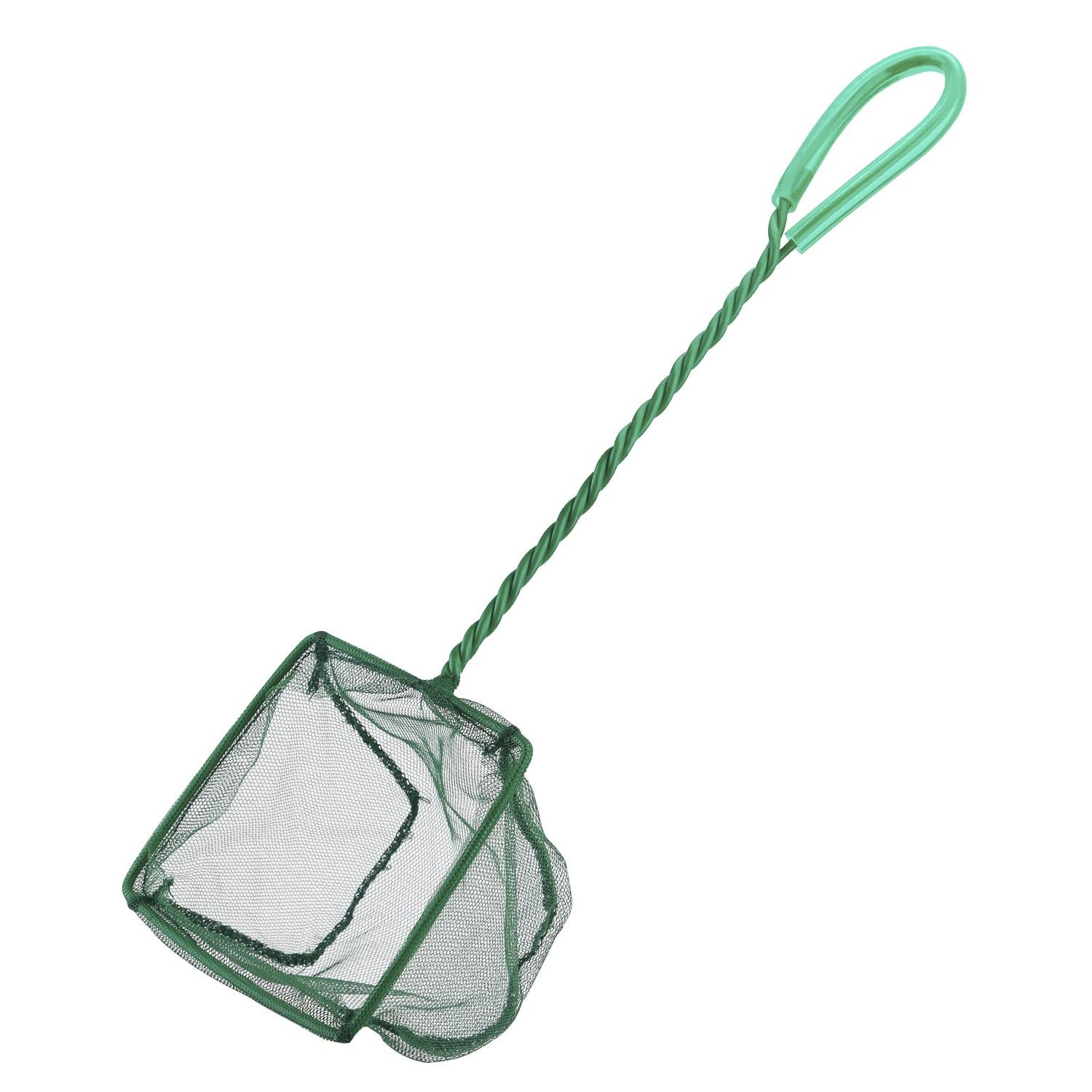
Pawfly 4" Aquarium Shrimp Net
Check Price on Amazon ★4.6Frequently Asked Questions
Is wolffia the same as duckweed?
Related but distinct. True duckweeds (Lemna, Spirodela) have small roots and 2–10 mm fronds; wolffia is completely rootless with fronds just 0.5–1.5 mm long, and feels gritty like cornmeal when rubbed between your fingers. Care overlaps, but handling, containment, and fry-food use differ enough to treat them separately.
How fast does wolffia grow in an aquarium?
Very fast in good conditions. With bright light 12+ hours daily, still water, and adequate nutrients, a colony can double its biomass in days through budding — daughter fronds simply break off the parent. In dim or cool tanks it creeps. If a tablespoon starter films the surface within three weeks, conditions are ideal.
How do I get rid of wolffia from my tank?
Complete removal is extremely difficult — the reason this guide stresses containment first. Expect weeks of daily skimming with a fine brine-shrimp net, thorough rinsing of nets, tubing, and filter intakes, and removing leaves it clings to. One surviving frond restarts the colony; many keepers find restarting the hardscape easier than eradicating an entrenched infestation.
Which fish eat wolffia?
Most omnivores graze it: guppies, platies, mollies, goldfish, and cichlids all pick at the mat, and fry of nearly any species benefit from constant grazing. It is soft and protein-rich, suiting fish too small for flakes. Skim fresh with a fine net, rinse in tank water, and feed directly — uneaten fronds keep growing instead of fouling the water.
Do I need fertilizer to grow wolffia?
In a stocked tank, usually not — fish waste and leftover food supply enough nitrogen and phosphate. In a livestock-free culture tray, dose a complete liquid fertilizer at one-quarter strength weekly, keeping nitrate between 5 and 20 ppm. Start low, observe livestock before increasing. Full-strength dosing is counterproductive: it feeds the algae film competing with the fronds for surface light.
Is wolffia invasive? Is it legal to keep?
It behaves invasively in warm, nutrient-rich waters, forming light-blocking mats — extension services advise eradicating wild infestations on sight. Check local regulations before buying or trading it, as some jurisdictions restrict it. Never release it or pour culture water into outdoor waterways; responsible containment is a legal as well as ethical obligation.
Small Plant, Big Responsibility
Wolffia is a paradox in a thimble: the world's smallest flowering plant, yet one of the hardest to remove — and most useful once grown deliberately. Bright light, still water, modest nutrients; harvest it as living fry food; contain it like the near-permanent resident it is. For what goes underneath, the best plants for a planted aquarium roundup will help you choose.