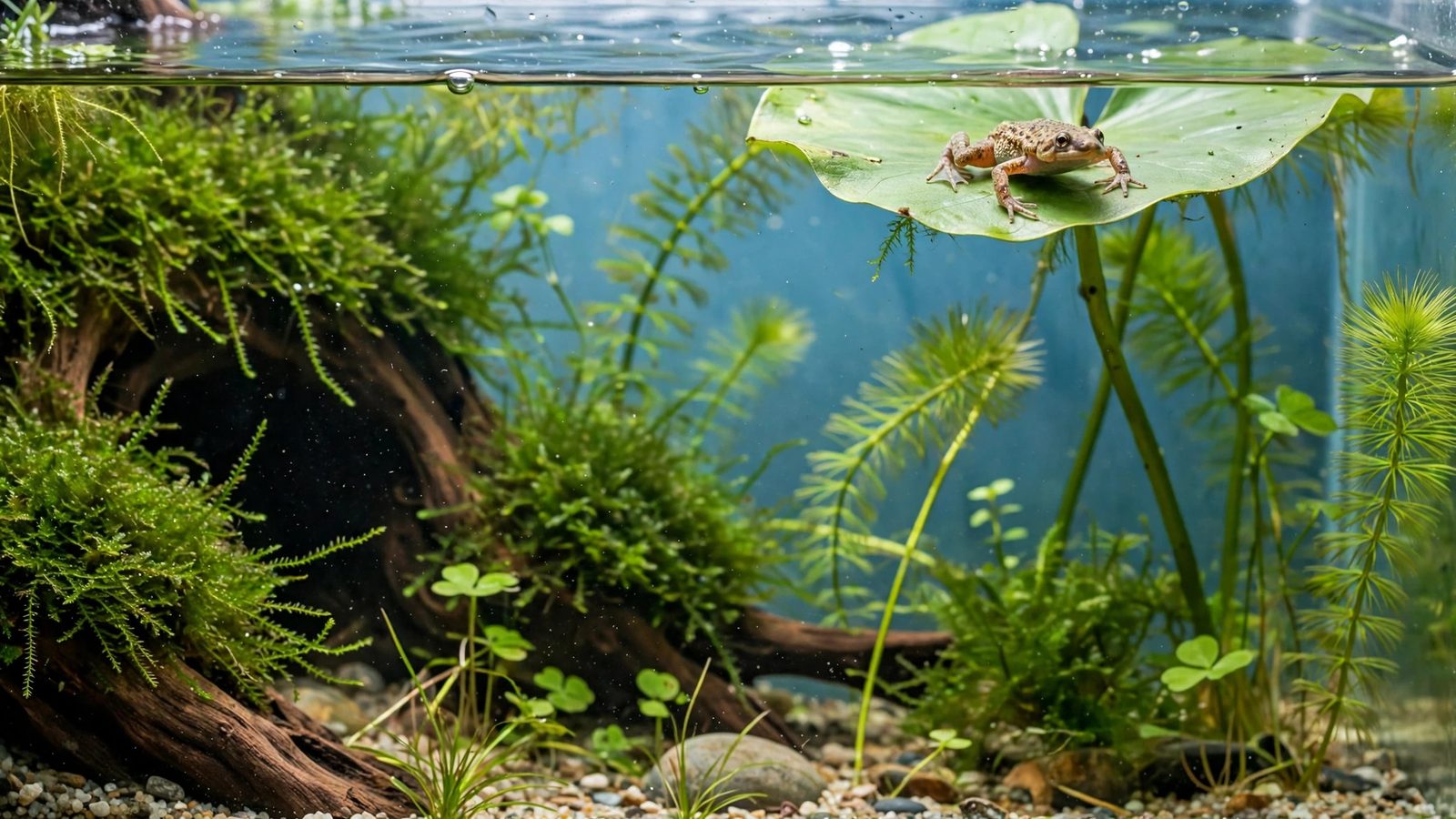
Most aquarium plants on the market were bred for bright tropical fish tanks — and bright tanks are exactly what African dwarf frogs hate. Put a light-loving plant in a dim frog tank and it rots within weeks, fouling the water for your frogs. The best plants for African dwarf frogs share a narrow checklist: low-light tolerance, soft broad leaves frogs can rest on near the surface, and no sharp edges that could scratch delicate frog skin.
What makes a plant "frog-safe"?
African dwarf frogs (Hymenochirus species) are nearly blind, soft-bodied amphibians surfacing to breathe every 15–20 minutes. That biology defines plant selection more than any aquascaping trend:
- Resting perches near the surface. Broad leaves held a few inches below the surface give frogs a place to pause after breathing — Anubias and Java fern are the classic choice.
- Dim-light tolerance. Frogs feed and breed best under subdued light. Plants rated for 20–30 PAR / low light won't melt in a dim tank — unlike light-hungry stem plants, which rot and spike ammonia.
- Soft tissue, no stiff blades. Frogs squeeze through decor with their whole bodies. Soft moss, broad crypt leaves, and flexible stems are safe; stiff needle-leaf clumps and ornamental grasses with sharp blade edges are not.
- Open structure. Dense thickets look natural but a 2-inch frog can wedge itself into a tight stem forest and panic. Plant in clumps with open swimming lanes between them.
The 11 best plants for African dwarf frogs, ranked
Ranked by value to a dwarf frog setup: low-light survival first, then perch/shelter value, then maintenance effort. The comparison table below summarizes placement and frog benefit for all eleven.
| Plant | Light | Placement | Frog benefit |
|---|---|---|---|
| Anubias barteri | Low (20–30 PAR) | Midground, on hardscape | Broad horizontal leaves = best resting perches |
| Java fern (Microsorum pterotoides) | Low | Background, on wood/rock | Tall leaves as mid-water rest stops |
| Amazon frogbit | Low–medium | Floating | Surface shade + trailing root shelter |
| Red root floater | Medium | Floating | Dense root curtains for shy frogs |
| Cryptocoryne wendtii | Low | Foreground/midground | Soft broad leaves at frog eye level |
| Java moss | Low | Ground/wood | Soft hiding mat; hosts microfauna frogs nibble |
| Anacharis (Elodea densa) | Low–medium | Background | Fast oxygenator; soft flexible stems |
| Water sprite | Low–medium | Floating or planted | Feathery soft cover; doubles as surface shade |
| Dwarf water lettuce | Medium | Floating | Long roots = favorite frog ambush perch |
| Bacopa caroliniana | Low–medium | Background | Soft upright stems; doesn't need trimming often |
| Marimo moss ball | Low | Bottom | Soft bottom "furniture" frogs nose under |
1. Anubias barteri — the resting perch champion
If you buy one plant for a frog tank, make it this. Anubias grows stiff, horizontal, leathery leaves on a thick rhizome, and the broadleaf varieties naturally hold their foliage in the upper third of the tank when tied to tall driftwood. Frogs surface, breathe, then settle onto the leaf like a hammock. It grows at 20 PAR, needs no substrate (tie it to rock or wood), and its slow growth means almost no maintenance. Give each 10-gallon frog tank two good-sized rhizomes. See the full rundown in our best epiphyte aquarium plants guide.
2. Java fern — tall, forgiving, unkillable
Java fern sends up leathery strap leaves 6–12 inches tall, giving frogs vertical structure to pause against mid-ascent. Like Anubias it is an epiphyte — rhizome above the substrate, tied or glued to hardscape — thriving in low light and slightly alkaline water (frogs prefer pH 7.0–7.8). Skip the "needle leaf" cultivars: stick to the standard broadleaf form for frogs.
3. Amazon frogbit — shade plus living shelter
Frogbit forms 1–2 inch rosettes on the surface with fine roots trailing 3–6 inches into the water. That root curtain is premium frog habitat: frogs hide in it, hunt through it, and the leaf mat dims the light below. Keep coverage under 50% of the surface so frogs always have clear lanes to surface for air — a fully closed mat can force a frog to search for a breathing gap.
4. Red root floater — the shy-frog sanctuary
Similar surface role to frogbit but with denser, finer root tangles that timid frogs especially love. The catch is light: in a dim frog tank it grows greener and leggier — still functional shelter, just less ornamental. Place it under the brightest spot in the tank and let frogbit take the darker edges. See our floating plants for beginners guide for keeping both under control.
5. Cryptocoryne wendtii — broad leaves at frog level
Crypts grow rosettes of broad, ruffled leaves 4–8 inches tall at mid-tank height — exactly where frogs spend most of their time. The leaves are soft and flexible, so a frog brushing through suffers no abrasion. Wendtii is the most forgiving crypt: it survives 20 PAR, doesn't demand CO₂, and once settled grows steadily. Plant in groups of 3–5 crowns 3 inches apart; leave gaps between groups for frog highways.
6. Java moss — the soft hiding mat
Tied to driftwood, rocks, or substrate, Java moss forms a soft, frog-safe carpet. It harbors infusoria and micro-crustaceans that frogs pick at between feedings — free enrichment. It grows in near-darkness (15+ PAR) and needs only occasional thinning.
7. Anacharis — the fast oxygenator
Anacharis (Elodea densa) is one of the few fast growers that belongs in a dim tank: it photosynthesizes aggressively even at low light, pumping oxygen into the water and soaking up ammonia — both welcome in frog tanks where feeding can be messy. Its stems are soft and flexible, bending when a frog pushes through. Plant stems 1.5 inches apart in background bunches; trim tops monthly to keep it from shading everything. Responsibility note: Anacharis (Egeria densa) is invasive in many regions and has choked waterways worldwide. Never release it into the wild or dump tank water with fragments into drains; compost or trash trimmings.
8. Water sprite — flexible surface-or-substrate plant
Water sprite (Ceratopteris thalictroides) works two ways: planted as a lacy midground bush, or floating as a soft surface mat frogs can nose through. Floating is the better frog use — it adds surface shade while staying looser and more breathable than a frogbit mat. One mother plant colonizes a tank in a month via leaf plantlets; trim brown fronds promptly.
9. Dwarf water lettuce — the root-perch specialist
At 2–3 inches across, dwarf water lettuce is sized for frog tanks where full water lettuce would dominate. Its roots hang 4–8 inches deep and frogs cling to them mid-water, resting in the root tangle. Needs medium light directly under the lid and dislikes splashing from filter outflow (wet leaves rot), so corral it in a feeding ring away from the filter. Like all floaters, keep it under half the surface for open breathing lanes. Responsibility note: dwarf water lettuce is regulated or prohibited in several states — check local rules before buying or transporting it, and never release it into outdoor waterways; compost or trash the excess.
10. Bacopa caroliniana — the set-and-forget background stem
Bacopa is the lowest-maintenance background stem for dim tanks: round soft leaves, upright habit, tolerates 25+ PAR without CO₂, and trimming is a monthly job. Its flexible stems pose no trapping risk.
11. Marimo moss ball — bottom enrichment
Frogs nose under moss balls, rest against them, and push them around the bottom. The ball is entirely soft algae — zero injury risk — and it photosynthesizes at very low light. Roll each ball weekly so all sides stay green; one per 5 gallons is plenty.
How to plant a dwarf frog tank (by zone)
A frog tank is planted in three functional zones, not by looks:
- Surface (0–3 inches deep): Frogbit or dwarf water lettuce, max 50% coverage. Always leave at least one open breathing lane.
- Mid-water perches (3–10 inches deep): Anubias on tall driftwood, Java fern on rocks, crypt groups at mid height. Leaves within 3 inches of the surface matter most — those are the breathing-break perches.
- Bottom and edges (substrate): Java moss mats, moss balls, crypt foreground. Keep the center-bottom open as a feeding floor — frogs are nearly blind and find food by smell; a clear area makes feeding reliable.
For the general principles behind this zoning, our aquarium plant placement guide covers height layers in more depth. Frog tanks run low-tech by definition, so stick to species from our easiest no-CO₂ plants list — everything ranked above qualifies.
The escape-prevention planting rule
African dwarf frogs are notorious escape artists — they climb glass, decor, and plant mats and can cross a lid gap in seconds. Planting must respect that:
- Keep all plant tops, floating mats, and driftwood at least 2–3 inches below the tank rim. A floating mat bridging the gap is a ramp, not a decoration.
- A tight-fitting lid with no gaps over 1/4 inch is non-negotiable. Seal filter and heater cable cutouts with sponge or foam.
- Lower the water level 2–3 inches in a rimless or open-top setup — the extra air gap defeats climbing attempts.
- Never let frogbit or water lettuce mats press against the lid; frogs push up through the mat and wedge themselves between leaf and lid.
If you need plants that attach to decor instead of substrate — useful for keeping the bottom open as a frog feeding floor — the aquarium plants without substrate guide lists epiphytes and floaters that work for exactly this layout.
Plants to avoid in African dwarf frog tanks
Honest exclusions, with reasons:
- High-light stem plants (Rotala, Ludwigia super red, Pogostemon stellatus): they melt in dim frog tanks, and rotting stems foul water fast.
- Stiff ornamental grasses with sharp blade edges: abrasion risk on frog skin.
- Dense stem forests packed stem-to-stem: trapping hazard for a 2-inch frog, even with soft species. Always leave swim lanes.
- Terrestrial "aquarium" plants (non-aquatic Dracaena, mondo grass sold for aquariums): they rot underwater within weeks.
Lighting and water parameters that keep plants alive in frog tanks
The frog sets the parameters:
- Light: low — 0.5–1 WPG on old fluorescents, or a dimmable LED at 20–30 PAR, 6–8 hours daily. Frogs prefer dim; brighter light causes stress and algae.
- Temperature: 75–80°F (24–27°C). All ranked plants tolerate this range.
- pH: 6.8–7.8. Fine for every plant on this list.
- Fertilizer: a light all-in-one liquid dose weekly (half label strength) is plenty — heavy dosing in dim tanks just feeds algae. Root tabs under crypts if the substrate is inert.
- No CO₂ needed. Every plant ranked here grows without injected CO₂; adding it would require higher light, which fights the frogs' preference.
 ★4.5
Finnex Stingray 2.0 LED Light
Check Price on Amazon ★4.5Frequently Asked Questions
Do African dwarf frogs need live plants?
Not strictly — frogs survive in bare tanks — but live plants improve the setup: they absorb ammonia from messy feeding, oxygenate the water, dim harsh light, and provide resting perches and hiding spots that reduce stress. A frog tank with a few low-light plants is easier to keep stable than a bare one.
What plants do African dwarf frogs like to sit on?
Broad, sturdy leaves held near the surface. Anubias barteri is the classic: its 3–5 inch leathery leaves hold a frog's weight without bending, and mounted 2–3 inches below the waterline they become breathing-break perches. Large crypt leaves and the root tangles of dwarf water lettuce are the runners-up.
Can African dwarf frogs get stuck in plants?
Yes, in the wrong planting. Dense thickets of stiff-stemmed or needle-leaf plants can trap a small frog that pushes in and can't reverse. Avoid tight stem forests, leave open swim lanes between plant groups, and choose soft flexible species like moss, Anubias, crypts, and Anacharis. If you see a frog wedging into decor repeatedly, thin that spot.
How much of the surface can floating plants cover?
Keep floating coverage at or below 50% of the surface. Dwarf frogs breathe air and must always have open lanes to the surface — a fully closed mat forces them to hunt for a breathing gap. Skim extras weekly; frogbit and water lettuce double fast.
Do African dwarf frogs eat aquarium plants?
No — dwarf frogs are carnivores with poor eyesight and won't browse leaves. Nibbled leaf edges are almost certainly from tankmates like snails or shrimp. The real risk runs the other direction: rotting light-hungry plants fouling the water. Stick to the dim-tank species ranked above and this problem disappears.
Will frogs escape through gaps around plants and equipment?
They can and will use anything as a ladder — floating mats, tall driftwood, heater cables. Use a tight lid with gaps under 1/4 inch and seal cable cutouts with foam. In open-top setups, lower the water level a couple of inches. An escaped frog found in time usually survives if rehydrated quickly.
The bottom line
Planting a dwarf frog tank is the opposite of a high-tech aquascape: dim light, soft leaves, open lanes, and a tight lid. Start with two Anubias on driftwood, a crypt group, Java moss, and a patch of frogbit — that five-plant starter covers perches, shelter, shade, and water quality. Your frogs don't care about the aquascape — just a leaf near the surface, dim light, and a lid they can't beat.