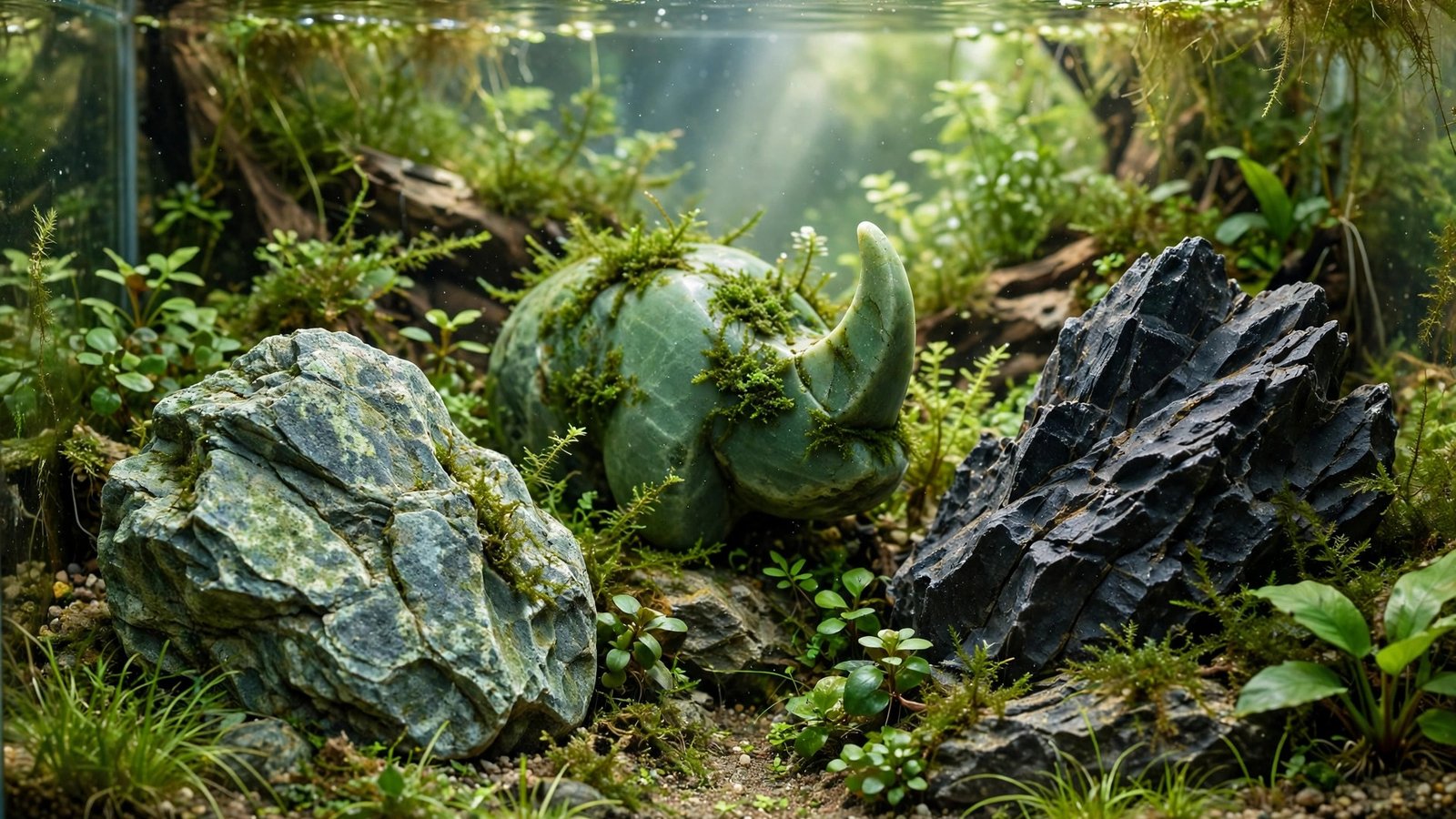
October 2026 just became the most interesting month for aquascaping hardscape in years. Four brand-new arrivals — Chameleon Stone, Jade Rhino Stone, Black Ridge Stone, and Rasamala Root — have landed at major US retailers, and anyone scouting for a chameleon stone aquarium build is arriving at exactly the right moment. By the end of this guide you'll know what each material actually does in a scape, which aquascaping styles each one suits, how to test each for water-chemistry effects before it ever touches your tank, and which purchase is worth the money.
Why October 2026 Is a Big Moment for Hardscape
Hardscape trends move slowly. For years the market has rotated around the same handful of classic aquascaping rocks like Seiryu and Dragon Stone, and honestly, that's fine — those stones earned their reputation. But every few years a retailer imports a genuinely new material, and October 2026 delivered four of them at once: Chameleon Stone, Jade Rhino Stone, Black Ridge Stone, and Rasamala Root, all appearing on major US retailers' new-arrivals lists at the same time.
Why should you care before the hype fades? Two reasons. First, early-mover materials let you build a scape that doesn't look like everyone else's Pinterest board — there's real creative value in being the first tank in your local club with a stone nobody has seen underwater yet. Second, new stone types sometimes solve practical problems: a color range that previously didn't exist, a texture that moss grips better, or a weight-to-size ratio that makes large layouts manageable.
The catch is that new means untested. Unlike Seiryu Stone, whose pH-raising behavior is well documented, these four have almost no published hobbyist experience behind them — which is exactly the gap this guide fills: what each material does in a scape, which styles it suits, and how to test it safely yourself.
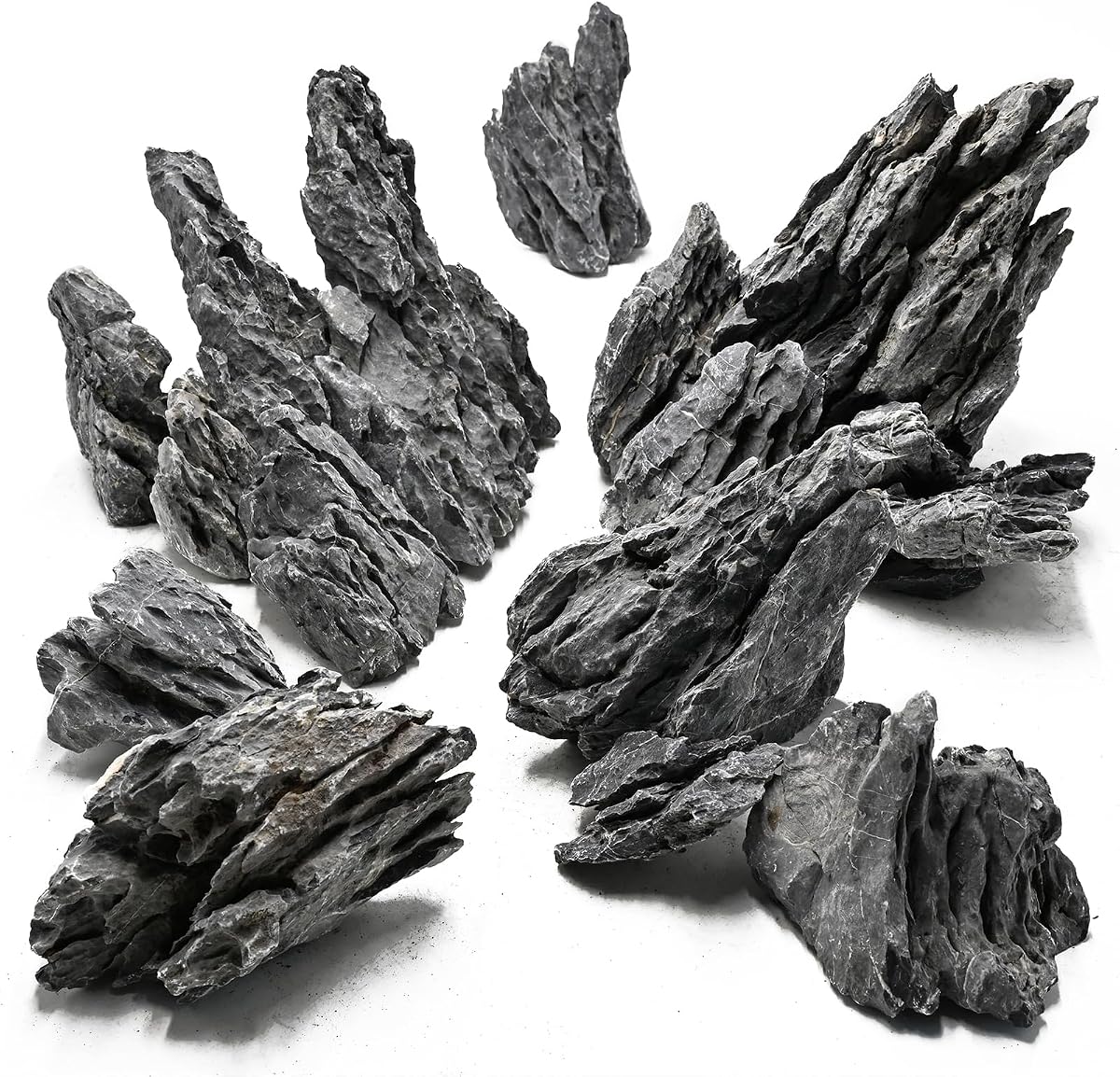 ★4.5
Eorbow Natural Seiryu Stone Rocks
Check Price on Amazon ★4.5Chameleon Stone: The Color-Changing Centerpiece
Chameleon Stone earned its name from a trick you can see in any shop tank: dry, the rock reads as a light, unremarkable gray. Submerge it, and it transforms into a dramatically darker, richer stone with far more visible character. At roughly $139 for a retail bag, it's the premium-priced arrival of this batch — and that price only makes sense if you buy it for the transformation.
What it looks like, dry versus wet
The dry appearance is genuinely deceptive: pieces that look bland and chalky on a shelf reveal depth and tonal variation once wet. Most people select hardscape dry, in store — with Chameleon Stone you must judge it wet. Dunk candidate pieces in a bucket at the shop or buy expecting the palest gray pieces to become your most interesting dark accents.
Where it shines in a layout
The wet darkening gives Chameleon Stone two personalities in one bag: lighter, subtle structure pieces for the background and dramatically darker focal stones for the foreground. It pairs beautifully with bright green mosses and red stem plants — the darkened rock makes both pop far harder than mid-gray stone does. It suits nature-style and diorama layouts where the hardscape needs to feel like a real landscape that shifts with the light.
Jade Rhino Stone: Green-Gray Texture That Plants Love
If Chameleon Stone is about color drama, Jade Rhino Stone is about texture. It's a rugged, heavily textured stone in natural green-gray tones, with an irregular, ridged surface that looks like folded sediment. Retail bags run about $48–$105 depending on size, making it the most accessible stone of the new arrivals — and arguably the most versatile.
Texture as a planting strategy
Those ridges and crevices aren't just for show. Deeply textured stone gives epiphytes and mosses something to grip: Java moss, fissidens, and anubias roots establish noticeably faster on ridged surfaces than on smooth ones, and the green-gray base color harmonizes with the plants instead of fighting them. After three to six months of growth, a Jade Rhino Stone layout reads as ancient rock emerging from vegetation rather than as a pile of rock with plants glued on. That's the nature-style effect people pay contest winners for.
Best styles and tank sizes
Jade Rhino Stone works across tank sizes, but it genuinely excels in medium and large planted tanks (30 gallons and up) where you can stack irregular pieces into ridgelines and valleys. In a nano, use one striking piece with fine gravel rather than a crowd of fragments — too many textured rocks in 10 gallons reads as rubble. On chemistry: green-gray coloration in ornamental stone is commonly associated with mineral content, so don't skip the vinegar test below.
Black Ridge Stone: The Dark Anchor
Black Ridge Stone brings the moody end of the spectrum: dark gray to charcoal tones with earthy brown patches and a heavily weathered surface. At about $100 a bag, it sits between Jade Rhino and Chameleon Stone on price — and it fills a gap that matters, because genuinely dark, textured, affordable aquarium stone has always been scarce.
Iwagumi and blackwater builds
Dark stone is the backbone of two styles: iwagumi, where the rocks are the scape, and blackwater/biotope builds, where the stone must read as submerged river rock under tannin-stained water. Black Ridge Stone's weathered surface gives it the age that smooth black lava rock lacks, and its near-black wet color won't fade against dark substrates. In an iwagumi layout, one large Black Ridge piece with two satellites beats five equal-sized stones every time — odd numbers and clear hierarchy are the whole game in that style.
Weight and placement
Weathered, dense stone is heavy. Budget accordingly: a 40-gallon iwagumi-style build may want 8–12 kg of rock, and that weight sits on your glass bottom. Use an egg-crate mat under heavy rocks to distribute the load and protect the tank — it's the cheapest insurance in the hobby. Black Ridge's irregular shape also means it stacks with natural friction, so practice your dry layout before any water enters the picture.
Rasamala Root: The Wood That Arrived With the Stones
Rasamala Root isn't a stone — it's a branching hardwood root that hit the same new-arrivals lists at around $40, and the smartest October 2026 builds will combine these stones with new root wood. Expect tannins: the water will tint amber for weeks, which is harmless but worth knowing about in advance. Soak it one to two weeks, changing the water every couple of days, per our guide to preparing driftwood for aquariums; the tannins guide covers what the tint means for your water. Pair it with Black Ridge Stone for a moody riverbank scene, or with Jade Rhino Stone for a flooded-forest look — then moss the branch tips and let it age into the layout.
The Safety Checklist for Any New Stone
New stone, new risk. Retailers sell these materials for aquascaping, which means they've been cleaned and are intended for aquarium use — but "intended for" is not the same as "inert in your water." Mineral composition varies even within the same product line. Run this checklist on every new stone before it touches your tank, without exception.
Step 1: The vinegar test (5 minutes)
Put a few drops of plain white vinegar on several spots of each piece. If it fizzes or bubbles, the stone contains carbonates and will raise your pH and hardness over time. That isn't automatically disqualifying — our guide on how rocks change water chemistry explains exactly what the fizz means and which livestock it matters for — but it is information you need before the stone is buried under substrate. Test multiple pieces, because a bag is never uniform.
Step 2: The bucket soak (24–72 hours)
Scrub the stone under running water with a stiff brush (no soap, ever), then submerge it in a bucket of your tap water. Test pH and GH at the start and again after 24 and 72 hours. A shift of more than about 0.3 pH points or a measurable GH rise means the stone is actively leaching minerals — manageable in a large tank with regular water changes, risky in a nano or a soft-water shrimp tank.
Step 3: Plan the dry layout first
Never place hardscape into a flooded tank and hope for the best. Use the dry-layout method: build the composition in the empty tank, photograph it from your normal viewing position, live with it for a day or two, then flood. With new materials especially, this is where you discover that the piece you loved dry looks wrong wet — and with Chameleon Stone's color shift, this step is twice as important.
| Check | How | Time | What it tells you |
|---|---|---|---|
| Vinegar test | Drops of white vinegar on the stone | 5 minutes | Carbonate content; predicts pH/GH rise |
| Bucket soak | Submerge in tap water, test pH/GH at 24 h and 72 h | 1–3 days | Real leaching behavior in your water |
| Wet-look test | Dunk pieces and view under your tank light | 10 minutes | Final color — critical for Chameleon Stone |
| Stability check | Stack pieces dry, nudge them | 10 minutes | Whether the layout will hold or needs glue |
Which Stone for Which Scape: The 2026 Shortlist
| Material | Best aquascaping styles | Best tank size | Standout trait |
|---|---|---|---|
| Chameleon Stone | Nature style, diorama, Dutch accents | 20 gal+ | Dry-to-wet color transformation |
| Jade Rhino Stone | Nature style, jungle, moss valleys | 30 gal+ | Ridged texture; green-gray harmony with plants |
| Black Ridge Stone | Iwagumi, blackwater, biotope | Any (mind the weight) | Dark, weathered, aged appearance |
| Rasamala Root | Blackwater, flooded forest, riverbank | Any | Fine branching; pairs with all three stones |
If you buy one material: choose Jade Rhino Stone. It's the cheapest of the stones, the most forgiving to arrange, and its texture actively helps plants establish. If you buy two: add Black Ridge Stone for contrast — light-on-dark is the oldest composition trick in aquascaping, and these two materials were practically made for each other. Chameleon Stone is the connoisseur's pick: the most expensive, but the only one with a genuine visual trick.
Frequently Asked Questions
Does Chameleon Stone change aquarium water parameters?
There is no published long-term data yet — the stone is too new. Its metamorphic appearance suggests it is denser and less carbonate-rich than limestone-type stones, but that is an inference, not a guarantee. Run the vinegar test and a 72-hour bucket soak with pH and GH readings on your own bag before placing it. If the soak shows no measurable shift, treat it as inert in your tank and re-test after a month.
How much of each stone should I buy for a standard tank?
Work with 1.5–2 kg of stone per 10 gallons as a starting point, and always buy more pieces than your layout needs. Roughly half of any natural stone bag ends up as rejects once you audition pieces wet: wrong shape, wrong color match, too small to anchor. Extra pieces become detail stones for nano tanks or future rescapes, so the surplus is never wasted.
Can I combine these new stones with Dragon Stone or Seiryu in one tank?
You can, but mix with intent. Combining Chameleon Stone's smooth-dark character with Dragon Stone's pitted ochre creates intentional contrast; mixing Jade Rhino Stone with Seiryu Stone muddles two similar gray-greens into visual noise. As a rule, pair stones that differ clearly in color or texture — never both similar. And never mix a carbonate-positive stone with a buffering substrate unless you understand the chemistry trade-off.
Is Black Ridge Stone safe for shrimp tanks?
Only after testing. Shrimp — especially Caridina species — need stable, soft, slightly acidic water, and any untested stone is a gamble in that environment. Run the full bucket-soak protocol and look for zero measurable pH or GH movement over 72 hours. If the stone shifts your water even slightly, keep it out of the shrimp tank and use it in a hard-water community or cichlid setup instead, where a mild mineral contribution is harmless.
Why is my new Rasamala Root floating, and how long until it sinks?
New root wood is buoyant because its fibers are full of air. Soaking for one to two weeks usually waterlogs most pieces; denser sections can take three to four weeks. You can speed it up by boiling (which also drives out tannins faster) or by anchoring the root with stone or slate until it stays down on its own. A white biofilm in the first weeks is normal bacterial colonization — shrimp and snails will graze it away.
Your 2026 Hardscape Shortlist
The October 2026 arrivals give aquascapers something they haven't had in a while: genuinely new raw materials. Chameleon Stone rewards the buyer who tests pieces wet. Jade Rhino Stone rewards the patient planter who lets moss do the finishing work. Black Ridge Stone rewards the bold composer who builds around one dark anchor. Rasamala Root ties all three together with living, branching structure. Buy early while stock is fresh and piece selection is good, test everything before it touches water, and dry-layout twice. For current stock and product photos, see the Glass Aqua new arrivals page and the Buce Plant aquascaping rocks collection, both carrying these materials as of October 2026.