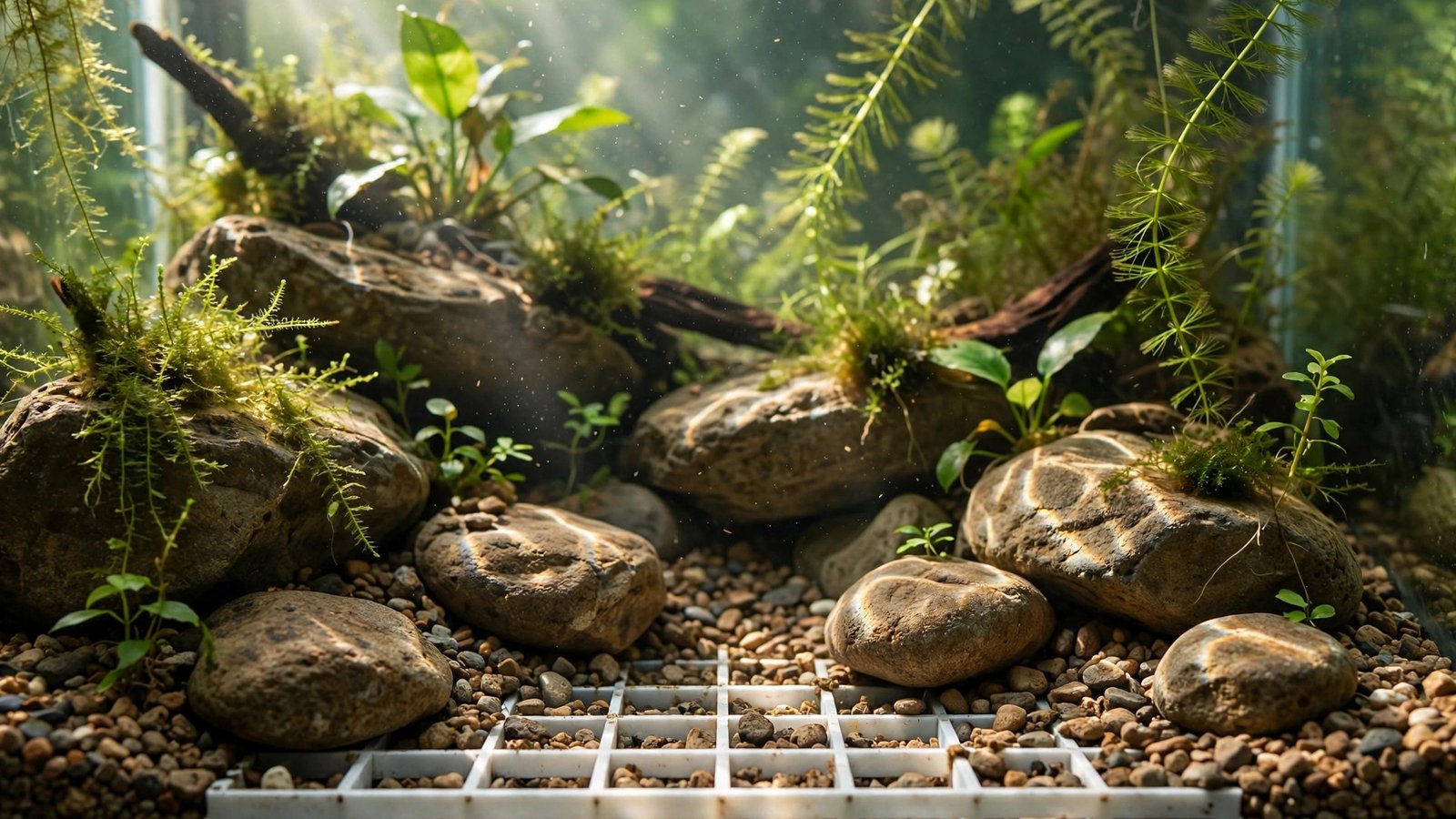
When you're building a hardscape with heavy rocks, the piece of equipment that protects your tank from disaster costs about ten dollars at a hardware store — and most beginners have never heard of it. Using egg crate under aquarium rocks is one of the oldest pro tricks in the hobby: a plastic lighting-diffuser grid laid on the bottom glass before any stone goes in, spreading each rock's weight across a wide surface instead of a few sharp pressure points. It takes ten minutes to install, it hides completely under your substrate, and it can be the difference between a tank that lasts decades and one that springs a leak the first time someone bumps a tall rock tower.
There is a catch, though — egg crate is a specialist with real limitations. Used wrong (floating sheets, wall-to-wall coverage under deep sand, coated metallic panels), it causes more problems than it solves.
What Egg Crate Actually Is (and What It Isn't)
Despite the name, "egg crate" has nothing to do with eggs. It's a rigid plastic grid panel — fluorescent light diffuser — sold in the lighting section of hardware stores in roughly 2 x 4 ft sheets, usually about half an inch thick with half-inch square openings. Drop ceilings used them for decades, so they're cheap, widely available, and molded from polystyrene or acrylic plastic that's inert in aquarium water.
It is not the silvered or "chrome" diffuser panels you sometimes see hanging in office ceilings. Those metallic coatings can flake and degrade in water — only use plain white or black uncoated panels. It is also not foam, fabric mesh, or a product sold for aquariums at a markup; the entire point is that the hardware-store version is identical, for a fraction of the price.
Why Put Egg Crate Under Hardscape? Three Real Reasons
1. Protecting the bottom glass from pressure points
Aquarium glass is strong but brittle. A sharp-pointed rock sitting directly on bare glass concentrates the entire rock's weight onto a few square millimeters — a load profile glass tolerates poorly. A bump during maintenance, a rock tower settling half an inch over months, or a burrowing fish undermining the base can turn that pressure point into a cracked panel. The egg crate grid spreads each rock's weight over dozens of plastic ribs, so no single point takes the full load. This is the reason even experienced aquascapers use it under large structures: as one long-running reef-aquascaping guide puts it, place plastic egg crate under large, heavy structures for extra peace of mind and to spread pressure points on the glass.
2. Locking rocks in place so they can't shift
The grid does more than distribute weight — the square openings give rock bases mechanical "teeth" to sit in. A rounded boulder that would slide across bare glass sits still when its base settles into the grid. That stability compounds: stacked structures built on a seated base rock shift far less over time, which matters most in tanks with active diggers. Burrowing cichlids, loaches, and catfish can excavate substrate from under rockwork; a base rock seated in egg crate resists tipping in ways a base rock sitting on bare glass never will.
3. Preventing rocks from settling into and compacting substrate
When heavy stone rests directly on deep substrate, it slowly sinks. Over months, a once-tall rock formation settles lower, substrate migrates out from under it, and anaerobic dead zones can form under the pressure. Egg crate gives the rocks a rigid foundation to rest on instead, keeping the scape's designed heights stable long-term. It also helps when building terraces and slopes in your aquascape, where a level grid base stops stone retaining walls from walking downhill under their own weight.
When Egg Crate Is Worth It — and When It Isn't
Egg crate is insurance, not decoration. Use it when any of these are true:
- Heavy or dense stone: large seiryu, frodo, or dragon-stone slabs and towers — especially stacked structures where weight multiplies.
- Sharp or pointed rocks: anything with a sharp pressure point contacting the glass, even if it's a modestly sized piece.
- Digging livestock: cichlids, loaches, catfish, and large plecos that excavate under hardscape.
- Tall rock towers or arches: gravity-loaded structures that a bump could topple.
- Acrylic tanks: acrylic scratches easily; rocks sliding during maintenance on bare acrylic is a guaranteed scratch risk.
Skip it — or use an alternative — when:
- Deep sand beds (over ~3 inches): restricting circulation through a deep bed can encourage anaerobic hydrogen sulfide pockets under the grid. Keep the grid under the rocks only, never wall-to-wall under a deep bed.
- Light hardscape only: a few small river stones or a single piece of driftwood doesn't justify it. If you're unsure whether your rock is safe, our guide on choosing aquarium-safe river rocks covers the weight and sharpness check.
- Nano tanks with delicate balance: in very small tanks, a grid sheet consumes real water volume and can interfere with substrate slopes — hardscape techniques for nano aquascapes often favor silicone-bonded stone instead.
Which Egg Crate to Buy
Walk into any major hardware store and ask for fluorescent light diffuser panels (the "egg crate" nickname confuses staff — use the product name). What to look for:
- Uncoated white or black plastic only. Avoid silver/chrome or mirrored finishes; coatings flake in water.
- Standard grid: half-inch openings, roughly half an inch thick. The standard sheet is about 24 x 48 inches — one sheet covers several tanks.
- No paint, no coatings, no "antimicrobial" labels. You want plain polystyrene or acrylic. If a panel smells strongly chemical or lists additives, skip it.
- Black vs. white: purely cosmetic. Black disappears against dark substrate and under shadows; white is fine buried under light sand. If any corner pokes above the substrate line, black is far less noticeable.
Black panels sometimes cost a little more or need ordering online, but they're the better pick for any scape where the grid might peek out between rocks.
How to Cut and Install Egg Crate Under Aquarium Rocks
This is a dry-tank job — install it before water, substrate, and rockwork. The whole process takes about ten minutes plus cleanup.
Step 1: Size the panels to the rockwork footprint
You do not need to cover the entire tank bottom. Cut panels to cover only the area under and around your rock structures, extending 2–4 inches beyond where the rocks end. That overhang margin is the part doing the weight-distribution work — the grid extends the load footprint well past each rock's base.
For multiple separate rock groupings, cut separate pads for each. One big wall-to-wall sheet wastes plastic, traps debris under itself, and restricts substrate circulation across the whole tank for no benefit.
Step 2: Cut with snips or a knife
The panels snap easily: score along a grid line with a utility knife and break, or cut with diagonal cutters, pruning shears, or tin snips following the grid ribs. Cutting on the rib lines leaves a clean edge. Wear gloves — freshly cut plastic edges can be sharp. Test-fit each pad in the dry tank before moving on.
Step 3: Lay pads on bare glass, clean the edges
Rinse the cut panels to remove plastic dust, then set them on the bare bottom glass. Press each pad flat — a warped panel creates a rocking plate under your rocks, defeating the purpose. If a pad rocks, trim the warped corner or replace it.
Optional but worth it for permanent scapes: run a thin bead of aquarium-safe silicone under a couple of grid edges to lock the pad in place. This stops substrate from migrating under the grid and prevents the pad from sliding while you stack rocks. Let it cure fully before adding substrate.
Step 4: Build the hardscape directly on the grid
Set your base rocks first, seating each one so its weight settles into the grid — give each base rock a firm wiggle to seat it. Stack upward from there, using aquascaping glue or epoxy between stacked stones for any structure you couldn't comfortably bump with your elbow. Then add your substrate around and over the grid, burying it completely.
Substrate depth over the grid should match your plan — see our guide on proper substrate depth for aquarium plants — with the grid pads disappearing fully under the bed. Any exposed grid edge looks unfinished and traps algae.
Stacking Heavy Stone Safely on an Egg Crate Foundation
The grid is a foundation, not a guarantee — tall structures still need sound stacking. A few rules from hard-won experience:
- Base stones flat-side down: every tower starts with the flattest, widest-based rock you own. Three-point contact is the minimum; flat contact is the goal.
- Lower center of gravity: the heaviest stones go at the bottom. A tower that's heavy at the top will walk its base off the grid eventually.
- Glue the joints that matter: any joint you'd be nervous to bump during water changes gets glued. Aquarium-safe cyanoacrylate (gel super glue) works between dry stones in seconds; epoxy putty bridges gaps.
- Test before water: with the tank dry, push each tower laterally with moderate force. Anything that moves now will move later with fish, flow, and time against it.
- Keep rockwork off the side glass: leave at least an inch between rock edges and the side panels — glass panels flex, and a rock pressing a side wall is a slow-motion crack.
If you're choosing stone specifically for a heavy build, read our overview of whether aquarium rocks raise pH — dense limestone-family stones like seiryu affect water chemistry as well as carrying the most weight, so pick your rock with both in mind.
Common Mistakes to Avoid
- Covering the whole tank bottom. Wall-to-wall egg crate under a deep substrate bed restricts flow, traps debris, and invites anaerobic zones. Cover rock footprints only.
- Using coated or metallic panels. Silvered diffuser panels flake; painted ones leach. Plain white or black, no exceptions.
- Letting edges poke above the substrate. Exposed grid collects algae and looks unfinished. Bury pads completely, with substrate depth to spare.
- Skipping the test-push. Egg crate doesn't fix bad stacking — it only protects against good stacking's risks.
- Forgetting the substrate goes on last. Grid first, then rocks, then substrate poured around them. Substrate under the rocks defeats the rigid-foundation benefit.
- Using it as the only safety measure for extreme structures. For very tall or cantilevered builds, combine the grid with glue/epoxy joints and a leak alarm — the grid protects the glass, not the scape's stability.
Egg Crate Alternatives: When Something Else Fits Better
Egg crate is the cheapest and most versatile foundation, but it's not the only one:
- Foam pond liner / filter mat: closed-cell foam sheets (like pond underlayment) cushion rocks and distribute weight with a softer touch than rigid grid. Good under moderate-weight stone, but heavy towers can compress foam over time.
- Thin acrylic or polycarbonate sheet: a flat plastic sheet spreads weight without grid openings. Simpler, but offers no mechanical "teeth" to seat rocks, and trapped debris under a solid sheet is harder to flush.
- Silicone bonding: gluing rocks directly to each other and to a base plate with aquarium silicone creates one rigid structure. Best for nano tanks and showpiece towers where nothing may shift, ever.
- Rock pillars on the glass: for very heavy showpiece stones, some builders place the largest stones on small acrylic feet, then pour substrate around. This works but concentrates load — only for single stones with broad, flat bases.
- Pumice or lava base layers: a lightweight pumice base layer under substrate raises the bed cheaply, but it's a substrate fill, not a rock foundation — it doesn't protect the glass. Use it with egg crate, not instead of it.
Frequently Asked Questions
Is egg crate safe for aquariums?
Plain, uncoated polystyrene or acrylic light-diffuser panels are inert in aquarium water and have been used in the hobby for decades. The safety rule is simple: no coatings, no paint, no metallic finishes, no "antimicrobial" additives. Rinse new panels to remove manufacturing dust before installing, and the material itself will not affect water chemistry.
Do I need egg crate under every rock in my tank?
No. Use it under heavy, dense, sharp, or stacked stone — and in tanks with digging fish. A few small rounded stones or a single piece of driftwood don't need it. Cover only the footprint under and around your rock structures, extending a few inches past the rocks.
Will egg crate raise my substrate level or look bad?
The grid is about half an inch thick and disappears completely once buried under substrate. As long as you pour enough substrate to cover the pads with your planned depth to spare, nothing is visible. Black panels are the safer choice in case any corner gets exposed during rescapes — they blend into shadows far better than white.
Can I add egg crate to a tank that's already set up?
Not practically. Installing it requires placing pads on bare glass before rocks and substrate go in, which means a full teardown of an established tank. If your tank is running and the rockwork is already stable, don't disturb it — the grid is a build-stage tool. Plan it for your next scape or rescape instead.
Does egg crate work in saltwater tanks?
Yes — the same panels are inert in saltwater, and reef aquascapers have used them under heavy live rock for years. In fact, the most-cited advice for the technique comes from reef aquascaping: heavy structures need pressure distribution on the glass. The same cautions apply about deep sand beds and coated panels.
Build It Right, Then Forget About It
Egg crate under aquarium rocks is the definition of invisible insurance: ten minutes and ten dollars at the hardware store, and then you never think about it again — which is exactly the point. Cut pads for your rock footprints, build the hardscape on the bare grid, bury it under substrate, and your glass is protected from pressure points, shifting stones, and digging fish for the life of the scape. For technique inspiration on the structures you're building on top of it, experienced builders also use zip ties and light grid to anchor driftwood structures — the same pressure-distribution principle sits behind the whole approach. Do the boring foundation work once, and the tank takes care of itself.