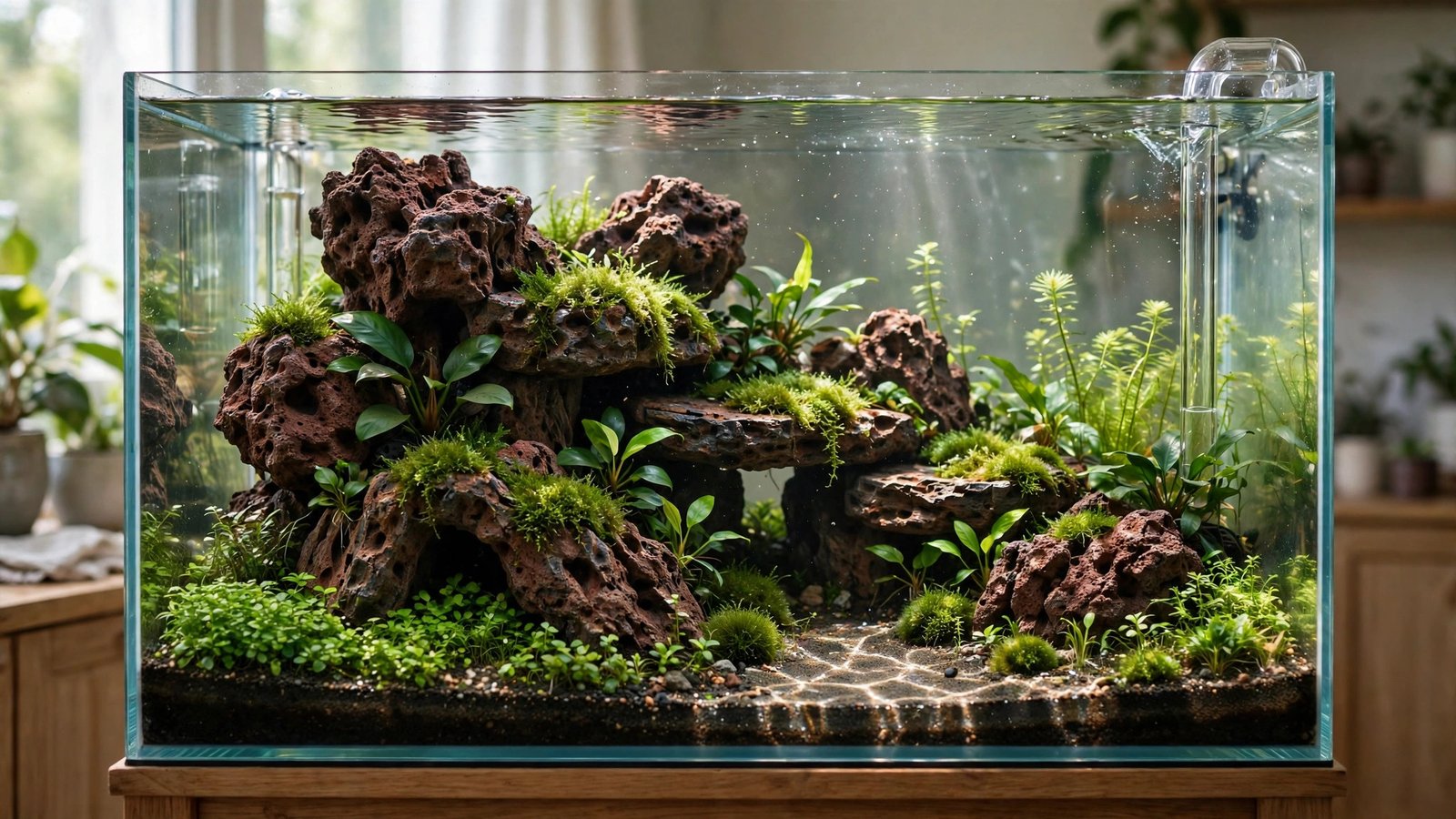
Walk into any big-box garden center and you'll find it: a twenty-dollar bag of red lava rock meant for barbecue grills and landscaping mulch. What the staff don't realize is that this humble bag is one of the most versatile materials in the planted-tank hobby. Used as a lava rock aquarium substrate layer, it solves three problems at once — holding slopes together, housing huge amounts of beneficial bacteria, and giving scapes the rugged structure that river-worn pebbles can't. It is also completely inert, which is both its superpower and the trap that catches beginners. This guide covers all three jobs, the sharp-edges question every fish keeper asks, how to prep a hardware-store bag, and an honest comparison with aquasoil so you can set up a thriving tank whether you run a filter-free fishbowl or a high-tech CO2 cannon.
Three Jobs in One Bag: Substrate, Structure, Filtration
Most aquarium materials do one thing. Lava rock — a vesicular basalt formed when volcanic gases bubble through molten rock — does three, because of one property: porosity. A single piece is riddled with interconnected pores, tunnels, and chambers. All that internal surface area is what makes lava rock uniquely valuable in planted tanks.
Job 1: A substrate topper and base layer that plants actually root into
Lava rock works as a substrate in two ways. Fine grades (roughly 2–6 mm "lava sand" or crushed gravel) make a serviceable topper over a nutrient layer like mineralized topsoil or pond soil — it locks the soil down, prevents clouding, and resists the compaction that suffocates roots. Because the pieces are irregular, they knit together instead of slumping into a solid mass the way fine sand does, so water and oxygen keep circulating around the root zone. The trade-off: lava rock holds zero nutrients. Plants rooting in it depend entirely on what you add — root tabs for heavy root feeders, liquid fertilizer for the water column. For a full breakdown of nutrient-free substrates, see our complete guide to inert substrates.
Job 2: The slope and terrace builder (the mesh-bag trick)
Here's the technique aquascapers quietly rely on: chunk lava rock (10–30 mm pieces) goes into mesh media bags, and the bags become structural filler under your substrate. Want a dramatic rear slope without buying twelve bags of aquasoil? Stack two or three flat bags of lava rock at the back, drape your soil over them, and you've built a stable hill for the price of one bag of rock and a handful of laundry bags from the dollar store.
This works because lava rock is light — about a third the density of gravel — so tall structures stay stable, and the voids between chunks stay open, meaning the substrate above never sits on an anaerobic dead zone.
Job 3: Biological filter media hiding in plain sight
That same porosity gives lava rock an enormous internal surface area — estimates for similar porous volcanic media run into the hundreds of square meters per liter. In practical terms: a mesh bag of lava rock in your canister filter, sump, or even tucked into the back corner of a filterless bowl performs like expensive ceramic bio-media at a fraction of the cost. Water flows through the pores, and nitrifying bacteria colonize every surface, converting ammonia and nitrite into nitrate your plants can use. It never exhausts, never needs replacing — when flow slows, a quick rinse in old tank water restores it. This is one reason experienced keepers drop a bag of lava rock into every new tank: it quietly accelerates and stabilizes the cycle.
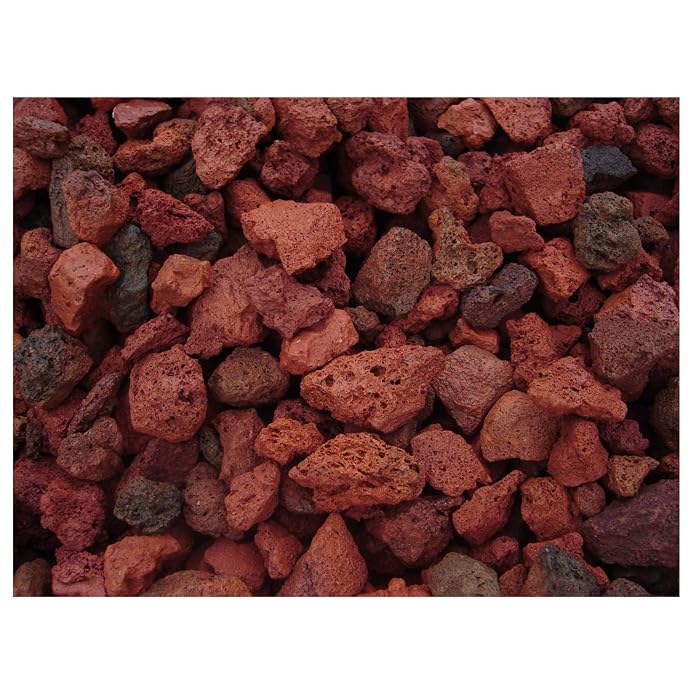
A dedicated aquarium lava rock avoids landscaping-grade surprises: LANDEN lava rocks.
 ★4.3
LANDEN Natural Red Lava Rocks
Check Price on Amazon ★4.3The Sharp-Edges Question: Is Lava Rock Safe for Fish and Shrimp?
Raw lava rock is genuinely sharp — freshly broken edges can cut skin, and the concern is obvious for delicate species.
Which forms are safe, and which to avoid
- Tumbled or polished lava rock: sold for aquariums and landscaping, with softened edges. Safest choice for corydoras, loaches, and any bottom-dwelling species with delicate barbels. Worth the small premium.
- Grill/fire-pit lava rock from hardware stores: variable quality. Pieces range from smooth to razor-edged. Perfectly usable once sorted (below) — this is what most of us actually buy.
- Fine lava gravel (2–4 mm): the cut risk drops dramatically with smaller grades. Good for shrimp tanks and foreground carpets.
- Avoid large, freshly-fractured chunks with knife edges in tanks with scaleless fish, bettas with flowing fins, or axolotls. Either tumble them yourself or leave them for the mesh-bag structure job, where no animal contacts them.
How to sort and rinse a hardware-store bag (the real-life workflow)
Dump the bag into a wheelbarrow or big tote outside. Wear gloves — you'll thank me. First pass: pick out the showpiece pieces with interesting texture and color for hardscape use. Second pass: separate usable media-grade chunks (roughly 1–3 cm) from powder, dust, and oversized boulders. Third: set aside anything with a genuinely knife-sharp edge — those go into mesh bags for the slope trick, where their edges never touch livestock.
Rinsing is non-negotiable. Lava rock arrives coated in fine volcanic dust that will turn your tank milky for days. Rinse in batches in a bucket under a garden hose until the runoff is clear — usually five or six fills per batch. A final soak overnight in a bucket of dechlorinated water lets trapped dust settle out; check the bucket the next morning and re-rinse if it's still cloudy.
One more prep note: lava rock can raise pH slightly in some batches, though it's far less reactive than limestone or seiryu stone. If you're keeping soft-water species, test a bucket soak for 48 hours with a pH strip. Our article on whether aquarium rocks raise pH walks through the vinegar test and soak test in detail.
Lava Rock Aquarium Substrate vs Aquasoil: An Honest Comparison
Forums argue this endlessly, but it's a false contest — they do different jobs. Aquasoil is a nutrient delivery system: it contains nitrogen, phosphorus, and micronutrients, buffers pH downward, and grows plants explosively from day one. Lava rock is infrastructure: structure, drainage, and biological surface. The right comparison isn't "which is better" but "which job does my tank need done?"
| Factor | Lava Rock | Aquasoil |
|---|---|---|
| Nutrient content | None — completely inert | Rich in N, P, K and trace elements |
| pH effect | Neutral to very slightly alkaline | Buffers down, often to 6.0–6.8 |
| Ammonia on setup | None — fish-safe immediately | Leaches ammonia for 2–6 weeks; fishless cycle required |
| Lifespan | Effectively permanent | Nutrients exhaust in 1–3 years; granules soften |
| Best for | Slopes, structure, bio-media, capping soil, low-tech tanks with tabs | High-tech carpets, heavy root feeders, rapid grow-out |
| Cost (10 gal tank) | $10–20 hardware-store bag | $30–60 for a bag of premium soil |
| Planting experience | Stems can pop out of loose chunks; add a sand cap or use fine grade | Soft granules hold stems and carpets easily |
The honest bottom line: lava rock never replaces aquasoil's nutrient role. If you want the fast, lush growth that makes aquasoil famous, either use aquasoil or accept that a lava-rock tank runs on root tabs + liquid fertilizer — no exceptions. Where lava rock wins is longevity, cost, and versatility: it doesn't exhaust, doesn't leach ammonia, and does three jobs the soil can't. Many veteran scapers use both — aquasoil where plants root, lava rock in bags where structure and filtration are needed. For the full nutrient-budget picture, see our buffering substrates guide.
Setup Walkthrough: Low-Tech Lava Rock Tank
This is the most forgiving way to use lava rock — a 10 or 20-gallon tank that thrives on neglect with plants fed by tabs and liquid ferts.
- Structure first: place mesh bags of lava chunks (10–30 mm) to build your rear slope and any terraces. Arrange hardscape stones on top. For stone choice, our best rocks for aquascaping guide covers inert, plant-safe options.
- Substrate bed: spread 2–3 inches of fine lava gravel (2–6 mm) over everything. Push root tabs deep into the bed every 4–6 inches, especially under sword plants and crypts.
- Plant heavy from day one: anubias and Java fern tied to the larger lava chunks (rhizomes must stay above the substrate), crypts and swords planted in the bed, stem plants in the deeper back sections.
- Fill gently: pour water over a plate or plastic bag to avoid blowing the bed apart. Lava dust that survived rinsing will settle within hours.
- Filter and ferts: a bag of lava rock in the filter (or even a coarse sponge) handles biofiltration. Dose a comprehensive liquid fertilizer at half the label rate to start — start low, watch for two weeks, then adjust. Algae in low-tech tanks almost always means too much light or fertilizer too early, not too little.
Maintenance is straightforward: vacuum the surface lightly during water changes — fine lava gravel doesn't compact, so detritus sits on top where you can reach it. Our guide to cleaning substrate around plants shows the technique without uprooting everything.
Setup Walkthrough: High-Tech Lava Rock Tank
Yes, lava rock works in CO2-injected tanks — Dutch-style growers have run gravel-based high-tech systems for decades. The difference is discipline.
- Base layer = lava gravel (3–5 mm), 2–3 inches deep, over mesh bags of chunk lava for elevation. Some growers add a thin layer of peat or a nutrient base under the gravel for a slow-release boost — optional but effective.
- Fertilization is the whole game. Without aquasoil's buffer, you're the nutrient system: daily liquid dosing (EI or a lean-dosing regime), root tabs replenished every 2–3 months under heavy feeders. Start dosing low and increase as plant mass grows.
- Carpeting plants need help — dwarf hairgrass and monte carlo root poorly in chunky gravel. Either use the finest lava grade, cap planting zones with an inch of sand, or — honestly — cap aquasoil with sand in the carpet zones and keep lava rock for the structural areas.
- CO2 and flow: keep CO2 stable (drop checker lime-green) and flow strong — lava rock's porosity harbors biofilm that can trap detritus, so good circulation matters more here than in a soil tank.
- Expect a faster cycle, slower start. The seeded bio-surface means ammonia stays low from day one, but stem plants take a week or two longer to settle in than they would in fresh aquasoil. Patience here pays off in a tank that runs unchanged for years.
Gravel Size and Long-Term Care
Size matters more than most guides admit. Under 2 mm, lava gravel packs too tightly and behaves like sand; over 8 mm, stems won't stay planted and food falls into unreachable voids. The 2–6 mm sweet spot anchors plants, resists compaction, and vacuums easily. Our deep dive on gravel size for planted tanks covers the physics in detail.
Long-term, lava rock asks for almost nothing: replenish root tabs on schedule, dose liquids consistently, and rinse filter bags in old tank water every few months. It doesn't break down, doesn't exhaust, and doesn't need replacing — the tank you build today can run on the same rock a decade from now. The trade-off never changes: you are the fertilizer system, permanently. Accept that, and lava rock is one of the cheapest, most honest materials in the hobby.
Lava Rock Aquascaping Styles
Lava rock's look limits its starring roles, but within those limits it has genuine styles:
- Volcanic/mountain scapes: black lava rock is volcanic terrain — lean into it. A black-rock mountain with sparse planting and dark substrate reads as a volcanic island, especially with misting/fog effects in open-top tanks. It's one of the few styles where lava rock is the correct aesthetic choice, not a compromise.
- The hidden skeleton: build the entire hardscape volume from lava rock, then face only the visible front surfaces with dragon stone or Seiryu. From the front it's a premium stone scape; the lava rock core saved hundreds of dollars and tons of weight. Professional large-tank builders do this routinely.
- Moss-dominant scapes: when 90% of the rock will be moss-covered within months, the underlying rock's looks barely matter — but its grip does. Lava rock's porosity makes it the best moss anchor available, so moss-heavy designs (moss walls, moss mountains, moss "trees" on lava rock trunks) legitimately prefer it over prettier stones.
- Breeding/holding tanks: in fish rooms, lava rock piles create cheap, effective territory structure for cichlids and shelter for fry — function over form, exactly where lava rock belongs.
Sourcing
Landscaping yards and garden centers sell lava rock by the bag (usually labeled "lava rock" or "volcanic rock" for grills/landscaping) — red and black varieties. Aquarium stores sell smaller "aquarium lava rock" bags at a markup; the landscaping product is identical. Choose pieces with deep vesicles and interesting shapes; avoid crumbly pieces that shed. For filter media, the small "lava pebble" grade is ideal.
Long-Term Maintenance Schedule
Lava rock is permanent, but it's not maintenance-free. The routine:
- Weekly: turkey-baster blast visible pieces during water changes — dislodges surface detritus before it packs into vesicles.
- Monthly: inspect moss-wall and background structures for detritus accumulation behind them; siphon what you can reach. Check stacked pieces for shifting.
- Quarterly: deep-clean filter lava media — rinse in old tank water (never tap water with chlorine; it kills the biofilm you're cultivating). Replace any pieces that have become excessively clogged and won't rinse clean.
- Annually: pull and inspect hidden structural pieces for stability; re-seat anything that's shifted. This is also the moment to thin moss walls before they get out of hand.
Follow this and lava rock structures last the life of the tank — the rock itself never degrades, so maintenance is entirely about what accumulates on it, not the material failing.
Frequently Asked Questions
Is lava rock safe for shrimp tanks?
Yes — lava rock suits shrimp tanks well. It's inert, won't swing pH or hardness, and its pores grow biofilm that shrimp graze on constantly. Use fine grade (2–4 mm) or tumbled pieces, rinse thoroughly to remove dust, and check that no razor-sharp edges sit where shrimp forage. Many breeders run lava rock as both substrate and filter media in neocaridina colonies.
Does lava rock change water parameters?
Barely. True lava rock is an inert basalt that doesn't meaningfully raise GH, KH, or pH in most tanks. Some batches contain trace carbonates and can nudge pH slightly upward — a 48-hour bucket soak with before-and-after pH readings will tell you for certain. It will never lower pH the way aquasoil does. If you need soft, acidic water for caridina shrimp or wild-caught tetras, lava rock neither helps nor hurts — manage parameters with your water source instead.
Can I use lava rock straight from the garden center?
Yes, with preparation. Garden-center and grill lava rock is the same volcanic basalt sold at aquarium markups — just dirtier and sharper. Sort out the knife-edged pieces (gloves on), discard the dust and oversized chunks, and rinse until runoff is completely clear, then soak overnight. Avoid "decorative" lava rock dyed bright colors or treated with sealants; natural red and black basalt is what you want.
Do I still need fertilizer with lava rock substrate?
Absolutely — this is the critical point. Lava rock contains no plant nutrients, so an unfertilized lava-rock tank will stall: yellowing leaves, stunted stems, algae taking over. Push root tabs under heavy root feeders like swords and crypts, and dose a comprehensive liquid fertilizer in the water column for stems and epiphytes. Start at half the label dose and adjust after observing growth for two weeks; over-dosing a new tank feeds algae, not plants.
How do you attach plants to lava rock?
Lava rock's rough, pitted surface is ideal for epiphytes. Tie anubias, Java fern, or bucephalandra to a chunk with cotton thread or fishing line — the rhizome grips the texture within weeks and the thread dissolves or can be removed. Cyanoacrylate (super) gel glue also works on dry rock and is aquarium-safe once cured. Mosses can be wedged into crevices or tied on; they anchor into the pores faster than on smooth stone. Never bury rhizomes in the substrate — they rot.
Will lava rock work as my only filter media?
For low-to-moderate stocking, yes. A mesh bag of 10–20 mm lava chunks has enormous bacterial surface area and functions like ceramic bio-media at a fraction of the cost. Pair it with a coarse mechanical sponge in front to keep detritus out of the pores, and rinse the bag in old tank water when flow drops. In heavily stocked or high-tech tanks, treat it as a supplement to — not a replacement for — purpose-built media, and never replace all your media at once, which crashes the cycle.
Will lava rock raise pH?
No. Basalt/scoria is chemically inert in aquarium conditions — unlike Seiryu stone, it contains no meaningful carbonates. If your pH rises after adding lava rock, the cause is elsewhere (test your source water and other hardscape).
Can I use red lava rock, or only black?
Both are fine — same material, the red is just iron-oxidized. Red lava rock suits warm-toned scapes and blackwater styles; black suits high-contrast modern layouts. Mix them only deliberately — random red-black mixing usually looks accidental.
How do I clean algae off lava rock?
For in-tank pieces: stiff brush + nerite snails for maintenance. For removed pieces: bleach soak (diluted, then thorough dechlorinated rinse and complete drying) resets them fully. The porosity means algae roots deeply — prevention (shading, planting over, balanced light) beats cure.
Can lava rock replace ceramic media in my canister filter?
Yes — it's a legitimate, widely-used budget biomedia. Use 0.5–1 inch chunks, rinse thoroughly, and fill the biological trays. Performance is comparable to mid-range ceramic media. The only trade-off: it's less uniform, so pack it loosely enough for good flow.
The Honest Verdict
Lava rock is the hobby's great workhorse: cheap, permanent, quietly doing three jobs while prettier materials get the credit. Its only real demand is honesty about what it can't do: feed plants. Give it root tabs, liquid fertilizer, and a proper rinse, and it will outlast every other substrate in your fish room. For a volcanic rock that looks striking and costs nearly nothing, that's a deal worth taking. For deeper comparisons, the Aquarium Co-Op substrate guide and Tropica's aquascaping resources are solid next stops.