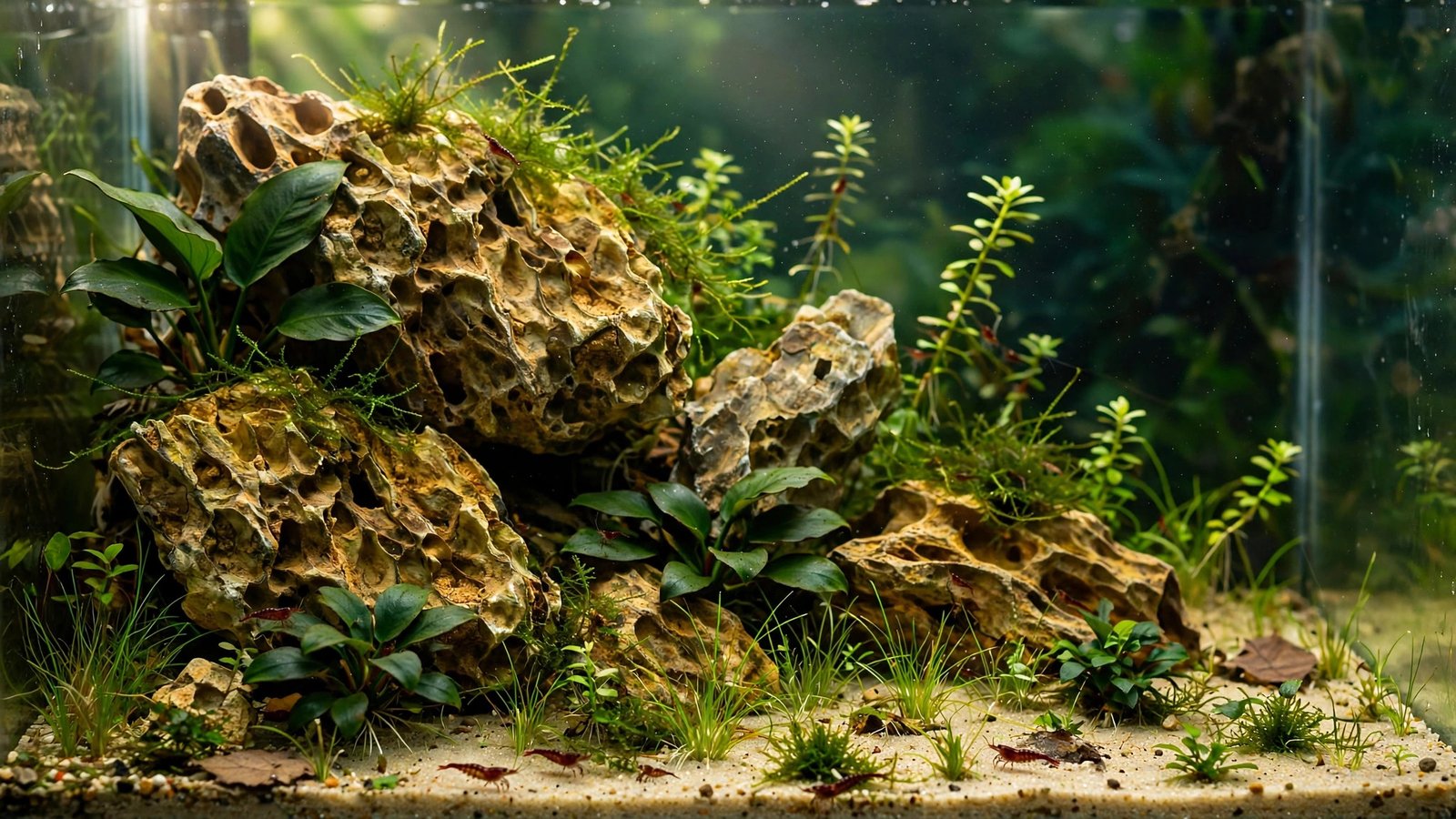
Few hardscape materials have shaped modern aquascaping like dragon stone — the pitted, clay-brown rock whose creviced surface seems designed for moss, epiphytes, and dramatic nature-style layouts. Sold as "Ohko stone," it's beloved for three reasons: it looks spectacular, it's effectively inert, and plants colonize its texture like it was made for them. This guide covers selecting, preparing, aquascaping with, and maintaining dragon stone.
What Dragon Stone Is
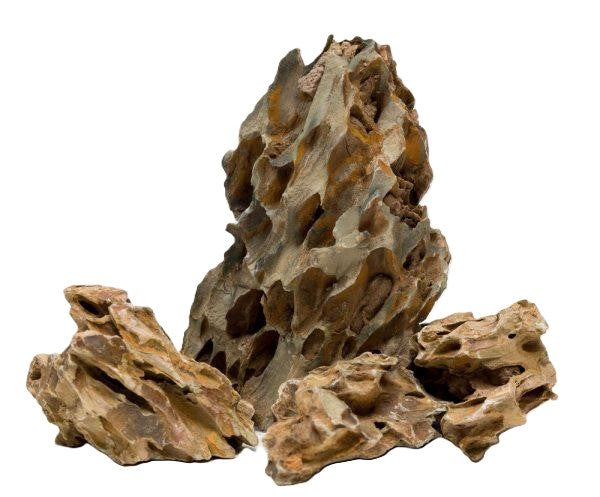
Dragon stone (Ohko stone) is a clay-based sedimentary rock — hardened clay/mudstone with a deeply pitted, honeycombed surface in warm brown, tan, rust, and ochre tones. The "dragon scale" texture that gives it its name comes from differential weathering of the clay layers. Key properties:
- Effectively inert — it doesn't meaningfully alter pH, KH, or GH. (Minute clay particles may cloud water initially, but that's sediment, not chemistry.) This makes it the go-to stone for shrimp tanks and soft-water setups where Seiryu's carbonate leaching would be a problem.
- Lightweight for its size — clay stone is less dense than granite or basalt, so large dramatic pieces are manageable. Still heavy — support the tank accordingly.
- Soft enough to shape — you can chip, carve, and break dragon stone with hand tools, customizing pieces to your scape. Few aquascaping stones allow this.
- Plant-colonizing texture — moss, anubias roots, and even carpeting plants grip the pitted surface eagerly. It's the best common stone for the "ancient planted ruin" look.
Selecting Good Pieces
Dragon stone varies enormously piece to piece. Shop in person when possible and look for:
- Deep pitting and crevices — the texture is the point. Smooth, bland pieces are just brown rocks; heavily textured ones are dragon stone.
- Interesting silhouettes — look for pieces with a clear "front" and dramatic profile. Photograph candidates from multiple angles; the camera reveals what the eye misses.
- Color consistency — pieces range from pale tan to deep rust. For a coherent scape, select stones in a similar color family. Mixed pale-and-dark pieces in one tank usually clash.
- Structural integrity — tap the piece; it should ring solid, not crumble. Reject pieces with deep cracks that will split under their own weight (or in your tank).
- Size planning — buy 2–3× more stone than you think you need. Aquascaping is subtractive: you arrange many, remove most. The leftovers become future nano-scape material (see our nano hardscape guide).
 ★4.5
Unocho Dragon Stone Aquarium Rocks
Check Price on Amazon ★4.5Preparation: The Clay-Dust Problem
Dragon stone's one real annoyance: clay dust and loose sediment packed into every crevice. Unprepared stone clouds tanks and coats everything in fine brown silt. Preparation is thorough but simple:
- Pressure-wash or hose-blast every crevice — this removes 90% of the loose material. A garden hose with a jet nozzle works; a pressure washer is better.
- Scrub with a stiff brush — toothbrush for deep pits. You'll be amazed how much keeps coming out.
- Soak 24–48 hours, then scrub again — soaking loosens deep sediment the first wash missed.
- Final rinse until runoff is clear. When you can blast a crevice and get clean water, it's ready.
- Test a piece — drop your cleaned stones in a bucket of water for a day. If the water's clear and pH/KH unchanged, you're good. (They will be — dragon stone is famously inert — but the test builds confidence.)
Even well-prepped dragon stone may shed a little dust when first placed — normal water changes and filtration clear it in days.
Aquascaping With Dragon Stone
The nature-style language
Dragon stone speaks nature style: weathered, ancient, organic. It pairs with driftwood (especially spider wood's chaos against the stone's solidity), moss, ferns, and anubias. The classic composition: a dominant stone group forming a mountain or cliff, wood weaving through, plants softening everything.
Planting on the stone
This is dragon stone's superpower. Techniques:
- Moss: press moss into crevices or glue small portions into pits — it anchors in days and spreads across the texture. Java moss, Christmas moss, and peacock moss all thrive on it.
- Epiphytes: wedge anubias and bucephalandra rhizomes into crevices — the pits hold them without glue, and roots colonize the stone.
- Terrestrial-style accents: in open-top or paludarium setups, the porous stone wicks moisture — mosses and even small ferns grow emersed on damp dragon stone above the waterline.
- Carpet integration: let Monte Carlo or hairgrass grow up against and slightly onto low stone edges — the "plants reclaiming ruins" effect.
Composition principles
- Odd numbers, one dominant — the Iwagumi-derived rule works for dragon stone groupings too.
- Bury one-third — stones sit in the landscape, not on it. Deep burial also stabilizes tall pieces.
- Consistent orientation — align the stone's strata/texture direction across pieces for geological coherence.
- Leave negative space — dragon stone's texture is visually busy; give it room to breathe against open sand or water.
Dragon Stone vs Seiryu: The Big Decision
These are the two defining aquascaping stones, and the choice comes down to chemistry + aesthetics:
- Choose dragon stone for shrimp tanks, soft-water setups, nature-style scapes, warm color palettes, and plant-colonized "ancient" looks. Inert and worry-free.
- Choose Seiryu for Iwagumi layouts, cool blue-gray palettes, dramatic jagged minimalism, and tanks where slightly harder water is fine or welcome. See our Seiryu guide for managing its KH effect.
Many scapers eventually own both and choose per-project. They're different instruments, not competitors.
Maintenance
- Algae in pits: dragon stone's texture collects algae like it collects moss — a toothbrush during water changes is the essential tool. Nerite snails help significantly.
- Deep cleaning: for removed stones, a diluted bleach soak (then thorough dechlorinated rinsing and drying) resets badly algae-coated pieces. Don't boil — thermal shock can crack clay stone.
- Stability checks: the stone is soft enough that stacked arrangements can shift as pieces settle — check tall stacks monthly and re-seat as needed. For permanent stacks, aquascaping glue + tissue bonds dragon stone well.
- Color over time: submerged dragon stone darkens slightly and biofilm gives it a rich patina — most keepers find it looks better at year two than day one.
Building With Dragon Stone: Structural Techniques
Dragon stone's workability makes it the best common stone for built structures, not just placed rocks:
- Dry-stacking: the pitted texture gives stacked stones surprising grip — dry-stack your formation outside the tank first, photograph it, then rebuild in the tank. Gravity + friction holds modest stacks; anything tall gets glued.
- Glue + tissue method: cyanoacrylate glue with cigarette-filter tissue or paper towel as a binder creates strong, natural-looking bonds between dragon stone pieces (see our glue guide). The bond is rock-strong and the tissue disappears under a dusting of stone powder.
- Carving custom pieces: need a flat base for stability? A notch for wood to slot into? A cave entrance? Chisel and masonry bit shape dragon stone easily — it's the only popular aquascaping stone you can genuinely sculpt.
- Caves and overhangs: flat-ish pieces make natural cave roofs for apistos and catfish; the pitted undersides grow biofilm that fry graze. Build caves with the entrance facing the front glass for viewing.
- Terracing with stone: flat dragon stone slabs make excellent retaining walls — their texture looks far more natural than slate for the purpose, though slate's flat layers stack more precisely.
Frequently Asked Questions
Is dragon stone really pH-neutral?
For practical purposes, yes. It's clay-based, not carbonate-based, so it doesn't leach KH or raise pH the way Seiryu or limestone does. You may see a tiny initial pH dip from residual organic matter in the pits (removed by proper cleaning), but no lasting chemistry shift. It's the standard stone for caridina shrimp tanks for exactly this reason.
Why is my water brown after adding dragon stone?
Clay dust and sediment from unprepared crevices — not tannins, not chemistry. It means the prep was insufficient: pull the worst pieces, hose-blast the crevices again, and let filtration clear the rest. Properly prepared dragon stone doesn't discolor water.
Can I break dragon stone to shape it?
Yes — it's one of the few aquascaping stones soft enough to shape with hand tools. Score with a chisel and tap to split along natural planes; the fresh faces weather in and look natural within weeks underwater. Wear eye protection and a dust mask — clay dust is unpleasant to breathe.
How much dragon stone do I need?
More than you think. A good rule: buy 1–1.5 lbs per gallon for a stone-dominant scape, then use the best 60% and save the rest. Stone is the cheapest part of a scape to over-buy and the most annoying to run short on mid-composition.
Dragon stone vs lava rock — which for a moss wall?
Both work, but differently: lava rock's extreme porosity grips moss slightly better and it's cheaper; dragon stone looks far more natural and refined. For a visible feature, dragon stone; for a background utility wall, lava rock saves money. Many tanks use both — dragon stone in front, lava rock behind.
The People's Stone
Dragon stone earned its ubiquity the honest way: it's beautiful, it's inert, it's workable, and it makes plants look good. It doesn't demand chemistry management like Seiryu or preparation marathons like Mopani — just a good hose-down and an eye for composition. For nature-style planted tanks, especially shrimp tanks, it's the default choice for good reason. Buy more than you need, clean it well, bury it deep, and let the moss do the rest.