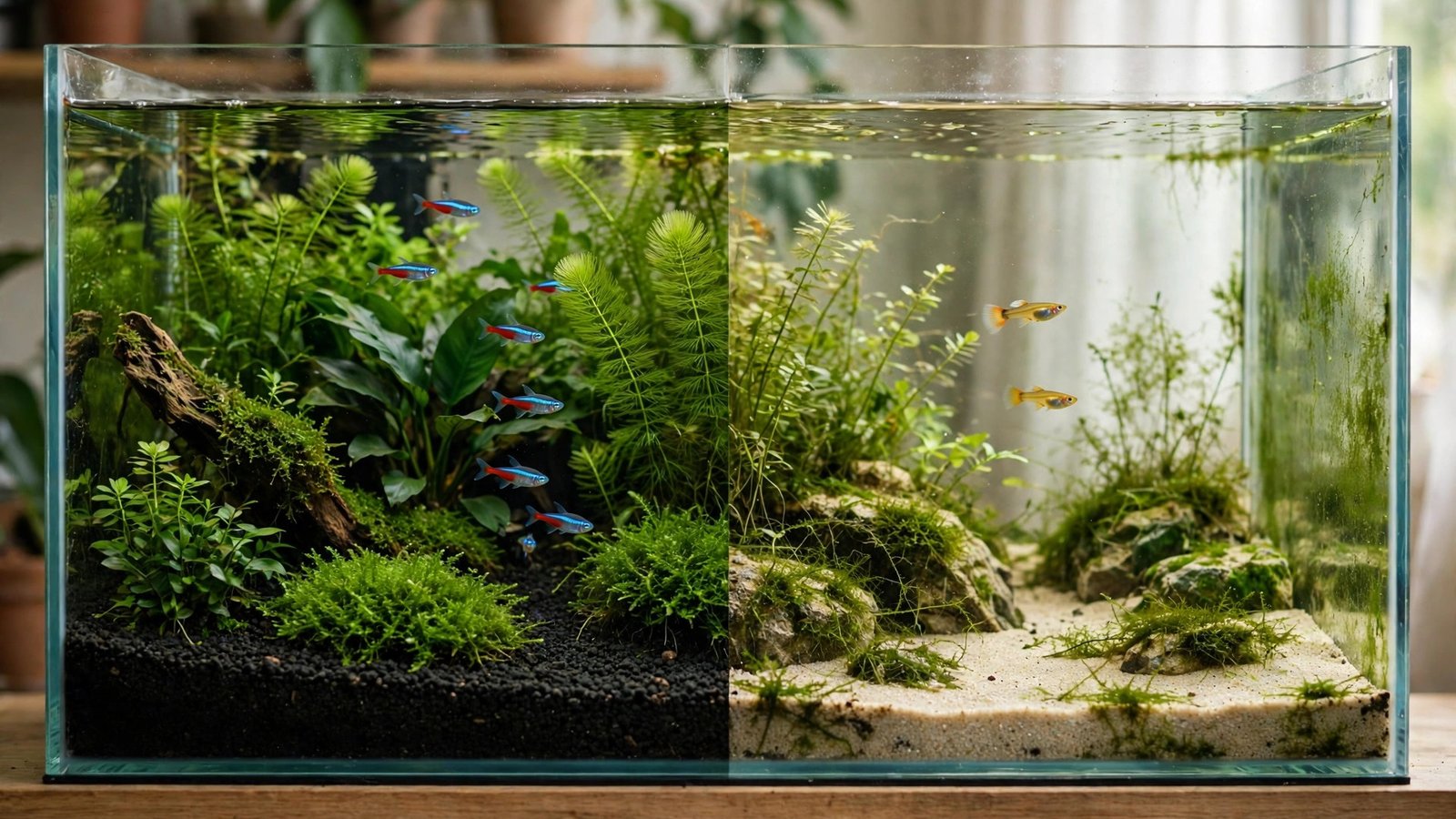
You have probably stared at the substrate aisle, a bag of black sand in one hand and white gravel in the other. That choice follows you for years: it changes how vivid your fish look, how quickly you notice algae, and how often you feel like vacuuming. By the end of this dark vs light substrate aquarium guide, you will know which color suits your tank, your livestock, and your tolerance for maintenance.
Fish Coloration: Why Dark Substrate Makes Colors Pop
Hold a neon tetra over white paper and then over black paper and you will see the effect in seconds: over the dark surface, the blue stripe deepens and the red belly intensifies; over white, the fish looks washed out. This is not an optical illusion. Most aquarium fish carry pigment cells called chromatophores that expand or contract to match their surroundings — a camouflage reflex. A dark riverbed tells a cardinal tetra it is safe to show off; a bright, reflective bed tells it predators can spot it, so it dials its colors down.
You will notice this most dramatically with showpiece species. Bettas display their fullest fin coloration over black sand or dark aquasoil. Discus develop richer base tones and bolder patterning against dark beds. Even everyday community fish — ember tetras, cherry barbs, harlequin rasboras — look noticeably more saturated on dark substrate. If your primary joy is the fish themselves, dark substrate is the single biggest visual upgrade you can buy for under forty dollars.
Light substrate does not ruin fish, though — it just changes what you see. Schooling fish like rummy-nose tetras still flash red noses over white sand, and a hundred tiny silhouettes gliding over a bright bed is its own kind of beautiful. Some breeders deliberately use light beds to spot fry and eggs more easily.
Behavior matters as much as color here. Bottom-dwellers spend their lives an inch above the bed, and many dislike the glare of reflective white sand. Corydoras and kuhli loaches forage more boldly on darker beds, closer to the shaded streambeds most of them evolved in. If you are setting up a cory tank, read our guide on the best substrate for corydoras before you commit to a color — grain size and sharpness matter as much as shade for barbels.
Dark vs Light Substrate Aquarium: The Comparison at a Glance
Before we dig into the nuances, here is the honest head-to-head across every category that actually matters in daily tank life:
| Factor | Dark substrate | Light substrate |
|---|---|---|
| Fish coloration | Deepens reds, blues, and patterns via chromatophore response | Washes out many species; metallic and pale fish still look clean |
| Algae visibility | Green spot and green dust algae stand out clearly | Green, brown, and blue-green algae all show strongly against the pale bed |
| Plant contrast | Green plants look richer; red plants glow; moss and carpet plants stand out | Green plants blend in slightly; red plants can look muted without strong lighting |
| Waste visibility | Uneaten food, snail shells, pale detritus show within hours | Waste blends in for days; the bed looks "clean" longer |
| Maintenance pressure | Debris vigilance — light vacuuming keeps it pristine | Algae vigilance — scrubbing keeps it white |
| Light reflection | Absorbs light; lower leaves may need stronger fixtures | Reflects light upward; can reduce the PAR your fixture needs |
| Depth illusion | Makes the tank feel deeper and larger | Makes the tank feel shallower and brighter |
| Aquascaping styles | Nature style, Iwagumi dark variants, jungle tanks, blackwater biotopes | Beach and river themes, bright Dutch tanks, white-sand Iwagumi |
Algae and Waste Visibility: The Honest Trade-Off
Here is the uncomfortable truth nobody on a product bag will tell you: every substrate color hides one thing and exposes another. Dark substrate hides brown diatoms and dark detritus beautifully, but every pale flake of uneaten food, every empty snail shell, and every shred of shed plant matter shows up like snow on asphalt. If you overfeed even slightly, a black sand bed will announce it within a day.
Light substrate flips the equation. Fish waste and leftover food blend in for much longer, so the bed looks tidy for days — but algae has nowhere to hide. Green spot algae on white sand is visible from across the room, brown diatoms during a new-tank cycle turn a pale bed into a brown bed, and a cyanobacteria patch on light gravel is impossible to ignore. Which trade-off bothers you less is a genuine personality question, and the right answer is the one that keeps you maintaining the tank instead of resenting it.
Whichever side you land on, the cleaning technique differs. On dark beds, a gentle hover of the siphon just above the surface lifts pale debris without disturbing the bed. On light beds, you will want to lightly stir the top layer and gravel-vac more deliberately, since waste sinks invisibly into the grain. Either way, rooted plants and carpeting complicate vacuuming — our walkthrough on how to clean aquarium substrate with plants covers the plant-safe techniques for both colors.
How Plants Look — and Grow — Over Each Color
Color theory is not just for painters; it runs your whole aquascape. Green is the most common plant color in the hobby, and green against black is the highest-contrast pairing available: java fern, anubias, crypts, and carpet plants like Monte Carlo read lush and saturated over a dark bed. Red plants — Alternanthera reineckii, Ludwigia super red, Rotala — practically glow against black substrate because the eye has no competing brightness. Photographers know this, which is why contest-winning nature-style tanks are overwhelmingly dark-bedded.
Over light substrate, the palette inverts. Pale sand evokes shallow rivers, beaches, and sunlit shallows, and tanks built around that feeling — Iwagumi layouts with white sand, river biotopes with smooth pebbles — look stunning when the plants are healthy and the bed is genuinely clean. The cost is contrast: mid-green plants can look washed out, and red plants may need noticeably stronger light to hold their saturation against a reflective bed. Light substrate literally bounces photons back up at your plants' lower leaves, which can help carpet plants fill in faster.
One nuance worth knowing: color is separate from chemistry. A black aquasoil like ADA Amazonia and a black inert sand like CaribSea Tahitian Moon share a color but behave completely differently — one buffers pH and supplies nutrients, the other does nothing chemically at all. Decide color and substrate type independently: first choose your color family, then choose the product that fits your planting ambitions. Our head-to-head of aquarium soil vs gravel and the inert substrates complete guide will help you sort the chemistry from the aesthetics.
The Maintenance Reality of Each Color
A dark planted tank asks for frequent light touch-ups: a quick surface hover of the siphon once a week keeps the bed looking immaculate, because debris has nowhere to hide. The upside is that you catch overfeeding and stocking problems early — the bed is a dashboard for your feeding habits. The downside is that "immaculate" demands consistency; skip two weeks and a dark bed looks noticeably grubby.
A light tank asks for different vigilance. Weekly maintenance is more about the algae film on the top layer of sand than about debris. The trick experienced keepers use is a light "stir and siphon": gently disturb the top half-inch of sand with the siphon tube, let the detritus cloud up, and pull it out. You will also fight compaction more visibly on pale sand — which is genuinely useful, because it is your early warning system for the gas pockets that form in deep substrate before they become a problem.
Depth compounds both effects. A bed deeper than about 3 inches traps more debris regardless of color, and on dark beds the pale waste is especially obvious. If you are rescaping, check the recommended substrate depth for aquarium plants so the color choice is not fighting a depth mistake at the same time.
Which Products to Buy for Each Side
For dark planted beds, the two proven workhorses are CaribSea Eco-Complete Planted Black (20 lb bag, roughly $25–$30, iron-rich and ready out of the bag — no rinsing) and Seachem Flourite Black Sand (finer grain, excellent for carpeting plants, but rinse it well or it clouds the tank for days). If you want a dark nutrient soil, ADA Amazonia Ver.2 in black is the contest standard — it buffers pH down to roughly 6.0–6.5 in the first months, at about $40–$50 per 9 L bag.
For light beds, Quikrete Pool Filter Sand (50 lb for around $10–$15 at pool supply stores) is the budget king: uniform tan grain, inert, plant-safe, and easy to vacuum. CaribSea Super Naturals in Torpedo Beach or Sunset Gold is the prettier aquarium-branded upgrade at roughly $20–$25 per 20 lb, smoother on bottom-dweller barbels. The capped-sand method — an inch of organic soil under two inches of pool filter sand — gives you nutrients without sacrificing the bright look. See our pool filter sand for planted tanks guide for the full setup.
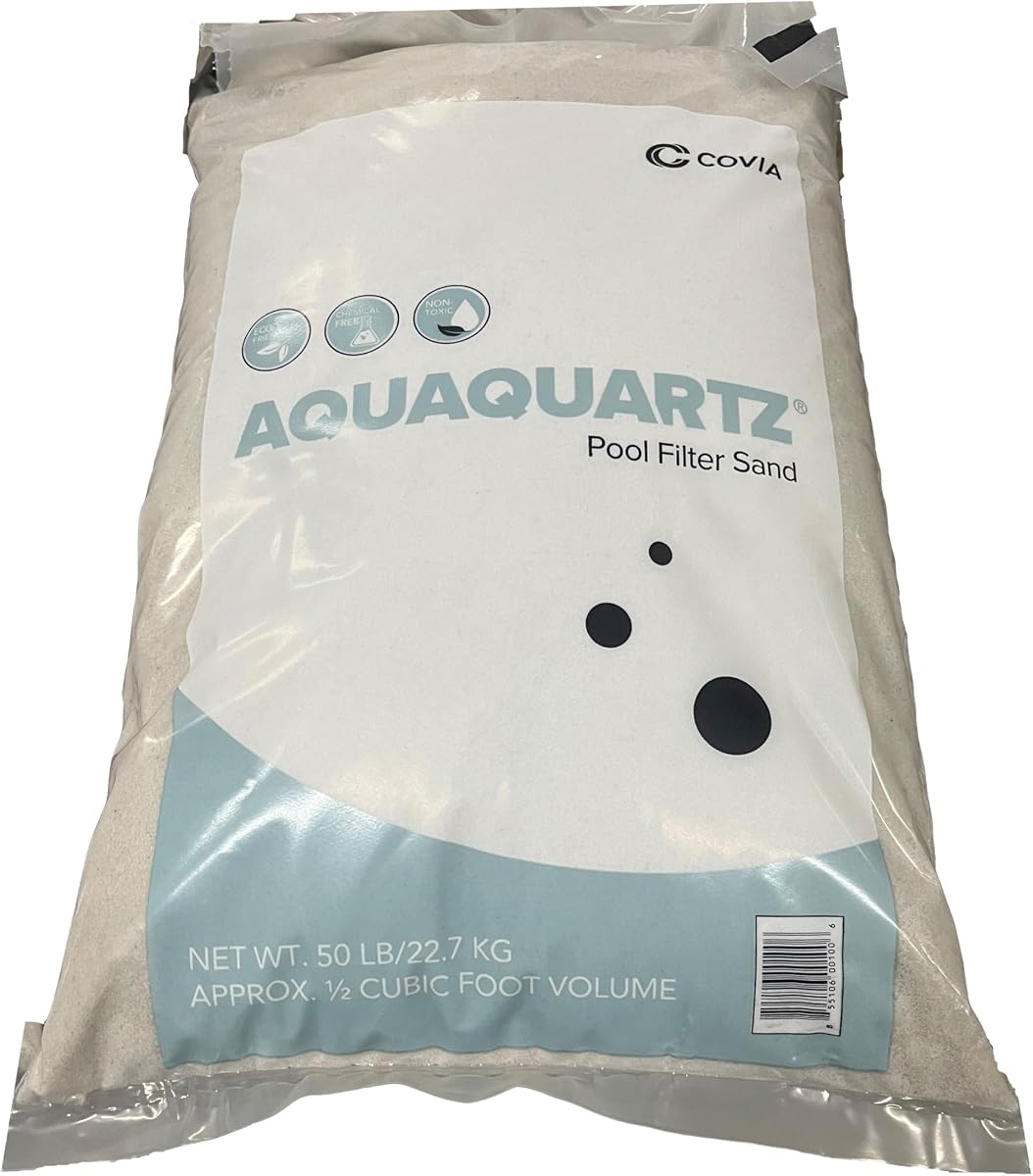
Covia AquaQuartz Pool Filter Sand
Check Price on AmazonFrequently Asked Questions
Does dark substrate really make fish colors brighter?
Yes, and the effect is biological, not just contrast. Most aquarium fish adjust their chromatophores — pigment cells in the skin — to match their environment. Over a dark bed, these cells expand and the fish displays fuller coloration; over a bright bed, the same fish contracts them as camouflage against predators. You will see the biggest difference in neon and cardinal tetras, bettas, and discus. Give new fish 2–4 weeks on a dark bed before judging their final coloration, since the change is gradual.
Is light substrate harder to keep clean than dark?
It is harder to keep looking clean, but not necessarily dirtier. Light sand hides fish waste well, so it looks tidy longer between cleanings, but it shows every speck of green spot algae, brown diatoms, and cyanobacteria. Dark substrate hides algae better but exposes pale debris and uneaten food within a day. Choose based on which chore you mind less: light beds need algae vigilance, dark beds need debris vigilance. Weekly 30% water changes with a quick siphon pass keep either color presentable.
Can I mix dark and light substrate in the same tank?
Absolutely, and it is one of the most effective aquascaping tricks. The classic approach is dark aquasoil in the planted zones with a light sand path or river running through the foreground — you get plant contrast where it matters and an easy-to-siphon bright focal area. Use rocks or driftwood as a barrier so the two materials do not mix over months of siphoning and plant growth. Expect some migration anyway, and plan to re-separate the boundary every few months during water changes.
Which substrate color is best for a planted tank with CO2?
Dark substrate, for two practical reasons. First, high-tech planted tanks aim for lush, saturated plant mass, and dark beds maximize the green-on-black contrast that makes a Dutch or nature-style scape look expensive. Second, CO2-injected tanks grow fast and produce more trimmings and debris, and spotting pale plant waste on a dark bed lets you remove it before it decays. That said, bright Iwagumi-style CO2 tanks with white sand win contests regularly — color is aesthetic, while the CO2 system, lighting, and nutrients do the actual growing.
Does substrate color affect algae growth itself, or just how visible it is?
Mostly visibility, with one real exception. Algae grows on nutrients, light, and CO2 balance regardless of bed color. The exception is light reflection: pale sand bounces light back up into the water column and onto glass, which can slightly accelerate green dust and green spot algae on nearby surfaces in high-light tanks. Dark substrate absorbs that light instead. The difference is modest compared to photoperiod and nutrient control, so do not choose a color as an algae-control strategy — choose your photoperiod and dosing first.
What is the safest light substrate for bottom-dwelling fish?
Pool filter sand and CaribSea Super Naturals are the two safest widely available options: both have smooth, rounded grains that will not damage corydoras barbels or loach bellies. Avoid crushed coral, coarse blasting sand, and sharp decorative gravels marketed for brightness, which can injure bottom-dwellers regardless of color. Keep the grain size at 0.5–1.5 mm so waste sits on top where your siphon can reach it instead of packing into the bed.
Make the Choice That Fits Your Tank, Not the Store Display
Strip away the marketing and the decision comes down to three questions. Do you want your fish at their most vivid, or your scape at its brightest? Do you mind seeing debris more than algae, or algae more than debris? Answer those honestly and the right bag practically picks itself. There is no objectively superior color — only the one you will still love looking at two years from now. Pick it, commit to it, and spend the energy you saved on the things that actually grow plants: consistent light, stable CO2, and a feeding hand you keep honest.
For further reading, Tropica's guide to choosing aquarium substrate covers how substrate interacts with plant nutrition, and the TFH Magazine overview of fish coloration explains the chromatophore science behind why your tetras glow over black sand.