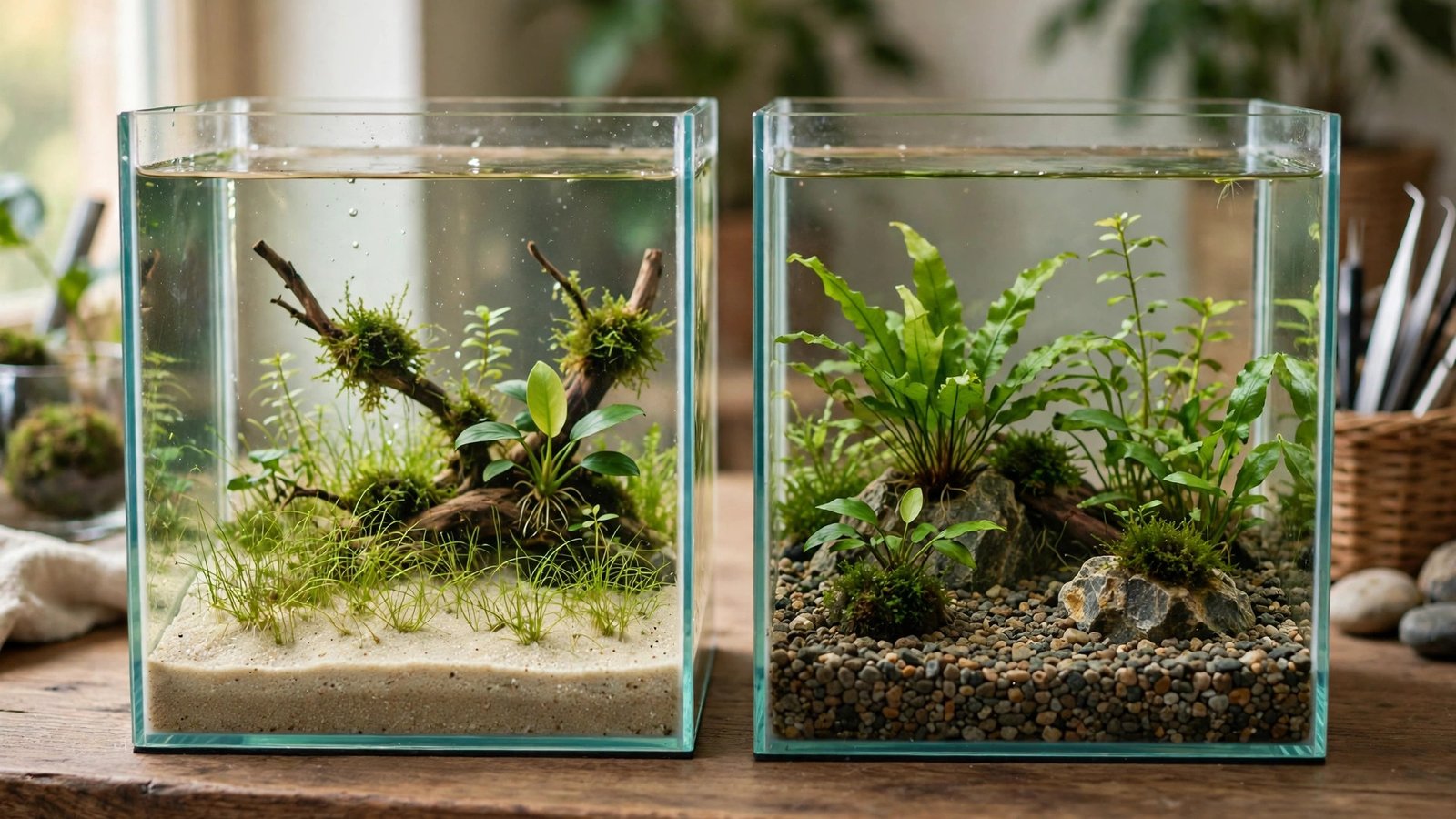
When you set out to build a planted aquarium, the substrate decision lands early and sticks with you for years, because few hobbyists enjoy tearing down a tank to swap the ground it stands on. The debate over sand vs gravel for planted tanks never really settles, because both materials grow beautiful aquascapes in the right hands. Sand pleases bottom-dwellers and carpet plants, gravel flatters deep-rooted swords and makes maintenance simpler. What follows is a genuine head-to-head: rooting, nutrient delivery, compaction risk, cleaning, looks, and cost, with a clear verdict for every common tank style so you can stop second-guessing and start planting.
The Quick Verdict
If you only read one paragraph, make it this one. Sand wins for carpet plants, bottom-dwelling fish, and anyone who dislikes gravel vacuuming around stems. Gravel wins for heavy root feeders like Amazon swords and crypts, and for beginners who want forgiving maintenance and deep root runs without fuss. Both are inert by themselves, so neither feeds plants directly — the real difference is texture, and texture changes everything from how roots anchor to how debris behaves. Many of the best planted tanks on the internet use a hybrid: nutrient-rich aquasoil below, sand or gravel above. This guide assumes plain inert sand or plain inert gravel, then shows you how to fix each one's weaknesses.
Round 1: Rooting and Plant Anchoring
Fine sand packs tightly, and that density is both its gift and its flaw. Small grains interlock around delicate roots and runners, so carpeting plants like dwarf hairgrass, Monte Carlo, and Eleocharis stay put where coarser material would let them float free. If you have ever watched a newly planted glosso carpet migrate to the surface of a gravel bed overnight, you already understand why carpeted tanks overwhelmingly choose sand.
Gravel, especially 2–5 mm grades, leaves generous spaces between stones. Large-rooted plants love those gaps: an Amazon sword or Cryptocoryne can push thick roots deep and fast, building an anchor no sand bed can match in the same timeframe. The tradeoff is that fine rootlets of delicate stems wander through gravel without much purchase, and freshly planted stems pull loose during water changes until their roots establish.
Winner by category: sand for carpets, mosses, and foregrounds; gravel for swords, crypts, and other heavy root-feeders. If you are choosing the right sand for a planted aquarium, lean toward 0.5–1 mm grains; if gravel, keep it under 5 mm so roots can thread through.
Round 2: Nutrient Delivery to Roots
Neither plain sand nor plain gravel contains meaningful nutrients. Plants in both substrates live off whatever you add: root tabs, water-column dosing, fish waste, and organic matter that settles into the bed. The difference is how that food reaches the roots.
Water flows through gravel far more freely than through sand. Fertilizer dissolved in the water column, and mulm broken down by bacteria, migrates down between the stones to the root zone. This makes gravel tanks surprisingly forgiving if your dosing schedule is casual, because nutrients circulate rather than sitting in dead spots.
Sand's tight packing slows that exchange. On one hand, root tabs placed in sand dissolve slower and last longer, feeding plants in a concentrated pocket. On the other, mulm sits on the surface instead of sifting down, so sand beds depend more on your water-column fertilization and less on the slow recycling of trapped organics. Aquarists who run root tabs in inert substrates often report that sand makes tabs more efficient per capsule, since nutrients stay local rather than washing through to the water.
Verdict: roughly a draw with a caveat. Gravel distributes nutrients passively; sand rewards deliberate feeding. Either way, inert substrates demand that you actually feed your plants — nothing in the bag does it for you. If you want to read more on the science of how different bottom layers affect root growth, Tropica's substrate care guide explains the principles behind substrate choice and planting depth well.
Round 3: Compaction and Anaerobic Risk
This is the round sand loses on reputation and sometimes in practice. When fine sand packs into a deep, undisturbed layer — especially above 6 cm or 2.5 inches — the bottom can go anaerobic. Anaerobic bacteria produce hydrogen sulfide, the rotten-egg gas, which in large amounts harms roots and, if released suddenly, fish. In a heavily planted tank this is rarely dramatic, because plant roots oxygenate the substrate around them and their growth physically churns the bed.
The practical fixes are simple: keep sand depth at 4–5 cm in planted zones, add Malaysian trumpet snails to burrow and turn the bed, and avoid packing sand down during setup — a gentle pour and a light leveling are enough. Most planted sand beds never develop problematic pockets when plants and snails are working the soil.
Gravel resists compaction by nature. Water circulation between the stones keeps oxygen flowing, so anaerobic pockets are almost a non-issue even at greater depths. The cost of that openness is that detritus migrates deep into the bed, where it can rot out of sight and drive nitrates up if you never vacuum.
Winner: gravel, for effortless safety. Sand demands a little awareness, but a planted sand bed with snails is no ticking bomb — it is a routine, manageable maintenance habit.
Round 4: Cleaning and Maintenance
Sand is easier to keep looking clean and harder to truly deep-clean. Debris settles visibly on top of sand rather than disappearing between stones, which means you can see when the tank needs attention — and a gentle hover of the siphon just above the surface lifts waste without sucking up the substrate itself. That said, you should never plunge a gravel vacuum into a sand bed; you will pull half the bed out and leave a crater. Keep the siphon tube an inch above the surface and let the current do the work.
Gravel invites the classic vacuum-and-plunge routine: push the tube into the bed, let it lift and drop the stones, and watch mulm swirl out. It is satisfying and effective around hardy plants, but in a densely planted tank there is simply no room to plunge between stems. In practice, gravel beds in mature planted tanks accumulate buried mulm that the owner can never fully reach — which is exactly why cleaning substrate in planted tanks deserves its own technique, different from the bare-tank routine most guides describe.
Winner: sand, for planted tanks. Surface waste is visible, accessible, and the hover-vacuum technique disturbs plants the least. Gravel wins only in lightly planted setups where you can vacuum aggressively.
Round 5: Aesthetics
Beauty is subjective, but aquascaping culture has a clear bias: most competition-level aquascapes use sand or soil, not gravel. Sand reads as a natural riverbed, reflects light softly upward onto plants and fish, and its smooth surface makes green carpets and bright fish pop. Light sand also brightens the lower water column, which can make a dim tank feel alive.
Gravel's mottled, multi-toned look reads as a stream bed or rocky shoreline, and in nature-style or biotope tanks that is exactly right. Dark gravels frame plants with strong contrast and make colorful fish like tetras and guppies look electric. The drawback: many commercial gravels are unnaturally dyed, and those candy colors fade or chip over time, exposing a pale core that ruins the effect.
One more visual consideration: sand shows every speck of algae on its surface, while gravel hides early algae in its gaps. If you hate seeing debris, sand will nag you into more frequent cleaning; if you hate ugly substrate, gravel's forgiveness has value.
Winner: sand, slightly — for the classic planted-aquarium look. Gravel owns the biotope and rocky-stream aesthetics.
Round 6: Cost and Availability
Inert gravel is the cheapest substrate you can buy, and it is sold in every pet shop on earth. Sand is only marginally more expensive, but the good stuff matters: pool filter sand and play sand cost almost nothing, while aquarium-branded sands cost more for consistency and color control. The trap with bargain sand is silt — cheap playsand often needs a dozen rinses before the water stays clear, whereas quality pool filter sand is pre-graded and rinses clean quickly.
For large tanks the math favors sand. A 200-liter tank needs a lot of substrate, and at that scale the per-kilo price of cheap inert materials beats any commercial aquasoil. Check how much substrate a planted tank needs before you buy, because underestimating leaves an embarrassingly thin bed and overestimating leaves expensive bags in the garage.
Winner: tie. Both are cheap, widely available, and last essentially forever. Spend the savings on plants and a good light instead.
Sand vs Gravel for Planted Tanks: Side-by-Side Comparison
| Factor | Sand | Gravel |
|---|---|---|
| Carpet plants | Excellent — fine grains hold runners | Poor — runners drift between stones |
| Deep root feeders | Good, slower root expansion | Excellent — open gaps favor thick roots |
| Nutrient delivery | Slow; root tabs work well locally | Good circulation to root zone |
| Compaction risk | Real if too deep or unplanted | Minimal |
| Cleaning style | Hover vacuum above surface | Plunge vacuum into bed |
| Bottom-dwelling fish | Excellent — gentle on barbels | Sharp edges can injure corys |
| Debris visibility | Sits on top, visible | Sinks in, hidden until it rots |
| Aquascape look | Classic planted-tank riverbed | Stream-bed or biotope feel |
| Typical cost | Very low to moderate | Very low |
Verdicts by Tank Type
High-tech carpeted scape (CO2, strong light)
Sand, no contest. Carpet plants define the scape and sand is their ideal medium. Cap at 4–5 cm, plant heavily from day one, add trumpet snails, and dose the water column. Pair with root tabs under heavy foreground sections.
Low-tech planted community tank
Either works — pick by your stocking. Keeping corydoras, loaches, or kuhlis? Sand protects their barbels and they visibly enjoy sifting it. No bottom dwellers? Gravel is simpler to maintain and forgives casual water changes. See the best substrate choices for corydoras if catfish are the reason you are here.
Sword-and-crypt jungle (heavy root feeders)
Gravel, 3–5 mm, deep bed. Big plants with thick root systems thrive in the open structure, and a properly deep substrate lets them reach full size. Drop root tabs in at planting and refresh them every few months.
Biotope or nature-style tank
Match the habitat. Amazonian blackwater? Fine sand with leaf litter. Rocky African rift stream? Gravel or pebble. Authenticity is the whole point of a biotope, so let the river or lake you are copying decide.
Breeding or fry tank
Sand. Fry and eggs that settle are far easier to spot on sand, and gentle hovering beats plunging a vacuum around newborn fish.
The Hybrid Option: Getting Both
You are not required to pick one material for the whole tank. A common professional approach is zoned substrate: sand in the foreground for carpets and bottom dwellers, coarser gravel at the back for big root feeders and stem plants. Use a terrace or hardscape barrier to stop the layers mixing — sand migrates downward into gravel over time, so a stone or plastic divider pays for itself.
The other hybrid is nutrient-rich soil below, inert cap above. A base of aquasoil under a sand or fine-gravel cap gives plants real nutrition from the start while the cap keeps the soil from clouding the water. This bridges the gap between inert substrates and premium soils, and the cost sits comfortably in the middle. If that sounds appealing, compare the tradeoffs in our guide to aquarium soil versus gravel before committing.
A reliable pick here is pool filter sand.
A reliable pick here is CaribSea Eco-Complete.
Frequently Asked Questions
Can you put sand on top of gravel in a planted tank?
Technically yes, but it rarely stays pretty. Fine sand sifts down through gravel over weeks, the layers invert, and you end up with mixed substrate that compacts worse than either material alone. If you want both materials, zone them side by side with a hardscape barrier instead of layering one over the other.
Will sand suffocate plant roots?
Not in a planted tank managed sensibly. Living roots actively oxygenate the substrate around them, and burrowing snails keep fine sand aerated. Suffocation only becomes a real risk with very deep sand (over about 7 cm), no plants, and no snails — a combination that rarely exists in a healthy planted tank.
Is pool filter sand safe for aquariums?
Yes — pool filter sand is one of the hobby's best bargains. It is pre-graded to a uniform grain size, rinses cleaner than play sand, and its slightly rounded grains are gentle on fish. Rinse it a few times to remove dust, and check the label to make sure it is 100% silica with no chemical additives.
Does gravel size matter for planted tanks?
It matters more than most beginners expect. Grains in the 2–5 mm range are the sweet spot: small enough for roots to grip, large enough to resist compaction. Pea gravel above 8 mm anchors poorly and traps too much debris. Our guide to gravel size for planted tanks breaks down exactly which grades suit which planting styles.
How deep should sand or gravel be in a planted tank?
Aim for 4–6 cm (about 2 inches) across most of the tank, deeper — up to 8–10 cm — where large root feeders will sit, and shallower at the front glass for a clean look. Foreground carpets need less depth than sword roots. Slope the bed upward toward the back for both visual depth and extra root room where the big plants live.
Do I need fertilizer if I use sand or gravel?
Yes. Both are inert, meaning they supply no nitrogen, phosphorus, potassium, or micronutrients on their own. Plan on water-column dosing plus root tabs placed near heavy root feeders from day one. Plants can look fine for a month or two on fish waste alone, but deficiencies — pale leaves, holes, stunted growth — always catch up eventually.
Final Word
Sand vs gravel is not a fight with one winner, it is a question about what you want the tank to be. Choose sand when carpets, bottom dwellers, and a bright riverbed look define your vision; choose gravel when big root feeders, forgiving maintenance, and a stream-bed feel matter more. And remember that both are simply canvases — plants are fed by what you add to them, not by the bag the substrate came in. Pick the texture that suits your plants and your fish, feed it properly, and either choice will carry a gorgeous planted tank for years.