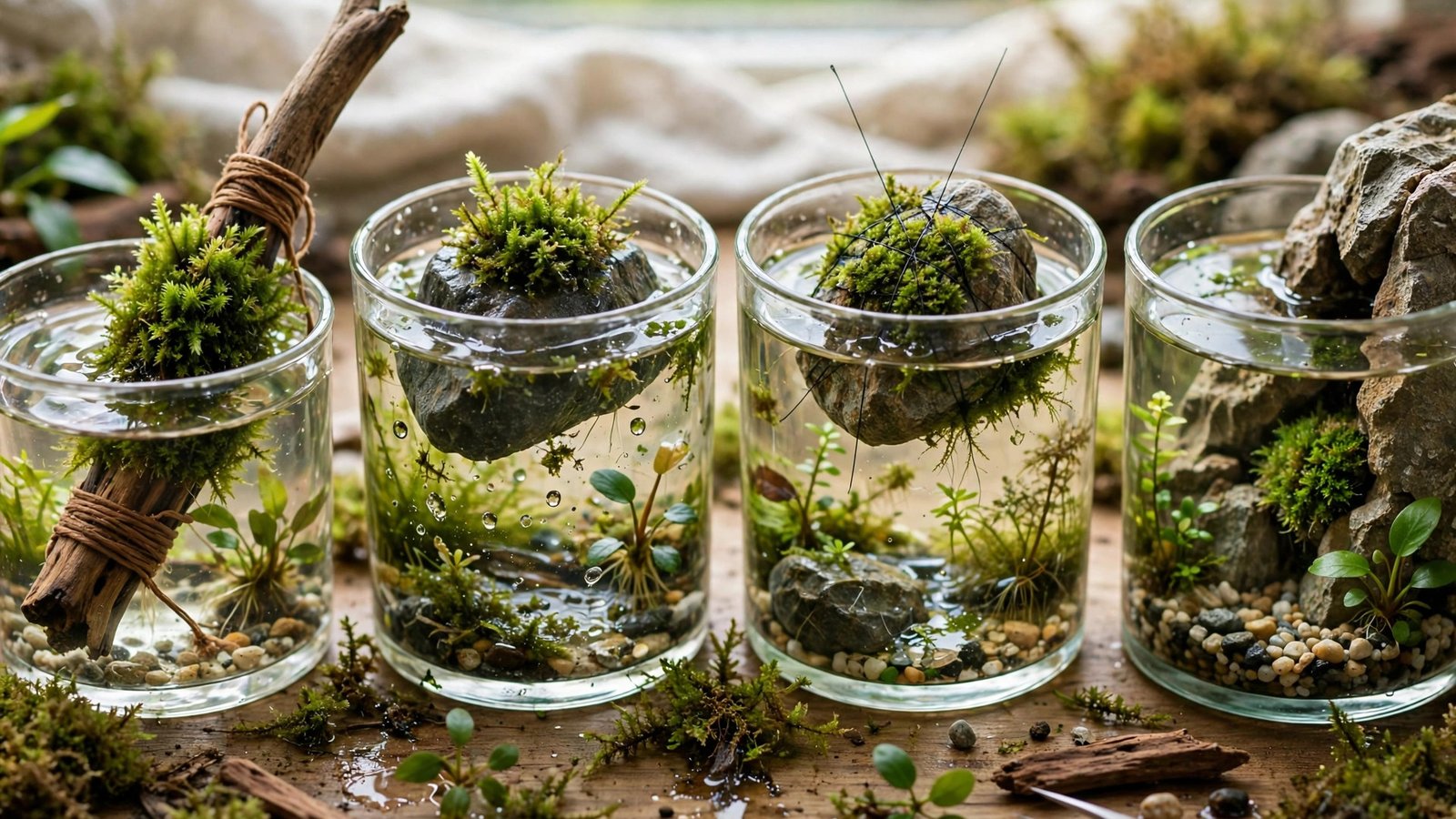
Moss left loose on the substrate usually ends up in the filter intake — or colonized by algae before it ever attaches. Learning how to attach moss to wood and rocks correctly is what separates an aquascape that looks wild and green in six months from one still showing bare thread a year later.
How to attach moss to wood and rocks: the 4 methods at a glance
Thread and glue are the everyday workhorses for hardscape accents; mesh suits flat walls and carpets; the press-in dry-start is the secret weapon for heavily textured wood. For bigger vertical projects, the guide to building an aquarium moss wall extends these same attachment principles to full-scale walls.
| Method | Speed | Hold strength | Best moss types | Difficulty |
|---|---|---|---|---|
| Tie with thread or fishing line | Moderate (10–15 min per piece) | Medium — roots in 2–3 weeks | Java moss, Christmas moss, Taiwan moss | Easy |
| Super glue gel (cyanoacrylate) | Fast (1–2 min per patch) | Strong instantly | Java moss, Christmas moss, Fissidens fontanus | Easy |
| Stainless steel mesh | Slow setup, fast coverage | Strong once filled (3–4 weeks) | Java moss, Riccia fluitans, Subwassertang | Moderate |
| Dry-start press-in | Quick setup, 1–2 week rooting | Very strong once submerged | Java moss, Christmas moss, Fissidens | Moderate |
 ★4.6
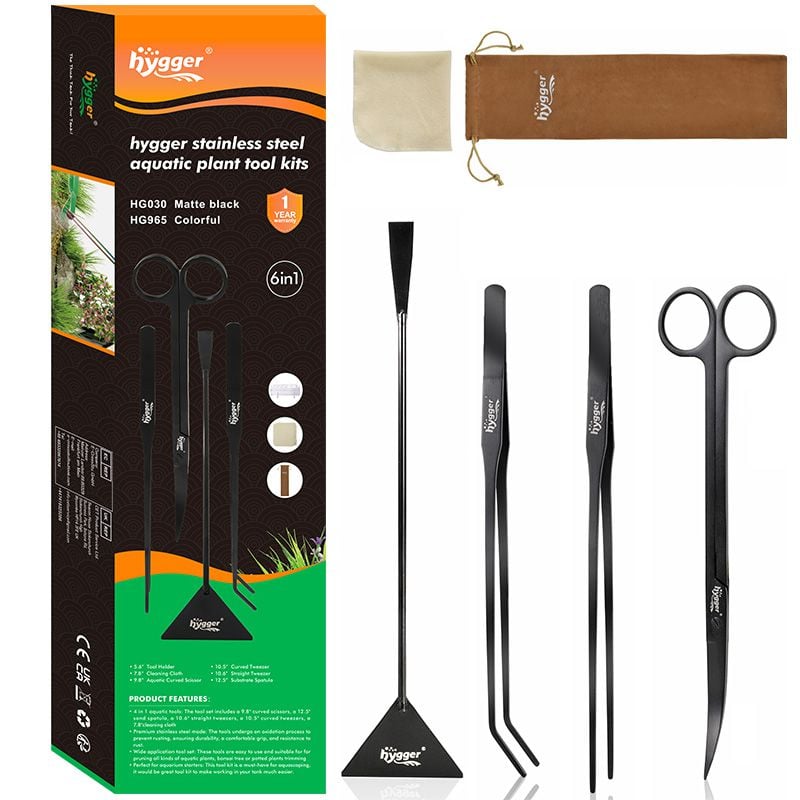
hygger 6-in-1 Aquarium Aquascaping Tool Kit
Check Price on Amazon ★4.6Method 1: Tie it down with thread or fishing line
Spread a thin layer of moss over the wood or rock, then wrap dark green cotton thread or 2–4 lb monofilament fishing line around the piece in a spiral, wraps spaced 1–2 cm apart. Keep tension firm but not crushing.
Cotton thread is the forgiving choice: plain dark-green sewing cotton is nearly invisible under growth and rots in about 4 weeks, right as rhizoids take over. Fishing line holds indefinitely, which sounds better until you're plucking translucent line from a filled-in mat a year later. Reserve it for high-flow tanks where moss gets tugged hard before it roots.
Trim the moss layer under 1 cm thick before tying. Thick clumps suffocate their own undersides: the bottom dies and the whole patch floats free in week three.
Method 2: Super glue gel — the fastest option
Plain cyanoacrylate bonds instantly to wet surfaces, cures underwater, and is fish-safe once cured — the standard aquascaping glue in professional builds. The critical detail: use gel, not liquid. Liquid runs into the water column, creates a white haze, and burns eyes; gel stays where you put it.
Pat the attachment spot with a paper towel until damp, not dripping. Squeeze a pea-sized blob onto the surface — never onto the moss — then press a thin tuft in with tweezers and hold 30–60 seconds. Wait 10–15 minutes before submerging for full-strength cure. In a running tank, apply the blob to a submerged rock directly and hold a full 60 seconds against the current.
Read the label: skip "anti-fungus," "anti-mold," or medicated formulas — the additives are toxic to shrimp and fish. Plain cyanoacrylate gel with zero additives is the target; cheap store brands work exactly like aquarium-branded tubes.
Method 3: Stainless steel mesh for even coverage
Mesh delivers the most uniform mats — ideal for flat rock faces, wall sections, and foreground carpets. Sandwich a thin moss layer between two sheets of 304-grade stainless steel mesh, zip-tie or sew the edges shut with fishing line, and press the panel against the hardscape. Or single-sheet moss onto mesh and pin it with a few glue dabs behind.
Coverage takes 3–4 weeks to fill in. Use only 304 or 316 stainless steel — galvanized or painted meshes leach metals. After 4–6 weeks, once the moss has woven through the grid, leave the mesh buried permanently; removing it later tears the mat.
Method 4: Dry-start press-in
Aquascaping before flooding? You get the best attachment free. While the wood is dry, press moss into every crevice and rough patch of the grain — no thread, no glue, no mesh. Fissured woods like the best driftwoods for aquascaping grip moss mechanically as rhizoids push into the texture.
Mist twice daily and cover the tank with cling wrap to hold 80–90% humidity for 1–2 weeks. In humid air, moss grows emersed and anchors hard; when you flood, it's already self-attached. One missed misting on a hot day can brown a whole patch. Prep the wood first with this guide to preparing driftwood for an aquarium.
Matching moss to surface and method
Java moss is the universal soldier: it anchors to almost anything in 2–3 weeks with any method. Christmas moss forms neater, tree-like fronds and loves rough wood — spider wood versus manzanita both work, but spider wood's ridges give rhizoids more purchase. Fissidens fontanus is slow (budget 4–6 weeks) but forms an impossibly tight velvet coat on rock faces, where glue beats thread.
Riccia fluitans is the exception: a floating liverwort with no real roots, it never self-attaches and must live permanently under mesh or thread. For porous rocks, lava rock in planted tanks is the classic moss canvas; dragon stone (ohko) holds moss well in its pitted faces. Smooth river stones are the hardest surface — glue is your only real option.
Fresh wood complicates attachment: new driftwood often grows a white fungus on new driftwood that coats the surface with biofilm, blocking rhizoid contact. Wait out the fungus cycle (2–3 weeks) before attaching moss, or it lifts off with the slime. Moderate light, steady CO2, and gentle flow all speed rooting — check species growth rates in the Tropica plant database before choosing your moss.
Frequently Asked Questions
Is super glue really safe for fish and shrimp?
Yes — plain cyanoacrylate cures into inert acrylic plastic within minutes and is non-toxic once cured, with decades of use in reef and planted tanks. The danger is the wrong product: avoid anti-fungus, anti-mold, or rubber-toughened formulas, and use gel rather than liquid so it never disperses into the water.
How long does moss take to attach to driftwood?
Expect 2–3 weeks for Java moss or Christmas moss on rough wood, 3–4 weeks on smoother surfaces, and 4–6 weeks for slow growers like Fissidens fontanus. Glue holds instantly, but true biological attachment still needs the full timeline. Don't remove thread or mesh before week 4.
Can I attach moss to rocks in a running tank?
Absolutely. Super glue gel works underwater: apply a pea-sized blob to the rock, press a thin tuft in with tweezers, and hold 60 seconds against the current. Thread works too, though it's fiddlier submerged. Dabbing the rock dry first, even briefly, dramatically improves the bond.
Why did my moss float away after a week?
Usually the layer was too thick — the bottom suffocates, rots, and releases the whole patch. Other culprits: thread tied too loosely, glue applied to the moss instead of the surface, or wood still shedding white fungus biofilm. Redo it with a 3–5 mm layer, firm tension, and glue on the hardscape.
Does fishing line or cotton thread work better?
Cotton thread suits most tanks: dark green sewing cotton is nearly invisible, costs almost nothing, and rots in about 4 weeks just as the moss takes over. Use fishing line only in high-flow tanks — then snip it out after 6–8 weeks, since it never rots.
Will moss attach to any rock?
Rough, porous rocks like lava rock and dragon stone give rhizoids texture to grip and attach fastest. Smooth river stones are the hardest surface — glue is your best bet there. Scrub the attachment area first if the rock has heavy algae or mineral crust, so rhizoids contact bare stone.
Whichever method you choose, the formula is the same: thin layer, firm hold, moderate light, and patience while rhizoids do their work. Once moss locks in, it's nearly indestructible — and a branch or rock wearing a living green coat is the cheapest way to age a tank by years.