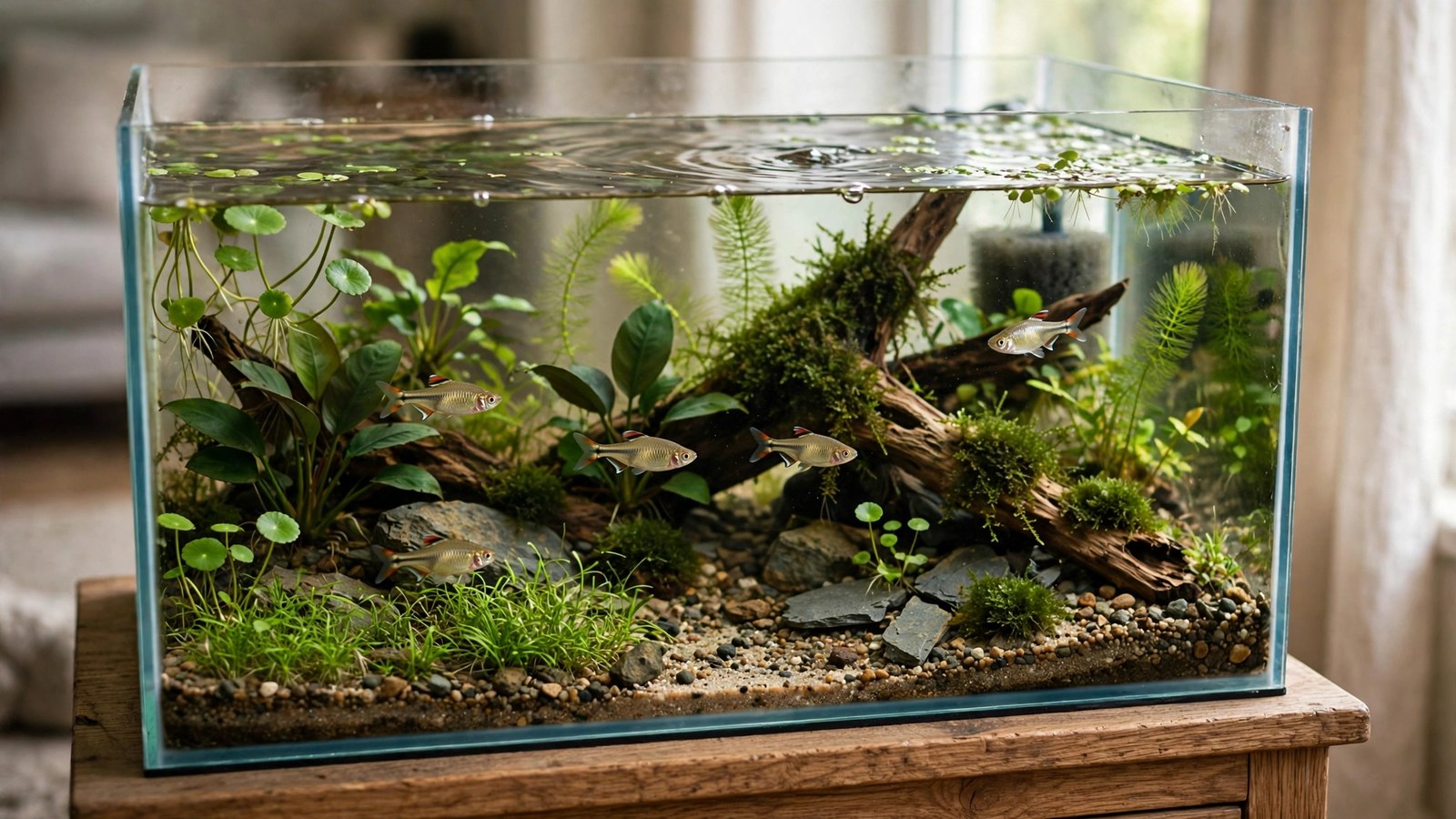
Most planted tanks fail at the heater — or more precisely, at the wrong fish fighting the heater. A white cloud minnow planted tank sidesteps the whole problem: these tiny schooling fish thrive in cool 64–72°F water, so you skip the heater entirely, grow lush fine-leaved plants at room temperature, and spend your energy on aquascaping instead of temperature management. By the end of this guide, you'll have a complete cold-water build plan — tank size, substrate, plants, gentle filtration, tankmates, and how to get your school breeding in the java moss.
Why White Clouds Are Built for Planted Tanks
White cloud mountain minnows evolved in the cool, shaded streams of China's White Cloud Mountains — water that rarely climbs above 72°F. Your unheated living room is already their natural habitat. While most community fish demand tropical stability, white clouds shrug off temperature swings that would stress a neon tetra into illness.
That cool-water tolerance is what makes them ideal planted-tank fish. Warm tropical water holds less oxygen, encourages algae, and forces plants to grow faster than your maintenance schedule allows. A cold-water planted tank runs calmer: plants grow steadily, oxygen stays high, and the whole system forgives missed water changes and inconsistent fertilizing.
Behavior seals the match. White clouds are peaceful mid-water schoolers that max out around 1.5 inches. They don't dig, don't uproot stems, and don't nibble leaves. A school of ten flashes copper and silver through a hornwort thicket all day without disturbing a single root. If you're comparing cold-water options, our planted goldfish tank setup shows how a different cold-water fish needs a very different plant strategy.
Equipment: Short List, No Heater
A 10-gallon tank works for a starter school of 8, but 15–20 gallons gives you far more aquascaping room and a more stable water column — extra volume smooths out the temperature and chemistry swings small tanks amplify. Buy the largest tank your space allows.
Lighting stays moderate. White clouds come from shaded streams and color up best under medium light, and so do the plants on this list — this build is deliberately low-tech. A simple LED like a Finnex Stingray or NICREW Classic on a timer, 6–8 hours a day, grows everything below without CO2. For the full no-CO2 method, see our low-tech planted tank setup guide.
Filtration must be gentle. A sponge filter is the classic choice: cheap, provides mechanical and biological filtration, aerates the water, and won't suck up eggs or fry. If you prefer a hang-on-back filter, baffle the outflow with a sponge pre-filter so the current doesn't push these small fish around all day. Strong flow is the single biggest equipment mistake in this build.
Do you really skip the heater?
Yes. White clouds are comfortable from 64–72°F and tolerate brief dips into the high 50s. In a normally heated home, the tank simply sits at room temperature. The only exception is a room that regularly drops below 60°F in winter — then a small adjustable heater set to 64°F is cheap insurance. For the full decision logic, see our heater for planted tank guide.
Substrate and Hardscape
Fine sand or small-grain gravel, 1.5–2 inches deep, is all you need. Sand suits the natural-stream look and lets uneaten food sit visibly on top for easy siphoning; fine gravel (2–3 mm) gives rooted plants slightly better anchorage. Avoid coarse gravel — detritus falls between the gaps and rots. Nutrient-rich aquasoils work but are overkill for the undemanding plants below and can leach ammonia the first month.
Hardscape should echo a cool mountain stream: one or two driftwood pieces, smooth river stones, and open swimming lanes through the middle. White clouds school in mid-water, so leave the center and front open — they need room to display. Anchor anubias and java fern to the wood rather than burying them (buried rhizomes rot), and let stones define planting zones without creating dead spots in the current.
The Plant Plan: Fine-Leaved Cover Plus Epiphytes
White clouds are egg-scatterers that drop tiny adhesive eggs among fine foliage, so fine-leaved plants aren't decoration here — they're the breeding engine. Build in two layers: a dense fine-leaf zone for shelter and spawning, plus hardy epiphytes on hardscape for structure.
Fine-leaved plants (the spawning zone)
- Hornwort: the workhorse. Grows in almost any water, pulls nutrients from the water column, and its feathery whorls catch eggs perfectly. Float a bunch at the surface too — white clouds often spawn near floating plants at dawn.
- Guppy grass: dense, fast-growing, and cool-water tolerant. Clumps in the back corners give fry their best hiding odds against hungry adults.
- Java moss: tie it to wood or let it mat on the substrate. Eggs lodge in the filaments, and newly hatched fry graze infusoria among the fronds for their first meals.
Epiphytes and structure plants
- Anubias nana: glue or tie rhizomes to driftwood. Slow, indestructible, and unbothered by cool water — the anchor plant of this build.
- Java fern: another tie-to-wood classic. Plantlets sprouting on old leaves can be harvested to fill gaps for free.
- Cryptocoryne wendtii: a rooted foreground accent that handles cool water well once established. Expect initial melt after planting — new leaves follow within two weeks.
Plant heavily from day one. Aim for 60–70% of the substrate planted or covered before fish arrive — a planted tank cycles better and resists algae when plants outnumber the space algae wants.
Water Parameters and Cycling
White clouds ask for almost nothing chemically: pH 6.5–7.5, soft to moderately hard water (4–12 dGH), and — the non-negotiable — zero ammonia and nitrite. They do want clean, oxygenated water, so keep slight surface agitation and never let the tank stagnate. Our planted tank water parameters guide covers testing in full.
| Parameter | Target range | Notes |
|---|---|---|
| Temperature | 64–72°F | Room temperature; no heater in a heated home |
| pH | 6.5–7.5 | Stability matters more than the exact number |
| Ammonia / nitrite | 0 ppm | Cycle fully before adding fish |
| Nitrate | 5–20 ppm | Plants consume it; dose if it hits zero |
| GH / KH | 4–12 / 3–8 dGH/dKH | Avoid very soft water for fry development |
| Lighting | Moderate, 6–8 hrs/day | Timer-controlled; longer invites algae |
Fishless-cycle for 2–3 weeks before adding fish, using bottled ammonia or a daily pinch of fish food. Planted tanks often "silent cycle" faster since plants absorb ammonia directly, but verify with a liquid test kit: dose to 2 ppm ammonia and confirm it clears to zero within 24 hours. Add the whole school at once after the cycle completes so the group settles together.
Stocking the School and Choosing Tankmates
White clouds are schoolers in the truest sense — 8–12 is the minimum for natural behavior, and 12–15 in a 20-gallon is spectacular. Single-digit groups turn skittish and washed-out; the school is the whole point of the species. Stock 8 in a 10-gallon, 12 in a 15-gallon, and up to 15–18 in a 20-gallon without overloading the bioload.
Tankmates must share the cool-water requirement, which rules out most tropical community fish. Tetras, guppies, platies, and bettas all want 74°F+ and will be chronically stressed — and stress is how disease starts. Stick to true cold-water companions:
- Cherry shrimp: the perfect partner. Same temperature range, constant algae grazers, and red pops against green plants. Adults are too big for white clouds to eat; dense moss keeps a colony breeding despite occasional shrimplet losses.
- Nerite snails: unbeatable algae cleaners that can't reproduce in freshwater — no population explosions.
- More white clouds: honestly the best "tankmate." A second morph — gold or longfin white clouds — adds variety with zero compatibility risk.
Avoid anything large, nippy, or tropical. When in doubt, the species-only tank is the strongest version of this build.
Feeding and Weekly Maintenance
White clouds are unfussy omnivores. A quality micro-pellet or crushed flake as the staple, fed once or twice daily in amounts finished within 60 seconds, plus frozen daphnia or baby brine shrimp 2–3 times a week, brings out their best color and conditions them for breeding. Live or frozen food is the real trigger — a week of daphnia in upper-60s water reliably sparks dawn spawning.
- Weekly 25–30% water change with dechlorinated water matched within 2–3°F of tank temperature.
- Trim fast growers monthly — hornwort and guppy grass can double in weeks. Thin so light reaches lower levels.
- Gravel-vac open areas lightly; leave mulm in planted zones as free fertilizer.
- Fertilize lightly: half-dose all-in-one liquid fertilizer weekly is plenty in cool low-tech water. Skip dosing if nitrate stays above 10 ppm from fish waste alone.
- Clean the sponge filter monthly by squeezing it in old tank water — never tap water.
Want to run even leaner? Our no-filter planted tank setup guide shows how far plant filtration goes in a mature tank — though we still recommend the sponge filter for this build.
The Breeding Bonus: Free Fry in the Moss
A healthy white cloud planted tank breeds on its own. At dawn, males chase females through the fine-leaved plants, scattering dozens of tiny adhesive eggs that stick to hornwort, guppy grass, and java moss. Eggs hatch in 48–72 hours at room temperature.
You don't need a separate breeding tank — but you do need cover. In a densely planted tank, a few fry from each spawn dodge the adults and grow up on their own. For serious numbers, move a moss clump full of eggs to a small container of tank water with an airstone; feed infusoria or powdered fry food the first week, then baby brine shrimp. Within two months you'll have juveniles some local fish stores will take.
Two things improve in-tank fry survival: feed the adults well (well-fed adults hunt fry less) and keep floating-plant cover thick. A mat of floating hornwort at the surface is a fry nursery — newborns instinctively head upward into it.
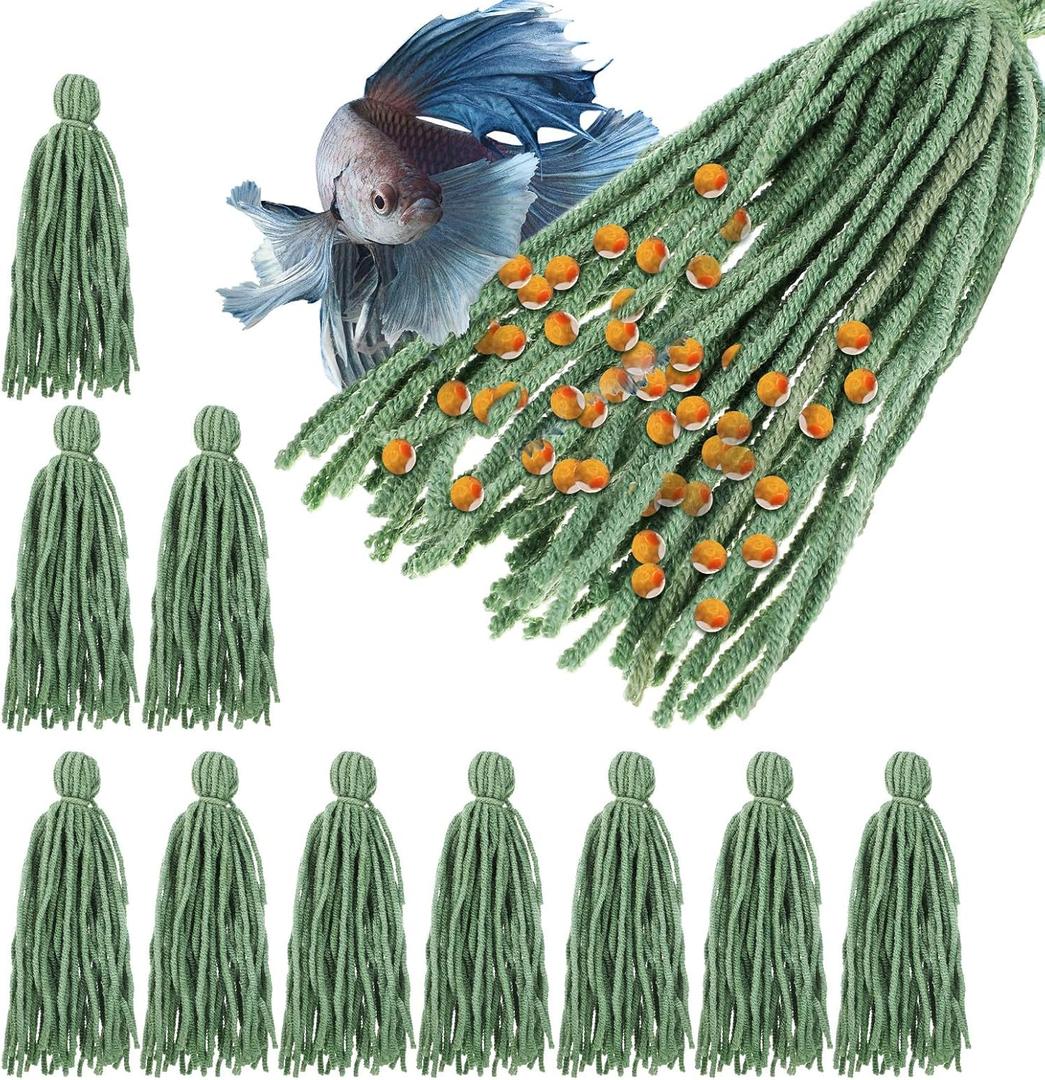 ★3.8
Spawning Mops for Fish
Check Price on Amazon ★3.8Frequently Asked Questions
Do white cloud minnows need a heater?
No. White clouds thrive at 64–72°F and tolerate brief dips into the high 50s, so in any normally heated home the tank runs at room temperature with no heater. Only add a small adjustable heater set to 64°F if the room regularly drops below 60°F in winter, like an unheated basement or garage.
What temperature is best for a planted white cloud tank?
Aim for 66–70°F — the sweet spot where fish and plants both perform best. This range keeps oxygen high, slows algae versus tropical temperatures, and suits every plant on this build's list. Avoid sustained temperatures above 74°F, which stress white clouds and accelerate algae.
Will white clouds eat shrimp babies?
They'll pick off some shrimplets — a newborn cherry shrimp is bite-sized to an opportunistic minnow. But they can't catch healthy adult shrimp, and a colony still thrives alongside them with dense moss and plant cover for babies to hide in. Expect slower colony growth than a shrimp-only tank, not colony collapse.
How many white clouds should I keep together?
At least 8, ideally 10–12. White clouds are true schoolers: small groups turn shy, pale, and inactive, while a proper school displays constantly and colors up. Stock 8 in a 10-gallon, 12 in a 15-gallon, and up to 15–18 in a 20-gallon.
Can I keep white clouds with tropical fish like tetras?
Not happily. Tetras, guppies, and most community fish want 74–78°F water while white clouds do best below 72°F — no temperature suits both long-term. Either the tropical fish sit chilled and disease-prone, or the white clouds sit warm and stressed. Build around cold-water tankmates like cherry shrimp and nerite snails instead.
Your Cold-Water Build, Start to Finish
The white cloud minnow planted tank is the rare build that gets easier the longer you keep it: no heater to fail, no CO2 to tune, plants that thrive on light care, and fish that reward you by breeding. Set up the 10–20 gallon tank with sand, wood, and a wall of fine-leaved plants; cycle it properly; add your school of 8–12; and let the system settle. Six months from now you'll be trimming hornwort, watching fry grow out in the moss, and wondering why every tank isn't this simple.