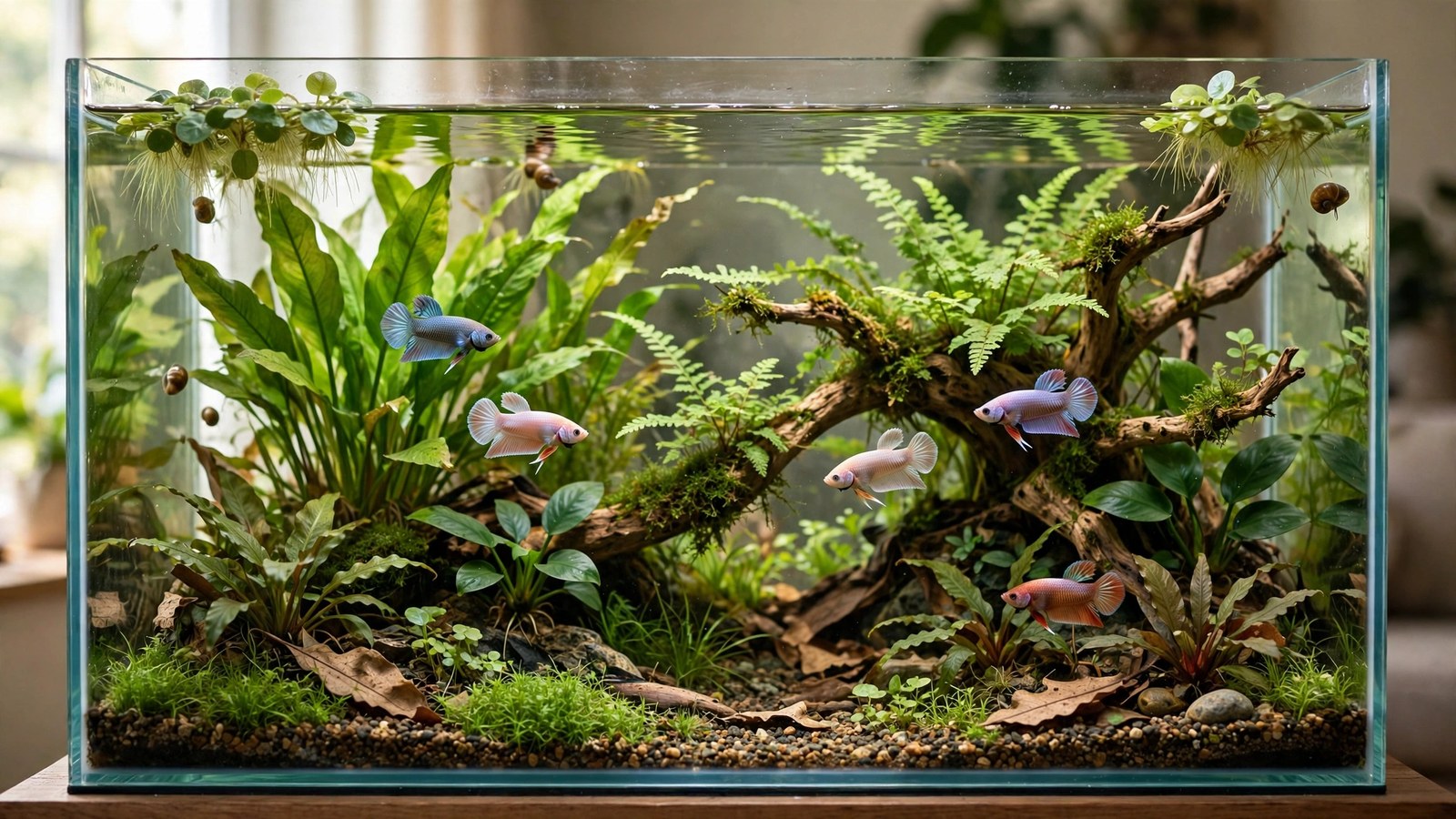
Most betta sororities fail for the same reason: they are set up like ordinary tanks, not like the underwater maze a group of female bettas actually needs. A planted betta sorority tank can work — many keepers run them for years — but only when the plants, tank size, and introduction protocol are all treated as non-negotiable. This guide gives you the complete setup, with the aggression risks stated honestly.
What a Betta Sorority Actually Is (and Isn't)
A betta sorority is a group of female bettas (Betta splendens) living in one tank. Females are less aggressive than males and share overlapping territories in the wild — but "less aggressive" is not "peaceful." Every sorority is a dominance hierarchy, and some females are simply too aggressive for any group.
That is the honest framing most setup guides skip: a sorority can fail through no fault of your setup. Sometimes one female relentlessly hunts the others, and the only fix is removing her permanently. If you cannot commit to watching the tank closely for the first month — and to pulling a fish out when needed — do not start a sorority. Build a planted betta tank for a single male instead; it is a far more forgiving project.
With that said, sororities do succeed when three conditions are met: enough space, enough fish to spread aggression, and enough plants to break sightlines. The plants are not decoration here. They are structural — they are what stops a chase.
The Non-Negotiable Rules
Before you buy a single plant, commit to these numbers:
| Rule | The number | Why it matters |
|---|---|---|
| Minimum tank size | 20 gallons, long format (30"×12"×12") | Footprint matters more than volume — a long tank gives chased females room to flee. |
| Group size | 5–7 females (never fewer than 5) | Fewer than 5 and one female becomes the permanent target. More than 8–9 in a 20-long increases territorial pressure. |
| All females, one species | Zero males | A male triggers relentless aggression and breeding behavior. Absolute. |
| Tank maturity | Cycled 4–6 weeks before fish | Adding fish to an uncycled tank layers ammonia poisoning on top of hierarchy fights. |
| Backup plan | At least one heated spare tank | Some females must be removed. A 5–10 gallon heated holding tank — or a confirmed rehoming option — is part of the setup. |
Notice what is not on this list: a precise water chemistry target. Sororities need the same stable tropical parameters as any betta tank — 76–80°F (24–27°C), pH 6.5–7.5, 0 ppm ammonia and nitrite. Stability beats perfection; our planted tank water parameters guide covers the testing routine.
Why Plants Are What Make Sororities Work
In a sparsely decorated tank, a dominant female can see from one end to the other — every subordinate permanently in her field of view means permanent confrontation. Dense planting changes the tank's geometry: when a chased female ducks behind a wall of stem plants, the aggressor loses visual contact and the chase instinct resets.
Keepers call this "breaking sightlines," and it is the entire planted design philosophy of a sorority tank. You are building an underwater maze with hiding routes, not aquascaping for beauty first. The practical test: from the front of the tank, you should not be able to see straight through to the back glass.
The Planted Betta Sorority Tank Layout, Zone by Zone
Think of the tank in three layers, each serving the sorority:
Background: the stem-plant walls
Plant tall, fast-growing stem plants in dense clusters of 10–15 stems each along the entire back and both sides, leaving only the front glass open — 4–6 clusters in a 20-long, planted 1–2 inches apart so they grow into solid walls:
- Limnophila sessiliflora — feathery and fast; fills in within weeks, tolerates low-tech setups.
- Rotala rotundifolia — bushes out after trimming; trims replant easily to thicken the wall.
- Hygrophila corymbosa 'Siamensis' — broad leaves, grows tall fast; good corner anchors.
- Ludwigia repens — sturdy and forgiving; reddish tones under decent light.
- Water sprite (Ceratopteris thalictroides) — plant it or float it; fine-leaved cover that bettas love.
Midground: the chase-breakers
Midground plants create obstacles in the open swimming space — the vertical features a chased fish darts behind. Plant 5–8 midground clumps across the middle so no straight swimming lane runs uninterrupted end to end:
- Java fern tied to driftwood or rocks — broad leaves make ideal rest spots.
- Anubias barteri varieties on hardscape — nearly indestructible, low light.
- Cryptocoryne wendtii — dense bushes in nutrient-rich substrate; very reliable.
- Amazon sword — one or two large swords create major visual barriers in a 20-long.
Surface: the floating canopy
Floating plants dim the light (betta aggression spikes in bright, exposed tanks), give subordinates surface hiding spots, and provide rest areas. Cover 30–50% of the surface, corralled to one side with airline tubing so you can feed through an open area. Our floating plants for betta tanks guide compares the options; the sorority standouts:
- Amazon frogbit — large rosettes, long roots, easy to thin; the classic betta floater.
- Red root floaters — striking red roots, moderate spread; dim light beautifully.
- Water lettuce — big, fast-spreading; use in moderation or it blocks all light.
Sorority Plant Shopping List
| Zone | Species | Quantity |
|---|---|---|
| Background | Limnophila sessiliflora (bunches) | 3 bunches (10–15 stems each) |
| Background | Rotala rotundifolia or Ludwigia repens | 2 bunches |
| Background corners | Hygrophila corymbosa 'Siamensis' | 2 pots |
| Midground | Java fern (on wood) | 2–3 portions |
| Midground | Anubias barteri / nana | 3–4 rhizomes on hardscape |
| Midground | Cryptocoryne wendtii | 3 pots |
| Midground anchor | Amazon sword | 1–2 plants |
| Surface | Amazon frogbit or red root floaters | 1–2 portions (spreads fast) |
This list assumes a low-tech setup — no CO2 injection needed. CO2 would speed growth, but aggression management, not growth rate, is the hard part here.
Equipment and Water Setup
The hardware for a sorority tank is deliberately boring — the money goes into plants and a backup tank, not gear.
- Tank: 20-gallon long minimum; a 29-gallon gives extra vertical space for tall stems. The 20-gallon planted tank setup guide walks through this footprint.
- Filter: a gentle hang-on-back or sponge filter. Bettas hate strong current — baffle the output if it pushes plants around.
- Heater: adjustable 100W for a 20-long, set to 78°F (25.5°C). Temperature swings cause stress, and stress causes aggression.
- Light: a basic full-spectrum LED on a timer, 6–8 hours daily. Medium-low intensity is fine — you want the floaters dimming the tank, not blasting light.
- Substrate: nutrient-rich aquasoil, or plain gravel with root tabs under the swords and crypts. Pick what your plants need.
- Lid: tight-fitting. Bettas jump, and a sorority dispute can send a fish airborne.
- Hardscape: 2–3 pieces of smooth driftwood or rock forming caves and barriers. Sand sharp edges — torn fins get nipped by tankmates.
Cycle the tank for 4–6 weeks before any fish — run the filter, grow the plants, and complete a fishless cycle. The planted tank cycling guide has the full protocol. An uncycled sorority stacks ammonia stress on hierarchy stress, and the combination kills fish.
 ★4.4
BN-LINK Digital Outlet Timer
Check Price on Amazon ★4.4Stocking Order and Introduction Day Protocol
How you introduce the females matters almost as much as the planting. The goal: 5–7 strangers establish a hierarchy as fast and fairly as possible — no single fish "owns" the tank first.
- Source your females together if possible. Females from the same breeder batch start with an existing pecking order. Pet-store females from different tanks work too, but expect a longer settling period. Pick females of similar size — a tiny juvenile among large adults becomes an instant target.
- Quarantine new fish for 2–3 weeks in the backup tank, especially store-bought fish. One sick fish in a group of six turns treatment into a nightmare.
- Introduce all females on the same day, in the evening. Rearrange the hardscape and do a partial water change that morning to reset territorial claims, then release all the fish within the same hour.
- Feed immediately after release. A good feeding distracts from the first territorial assessments. Feed small amounts twice daily for the first week.
- Dim the lights for the first 48 hours. Bright light on day one amplifies confrontations.
- No tankmates on day one. No snails, no shrimp, no other fish. Let the hierarchy settle for 3–4 weeks first — many successful sororities stay betta-only permanently.
If you later want tankmates, wait until the hierarchy is stable (week 4+) and choose calm, fast, non-nippy species — the same principles as a planted community tank setup apply, with the extra rule that nothing in the tank may resemble a betta.
The First 30 Days: Monitoring and the Removal Plan
You are not done when the fish go in — you are on watch for a month.
What's normal
- Days 1–3: flaring, chasing, fin-nipping as the hierarchy sorts out. Expected — it usually calms down.
- Days 4–14: chases get shorter; a dominant female emerges and subordinates learn avoidance routes.
- Weeks 3–4: the tank should feel calm, with brief chases only — normal betta behavior, not a crisis.
What triggers removal
Act on these the same day — not "tomorrow":
- One fish is chased relentlessly — she cannot eat, hides constantly, her fins are shredded. Remove the victim to the backup tank to recover; she may need a permanent solo home.
- One fish hunts the others across the whole tank and it does not ease after two weeks. Remove the aggressor. Some females are simply not sorority fish.
- A female stops eating for more than 3 days or shows clamped fins and constant hiding — move her to the backup tank regardless of cause.
- Visible injuries — torn fins beyond minor nips, missing scales, or a swollen eye. Hospital-tank her immediately.
After a removal, watch for 3–5 days to confirm the tank stabilizes. Never add one new female to an established group — a lone newcomer gets mobbed. Add 2–3 at once, after rearranging the hardscape, and only once the tank is fully calm.
The monitoring routine
For the first two weeks, observe the tank for 15–20 minutes twice a day, including one feeding. Learn each fish: who chases, who gets chased, who eats, who hides. After week two, one focused observation daily is enough. Keep a simple log — a phone note with each fish's description and a one-line status.
Long-Term Maintenance
Once settled, a sorority runs like a heavily stocked planted tank:
| Task | Frequency | Notes |
|---|---|---|
| Water change, 25–30% | Weekly | Non-negotiable with 5–7 bettas. Vacuum open areas; leave planted zones undisturbed. |
| Stem plant trimming | Every 2–3 weeks | Trim background walls before they choke the surface. Replant tops to keep walls dense. |
| Floater thinning | Weekly | Keep coverage at 30–50%. Overgrown floaters block light and crash the plants below. |
| Filter maintenance | Monthly | Rinse media in old tank water. Never replace all media at once. |
| Parameter check (ammonia, nitrite, nitrate) | Weekly for month 1, then biweekly | Nitrate above 20–40 ppm means more water changes or lighter feeding. |
| Hardscape/hide check | Monthly | Confirm caves and barriers are still in place. |
One maintenance warning specific to sororities: do not do a full rescape on an established sorority. Tearing the tank apart destroys every territory at once and restarts hierarchy fights from scratch. Change layouts in small sections over several weeks, and never strip the sightline walls all at once. Females live 2–4 years — plan the tank like the multi-year commitment it is.
Frequently Asked Questions
How many female bettas do I need for a sorority?
Five is the absolute minimum, and 5–7 is the sweet spot for a 20-gallon long. With fewer than five, aggression concentrates on one or two fish and the lowest-ranking female gets harassed relentlessly. Larger groups need larger tanks — do not put 9–10 females in a 20-long.
Can I keep a male betta with female bettas in a sorority?
No. A male in a female group triggers constant breeding aggression — he will harass the females relentlessly, and the females will fight over him. Males are solitary fish, full stop. If you want a single male, build him his own planted betta tank instead.
What tank mates can live with a betta sorority?
Most experienced keepers run sororities betta-only — the safest recommendation. If you add tank mates, wait 4+ weeks until the hierarchy is stable, then choose peaceful, fast, non-nippy species that do not resemble bettas. Avoid anything flashy, long-finned, or fin-nippy, and have a backup plan for newcomers too.
Why is one of my female bettas suddenly aggressive after months of peace?
Hierarchy shifts happen — a subordinate female may challenge the dominant one, or a rescape can restart territorial disputes. Check for triggers first: a thinned plant wall that opened sightlines, or illness making a fish vulnerable. If aggression does not settle within a week, separate the aggressor; a sorority that worked for months can still fail.
Can I start a sorority in a 10-gallon tank?
No — this is the mistake that kills the most sororities. A 10-gallon cannot hold 5–7 females with enough territory and escape routes each; the minimum is a 20-gallon long. With only a 10-gallon, keep a single betta instead — it will be a healthier, more beautiful tank than a doomed sorority. For authoritative plant references used in this guide, see the Tropica plant database.
Bringing Your Sorority Home
A planted sorority is one of the most rewarding tanks you can run — but it is earned, not bought. Plant the jungle first, introduce carefully, watch honestly, and keep the backup tank ready.