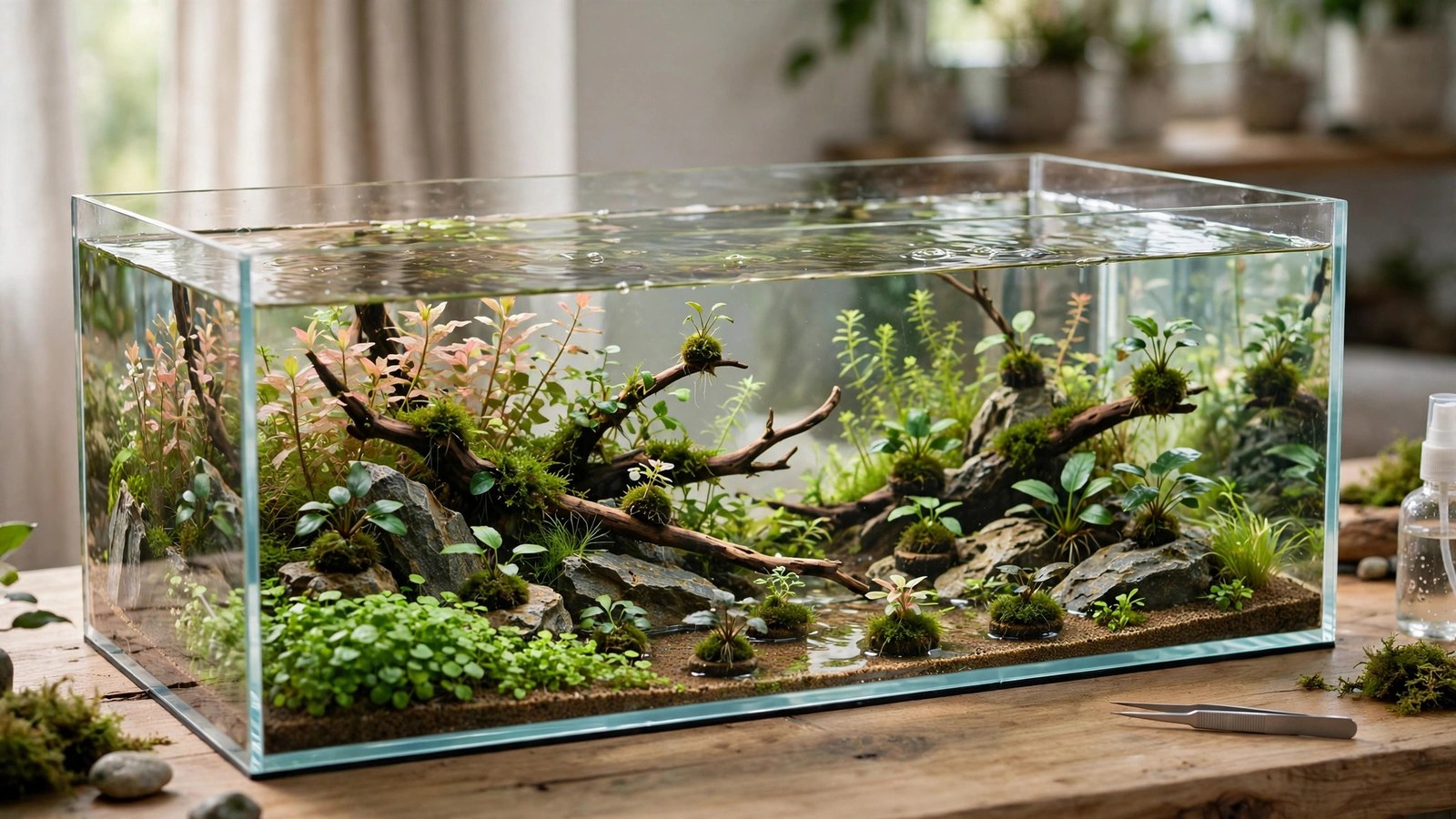
A low boy planted tank looks like someone sliced the top six inches off a standard aquarium — because that is essentially what happened. These shallow, wide glass boxes (often 8 to 10 inches tall) were popularized as coral frag grow-out tanks, and planted-aquarium hobbyists have adopted them. The footprint rewards you with an aquascape you can view from above like a living map and reach without dunking your sleeve — but shallow water changes the physics of lighting, substrate depth, and plant choice, so a conventional setup routine needs adjusting.
In this guide: picking equipment for a shallow footprint, safe substrate depth, plants that thrive when every inch of stem is on display, and handling the quirks — evaporation, temperature swings, surface film — of a low, wide tank.
What Is a Low Boy Tank, and Why Plant One?
The best-known is the 50-gallon low-boy at roughly 48" × 24" × 10", with smaller siblings like the 20-gallon at 24" × 20" × 8". The defining feature is height: rarely more than 10 inches of water.
For aquascaping, that geometry is a gift: the footprint of a mid-size tank with the accessibility of a pond — arrange hardscape standing upright, plant carpets without arm-deep contortions, and shoot top-down photos in one frame. Shallow water means light reaches the substrate with little intensity loss, opening up carpeting species that struggle in tall tanks. The tradeoff: you lose vertical planting space entirely, and every proportion mistake is visible from above.
Compared with nano planted tanks, a low-boy gives you elbow room. The tradeoff is surface area: with that much water exposed to air, evaporation and heat exchange become daily factors, covered below.
Choosing Your Low Boy Tank and Equipment
Tank sizes and what they cost in practice
- 20–25 gallon low-boys (e.g., ~24" × 20" × 8"): sideboard-scale, suited to a single carpet + rock layout (Iwagumi-style) or a moss-and-anubias composition — but one heater and one filter serve the whole tank, so failures hit harder.
- 50 gallon low-boy (~48" × 24" × 10"): the flagship: nearly 8 square feet of scaping real estate for islands, a valley, or a split hardscape/planted composition. Stands must be flat and level across the full 4-foot span; a 1/8" twist under a rimless low-boy is more punishing than under a braced tall tank.
- Used frag tanks: reef-keeper castoffs are the cheapest path in, but scrub and inspect them. Razor-scrape old calcium deposits (never steel tools on acrylic), and avoid tanks that held copper medications if shrimp or snails are planned — copper residue is notoriously persistent.
Filtration for a wide, shallow footprint
Standard hang-on-back filters work, but flow pattern matters more than rating. In a 48-inch low-boy, one HOB leaves the far end stagnant — use two smaller filters at opposite ends (or a canister with intake and outflow at opposite ends). The equipment logic in our 10-gallon planted tank setup guide scales down. Avoid strong horizontal powerheads: in 8 inches of water, a hard jet digs a trench in the substrate within days.
Heating shallow water
Shallow tanks equilibrate with room temperature fast — a low-boy can swing several degrees overnight in an unheated room. Use a heater rated slightly below what the same volume in a tall tank needs, and place it horizontally near the filter outflow for even mixing. In warm climates, the same physics works against you: large exposed surface plus a hot room means overheating risk, so keep low-boys away from sun-facing windows.
Lighting: spread beats depth
Shallow tanks flip the usual script: in 10 inches of water you don't need penetration, you need even spread. Two or three medium-power LED bars suspended 6–10 inches above the rim beat a single strong pendant, which creates a hot middle and dim corners. Start at 6 hours daily and add 30 minutes a week up to 7–8 hours.
A slim LED suits the low profile without overpowering it: Finnex Stingray LED.
Substrate Depth in Shallow Tanks
The central tension of a low-boy: substrate eats water. A 2-inch bed in a 10-inch-tall tank leaves 8 inches of water; in an 8-inch tank it leaves 6. Every inch added costs swimming height and the openness that makes low-boys attractive.
1.5 to 2 inches of substrate across most of the bed, sloping to 2.5–3 inches only in the back third. Keep the front third thin (1–1.5 inches) — carpets root fine in shallow substrate. Push root tabs in at planting and refresh every 2–3 months rather than relying on a deep nutrient reservoir.
Soil-based aquasoils, capped dirts, or plain inert sand all work, but each interacts with shallowness differently. Aquasoil releases ammonia early — in a small water volume that spike concentrates faster, so cycle carefully and consider a fishless start, as in our dirted tank setup guide. Capped dirt leaches less but can mound and show at the glass edge if the slope shifts; a 1-inch sand cap over 1–1.5 inches of soil keeps the profile low and clean. If you go fully inert, root tabs become your only root-zone nutrition — lean on water-column dosing for the rest, as in our low-tech planted tank guide.
A ready-to-use planted substrate simplifies the thin bed: CaribSea Eco-Complete.
Plant Choices for Low Height
Choose species by mature height first — a stem plant that forms a background in a standard tank will breach the surface here.
Carpets and foreground (0–2 inches)
- Dwarf hairgrass (Eleocharis parvula): the classic low-boy carpet — strong light at the substrate plus CO2 gives a dense lawn in weeks.
- Monte Carlo (Micranthemum tweediei): brighter and more forgiving of lower CO2 than hairgrass; great contrast against dark soil.
- Glossostigma elatinoides: fast and flat — spectacular top-down, but melts if light or CO2 wavers. High-light, high-attention.
- Marsilea hirsuta: slow, nearly indestructible clover carpet for low-tech low-boys. Patience is the price.
Midground anchors (2–5 inches)
- Anubias nana 'petite': glue or tie to hardscape. Slow growth is a feature here — it won't outgrow the scene between trimmings.
- Bucephalandra species: color and texture on rocks and wood, happy in moderate light.
- Cryptocoryne parva and C. wendtii 'green gecko': compact crypts — plant in groups of 5–7 for mass.
- Staurogyne repens: bushy and stays short under strong light — trim and replant the tops to thicken it.
Background accents — the ones that stay short
Your "background" in a 10-inch tank is roughly 5–7 inches tall. Rotala rotundifolia trimmed aggressively, Ludwigia arcuata, Pogostemon helferi, and Blyxa japonica all work if trimmed every 2–3 weeks. Emergent growth is the secret weapon of shallow tanks: Anubias, Bucephalandra, mosses, and Hydrocotyle tripartita growing out of the water over hardscape give you "height" above the glass. For species profiles and mature sizes, check the Tropica plant database.
Plants to skip
Avoid tall Vallisneria, large Amazon swords, giant Hygrophila, and fast vertical stems — they shade the carpet and demand weekly rescue trims. Floating plants like red root floaters are an exception, but corral them with airline-tubing rings or they will blanket the surface and starve the carpet of light.
CO2, Fertilizer, and Water Parameters
Shallow water loses CO2 to the air faster than deep water. Pressurized CO2 at a conservative rate (start around 1 bubble per 2 seconds on a 50-gallon low-boy) is the reliable path for carpets. Liquid carbon can supplement but never fully replace it, and it harms some plants and invertebrates at high doses. The rule throughout: start low, observe livestock, and change one variable at a time.
Fertilizer needs are modest but constant: with thin substrate and strong light, start with an all-in-one liquid at half the label dose, 2–3 times weekly, increasing only when new growth pales or slows. Baseline targets are the same as any planted tank: pH 6.5–7.5, GH 4–8 dGH, KH 2–6 dKH, nitrate under 40 ppm. Our full reference is planted tank water parameters.
Low Boy vs Standard vs Cube Footprints
| Feature | Low-Boy (48"×24"×10") | Standard 55-gal (48"×13"×21") | Cube (18"×18"×18") |
|---|---|---|---|
| Water depth | ~8–10" | ~21" | ~18" |
| Scaping area | ~8 sq ft — largest of the three | ~4.3 sq ft | ~2.25 sq ft |
| Light needed at substrate | Low–medium fixtures suffice (short throw) | Medium–high (depth loss) | Medium (depth loss) |
| Best plant styles | Carpets, low rosettes, emergent over hardscape | Full range incl. tall stems and swords | Compact stems, mosses, single focal plants |
| Fish suitability | Bottom-oriented species, shrimp, small schools; poor for tall-bodied fish | Best all-round for community fish | Shrimp, bettas, single-species setups |
| Evaporation rate | High — top off every 2–3 days | Moderate | Low |
| Viewing angle | Top-down + low front view | Front view | Front view |
| Maintenance access | Excellent — reach everywhere standing up | Good (arm-deep in spots) | Good |
Step-by-Step Low Boy Planted Tank Setup
- Level the stand. Check with a 4-foot level in both directions and shim until true; rimless low-boys punish uneven stands.
- Place hardscape dry. Lay out rock and wood remembering only 8–10 inches of water will cover it. Photograph the layout from above as your blueprint.
- Add substrate. 1.5–2 inches general depth, up to 2.5–3 inches in the back third. Mist as you go, and bank it against hardscape.
- Plant before filling. Carpets and small rosettes go in dry — the dry start suits shallow tanks — or in 1–2 inches of water; you can reach everything by hand.
- Fill slowly over a plate. Pour onto a saucer to avoid blasting the scape. Expect cloudy water for 24–48 hours with aquasoil.
- Install equipment, then light: filters, heater, CO2 diffuser near the filter outflow. Start lights at 6 hours/day; CO2 on 1 hour before lights, off 1 hour before lights-out.
- Cycle and stock gradually. Add livestock in small groups over 2–3 weeks — shallow water concentrates waste faster. Test ammonia and nitrite before each addition.
- Start the maintenance rhythm below in week one.
Maintenance Quirks of Shallow Tanks
Evaporation and topping off
A 50-gallon low-boy can lose a half inch of water every 2–3 days in dry or air-conditioned rooms. Top off with dechlorinated water between changes — evaporation leaves minerals behind, so it can't replace water changes. Our comparison of topping off vs water changes explains why both are needed. A glass or polycarbonate lid cuts evaporation by half or more and keeps jumpers inside.
Temperature swings
Less water per square inch of glass means the tank tracks room temperature closely. Keep the room stable, the tank away from doors and HVAC vents, and consider a heater controller with a separate probe as a failsafe — a stuck-on heater in shallow water can cook the tank in hours.
Surface film and gas exchange
The large surface that vents CO2 also collects protein film. Gentle agitation from a filter outflow prevents the oily layer that blocks light and gas exchange. If you run CO2, ripple — don't churn — the surface.
Algae in high-light shallows
Algae arrives through one door: too much light for the nutrients and CO2 available. Because the substrate sits so close to the light, "medium" fixtures here act like "high" fixtures in tall tanks. When algae appears, first reduce the photoperiod by an hour and confirm fertilizer is being dosed (skipped doses are the #1 silent cause) before buying equipment. Amano shrimp and otocinclus earn their keep here.
Trimming rhythm
Carpets reach "needs a trim" in 3–4 weeks under good conditions — faster than in tall tanks. Trim with curved scissors and siphon clippings immediately (decaying trimmings in 8 inches of water spike ammonia noticeably), and replant stem-plant tops rather than letting old stems grow leggy.
Frequently Asked Questions
Can I keep fish in a low boy planted tank?
Yes — choose species that suit shallow water: bottom-oriented fish (corydoras, kuhli loaches), small schools (neon tetras, chili rasboras), shrimp, and snails. Avoid tall-bodied fish like angelfish and discus, and use a tight lid with known jumpers. Stock lightly — about 75% of the level for a standard tank of the same volume.
Do I need CO2 for a low boy planted tank?
Not strictly — a low-tech low-boy with Marsilea, anubias, crypts, and mosses grows beautifully without injected CO2; see our low-tech planted tank guide. But for a dense dwarf hairgrass or Glossostigma carpet on a fast timeline, pressurized CO2 makes the difference; shallow tanks vent CO2 quickly, so run a slightly higher rate than calculators suggest.
How deep should substrate be in a shallow tank?
Keep it to 1.5–2 inches across most of the bed, sloping to 2.5–3 inches in the back third. Deeper substrate steals water column — in an 8-inch-tall tank, a 3-inch bed leaves only 5 inches of water, cramping fish and concentrating waste. Thin beds hold fewer nutrients, so add root tabs at planting and refresh every 2–3 months.
Why does my low boy tank lose so much water?
Surface area drives evaporation, and a low-boy has the most surface per gallon of any common footprint — roughly twice that of a standard 55-gallon. Dry air, air conditioning, and warm water all accelerate it. A fitted glass or polycarbonate lid cuts losses by half or more. Top off with dechlorinated water between water changes — topping off never replaces the water change itself.
Can a low boy tank sit on a regular table or desk?
A filled 50-gallon low-boy weighs over 400 pounds, so you need a stand rated for the weight and level across the full 48-inch span. A 20-gallon low-boy (around 200 pounds filled) can sit on sturdy solid-wood furniture if the surface is flat and fully supports it. Never place a rimless low-boy on an uneven surface — long glass panels flex and can crack under point loads.
What lighting works best over a shallow planted tank?
Prioritize even spread over raw power: two or three LED bars, or one full-length fixture suspended 6–10 inches above the rim, beat a single strong pendant. Because light loses little intensity over 8–10 inches of water, medium-power fixtures at the substrate match what high-power fixtures achieve in tall tanks. Start with a 6-hour photoperiod and lengthen gradually, letting algae tell you when you've found the right level.
Bringing It All Together
A low boy planted tank trades vertical drama for something rarer: a scape you can read like a landscape, tend without acrobatics, and photograph from above in one frame. Respect its three shallow-water rules — thin substrate, wide even light, a day-one maintenance rhythm — and you get the footprint advantage without the algae penalties.