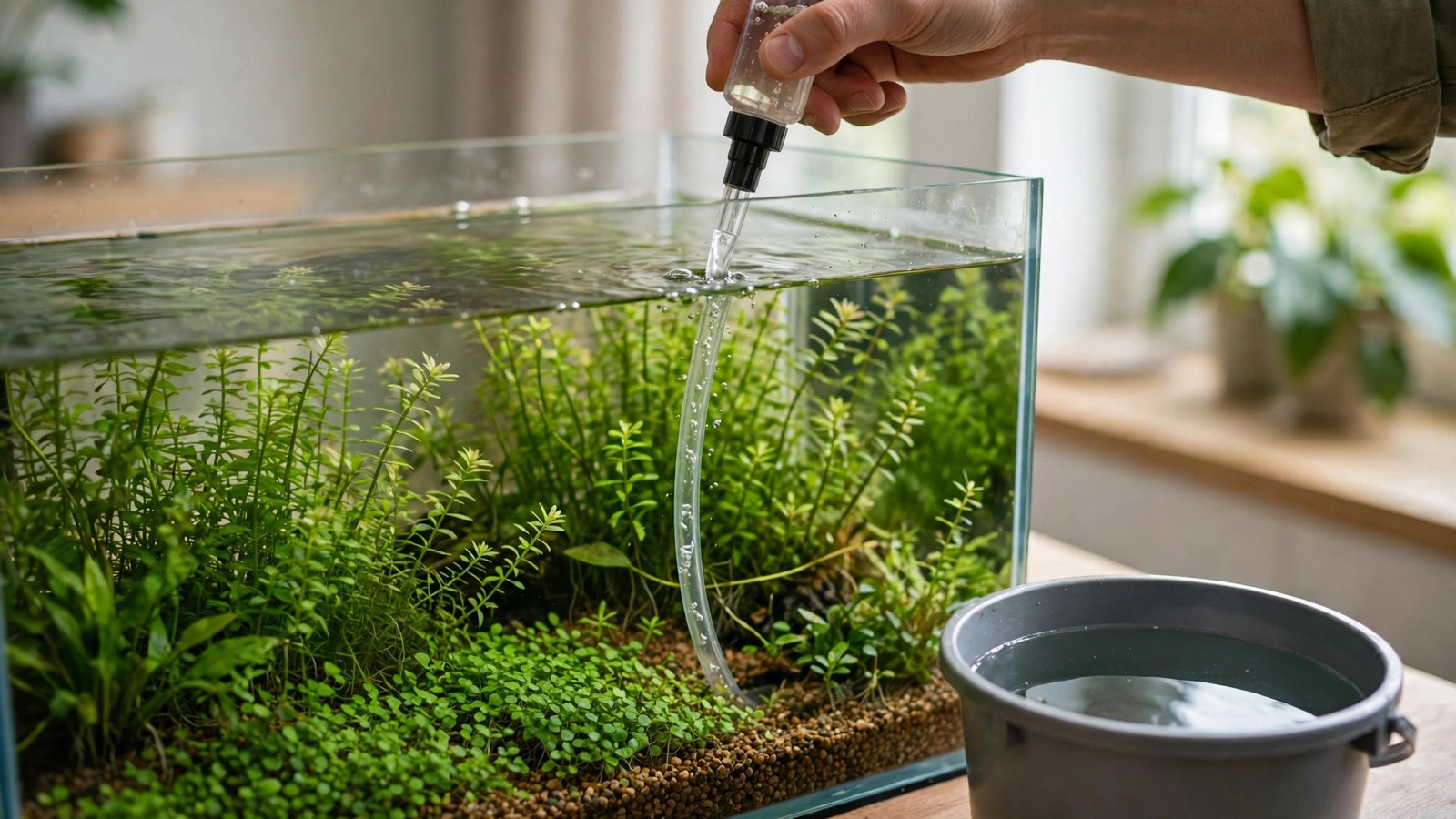
Most planted-tank advice gives you one number — usually a weekly percentage — and stops there. That number is a starting point, not a schedule. A heavily stocked, CO2-injected Dutch scape and a lightly stocked low-tech jungle do not accumulate waste at anything like the same rate, so they should not share a water-change routine.
The schedule that works is matched to your setup, then adjusted by what your test kit tells you.
Direct answer: Change 20–30% weekly in most planted tanks; 30–50% weekly in high-tech CO2 tanks, and 20–25% every two weeks in mature, lightly stocked low-tech tanks. New tanks need more, not less, in the first month. Test nitrate weekly and let the trend decide whether to change more or less.
Start with this schedule
Pick your row, run it for a month, and judge it on test results and plant growth. Consistency matters more than precision: a steady 25% every Sunday beats a heroic 60% whenever you remember.
| Setup | Change | How often | Why this amount |
|---|---|---|---|
| High-tech, CO2 injected, EI-style dosing | 50% | Weekly | Resets the generous nutrient dosing before excess feeds algae |
| High-tech, moderate dosing | 30–40% | Weekly | Clears organics and restores buffering without stripping nutrients |
| Medium light, liquid fertilizer, moderate stocking | 25–30% | Weekly | The default most planted tanks settle on long-term |
| Low-tech, no CO2, light stocking | 20–25% | Every two weeks | Slow growth produces waste slowly; plants consume much of the nitrate |
| Walstad-style soil tank, very light stocking | 10–20% | Every 2–4 weeks | Soil and dense plants handle much of the load; large changes disturb the balance |
| New tank, first month | 30–50% | Twice weekly | Dilutes ammonia and organics while the filter matures |
Measure volume against actual water, not nominal tank size: substrate and hardscape mean a 20-gallon tank may hold closer to 16 gallons.
Why your setup changes the answer
Three forces set how fast water quality drifts: waste going in, plant uptake, and dosing added on top. High-tech tanks score high on all three, so they accumulate organics and excess nutrients quickly — which is why estimative-index dosing pairs generous feeding with a 50% weekly reset.
Low-tech tanks invert the equation. Slow growers such as Anubias, Java fern and Cryptocoryne take up nutrients gradually and feeding is lighter, so waste accumulates at a pace a fortnightly change can handle. Tropica's maintenance guidance makes the same distinction from the other direction: up to 50% twice a week during the vulnerable start-up weeks, settling to around 30% weekly once biological balance is established.
Stocking cuts across both categories: a low-tech tank packed with livebearers can need weekly changes, while a lightly stocked high-tech tank may hold steady on less. If your setup straddles two rows, pick the more frequent one and let the nitrate trend talk you down.
Signs your schedule is off
Test nitrate the same day each week, just before the change, and write it down. One reading tells you little; four weeks of readings tell you whether your schedule is keeping pace.
Change more, or more often, when nitrate climbs week on week toward 40 ppm, when algae appears between changes, or when pH drifts noticeably — a sign buffering is wearing thin.
Change less when nitrate sits near zero for weeks and plants look pale despite adequate light and fertilizer: you may be diluting nutrients faster than the tank can use them. Drop to a smaller or less frequent change, hold it for three weeks, and watch new growth.
Special cases: new tanks, shrimp and holidays
New tanks deserve the most aggressive schedule here, not the most relaxed. During the first three to four weeks the filter is still establishing and plants are shedding emersed leaves, so two 30–50% changes a week keeps ammonia low; taper to weekly once ammonia and nitrite read zero for two consecutive weeks. Our companion guide to water-change technique for planted tanks covers the siphoning itself.
Shrimp tanks reward smaller, steadier changes. Caridina species react badly to sudden shifts in dissolved solids, so 10–15% weekly usually beats 30% fortnightly. Match temperature and minerals carefully, and do not trim, rescape or start a new dose on change day — one variable at a time.
Holidays are the one time skipping is fine. A healthy, mature tank handles two to three weeks without a change if you feed lightly, with a normal change the day before you leave and the day after you return. Do not compensate with a huge change on return day.
Build a routine you will actually keep
The best schedule is the one you do. Anchor the change to a fixed day, keep the siphon and bucket in one place, and prepare replacement water the night before if your tap runs cold in winter. If the routine itself is what puts you off, a drain-and-fill setup removes the bucket brigade entirely — see Water Changes Without the Mess: Home Plumbing Setups for Aquarists. Dose liquid fertilizer after the change, not before.
Revisit the schedule whenever the tank changes — new fish, stronger light, starting CO2, or a rescape that removes half the plant mass. If you are still unsure whether your tank needs changes at all, read whether aquarium plants need water changes first: yes, even in dense plantings, because plants cannot replace depleted minerals on their own. Fold your schedule into a full planted-tank maintenance schedule, and note that topping off is not a substitute — topping off versus water changes explains why top-offs concentrate dissolved waste instead of removing it.
Frequently asked questions
Can I change water less often if my tank is heavily planted?
Sometimes. Dense planting helps only if uptake keeps pace with waste input: a heavily planted, heavily stocked tank still needs weekly changes, while a heavily planted, lightly stocked one is where fortnightly changes genuinely work. Test nitrate for a month before stretching the interval.
Is a 50% weekly change too much for fish?
Not if replacement water matches temperature and is dechlorinated — large regular changes are standard in high-tech setups. What stresses fish is a sudden shift in temperature, pH or hardness, or neglect followed by a massive change. Steady and matched beats small and erratic.
Should I vacuum the substrate during every water change?
Skim debris and siphon open areas lightly each time, but avoid deep vacuuming through planted substrate: it disturbs roots and nutrient layers. Deep cleaning is a rare job for unplanted zones, not a weekly habit.
Does a water change remove fertilizer I just dosed?
Yes, partly — which is why you dose after the change. In EI-style routines the weekly reset is deliberate: dose generously through the week, reset with the change, and start again. For the dosing side of that reset, see How to Dose Liquid Fertilizer Without Causing Algae.