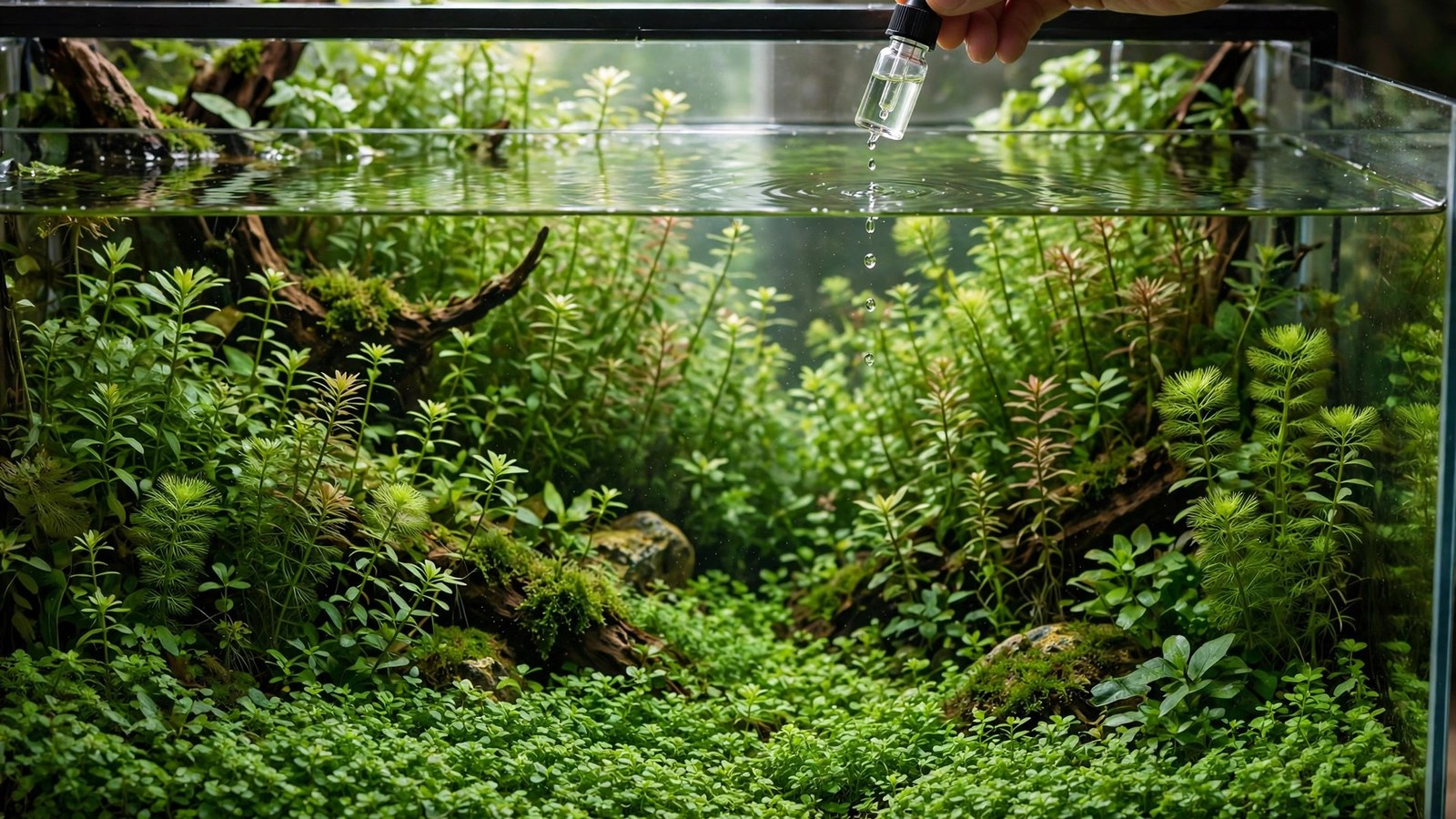
Most aquarists blame the bottle. A few days after the first dose, green dust appears on the glass or hair algae threads the moss, and the fertilizer gets binned. Yet the same dose in a balanced tank grows nothing but plants — which tells you the bottle was rarely the whole story.
The real question is not whether to dose, but how much your plants can actually use at your light level, and how steadily you deliver it. Get those two things right and liquid fertilizer becomes the safest part of your routine, not the scariest.
Direct answer: Dose liquid fertilizer without causing algae by starting at half the label dose, dosing 2–3 times a week instead of one large weekly dose, and fixing light and CO2 stability before you increase anything. In a low-light tank without CO2, a lean dose once or twice a week is usually enough; in a high-light CO2 tank, plants need regular, fuller dosing, and starving them is what invites algae. Judge the dose by new growth over two weeks, not by the glass on day two.
Why fertilizer alone rarely causes algae
Algae spores are already in every tank. They stay invisible while plants dominate and take off when plants stall. A stalled plant stops absorbing nutrients, leaks organics as leaves decay, and leaves light and CO2 unclaimed — exactly the opening algae needs.
The most common triggers are excess light for the plant mass present, CO2 that swings up and down, and decaying leaves left in the tank. Nitrate and phosphate alone have been dosed at high levels in thriving tanks for decades without producing algae. What causes trouble is a sudden change: a doubled dose, a light run at full intensity, or a CO2 bottle that ran out unnoticed. Stability beats any single number.
So before you cut fertilizer, check the real suspects in order: light duration (8 hours is a sensible ceiling), CO2 consistency, filter maintenance, and dead leaves. If those are steady and algae still appears within days of dosing, only then is the dose itself likely at fault.
Start lean and let plants tell you
Forget the idea that the label dose fits every tank. Labels assume a moderately planted, moderately lit tank; a sparse new scape, a low-light tank, or a tank with few fish needs far less. Start at half the label dose and watch new growth — not old leaves, which rarely recover — for two weeks.
Healthy new growth is compact, well coloured, and free of holes or transparent patches. Pale new leaves often point to iron or nitrogen shortage; pinholes in older leaves suggest potassium shortage. If new growth looks good, hold the dose; if it looks hungry, raise it by roughly a quarter and wait another two weeks.
A comprehensive liquid such as Seachem Flourish ★4.7 suits this lean approach well, because it supplies trace elements without loading the water with nitrogen and phosphorus. That makes it a forgiving first bottle for low-tech tanks, where fish waste already contributes some macronutrients.
As an Amazon Associate, this site earns from qualifying purchases made through links on this page, at no extra cost to you. Ratings shown were recorded when each product page was verified as live and in stock.
Pick a dosing method that fits your tank
There is no single correct method — only one matched to your light and CO2. Pick one and stick with it for a month; mixing methods mid-month creates the instability you are trying to avoid.
| Method | How it works | Best for | Water changes |
|---|---|---|---|
| Lean dosing | Half label dose, 1–2 times per week | Low light, no CO2, slow growers | 25% weekly |
| Estimative Index (EI) | Generous alternate-day macros and micros | High light with CO2, fast growers | 50% weekly to reset levels |
| All-in-one daily | One measured daily dose of a complete fertilizer | Medium light, mixed tanks, busy keepers | 30–50% weekly |
EI targets show how much a high-energy tank can consume: commonly cited weekly ranges run around 5–30 ppm nitrate, 1–2 ppm phosphate, 10–30 ppm potassium, and 0.2–0.5 ppm iron, with CO2 at 20–30 ppm. Those are not goals for a low-tech tank — they remind you that well-lit, CO2-injected tanks need far more than beginners expect, and under-dosing them causes the deficiencies that invite algae.
For a medium-light tank you want to keep simple, an all-in-one such as Thrive Planted Aquarium Fertilizer ★4.6 covers macros and micros in one bottle, removing the guesswork of mixing separate products. Dose it daily in small amounts, and keep the weekly water change that resets the system.
The weekly routine that keeps dosing stable
A repeatable week beats a perfect dose. Here is a routine for most planted tanks:
- Water-change day: Change 25–50% of the water, prune dead leaves, clean the filter pre-filter, and dose after the change so fresh water dilutes the dose evenly.
- Midweek: Dose again at the same small amount. In EI-style tanks this is a second or third dose; in lean tanks it may be the only midweek dose.
- Daily check: Glance at the drop checker in CO2 tanks and at new growth tips. A checker that stays green through the photoperiod matters more than any fertilizer adjustment.
- End of week: If algae increased, do not double the next dose or stop dosing entirely. Hold steady, shorten light by one hour, and remove algae by hand.
When algae appears anyway, troubleshoot in this order
If algae shows up after you start dosing, work through this sequence before changing the fertilizer. Most cases resolve at step one or two:
- Light: Cut the photoperiod to 6–7 hours for two weeks and reduce intensity if your light has a dimmer. Light is the accelerator; fertilizer is only the fuel.
- CO2: Confirm CO2 starts 1–2 hours before lights-on and stays stable. A drop checker that swings from blue to yellow across the day is a bigger algae trigger than any dose.
- Decay: Remove melting leaves, vacuum detritus, and cut back feeding for a week. Decaying organics release ammonia, the nutrient form most closely tied to algae blooms.
- Dose: Only now halve the dose for two weeks. If algae slows and plants stay healthy, you found your ceiling. If plants pale while algae continues, the problem was never the dose — return to the previous level and revisit light and CO2.
- Plant mass: Add fast growers such as hornwort temporarily. More healthy plant mass outcompetes algae for the same nutrients.
Further reading backs this order: the 2Hr Aquarist dosing guide compares lean and EI approaches, and the Barr Report EI guide sets out the classic ranges and CO2-first logic.
Companion article: if you’re seeing algae and aren’t sure fertilizer is the cause, start with Why Does My Tank Get Algae When I Add Fertilizer? — it covers diagnosis, while this article covers the dosing method.
Frequently asked questions
Should I stop fertilizing if algae appears?
No — stopping entirely starves plants and usually makes algae worse within two weeks, because stalled plants decay and release organics. Halve the dose, shorten light, and remove algae by hand instead.
Can I dose fertilizer on water-change day?
Yes, and it is the best day to dose. Dose after the water change so fresh water mixes the fertilizer evenly, and keep the amount the same each week so levels stay predictable.
Do low-light tanks need liquid fertilizer at all?
Often very little. In a lightly stocked, low-light tank, fish waste and tap water may cover much of the demand. A half label dose once or twice a week is a safe starting point.
Does fertilizer harm shrimp or snails?
Standard liquid fertilizers dosed as labelled are generally shrimp-safe, but invertebrates are more vulnerable to overdosing. Start lean and dose precisely with a syringe or measuring cap.