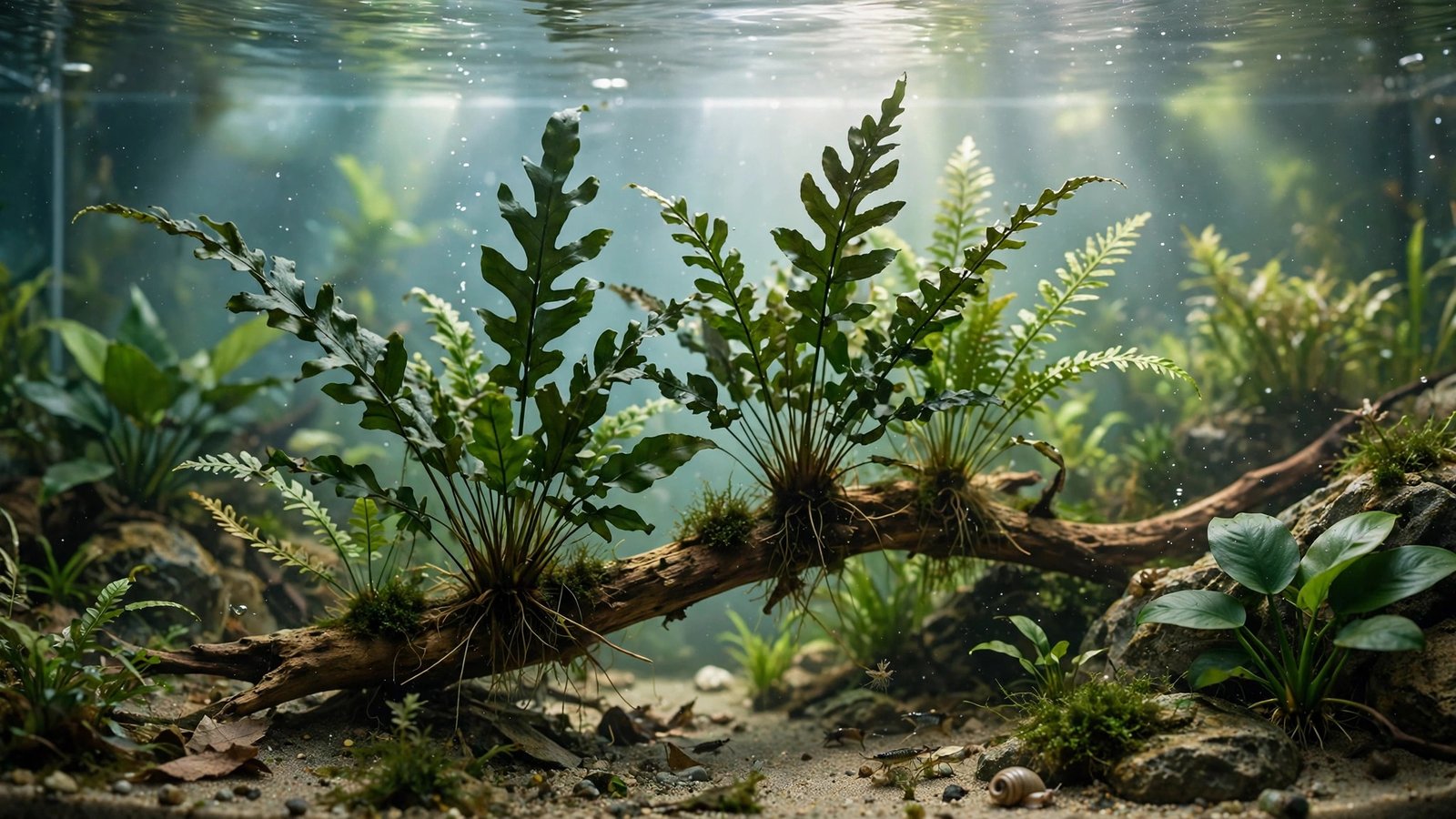
Most beginner plants come with a catch: bright light, pricey substrate, or CO₂. Among aquarium plants, Java Fern is the rare exception — tie it to a piece of wood, park it under a stock LED, and ignore it for weeks. If your first tank has ordinary lighting and zero fancy gear, this plant makes you feel like you know what you're doing. For the full how-to, see the Java Fern care guide covering lighting, CO2, fertilizer, and growth.
Aquarium plants java fern: why this classic is the easiest beginner win
Beginner tanks fail for predictable reasons. The stock light is too dim for the plants the store recommended, the gravel has zero nutrients, and nobody mentioned CO₂. Java Fern simply doesn't care about any of that. In the wild it clings to rocks and roots in shaded rainforest streams, so a dim aquarium with plain gravel and no injected CO₂ feels like home.
The numbers tell the story. Carpeting plants demand 60+ PAR and CO₂ to survive; Java Fern is comfortable at 20–40 PAR — exactly what a basic LED strip on a 10-gallon kit delivers. It feeds from the water column, so your bag of inert gravel is perfectly fine. You spend your budget on the plant, not on upgrading the tank to suit it.
The rhizome changes everything you thought planting meant
Almost every beginner kills their first plants the same way: they bury them. Java Fern refuses to play that game. Its horizontal rhizome — the thick green stem all the leaves sprout from — must stay exposed to the water. Bury it in substrate and it rots within weeks, and the whole plant follows. This single habit causes most "mystery Java Fern deaths."
Flip the failure around and it becomes the plant's superpower. Because it never needs planting, Java Fern works in bare-bottom quarantine tanks, shrimp cubes, and goldfish tanks with coarse gravel. You anchor it to what you already have — driftwood, lava rock, even filter hardware — with cotton thread, fishing line, or cyanoacrylate gel glue. To see exactly why burial kills it, read about why planting Java Fern in substrate goes wrong, and learn to attach Java Fern to driftwood or rock the right way.
How Java Fern stacks up against the other beginner epiphytes
Java Fern isn't the only low-light epiphyte, but it wins the beginner contest on balance. Here's how the usual suspects compare:
| Trait | Java Fern | Anubias | Bolbitis |
|---|---|---|---|
| Minimum light | Low (20–40 PAR) | Very low (15–30 PAR) | Low–medium (30–50 PAR) |
| Growth speed | Slow | Very slow | Slow |
| Size (mature) | 15–30 cm tall | 5–15 cm (nana) | 15–40 cm, bushy |
| Fish resistance | Excellent — bitter leaves | Excellent | Good |
| Algae on leaves | Occasional | Common (very slow growth) | Rare |
| Propagation | Plantlets on leaves | Rhizome division | Rhizome division |
Anubias tolerates dimmer light, but its near-frozen growth means algae on a leaf stays for months. Bolbitis is gorgeous but pickier about flow and transitions. Java Fern sits in the sweet spot: fast enough to outgrow minor algae, tough enough for inconsistent care. Want a second epiphyte? The Bolbitis heudelotii care profile is the natural next step.
Tough leaves that survive real beginner tanks — and real fish
A beginner's tank is a rough neighborhood: fluctuating parameters, algae blooms, and fish that treat soft plants as salad. Java Fern's thick, leathery leaves contain compounds most fish find unappetizing — it's one of the few plants that survives goldfish, silver dollars, and boisterous cichlids. See the full rundown of which fish eat Java Fern (and which leave it alone).
The slow growth high-tech aquascapers complain about is a beginner feature, not a bug. A fast stem plant in a dim tank melts overnight and fouls the water; Java Fern just sits there, adding one to two leaves a month, never causing a crash. That stability is why veterans recommend it as the first plant in a brand-new cycle.
One plant becomes ten: propagation for free
Here's the part that converts beginners into plant people: after a few months, mature leaves grow tiny replicas of themselves — miniature leaves and roots — on the leaf surface. At 2–3 cm, gently pull them off and tie them wherever you want the next plant.
No tools, no technique, no cost. A single $8 pot can populate a 20-gallon tank within a year, and each daughter plant is already adapted to your water. The fancier Windelov lace variety propagates exactly the same way, if you want a fringed look later.
Where to buy healthy Java Fern: potted vs tissue culture
You'll find Java Fern in two formats. Potted plants ($6–$10) are cheap and already a decent size — perfect for instant impact. Tissue-culture cups cost a few dollars more but arrive sterile: no snails, no algae, no pesticides. For a first tank, tissue culture is the safer buy — snail infestations are a classic beginner headache you can simply opt out of.
Inspect before buying: leaves firm and deep green, rhizome firm (not mushy), no slime. Rinse potted plants well and discard the rockwool. Worth bookmarking: Tropica's Java Fern database entry for the botanical details, and ADA's nature aquarium plant library for epiphyte aquascaping inspiration.
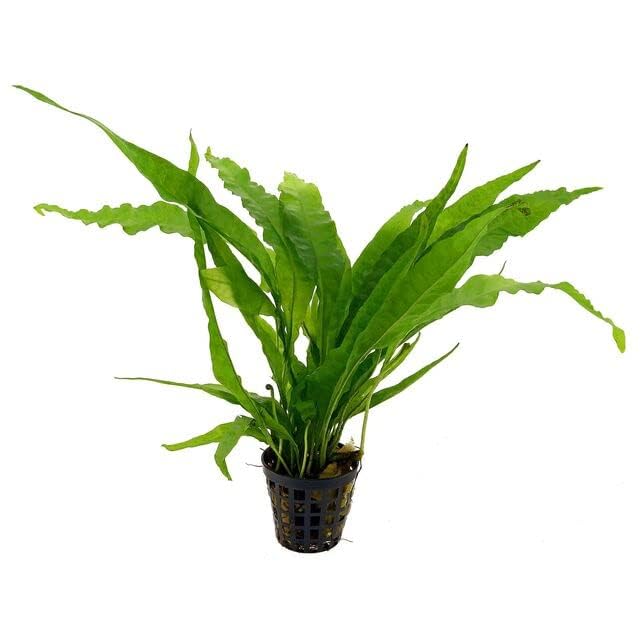
Dedicated buying section compares potted vs tissue culture; a potted Java Fern pack is the exact purchase: potted Java Fern.
 ★4.3
AquaLeaf Aquatics Potted Java Fern 5 Pack
Check Price on Amazon ★4.3Frequently Asked Questions
Can Java Fern grow in low light without CO2?
Yes — that's its defining trait. Java Fern thrives at 20–40 PAR from a basic LED and needs no injected CO2, absorbing nutrients through its leaves and rhizome. In low light it grows slowly but steadily; brighter light only speeds growth modestly while raising the algae risk on its leaves.
Why is my Java Fern turning brown or melting?
The most common cause is a buried rhizome — covered rhizomes rot and the whole plant declines. Old leaves also melt naturally after sprouting plantlets, which is normal. New leaves melting within a week of purchase is usually transition shock from nursery-grown emersed form; leave the rhizome intact and fresh submerged leaves will follow.
How do you attach Java Fern to driftwood?
Press the rhizome against the wood and secure it with cotton thread, fishing line, or a small dab of cyanoacrylate gel super glue. Keep the rhizome fully exposed above the surface it's tied to. Roots grip on their own within 3–6 weeks, after which you can snip away the thread.
Will goldfish or cichlids eat Java Fern?
Usually not. Java Fern's thick, leathery leaves contain compounds most fish find bitter, so it survives goldfish, silver dollars, and many cichlids. Very determined or hungry fish may nip fresh new growth, but established plants are overwhelmingly left alone — it's the go-to plant for tanks where softer species get shredded overnight.
How fast does Java Fern grow and spread?
Slowly — expect 1–2 new leaves per month in low light and up to 25–30 cm tall at maturity. It spreads via plantlets sprouting on mature leaves; detach them at 2–3 cm and attach them elsewhere. One plant can colonize a whole tank within a year this way, entirely for free.
Do I need fertilizer for Java Fern?
Not strictly, but a little helps. In low-light tanks with fish, fish waste often supplies enough nutrients. If new leaves emerge pale or stunted, dose a half-strength all-in-one liquid fertilizer weekly. Skip root tabs entirely — Java Fern feeds from the water column, not the substrate.
Java Fern earned its reputation by removing every variable that kills beginner plants: no substrate demands, no CO₂, no bright light, no delicate leaves. Tie one rhizome to a piece of wood this weekend, and in a year you'll be giving plantlets to friends.