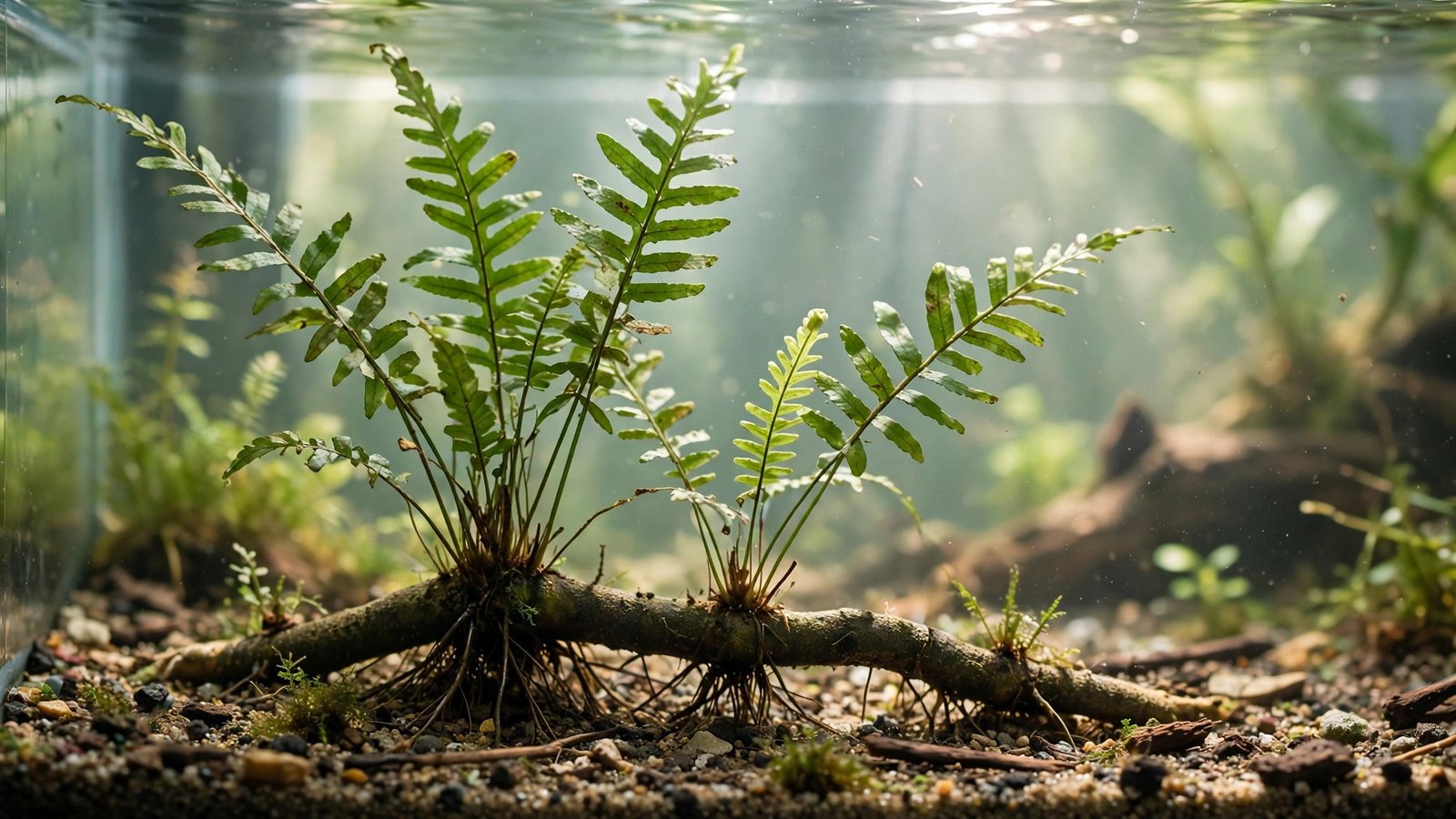
No — never bury a Java fern's rhizome in substrate. So, can you plant Java fern in substrate? The roots can rest on gravel, but burying that thick horizontal rhizome suffocates it, and within two to three weeks it turns to black mush. It's the costliest beginner mistake with this plant, because the fern looks fine while the rot spreads underground.
Why "Planting" Means Something Different Here
Java fern has no crown or stem to push into gravel. The thick green "root" along its base is the rhizome — a horizontal stem packed with meristem tissue that produces every leaf and frond. Its fine hair-like roots are mostly anchors that grip rock and wood, feeding from the water column rather than soil. In its native Southeast Asian streams, java fern clamps onto submerged roots and rocks where current washes over every surface — Wikipedia's species entry confirms this epiphytic habit. That rhizome evolved to breathe in flowing water; bury it in gravel or aquasoil and stagnant, low-oxygen conditions invite anaerobic bacteria that break it down. You lose the plant's entire growth engine, which is why the mistake is fatal rather than cosmetic. New to this species? Start with our complete java fern care guide for light, CO₂, and fertilizer basics.What Happens When You Bury It (Day by Day)
A buried java fern doesn't die immediately — it holds its leaves up for a while, so you assume all is well while rot spreads out of sight. Days 1–4: nothing visibly changes. Cut off from water flow, bacteria colonize the rhizome's surface — especially where it was pinched during planting. Days 5–10: soft spots. The rhizome feels spongy in places, brown patches show at older leaf bases, and new fronds stop unfurling. Often misread as "adjustment melt," this is the first stage of rhizome rot. Days 11–21: collapse. Patches turn black and travel the rhizome's length; tissue goes translucent and mushy, and often smells foul. Leaves detach at the base with almost no resistance. By now the rhizome is usually finished — though tissue ahead of the rot front can still be saved (see below). Fine aquasoil and bruised rhizomes speed this up: low-oxygen substrate plus planting wounds can turn a rhizome black in under a week.Can you plant Java Fern in substrate? The right way to anchor it
Every correct method follows one rule: the rhizome stays 100% above the substrate line. Roots may dangle into the gravel — they don't rot the way rhizome tissue does. Three proven approaches: 1. Tie it to hardscape. Wrap cotton thread or fishing line around the rhizome and driftwood or rock. Cotton dissolves in a few months, by which time the roots have gripped the surface. Gentle, with no pressure points. 2. Glue it. A dab of plain cyanoacrylate gel between the rhizome and a rock or wood surface sets in seconds. Nearly invisible once roots cover it, and strong enough for water changes. Glue the rhizome only — never leaves. 3. Wedge it into a crevice. Tuck the rhizome into a lava-rock crack or driftwood fork. Roots lock it in within weeks — the most natural-looking option, zero materials needed. Same rule covers every epiphyte: Anubias, Bucephalandra, and African water fern all demand rhizome-above-substrate placement. Learn the habit once and it transfers.The Exceptions (and Fine Print)
Two situations where java fern can coexist with substrate — both follow the same rule in disguise: Roots in substrate, rhizome out. Pushing only the hair-like roots into gravel while the rhizome rests fully on top is fine. But it's fragile — gravel shifts during water changes, and a roots-only planting quietly becomes a buried rhizome. Check it after every disturbance. Resting on a substrate slope. Some aquascapers settle the rhizome on the substrate surface at a hardscape base. It looks planted, but the rhizome sits above the line, not in it. In high-flow tanks, substrate creeps over it — and you're back in rot territory. What about the mesh pots and lead weights plants arrive in? Rock wool and weights are shipping materials, not homes. Buce Plant's java fern notes state it plainly: burying the rhizome will kill the plant. Peel off the rock wool, remove the weight, and anchor the rhizome to hardscape from day one. The same rules apply to the crested Windelov variety — and if you need filler around anchored fern clusters, subwassertang pairs well, while water sprite is a genuinely substrate-free floater.Rescue: What to Do If It's Already Buried
Caught early, java fern is remarkably forgiving. Work through these steps: 1. Dig it up gently. Slide fingers under the rhizome and lift — yanking tears roots and bruises it further. 2. Inspect and smell. Squeeze along its length. Firm green sections are alive; black, brown, or mushy sections are dead. A sour smell confirms active rot. 3. Cut away all dead tissue. With clean scissors, trim at least 5 mm into firm tissue past every mushy spot. Be ruthless — leftover soft tissue lets rot keep traveling. If the whole rhizome is mush, salvage leaf plantlets (step 5). 4. Re-anchor properly. Tie, glue, or wedge the surviving rhizome onto hardscape, fully exposed. Don't replant it in substrate, even temporarily. 5. Salvage the plantlets. Check older leaves for tiny baby ferns along edges or tips — the plant's backup plan. Detach any with their own leaves and roots and anchor them. Even a doomed mother plant restarts the colony for free. 6. Give it time. Expect two to four weeks of no growth while the trimmed rhizome calluses. New fronds from the cut ends mean you're in the clear. And remember: black dots on leaf undersides aren't rot — they're sporangia (spore clusters), normal on healthy java fern.Frequently Asked Questions
Can I plant java fern in gravel if I only cover the roots?
Yes — fine roots into gravel is fine, but the thick rhizome must sit fully exposed above it. It's unstable: gravel shifts during water changes and roots-only plantings quietly become buried rhizomes. Check it after every disturbance.
Will a buried java fern recover if I dig it back up?
Usually, if caught early. Dig it up, keep only firm green sections, and cut every mushy or black part away — 5 mm into healthy tissue. Re-anchor with the rhizome exposed. Expect 2–4 weeks of no growth while it calluses; if the whole rhizome is mush, salvage leaf plantlets.
Why do stores sell java fern in pots with rock wool?
Rock wool and lead weights are shipping containers, not growing instructions. At home, peel the rock wool off gently, remove the weight, and tie or glue the rhizome to hardscape. Treating the retail pot as a planting guide is how most beginners bury rhizomes.
Can java fern grow floating?
Yes, but growth is slower — floaters get shaded and tossed by flow. Treat floating as a holding pattern: fine for rescued plantlets or quarantine, not a permanent home for a display plant.
How do I tell rhizome rot from normal leaf melt?
Melt affects leaves only — they go translucent after a tank change while the rhizome stays firm and green. Rot is the reverse: the rhizome turns brown, then black and mushy, and leaves detach whole. Firm and green means melt; spongy, dark, or foul-smelling means rot.
The Bottom Line
Java fern is one of the easiest plants in the hobby — if you don't treat it like one that needs soil. Keep the rhizome on rock or wood, let the roots grab hold, and it grows for years. Bury it and you buy a two-week lesson in rot. Anchor it right once.