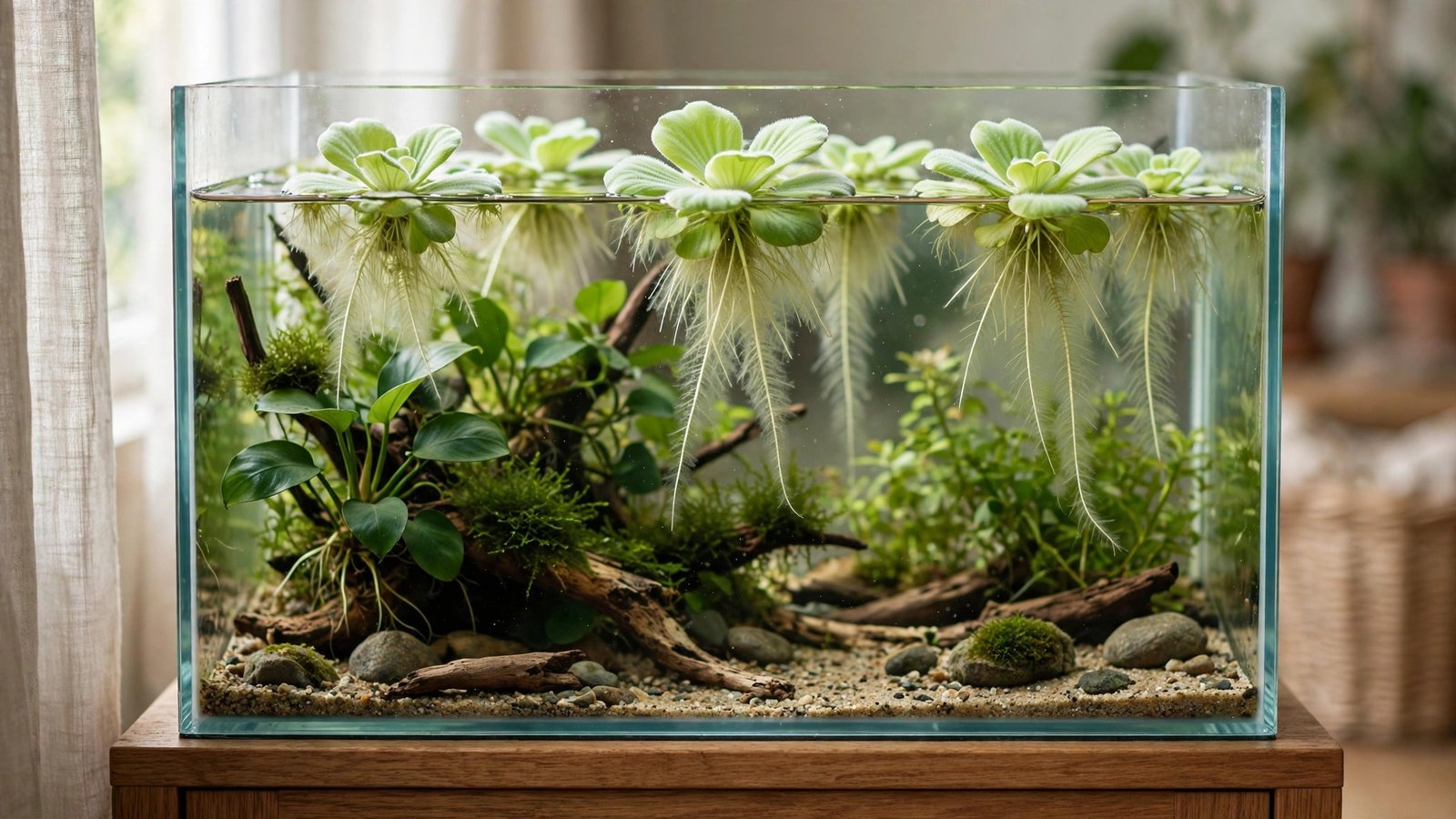
Few aquarium plants make as strong a first impression as water lettuce. With its velvety rosettes of pale-green leaves floating like tiny cabbages and feathery roots dangling below, Pistia stratiotes looks effortless — yet many aquarists watch a thriving colony melt away within weeks. Proper water lettuce aquarium care comes down to understanding one thing: this is a pond plant first and an aquarium plant second, and the conditions that make it happy are slightly different from what most tanks provide. Get the light, airflow, and surface conditions right, and water lettuce rewards you with rapid growth, crystal-clear water, and some of the best natural fry shelter in the hobby.
It is also worth knowing up front that water lettuce is classified as invasive in several regions and is regulated or banned in parts of the United States and other countries. Check your local regulations before you buy, and never release it into waterways. More on responsible keeping at the end of this guide.
Water Lettuce Aquarium Care: Meet the Plant
Water lettuce (Pistia stratiotes) is one of the most recognizable floating plants in the aquarium trade. Its leaves form a tight rosette of ribbed, spongy, velvety foliage, and a well-kept rosette can reach 10–15 cm across. Colonies can carpet an entire surface surprisingly fast.
Unlike rooted plants, water lettuce draws everything it needs — nutrients, minerals, and carbon dioxide — directly from the water through its roots and from the air through its leaves. This makes it a phenomenal nutrient sponge: excess nitrate, phosphate, and trace minerals that would otherwise feed algae are absorbed into new growth. Many aquarists use it as a living filter in breeding tanks and shrimp setups.
At a Glance: Care Parameters
| Parameter | Target Range |
|---|---|
| Light | Moderate to high (30–50 µmol/m²/s at surface) |
| Photoperiod | 8–10 hours per day |
| Temperature | 22–28 °C (72–82 °F); growth stalls below ~20 °C |
| pH | 6.0–7.5 (tolerant but prefers neutral to slightly acidic) |
| Water flow | Gentle; avoid strong surface agitation |
| Nutrients | Moderate nitrate (5–20 ppm); benefits from comprehensive liquid fertilizer |
| Tank type | Best in open-top tanks; struggles under tight lids |
| Growth rate | Fast — doubles in 2–3 weeks under ideal conditions |
| Difficulty | Easy in ponds, moderate in aquariums |
Light: The Make-or-Break Factor
Water lettuce has a high light appetite. In outdoor ponds it basks in full sun, and the dimmer lighting of many home aquariums is the most common reason indoor colonies underperform. Aim for moderate to high light at the water surface — the plant sits right at the top, so it usually gets the brightest light in the tank, but low-output kits and deep tanks can still leave it wanting.
If your rosettes are staying small, pale, or spreading their leaves flat and leggy instead of forming the classic cupped rosette, light is the first thing to suspect. An affordable upgrade often solves the problem; see our guide to upgrading your aquarium light on a budget before buying a new fixture. Keep the photoperiod to 8–10 hours — longer days rarely help and often just feed algae.
Light Positioning Tips
- Keep leaves dry and lit: leaves pressed against a lid or splashed constantly will rot. Open-top tanks or raised lights with good clearance are ideal.
- Watch for burn: too close to a powerful LED can bleach leaf centers. Raise the light or move some rosettes to one side to find the sweet spot.
- Uniform coverage: in long tanks, rosettes drifting into dark corners get shaded. Spread the colony rather than letting it bunch at one end.
Water Flow and Surface Conditions
Water lettuce hates being tossed around. Strong surface agitation from hang-on-back filters, powerheads, or airstones will push rosettes under, splash their leaves, and batter the roots. In nature it colonizes still backwaters and quiet pond edges, and it grows best when the water surface is calm.
If your filter output disturbs the surface, the simplest fix is a floating ring — a loop of airline tubing or a 3D-printed corral that keeps the colony fenced in a calm area while flow passes around it. This also limits how much of the surface gets covered (more below).
Nutrient Needs: Feeding the Fastest Grower in the Tank
Because water lettuce grows quickly and has no substrate to fall back on, it is a heavy feeder — but only from the water column. In a stocked tank with regular feeding, fish waste often supplies enough nitrate and phosphate to sustain it. In lightly stocked or heavily filtered tanks, however, it will yellow and shrink, and that is a sign to start dosing.
Fertilizer Strategy
- Comprehensive liquid fertilizer: a weekly dose of an all-in-one aquarium fertilizer covers micronutrients like iron, magnesium, and potassium that fast growers deplete first.
- Nitrate floor: aim to keep nitrate at or above 5 ppm. If your test kit reads zero in a tank with water lettuce, the plants are likely starving — and algae are waiting for their chance.
- Iron and yellowing: new leaves emerging pale with green veins point to iron or trace deficiency. Increase dosing gradually rather than correcting all at once.
- Fish load matters: in a moderately stocked tank, water lettuce can halve your nitrate readings between water changes. Re-test a week after adding a colony and adjust fertilizer accordingly.
Fast-growing floaters drain the water column quickly: a comprehensive liquid like Seachem Flourish.
Humidity and Airflow: Why Open-Top Tanks Win
This is the detail most care guides underplay, and it explains the classic mystery: water lettuce that thrives in an open tank but melts in a covered one — or the reverse. The leaves need moist but moving air. Under a tight-fitting glass lid, warm humid air stagnates, condensation drips continuously onto the rosettes, and the waterlogged crowns rot. In a very dry room with a strong fan, leaf edges can crisp instead.
The practical target is an open-top tank with gentle room air circulation. Avoid placing the tank under an air-conditioning vent that blasts dry air across the surface, and if you must run a lid (for jumping fish), use a mesh or egg-crate cover rather than sealed glass, and vent it daily. If the rosette centers are turning brown while the leaves stay dripping wet, excess humidity — not lack of it — is the problem.
Propagation: Runners Do the Work for You
Water lettuce reproduces by sending out stolons (runners), each of which forms a daughter rosette at its tip. A healthy mother plant can launch several runners at once, and within weeks you will have a colony — no seed-starting or special effort required.
To multiply intentionally, leave runners attached until the daughter rosette is roughly a third of the mother's size and has its own root tuft, then snip the runner. Because reproduction is vegetative, every daughter is a clone — which also means any pest or deficiency shows up across the whole colony at once, so inspect new additions before they join your tank.
Managing Roots, Crowns, and Colony Size
Root Length
Healthy water lettuce roots can reach 15–30 cm, drifting down like pale threads. In shallow tanks they pile on the substrate or drape over decor, which looks untidy and can tangle fry nets and filter intakes. Trimming is simple: lift the rosette and snip roots to 5–10 cm with clean scissors. Never tear them — ragged tears invite rot. The technique mirrors the method in our root pruning before replanting guide.
Thinning the Colony
A thriving colony doubles fast, and full surface cover shades everything below — starving light-hungry plants and suppressing gas exchange. Thin weekly once established, removing the smallest or oldest rosettes first and composting them (never flushing or dumping them). A good rule of thumb is no more than 30–50% surface coverage, unless the tank is deliberately a low-light refuge.
Crown Maintenance
Older rosettes push new leaves from the center while outer leaves yellow and die. Remove dead outer leaves promptly — decaying matter in the crown is the number-one starting point for crown rot. If a rosette's center turns brown and mushy, pull it immediately; it will not recover.
Corral rings keep the colony where you want it: floating plant corral rings.
 ★3.9
PAGOW Floating Plant Corral Rings
Check Price on Amazon ★3.9Preventing Shading: Protecting the Plants Below
Shading is the main reason aquarists fall out of love with water lettuce. A plant that is perfect for the top of the tank can be a death sentence for the scape underneath. Manage it deliberately:
- Use floating rings to confine the colony to one section of the tank, leaving a clear light corridor over demanding plants.
- Rotate position: every few days, nudge the ring to a different spot so no one area stays shaded permanently.
- Thin from below-facing light: remove rosettes directly above your most light-hungry plants first.
- Match companions: under a partial water lettuce canopy, choose shade-tolerant plants — hornwort and guppy grass both tolerate reduced light far better than carpeting species.
Why Water Lettuce Melts (and How to Fix It)
"Melting" — leaves turning translucent, then brown and mushy — has a few distinct causes, and the fix depends on getting the diagnosis right. Our guide to photographing aquarium plants for diagnosis can help you document symptoms if you need a second opinion, but start with this checklist:
The Melting Checklist
- Transition shock: plants shipped in the dark or moved between very different water chemistry often shed their outer leaves in the first 1–2 weeks. If the crown stays firm and new leaves are forming, wait — it is adjusting, not dying.
- Too little light: pale, small new leaves and a flat, spreading rosette. Raise light intensity at the surface.
- Cold water: below ~20 °C growth stalls and tissue weakens. Keep it in the tropical range.
- Condensation rot: brown, mushy crowns under a tight lid. Ventilate or switch to a mesh cover.
- Nutrient starvation: uniform yellowing of older leaves, shrinking rosettes. Test nitrate and start dosing.
- Chemical exposure: some algaecides and plant-safe claims notwithstanding, copper-based medications and certain anti-algae treatments damage floaters. Move water lettuce to a quarantine container during treatment.
- Pests: aphids colonize the leaf tops in warm, still air — blast them off with a strong jet of water or remove the worst leaves.
Work through the list in order. In most cases, the answer is light or airflow, not a mysterious disease.
Tankmates, Placement, and Practical Uses
Water lettuce's root curtain is outstanding fry and shrimplet cover — newborn livebearers and baby shrimp graze biofilm off the roots and hide from hungry tankmates. Betta keepers value it too: the shaded surface mimics their natural habitat, and the roots give bettas something to rest near.
Avoid pairing it with fish that eat or shred vegetation — goldfish and larger cichlids will dismantle a colony for fun. Keep roots clear of filter intakes with a pre-filter sponge.
If you want variety on the surface, water lettuce combines well with floaters that occupy different niches — Amazon frogbit and salvinia sit at different heights and textures, while red root floater adds color contrast. Each multiplies on its own schedule, so mixed surfaces need the same weekly thinning discipline.
A Responsibility Note: Invasive Species and Local Law
Water lettuce is one of the aquarium plants most frequently flagged by environmental agencies. It reproduces vegetatively, tolerates a wide climate band, and a single rosette washed into a warm waterway can found a population that mats over native habitat, blocks light, and depletes oxygen. For that reason it is banned or regulated in parts of the United States (rules vary by state), South Africa, and other regions — and listings change over time.
Responsible keeping is simple:
- Check before you buy: confirm water lettuce is legal to possess and trade in your state or country. University extension invasive-species pages, such as the University of Florida IFAS page on Pistia stratiotes, are authoritative references for status and risk.
- Never release it into ponds, lakes, rivers, storm drains, or wetlands — not even "just one rosette."
- Dispose of extras responsibly: seal thinnings in a bag and put them in the trash, or compost them fully. Never flush them or toss them outside.
- Buy from reputable sellers who can confirm the plant's origin and legality in your area; the Tropica plant database entry for Pistia stratiotes is a good species reference when verifying what you are buying.
Frequently Asked Questions
How fast does water lettuce grow in an aquarium?
Under strong light, warm water, and adequate nutrients, a healthy colony can double in two to three weeks, with each mother plant launching multiple runners. Growth slows dramatically below 20 °C, in dim light, or when nitrate reads zero. If yours is growing slowly, light intensity and fertilizer levels are the two levers to adjust first.
Why is my water lettuce turning yellow or melting?
Yellowing older leaves usually signal nutrient deficiency — most often low nitrate or missing micronutrients — while brown, mushy crowns point to condensation rot under a tight lid. Cold water and transition shock after shipping are other common causes. Check light, airflow, temperature, and nitrate in that order before assuming disease.
Can water lettuce grow in a tank with a lid?
It can, but it is harder. Sealed lids trap stagnant humid air and drip condensation onto the rosettes, which rots the crowns. If you need a lid for jumping fish, use a mesh or egg-crate cover with good ventilation rather than sealed glass, and wipe or vent condensation regularly. Open-top tanks remain the easiest setup for this plant.
Does water lettuce need fertilizer?
In a moderately or heavily stocked tank, fish waste often supplies enough nitrogen and phosphorus, but micronutrients like iron, magnesium, and potassium still run low in fast-growing colonies. A weekly dose of a comprehensive liquid fertilizer is cheap insurance, and in lightly stocked tanks it is effectively mandatory to prevent yellowing and stunting.
How do I stop water lettuce from taking over my tank?
Thin the colony weekly, removing the oldest and smallest rosettes first, and use a floating ring of airline tubing to confine it to part of the surface. Keeping coverage at 30–50% of the surface protects the plants below from shading and maintains gas exchange. Dispose of extras in the trash — never release them into waterways.
Is water lettuce good for betta fish or shrimp?
Yes — the dangling root curtain provides excellent cover and grazing surface for shrimplets and fry, and bettas appreciate the shaded, calm surface, which resembles their natural habitat. Just keep the roots trimmed enough to stay clear of filter intakes, and avoid strong surface agitation that would batter the rosettes.
Final Thoughts
Water lettuce asks for three things — good light, calm air, and steady nutrients — and in return gives you one of the hardest-working plants in the hobby: a nutrient sponge, a fry nursery, and a water purifier in one velvety rosette. Keep the colony thinned, the crowns dry, and the disposal responsible, and this pond classic will earn its place in your aquarium.