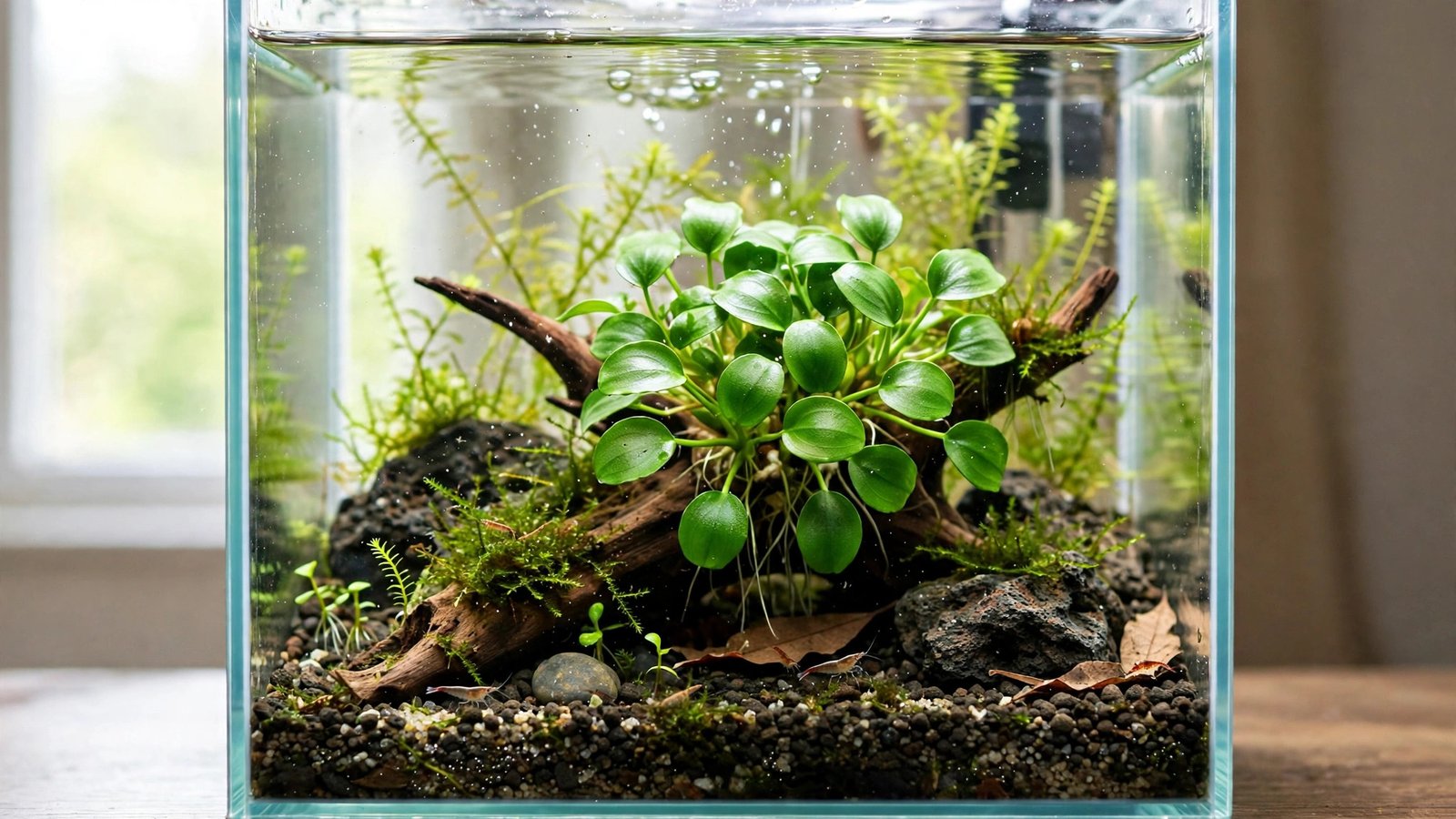
Walk into most planted tanks and you'd swear every dark-green rosette on the hardscape is anubias. Look closer at some of them and you'll find an imposter — one with smoother, slightly broader leaves and a softer green, growing happily in nano tanks where anubias would take over. That plant is most likely Schismatoglottis prietoi, and schismatoglottis prietoi care is even more forgiving than the anubias routine you're used to. By the end of this guide, you'll know how to plant its rhizome correctly, what it actually needs to thrive, and how to use it in small aquascapes.
The Anubias Lookalike: What's Actually Different
Schismatoglottis prietoi belongs to the aroid family, just like anubias and bucephalandra, which explains the resemblance. All three grow from a horizontal rhizome, all three prefer life attached to wood or stone, and all three tolerate low light. But prietoi has habits worth knowing before you treat it as a one-for-one anubias swap.
Its leaves are thinner and less rigid than most anubias, with a brighter green. It stays smaller — a mature clump rarely pushes past a few centimeters tall, where anubias would outgrow a nano tank. And it arrives almost exclusively as a tissue-culture cup (Tropica 1-2-Grow range), so there's no emersed-to-submerged melt. Rinse the gel, split the portion, plant it, and it just grows.
| Trait | Schismatoglottis prietoi | Typical Anubias |
|---|---|---|
| Leaf texture | Thin, smooth, soft green | Thick, waxy, deep green |
| Adult size | 3–7 cm tall | Often 10–25 cm+ depending on species |
| Growth speed | Slow — a leaf every few weeks | Slow to very slow |
| Lighting | Low to medium | Low to medium |
| Nano-tank fit | Excellent | Good for small species only |
| Purchase form | Usually tissue culture | Usually potted or on hardscape |
If you're weighing it against true anubias for a particular scape, our anubias care guide walks through the species-by-species differences in size and placement.
Schismatoglottis Prietoi Care: The Essential Routine
The routine is refreshingly short. Give it low to medium light, leave the rhizome exposed, dose a basic liquid fertilizer, and keep algae off the leaves. That's the whole job — this plant asks less of you than almost anything else in its category.
One caveat: "low light tolerant" doesn't mean no light. In a dim corner it survives but barely grows; under medium light you get steady new leaves. If you're unsure where your tank falls, our breakdown of how much light aquarium plants really need will help. CO2 is optional — most hobbyists keep it in plain low-tech setups. Nutrients come from the water column, so a lean all-in-one liquid fertilizer is enough; rich substrate under it helps nothing and risks burying the rhizome.
Water parameters are flexible: roughly 22–28 °C, pH anywhere in the soft-to-neutral range most community tanks run at. Stability matters more than any target number.
Planting the Rhizome the Right Way
The tissue-culture cup typically contains a small clump of plantlets on a shared or developing rhizome. Here's how to plant it:
- Rinse the nutrient gel off the roots under lukewarm tap water until nothing slimy remains.
- Gently tease the clump into 2–4 smaller portions with your fingers. Each portion should carry a piece of rhizome and a few leaves.
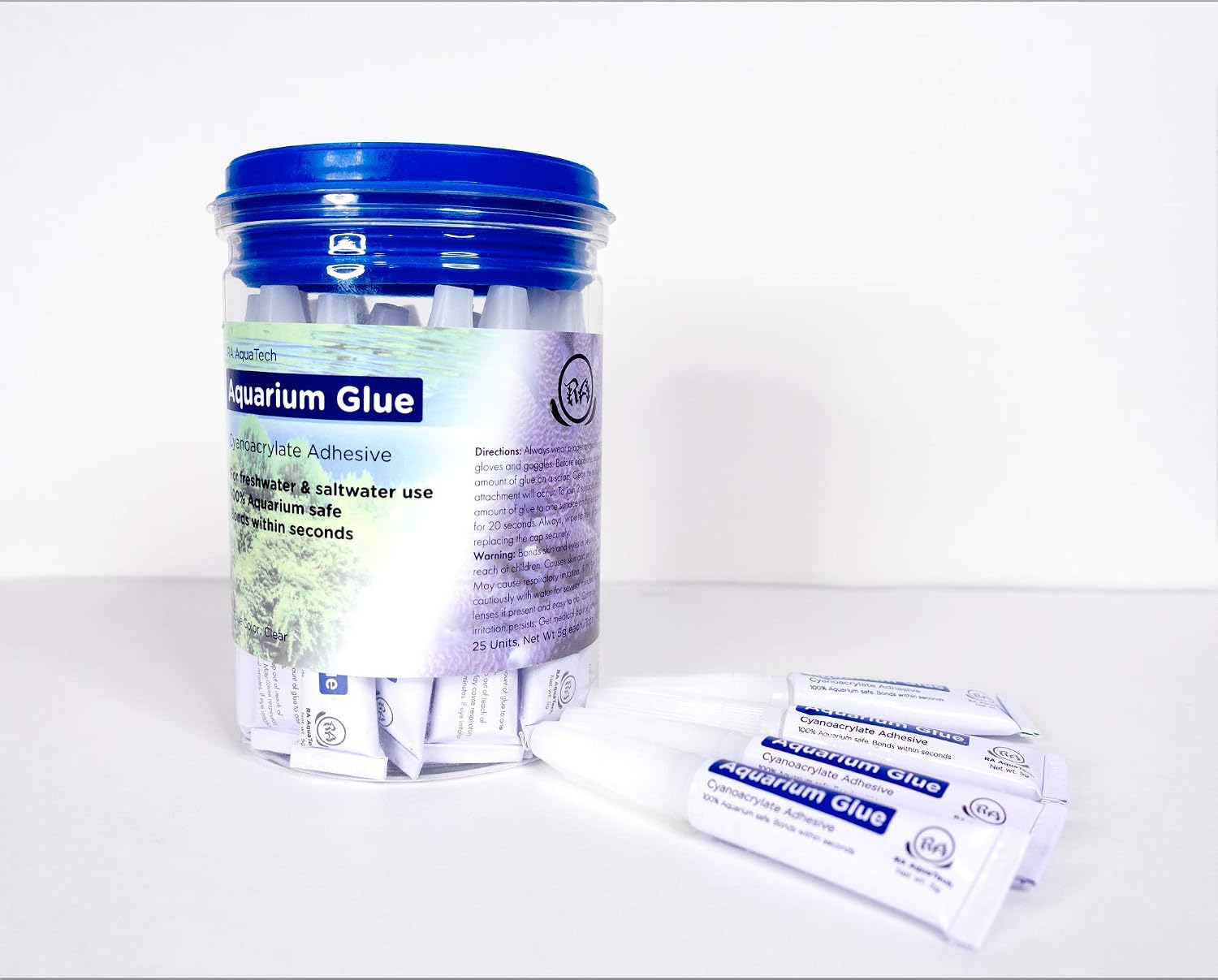
- Attach each portion to wood or stone with a dab of aquarium-safe gel superglue or a short length of cotton thread — the same method used for java fern and other epiphytes.
- Alternatively, nestle the portion into a crevice so the rhizome sits on the substrate surface while the roots dangle down.
- Leave it alone. New leaves emerge from the rhizome tip over the following weeks.
 ★4.3
RA AquaTech Aquarium Glue
Check Price on Amazon ★4.3Growth Rate and Everyday Maintenance
Set your expectations to slow and steady. In a typical low-tech tank, most hobbyists see a new leaf every two to four weeks — faster than anubias nana, but nothing like a stem plant. The payoff is a plant that never needs trimming to stay in scale. Yellowed older leaves pinch off cleanly at the rhizome.
Because the leaves are thin, they're more prone to spot algae than waxy anubias leaves if light runs high with little plant mass to absorb nutrients. Keep it in partial shade, run a 6–8 hour photoperiod while the tank matures, and the leaves stay clean. Algae that does appear wipes off gently with a soft toothbrush during water changes.
Propagation by Division
Once a clump has spread into a rosette several centimeters wide with multiple leaf stems, it's ready to divide. Lift it off the hardscape, find a rhizome section with at least three or four healthy leaves and some roots, and cut it with a clean blade. Reattach the new section exactly as you planted the original. A single tissue-culture cup can become three or four plantings within a year — which is why many hobbyists buy one cup for a nano tank and never need another.
Using It in Nano Tanks and Small Scapes
This is where Schismatoglottis prietoi earns its reputation. At 3–7 cm, it fills the niche between a moss carpet and a midground focal plant — perfect for 5–20 liter scapes where anubias barteri would be a bully and even anubias nana petite can feel chunky. It works as a foreground accent beside stone, a transition plant between carpet and hardscape, or a soft midground filler.
Good companions share its low demands and small scale: anubias nana petite for darker contrast, mosses for texture, and Cryptocoryne nurii as a slightly taller neighbor in the same palette. In shrimp tanks it's a natural fit — the small leaves collect biofilm that shrimplets graze, and it never needs the disturbance-heavy maintenance that stresses a colony.
Frequently Asked Questions
Does Schismatoglottis prietoi need CO2 to grow well?
No. It grows perfectly well without CO2 injection, and most hobbyists keep it in low-tech setups. Added CO2 may speed up leaf production slightly, but the difference is modest for a slow rhizome plant, so don't buy equipment for this plant alone.
Why are the leaves of my Schismatoglottis prietoi turning yellow?
Occasional yellowing of the oldest, outermost leaves is normal — pinch them off at the rhizome. If new leaves yellow too, check whether the rhizome is buried (the most common cause), then look at lighting and whether you're dosing any liquid fertilizer at all.
Can I plant it in the substrate instead of on hardscape?
Only if the rhizome stays above the surface. You can settle the roots into sand or fine gravel and let the rhizome rest on top, but burying the rhizome itself leads to rot. Tied or glued to wood and stone is the more reliable method.
Is it safe for shrimp and bettas?
Yes. It's fully aquarium-safe and popular in shrimp nano tanks, where its leaves gather biofilm that shrimplets graze on. The tissue-culture form carries no pesticides, and it has no sharp edges that could tear betta fins. It won't alter your water chemistry, making it a safe resting spot for bettas and a reliable foraging surface for shrimp colonies.
How fast does it spread?
Slowly. Expect a new leaf every two to four weeks in a low-tech tank, and a year or more before a single cup becomes a clump worth dividing. Buy enough portions up front if you want instant impact — it won't carpet a tank on a deadline.
The Quiet Achiever of the Nano Scape
Schismatoglottis prietoi will never be the loudest plant in your tank, and that's the point. It fills gaps other plants can't, asks almost nothing and rewards patience with a lush little rosette. For the official species entry, Tropica's plant database lists its full profile. Start with one tissue-culture cup, plant the rhizome where you can see it, and let it do the quiet work.