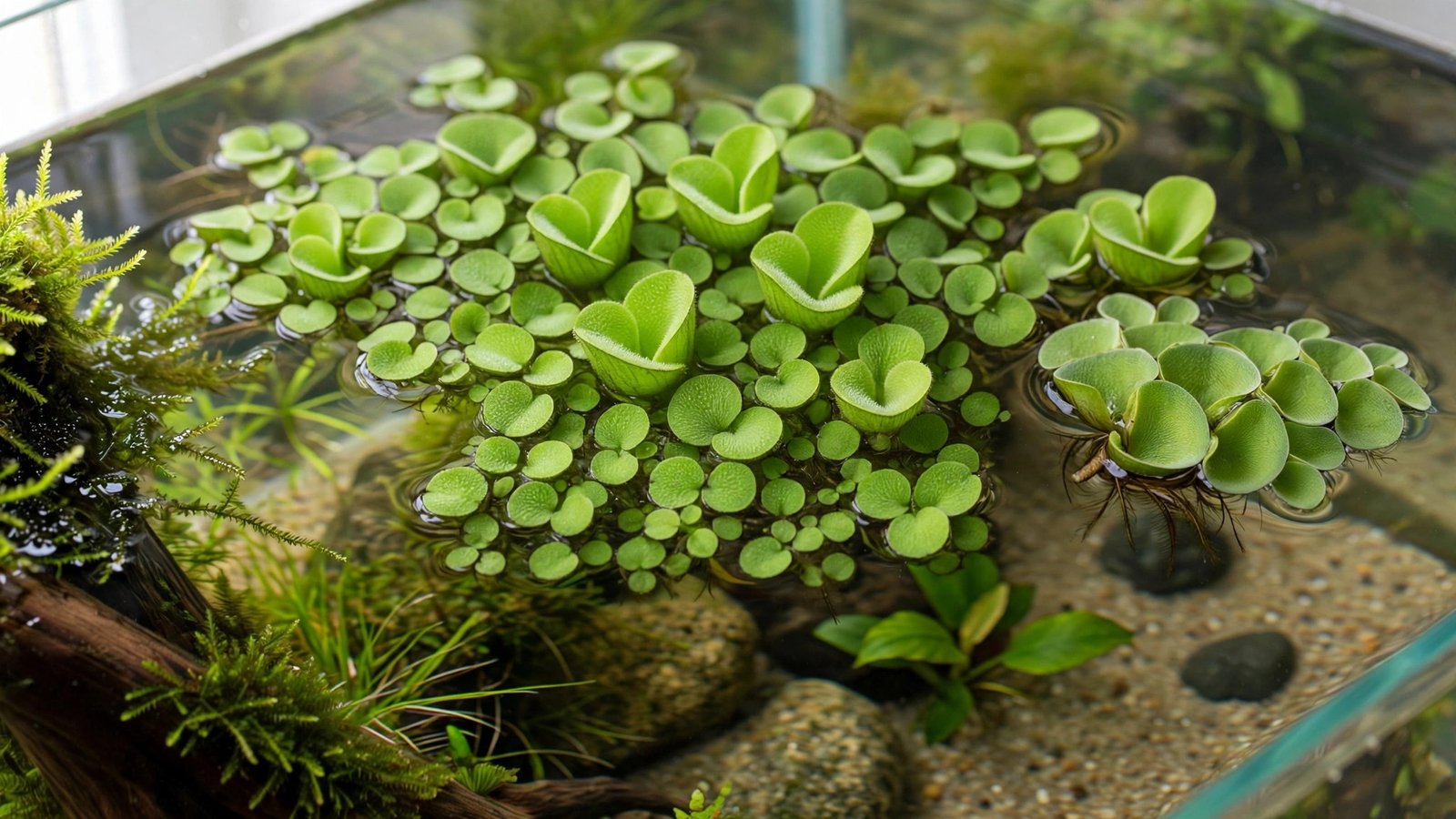
Most floating plants sprawl. Salvinia cucullata folds. Each frond curls upward along its midrib into a little hood, trapping a pocket of air beneath — so it looks less like a fern and more like tiny green cups riding the surface. Getting salvinia cucullata care right means respecting that design: warm air above the waterline, bright but gentle light, and a surface that barely moves. Do that, and it rewards you with one of the most sculptural floating mats in the hobby — dense, domed, and almost moss-like in texture.
What makes it different from common Salvinia
If you have kept the species covered in our complete Salvinia genus care guide, expect cucullata to break a few assumptions. Common Salvinia minima lies flat, spreads into wide rafts, and trails long feathery roots. Cucullata does none of that: its nickel-sized leaves fold into upright hoods, colonies knit into tight raised mats, and roots are short thread-like anchors rather than nets.
That compact habit changes the aquascaping job. You get shade and nutrient export like any floater, without roots snagging stems or fouling intakes. The trade-off is sensitivity: water pooling on the hoods invites rot faster than on flat leaves. Everything else in this guide flows from that one fact.
salvinia cucullata care: the core routine
Light is the easiest part. Low-to-medium light keeps it alive, but the hooded form develops best under medium–high light for 8–10 hours daily. In a covered tank, keep the bulb well clear of the lid — leaves scorched by a hot lid melt fast. When new growth comes in smaller and paler than old fronds, you are looking at a nutrient shortage, not a lighting problem.
Water parameters are forgiving: pH 6.0–7.8, temperature 20–28°C, most reasonable hardness. What it cannot forgive is turbulence. Filter outflow, air stones, and splashing HOB returns drive water over the leaf tops, and trapped moisture rots the hoods within days. Baffle the outflow with a spray bar, a sponge pre-filter, or a corral ring of airline tubing.
Feeding is lean and simple. With no real root system, cucullata pulls everything from the water column, so a half-to-full dose of liquid fertilizer after each weekly water change is usually enough. In a stocked tank with regular feedings you may barely need to dose at all — watch the new leaves and let them tell you. The fastest grower in your tank is also the first plant to show you when nutrients run thin.
How it compares to other floaters
| Floater | Leaf form | Roots | Light demand | Mat style |
|---|---|---|---|---|
| Salvinia cucullata | Hooded, cup-like | Short, minimal | Low to high | Compact, domed |
| Amazon frogbit | Flat, round | Long, dangling | Low to medium | Open raft |
| Red root floater | Flat, oval | Long, red | Medium–high | Open raft |
Propagating and thinning the mat
Cucullata multiplies by side shoots, so propagation is simply division: pull a clump apart and each piece keeps growing. A healthy colony doubles its footprint every two to three weeks — so your real recurring job is thinning, not growing. Every week or two, lift out a third of the mat and compost or share it.
This matters below the surface too: a full-cover mat starves the plants beneath of light, so cap coverage at roughly two-thirds. Hornwort beneath the mat tolerates that shade better than most stems and keeps pulling nutrients from the water column alongside it.
Paludariums: where it truly shines
Cucullata may be at home in a paludarium more than in a sealed aquarium. From tropical Asia's still, humid waters, it grows its most dramatic hoods under the humid open air of a paludarium. Floating rings around hardscape islands look natural in a way open rafts never quite do.
For placement ideas among other floaters, our guide to the best floating aquarium plants for beginners compares the head-term options side by side. In a paludarium setup, cucullata pairs beautifully with emergent growth like anubias and buce — the floating domes echo the texture of the hardscape above the waterline.
Buying Salvinia Cucullata
You probably will not find this one at the average fish shop. Specialists list it — Buce Plant carries it around $6.99, and sellers like FishyHub, Glass Aqua, and Flip Aquatics stock it in waves — but it sells out, and Etsy sellers move it as portioned clumps of 30–40 leaves. Tissue-culture cups are the best buy when available: pest-free, algae-free, and they acclimate with less melt.
Expect pond-grown portions to look flat and tired in the bag — the hoods develop over the following weeks. New to floaters generally? The roundup of the easiest aquarium plants for beginners covers the full starter list. For retailer parameters and care notes, see Buce Plant's listing.
Frequently Asked Questions
Is Salvinia cucullata hard to keep?
No — most keepers rate it easy, with a moderate learning curve around surface conditions. It tolerates a wide range of pH and hardness and needs no CO2 or substrate. The one real requirement is a calm surface: filter splashing that wets the hooded leaf tops causes rot. Baffle the outflow or corral the colony and it largely takes care of itself.
Does Salvinia cucullata need CO2?
No. Like all floating plants, it draws carbon dioxide directly from the air, where it is far more abundant than dissolved in water. That is why floaters grow fast without injected CO2. Skip the CO2 system and put the budget toward a decent light and a lean liquid fertilizer instead — those move the needle for this species.
Why are the leaves turning yellow or brown?
Three usual suspects: chronically wet leaf tops from splashing (they rot and brown from the crown outward), a nutrient shortage showing in new growth as small pale leaves, or heat damage under a hot lid in a covered tank. Fix the surface calm first, then bump liquid fertilizer after your next water change, and check lid-to-light clearance.
Can it grow emersed in a paludarium?
It stays a floating plant rather than growing emersed, but it thrives in paludariums because the humid open air above the waterline matches its tropical habitat. The hooded form develops most dramatically in that setting. Keep the water section still, give it 8–10 hours of light, and thin the mat before it shades out emergent plants.
Is Salvinia cucullata invasive?
Its genus is. Salvinia species are listed as invasive in several warm-climate regions, and related species like Salvinia molesta are noxious weeds in many states. Always check your local regulations before buying, and never release trimmings or tank water into outdoor waterways. One small patch of cucullata poses the same colonization risk as its cousins.
Quiet, sculptural, and undemanding once the surface is calm, Salvinia cucullata earns its place as the connoisseur's floater — distinct enough to be a conversation piece, easy enough to be your tank's hardest-working nutrient filter.