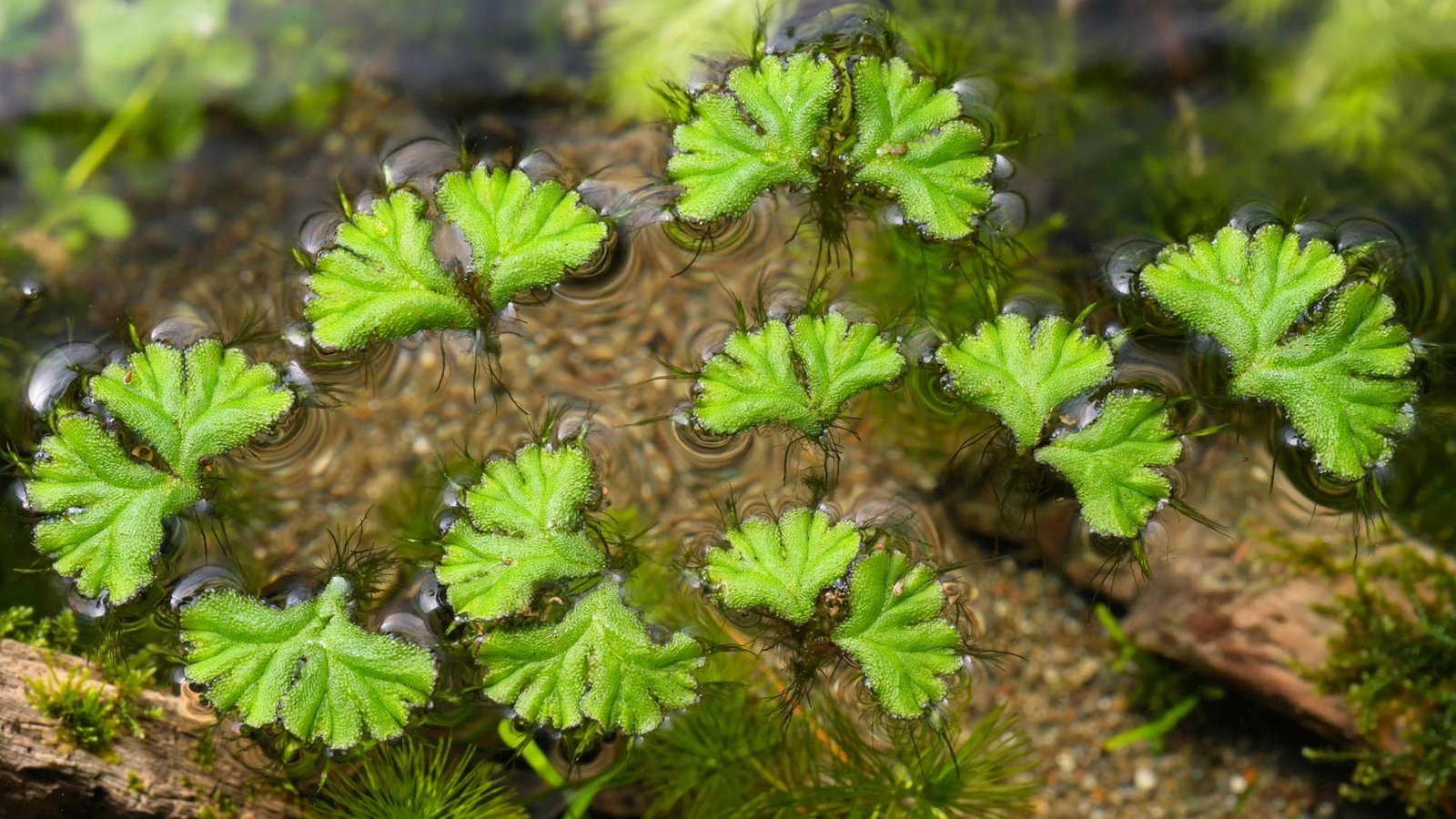
Some floating plants whisper. Ricciocarpus natans makes a quiet statement: a drifting mosaic of heart-shaped fronds, each backed with a dark-purple felt that shrimplets graze like a meadow. Often shelved — and mislabeled — beside crystalwort, it sits in a genus of its own and is one of the easiest surface plants an unheated tank can host.
Short answer: Can Ricciocarpus natans live floating in an unheated tank? Yes. This cosmopolitan liverwort grows at the surface in water from about 10 °C to 30 °C, in low to moderate light, with no CO2 and no substrate — it feeds from the water column. Identify it by heart-shaped fronds with a dense blackish-purple felt of rhizoids beneath; Dennerle Plants uses that felt to distinguish it from crystalwort (Riccia fluitans). A starter portion forms a sheltering mat within 3–4 weeks.
ricciocarpus natans: what it is and how it differs from crystalwort
Ricciocarpus natans belongs to the liverwort family Ricciaceae — the same family as crystalwort (Riccia fluitans) — but sits in a genus entirely of its own. You may also see an older variant spelling, Ricciocarpos natans; both names describe the same plant. A true liverwort, not a moss, it lives only at the water's surface: press it into substrate and it rots. Its range is genuinely worldwide, from temperate ponds to tropical ditches — which is why it shrugs at unheated aquaria.
Telling it apart from crystalwort takes one look at the underside: overlapping, heart-shaped (cordate) fronds about the size of a fingernail, each backed with a dense blackish-purple felt of rhizoids — root-like hairs, not true roots. Crystalwort forms narrow, forked ribbons with plain green undersides and can be tied down as a foreground carpet; Ricciocarpus is a floater, full stop. See our Riccia fluitans care guide for the crystalwort side, then compare the two below:
| Feature | Ricciocarpus natans | Riccia fluitans (crystalwort) |
|---|---|---|
| Genus | Ricciocarpus — its own genus | Riccia |
| Fronds | Heart-shaped, overlapping | Narrow, forked ribbons |
| Underside | Blackish-purple rhizoid felt | Plain green, no felt |
| Habit | Strictly floating | Floating or tied down |
| Best use | Surface cover, fry and shrimp shelter | Foreground mats, floating clumps |
Light, temperature, and water chemistry
Light is the easy part: low to moderate light, 6–8 hours a day. Riding the surface, it gets first claim on your fixture's output. Too dim, and rosettes turn pale and loose; too much strong light, and algae films creep across the fronds. A timer and a mid-range LED are plenty.
Temperature is where it earns its reputation: roughly 10–30 °C tolerated, fastest at 20–26 °C, slowing below about 15 °C — yet it rides out unheated tanks without complaint. Freezing water or sustained heat above about 35 °C kills it, so keep it out of ponds that ice over.
Water chemistry barely registers: pH 6.0–8.0, soft to moderately hard, feeding from the water column — no substrate, no CO2. In a stocked tank fish waste is usually enough; in a very lean tank, a half dose of all-in-one fertilizer every week or two keeps the green deep. Keep surface agitation gentle, or strong flow herds the colony into filter intakes.
| Parameter | What works |
|---|---|
| Light | Low–moderate, 6–8 hours daily |
| Temperature | 10–30 °C; fastest at 20–26 °C |
| pH | 6.0–8.0 |
| Hardness | Soft to moderately hard |
| CO2 | None needed |
| Fertilizer | Optional; half-dose in lean tanks |
| Flow | Gentle surface movement |
Propagation and keeping it contained
There is no planting step — attempting one is the classic beginner mistake, since buried fronds rot within days. Rinse your portion, set it on the surface, and walk away. Fronds branch and break apart on their own; to speed things along, pull a cluster in two and float both halves. A starter portion knits into a sheltering mat within 3–4 weeks.
Fast is the point — and the problem. Corral the colony with a loop of airline tubing away from the filter outflow, and thin the mat every one to two weeks, lifting out handfuls to compost, share, or replant elsewhere. Hold the line at two-thirds of the surface: beyond that it shades everything below and chokes gas exchange.
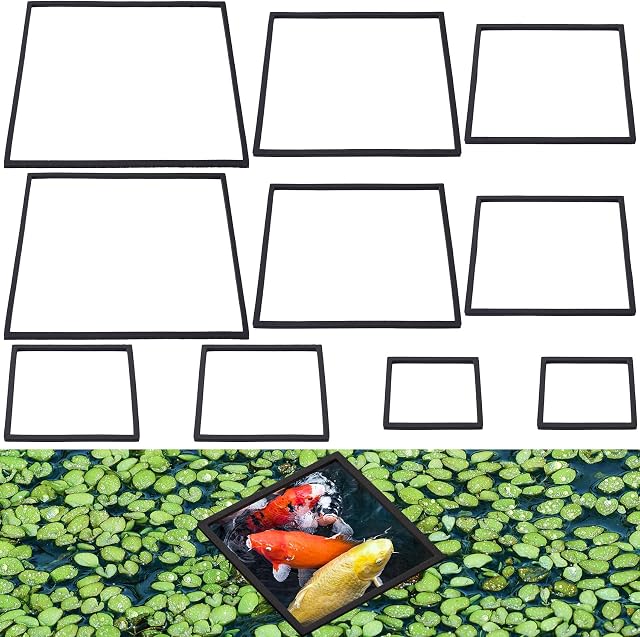
When buying, look for firm green fronds with dark felted undersides and no slime or sour smell. Tissue-culture cups arrive pest-free — worth the small premium for shrimp tanks. Compare your candidate against the Dennerle Plants page for Ricciocarpus natans before you pay; mislabeled crystalwort is the usual mix-up. A simple floating ring is the only accessory that genuinely helps.
 ★3.9
PAGOW Floating Plant Corral Rings
Check Price on Amazon ★3.9Shrimp, fry, and tankmates
The felted underside is why shrimp keepers love this plant: a permanent crop of biofilm that newborn shrimplets graze within hours of hatching, while the mat above shelters fry from the day they are born. Timid fish calm under the dappled shade, and the colony quietly drinks nitrates that would otherwise feed algae — which is why it ranks among the best floating aquarium plants for beginners and the most useful aquarium plants for fish tanks for fry cover.
Pair it with peaceful company — cherry and Amano shrimp, small tetras and rasboras, snails, calm bettas — and with other easy floaters such as Amazon frogbit, red root floaters, and common salvinia, giving each its own corral so the fastest does not smother the rest. Skip goldfish, silver dollars, and large cichlids — they will eat it — and keep surface skimmers away from the mat.
Common problems and quick fixes
Most trouble traces back to light, flow, or hungry tankmates:
- Pale, loose rosettes — too little light. Raise the photoperiod to 7–8 hours.
- Algae filming the fronds — too much light plus excess nutrients. Shorten the photoperiod, thin the mat, ease off fertilizer.
- Mushy patches after arrival — shipping stress. Pick out the soft bits; fresh growth follows within 1–2 weeks.
- Piling up at the filter intake — flow too strong. Baffle the outflow and corral the plant to the calm end.
- Fronds vanishing overnight — something is eating them. Goldfish and large cichlids treat it as salad; move it to a shrimp or fry tank.
Frequently Asked Questions
Is Ricciocarpus natans the same as crystalwort?
No. They share the liverwort family Ricciaceae but sit in different genera. Crystalwort (Riccia fluitans) forms narrow, forked ribbons and can be tied down as a carpet; Ricciocarpus natans floats only, with heart-shaped fronds and a blackish-purple felt beneath. Check the underside before buying — the felt is the giveaway.
Can it grow in an unheated or cold-water tank?
Yes — it is one of the best floaters for unheated setups, tolerating roughly 10–30 °C. Growth peaks around 20–26 °C and slows noticeably below about 15 °C, but a healthy colony rides out a cool room-temperature tank without complaint.
Does it need CO2 or fertilizer?
Neither, in most tanks. It feeds from the water column, so fish waste alone sustains it in any reasonably stocked aquarium. In a very lean, lightly stocked tank, a half-dose of all-in-one liquid fertilizer every week or two keeps the fronds deep green.
How do I stop it from taking over the surface?
Corral it with a loop of airline tubing and thin the mat every one to two weeks, lifting out handfuls to compost or share. Never let it cover more than two-thirds of the surface — a full cover shades everything below and restricts gas exchange.
Is it safe for cherry shrimp and fry?
Completely. Shrimplets graze biofilm off the felted undersides, and fry use the mat as overhead cover from hatching day. Rinse new portions well before adding them to a shrimp tank, since store-bought plants can carry pesticide residues harmful to invertebrates.
For a plant with no roots, no substrate, and no appetite for CO2, Ricciocarpus natans earns its keep fast: dappled shade, fry cover, and a living pantry for shrimplets. Give it gentle light, a corral, and a fortnightly thinning.