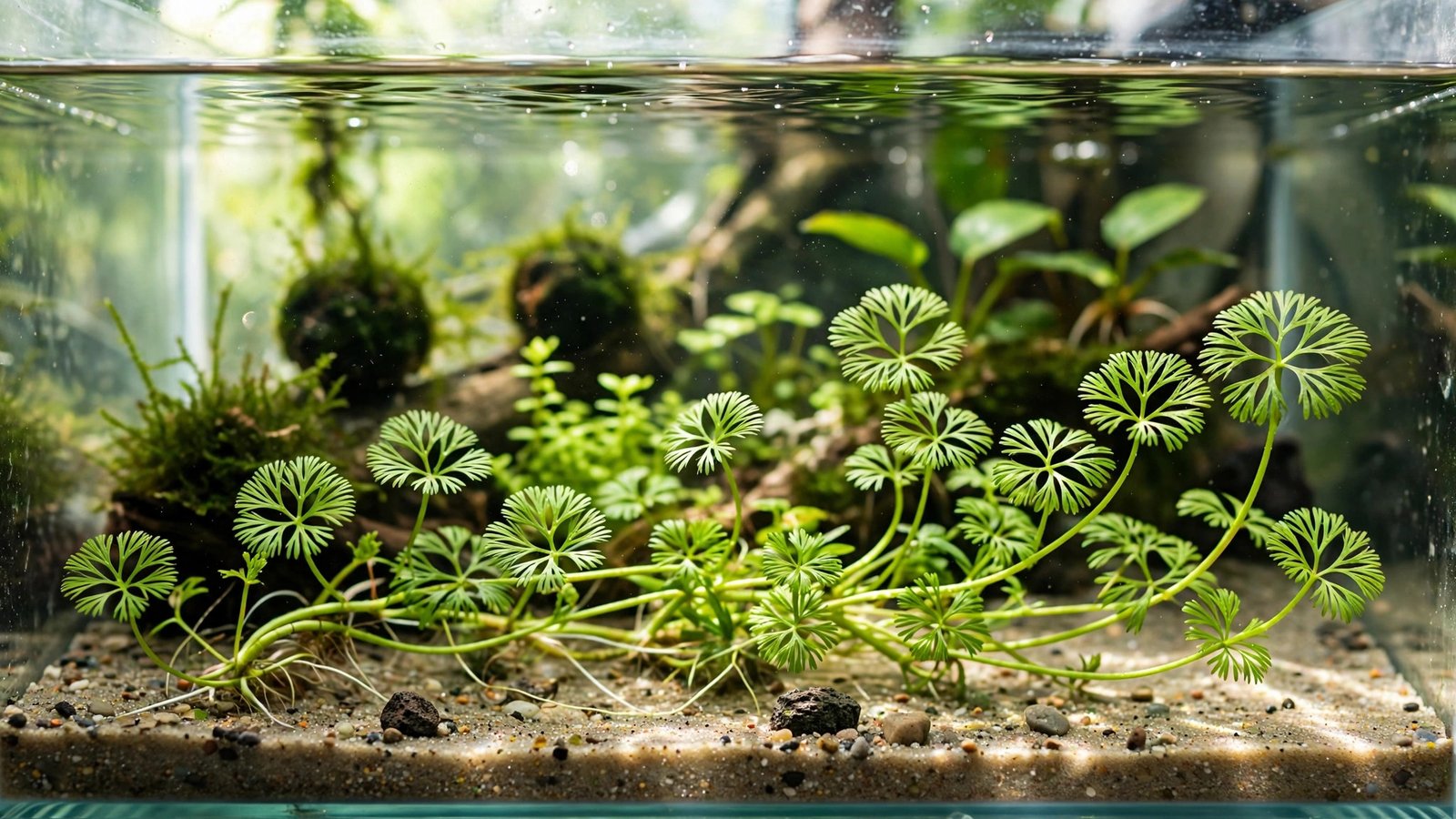
Most foreground plants make you work for every inch — you plant stem by stem, wait weeks, and trim constantly just to keep them low. Ranunculus inundatus does the opposite: this Australian river buttercup spreads through an underground runner network, surfacing as dozens of little parasol leaves that unfurl like tiny umbrellas over your substrate. No other carpet plant looks quite like it, and proper ranunculus inundatus care is mostly about managing those runners — aim them where you want the carpet, and cut them loose where you don't.
If you're still weighing your options, ranunculus is an unusual foreground pick for a planted tank — it earns its place on looks alone, then rewards you by doing most of the carpeting work itself.
Ranunculus Inundatus Care: Core Requirements
This plant grows along slow Australian streams, roots in wet mud and leaves in the air — so it adapts to submerged life fast but keeps one wild habit: reaching for light. Give it 50–80 PAR at the substrate and it stays compact, pouring energy into horizontal runners. Drop the light and it stretches — stems elongate, leaves shrink, carpet dream over.
It prefers the cooler side of tropical: 68–78°F, pH 6.0–7.5, soft to moderately hard water. Feed it through the roots — aquasoil, or root tabs under each cluster in inert sand and gravel; water-column dosing alone gives thin, pale leaves. CO2 isn't mandatory but transforms it: with 20–30 ppm, leaves grow broad and flat and fill-in takes 4–6 weeks. Without it, expect 8–12 weeks of slow, taller, looser growth — benchmark against a proven low-tech spreader like Monte Carlo first. The care notes on the Tropica 1-2-Grow cup agree: bright light, CO2, and cooler water keep it compact.
| Setup | Growth habit | Carpet fill-in |
|---|---|---|
| 40–60 PAR, no CO2 | Taller stems, small cupped leaves, slow runners | 8–12+ weeks |
| 60–80 PAR, 20–30 ppm CO2 | Flat parasols up to 1 inch wide, runners spreading 1–2 inches/week | 4–6 weeks |
| 80+ PAR, CO2, rich substrate | Densest carpet, daughter plantlets everywhere | 4 weeks, then thin it out |
Planting It Right: Spacing and Substrate
Most hobbyists meet this plant as a Tropica 1-2-Grow tissue-culture cup — pest-free and shrimp-safe, packed with tiny plantlets. Rinse the gel, split the cup into 6–8 portions, and plant each 2–3 inches apart in fine aquasoil — roots buried, crown exposed. A portion cup from Buce Plant works the same way: split, space, let the runners close the gaps.
Like dwarf sagittaria and other classic runner-spread foreground plants, ranunculus knits its carpet from a network of horizontal stems — so give it a defined foreground zone with a hardscape border, or it will march straight into your midground. Expect the first runners within 7–14 days, and don't panic when the original leaves melt; new submerged leaves follow within two weeks.
Propagation: Let the Runners Do the Work
You rarely need to replant ranunculus — it multiplies itself. Runners creep along the substrate; every inch or so a node roots and pushes up a parasol leaf. To speed things along, snip a rooted daughter and replant it 1–2 inches away. Or do nothing: left alone, the network roughly doubles carpet density every 2–3 weeks.
| Method | How | Timeline |
|---|---|---|
| Natural runners | Leave the runner network alone; nodes root on their own | Density doubles in 2–3 weeks |
| Runner cuttings | Snip rooted daughters, replant 1–2 inches apart | Rooted and growing in ~7 days |
| Fresh portions | Split a tissue-culture cup into 6–8 portions, spaced 2–3 inches apart | Full carpet in 6–8 weeks |
The approach mirrors Helanthium tenellum, another chain-sword runner: patience and spacing beat constant replanting every time.
Trimming the Parasol Carpet
Once the carpet closes, maintenance is five minutes a week. Snip stems climbing past 3 inches at the substrate line; curved trimming scissors reach under the parasols without uprooting neighbors. Cut runners crossing into unassigned territory. Thin dense patches by pulling every other plantlet so light reaches the base — otherwise the bottom melts out, leaving bare stalks.
Troubleshooting: Melt, Escapees, and Algae
Melt in weeks 1–2 is transition, not failure — tissue-culture and emersed leaves shed, and new submerged leaves replace them within two weeks. If melt continues past week 3, the crown is likely buried too deep, light is too weak, or CO2 is unstable; replant shallow and stabilize before you blame the plant.
Escapee runners travel under the substrate and pop up in the midground — a weekly runner patrol solves it: follow each one back to the mother plant and snip it at the base. Algae on the parasols usually means too much light for your CO2; dust leaves with a turkey baster during water changes, then dial light back 10–20% before reaching for chemicals. For a grassier texture beside the umbrellas, Lilaeopsis pairs well — a different visual layer, no runner competition.
Frequently Asked Questions
Does ranunculus inundatus need CO2?
No — but CO2 decides what it looks like. Without injected CO2 it survives: taller stems, smaller leaves, 8–12+ weeks to fill in. With 20–30 ppm, leaves grow broad and flat, runners spread 1–2 inches per week, and the carpet closes in 4–6 weeks. Skipping CO2? Hold light to 40–50 PAR so slow growth doesn't turn into an algae farm.
Why is my ranunculus melting after planting?
Almost always transition melt. Tissue-culture and emersed plants shed old leaves when submerged — expect ragged, dissolving leaves in weeks 1–2. Leave it alone: new submerged leaves emerge within two weeks. Worry only if melt continues past week 3, which usually means a buried crown, weak light, or unstable CO2. Plant shallow, roots down, crown exposed.
How fast will it carpet?
In a dialed-in tank (60–80 PAR, 20–30 ppm CO2, rich substrate), portions spaced 2–3 inches apart knit together in 4–6 weeks; low-tech setups take 8–12+ weeks. Established runners spread 1–2 inches per week — noticeably faster than chain swords. Don't disturb new runners; every time you pull one up, you reset its clock.
Can ranunculus inundatus grow emersed?
Yes — in the wild it's a marginal plant of slow Australian streams, roots in wet mud and leaves in the air. It grows beautifully emersed in humid paludariums or Wabi-Kusa, where leaves grow more finely divided and it can flower with small yellow buttercups. The submerged form is the classic umbrella look; plants transition between forms within a few weeks.
How do I stop runners from invading the midground?
Patrol weekly: follow any escapee runner back to the mother plant, snip it at the base, and replant or discard it. Substrate borders and hardscape edging slow it down but won't stop it — runners travel under the substrate and surface where they please. Treat it as a plant you steer, not a contained carpet: aim runners where you want fill-in, cut the rest.
Ranunculus inundatus is the rare foreground plant that does its own landscaping — give it light, CO2, and a little room, and it builds a parasol carpet no tweezer-planted stem could imitate. Respect the runners, trim weekly, and enjoy the strangest-looking carpet in the hobby.