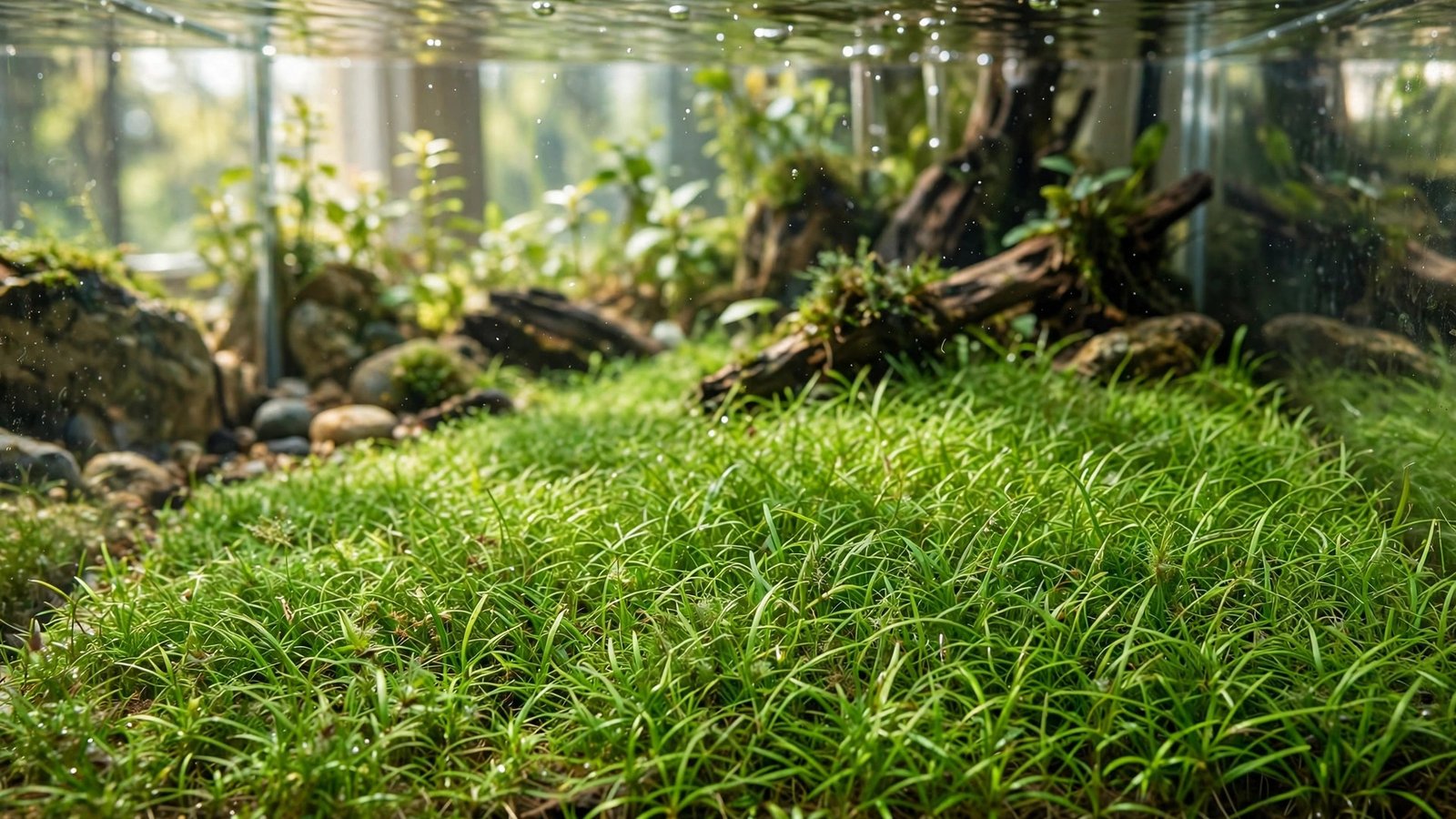
The most common way people meet Lilaeopsis — sold as micro sword — is as a clump of pale, flattened grass in a plastic pot, usually next to the dwarf hairgrass they actually came in for. Since aquarists are told a real carpet needs injected CO2 and a high-tech rig, micro sword reads as a consolation prize. That's selling the plant short. This guide to lilaeopsis aquarium plant care shows how micro sword carpets a low-tech tank — slowly, on its own terms — where that promise breaks down, how to space plantlets for a full carpet in about 60 days, and where it beats hairgrass.
What Lilaeopsis Actually Is
The plant in that pot is almost always Lilaeopsis brasiliensis, a true aquatic plant from South American wetlands and stream margins. It is not a grass at all — it belongs to the Apiaceae family, the same family as carrots and parsley, which explains the faintly aromatic smell when you crush a blade. Unlike true grasses, it grows from a creeping rhizome that sends up hollow, blade-like leaves 3–7 cm tall, with fine roots at every node. Tropica's species profile lists it as a slow, stolon-type foreground plant — and notably advises planting small clumps a few centimeters apart, which is exactly the grid method below.
Other species — L. novae-zelandiae, L. mauritiana — appear occasionally, but care is identical, and anything labeled "micro sword" at the shop is brasiliensis or a close lookalike. Growers raise it emersed (in damp air), so what you buy is short, stiff, and yellow-green; expect two unimpressive weeks underwater. That is normal.
The emersed-to-submerged transition
Nearly every commercial Lilaeopsis is grown emersed because it grows faster in air and ships better. Submerged, it must grow an entirely new set of thinner, softer blades, and the old emersed blades melt away over 2–4 weeks. Newcomers see this melt, assume they killed it, and yank the pot — while the rhizome underneath is already pushing out its first bright-green submerged leaves. If your plantlets look ragged in week three, leave them alone: melting emersed foliage with a firm, pale rhizome is a healthy transition.
The Honest Low-Tech Pitch: Carpets Without CO2
Here is the claim, stated plainly: in a tank with moderate light, decent substrate, and zero injected CO2, Lilaeopsis spreads outward from your planting spots into a continuous carpet. I've seen it fill a 10-gallon in three months and a 5-gallon shrimp tank in eight — a lawn with a slightly wild, meadow-like texture hairgrass never quite offers.
Now the honest part — where runners stall. Lilaeopsis is patient to the point of stubbornness, and it quits under specific conditions:
- It stalls in shade. Runners under hardscape shadows or overhanging stems stop. Unlike dwarf sagittaria, which colonizes dim corners cheerfully, micro sword needs light reaching the substrate along the whole spread path.
- It stalls in inert gravel without root nutrition. In plain gravel with no root tabs or aquasoil, new runners grow pale and thin, then give up — the most common cause of a "frozen" carpet, not a lack of CO2.
- It stalls when planted as one dense clump. A whole pot in one spot becomes a crowded tuft: inner blades rot from lack of flow and light while the rhizome competes with itself instead of sending runners.
- It stalls in tanks under about 6 weeks old. Brand-new setups with fluctuating chemistry give it a sluggish start; the same plantlets take off in days when planted into a tank cycled for two months.
None of these are solved by CO2. Injected CO2 makes Lilaeopsis grow faster — noticeably — but unlocks nothing the plant can't do without it. If your carpet is stalled, check light-to-substrate, root nutrition, and planting density before pricing a regulator.
Planting: The 60-Day Carpet Plan
Lilaeopsis does not reward the "one pot, one hole" method. Treat each pot as raw material for many small plantlets:
- Divide ruthlessly. Rinse off the rockwool, then tease the pot into plantlets of 5–10 blades each with a little rhizome. One standard pot usually yields 8–12 plantlets. Yes, they look pitifully small. That is the point.
- Plant in a grid. With tweezers, push each plantlet 1–2 cm into the substrate, spaced 2–3 cm apart over the area you want carpeted. Buried rhizomes rot — keep the white rhizome at or just above the substrate surface.
- Leave runner lanes. Don't fill every square centimeter. Runners travel 1–2 cm per week, so a 2–3 cm gap closes in about two weeks. Overplanting wastes pots.
- Wait through the melt. Weeks 1–3: emersed blades melt, submerged blades emerge. Weeks 4–6: runners appear — thin white threads that dive into the substrate and pop up a centimeter away as new plantlets. Weeks 7–9: the grid fills in. By day 60, a continuous carpet.
Water parameters are forgiving: 20–28 °C, pH 6.0–7.5, soft to moderately hard water. It survives at about 20–30 PAR at substrate level but carpets densely only above roughly 40–50 PAR — medium light in practical terms: a decent LED on a 12-inch-deep tank, 7–8 hours a day.
Substrate and feeding
Aquasoil is easy mode: it supplies everything for the first 2–3 months. In sand or inert gravel, push a root tab every 10–15 cm under the carpet zone at planting and replace every 2–3 months — Lilaeopsis feeds heavily through its roots, and this habit separates thriving carpets from stalled ones. Liquid fertilizer is secondary: a lean all-in-one at half strength once or twice a week keeps blades green without feeding algae. Start low, watch livestock and glass for a week, then adjust. Pale new blades usually mean exhausted root tabs, not a cue to double the liquid dose.
How Lilaeopsis Actually Spreads: Runners vs Replanting
This is the section most care sheets skip, and it determines whether your carpet looks like a lawn or a patchwork quilt. Lilaeopsis spreads by stolons — horizontal runners creeping along or just under the substrate, rooting at nodes and sending up new plantlets. A healthy runner advances roughly 1–2 cm per week: faster under CO2, slower in cool or dim tanks.
Runners are free labor, but they have opinions. They run outward into open substrate, not into neighboring plants' bases. A runner that hits a rock, a dense crypt root mass, or the glass turns, stalls, or pops up at an awkward angle. That's why carpeting around hardscape works and carpeting under it doesn't: lay out rock and wood first, then plant the carpet into the open lanes between them.
When to let runners work vs when to replant
Let runners fill open areas — slower than replanting, but it produces the densest, most natural turf, since each node roots exactly where conditions suit it. Intervene by replanting when:
- A runner leaps over a bare patch and lands far from its parent, leaving a bald lane behind. Snip the runner and replant the far plantlet in the gap.
- Runners escape the carpet boundary into the midground. Micro sword is polite compared to hairgrass — easy to pull — but trim the ambition early.
- Part of the carpet yellows or thins. Uproot the weak patch, refresh the root tab underneath, and replant divisions from a healthy area.
Cut runners with sharp scissors rather than yanking — a torn rhizome invites melt in the parent plant. And never "top" the carpet like a lawn in the first two months; the blades are still establishing their root grip, and a hard trim resets the clock.
Micro Sword vs Dwarf Hairgrass vs Dwarf Sagittaria
The carpet-plant aisle forces a choice, and the three low-tech contenders overlap enough that picking wrong costs months. Here's how they genuinely compare without CO2:
| Trait | Lilaeopsis (micro sword) | Dwarf hairgrass | Dwarf sagittaria |
|---|---|---|---|
| Low-tech carpeting | Yes — slow but reliable | Reluctant; often stalls without CO2 | Yes — fastest of the three |
| Shade tolerance | Moderate (stalls in deep shade) | Poor | Excellent |
| Blade texture | Flat, slightly wild meadow look | Fine, upright, manicured lawn | Flat ribbons, wilder and taller |
| Height control | Stays 3–7 cm naturally | Needs trimming or flops | Reaches 10–15 cm; shorter in bright light |
| Runner invasiveness | Polite; easy to redirect | Aggressive; pops up everywhere | Very aggressive in rich substrate |
| Shrimp tanks | Ideal — dense cover, gentle roots | Good, but traps debris | Good, though taller blades shade shrimplets |
| New-tank forgiveness | Moderate (melt phase worries beginners) | Low (melt + algae magnet) | High (just grows) |
The honest summary: pick dwarf sagittaria for the fastest low-tech fill if you don't mind taller, wilder growth (dwarf sagittaria care). Pick hairgrass for the manicured-lawn look with CO2 (dwarf hairgrass care). Pick Lilaeopsis for a low-tech carpet that stays short on its own, behaves politely at its borders, and gives shrimp a dense, grazable meadow. The plant for aquarists who trim reluctantly.
Where Lilaeopsis Wins: Shrimp Tanks and Foregrounds
Ask experienced shrimp keepers what carpets a Neocaridina tank, and micro sword comes up constantly. The dense, low blades create a biofilm factory: enormous surface area at shrimplet grazing height, sheltered from current and from larger tankmates' sightlines — baby shrimp vanish into it in a way hairgrass's upright blades never allow. It's also chemically gentle: no aggressive trimming that stresses shrimp, and slow growth means low nutrient demand with no heavy fertilization risking copper or nitrate spikes. Plant it around a moss- or Anubias-covered centerpiece, run moderate light with gentle flow, and the carpet doubles as a shrimplet nursery for years.
Long-Term Lilaeopsis Aquarium Plant Care: Trimming and Maintenance
Micro sword rarely needs trimming — blades top out around 5–7 cm and stop. Under CO2 or strong light it grows taller and denser, and a carpet ignored for months develops a thatch of old blades at its base that traps detritus.
- The maintenance trim: every 2–3 months, cut to about 3 cm with curved scissors. New blades emerge within a week.
- Thin, don't just top. If the base never clears detritus, pull every third or fourth plantlet entirely and replant the healthiest divisions — thinning rejuvenates the rhizome mat.
- Vacuum lightly. Hover a siphon just above the blades during water changes; pressing in tears runners.
- Watch the 6-month slump. Aquasoil exhausts and root tabs run out together around month six: blades pale, runners slow. Refresh the tabs — this one task fixes most "my carpet was great and now it's dying" stories.
Pair it in the midground with slow, structural plants that won't shade it out: Cryptocoryne parva, the slowest foreground crypt, sits naturally where carpet meets taller planting, and Pogostemon helferi adds a star-shaped accent contrasting beautifully with the grass blades.
Troubleshooting: The Usual Suspects
Carpet stalled after week 4. Fix order: (1) root tabs — present and fresh? (2) light at substrate — anything shading the lanes? (3) planting density — one clump instead of a grid? CO2 is item (4), only if the first three check out.
Blades turning yellow or transparent. Pale new growth means nutrient deficiency at the roots — refresh root tabs. Yellowing old blades with healthy new ones is normal turnover; pull the dead blades gently so they don't fuel algae.
Algae threading through the carpet. Hair algae loves a young carpet because sparse blades let light hit the substrate between them. Drop the photoperiod to 6 hours temporarily and add a cleanup crew — the carpet outgrows the problem once it densifies. Don't tear it out to "start clean"; you'll reset months of runner work.
Brown mush at the rhizome. Buried too deep, or the substrate went anaerobic under too-thick planting. Lift the area, trim back to firm white rhizome, replant shallowly, and thin the density.
Everything melted in week 2. Almost certainly emersed-leaf melt, not death. Firm, pale rhizome means alive. Mushy rhizome means shipping rot — replace those plantlets, but don't disturb the survivors.
Frequently Asked Questions
Does Lilaeopsis need CO2 to carpet?
No — that's the plant's whole appeal. Lilaeopsis carpets reliably in low-tech tanks with moderate light and root nutrition; CO2 only speeds up a process that works without it. What stalls carpets is shade, exhausted root tabs, one clump instead of a grid, or a brand-new tank. Fix those four before buying CO2.
How long does micro sword take to carpet?
Planted as a 2–3 cm grid of small divisions, expect runners by week 4–6 and a continuous carpet around day 60. Low light, cool water, or a new setup can stretch that to 3–4 months. One undivided pot may never carpet — division and spacing set the timeline, not luck.
Why is my Lilaeopsis melting after planting?
Commercial Lilaeopsis is grown emersed, in humid air, so its blades are built for air, not water. Over 2–4 weeks those blades melt while the rhizome grows new submerged foliage — a healthy transition. Leave plantlets undisturbed, keep parameters stable, and treat firm pale rhizomes with tiny bright-green new blades as your sign all is well.
Is micro sword better than dwarf hairgrass for beginners?
For low-tech beginners, yes. Dwarf hairgrass frequently stalls or melts without injected CO2, while Lilaeopsis carpets without it, stays short naturally, and spreads politely instead of invading the tank. Hairgrass wins on the manicured-lawn look and in high-tech setups. No CO2 means micro sword is the safer pick.
Can Lilaeopsis grow in plain gravel or sand?
Yes, but it needs root nutrition added — inert gravel or sand offers nothing to heavy root feeding. Push root tabs every 10–15 cm under the planting zone at setup and replace them every 2–3 months. Aquasoil makes the process easier since it feeds the carpet for the first few months, but plenty of lush carpets grow in sand-plus-tabs setups.
Will Lilaeopsis survive in a low-light shrimp tank?
It survives in low light (20–30 PAR at substrate) but won't carpet densely — runners stall and blades grow sparse and leggy. For a shrimp-tank carpet you want moderate light, roughly 40–50 PAR at the substrate on a 7–8 hour photoperiod, easily done with a basic LED on shallow tanks.
A Carpet for the Patient
Lilaeopsis rewards the aquarist who plants carefully, feeds the roots, and then mostly leaves it alone. It won't beat Marsilea or sagittaria on speed, and it will never look like a golf course. What it gives you is a low, dense, meadow-textured carpet asking for almost nothing — no CO2 rig, no weekly haircuts, no border wars — quietly becoming the best grazing ground your shrimp have ever had. Divide the pot, plant the grid, give it sixty days.