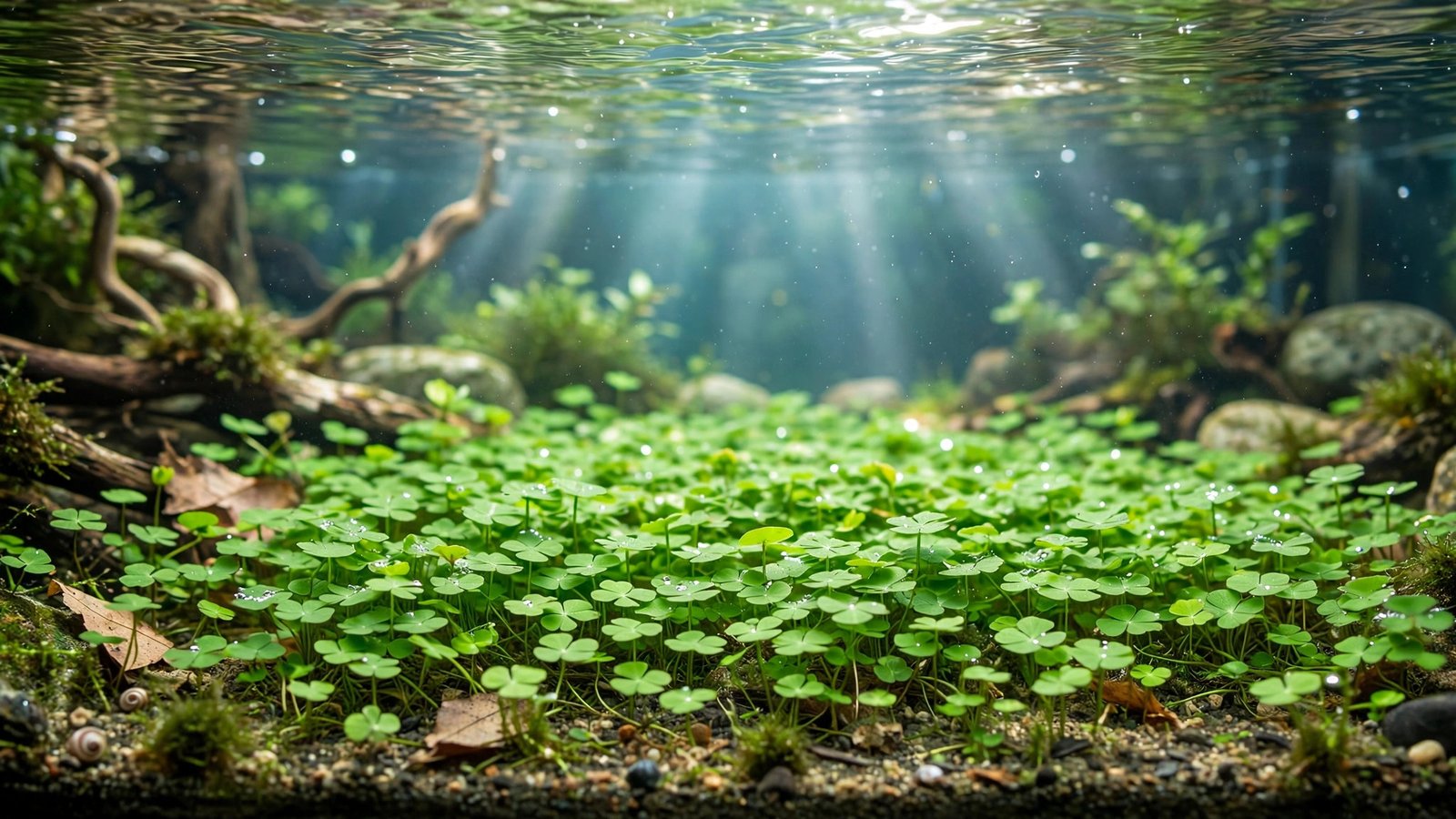
The biggest mistake with dwarf clover carpets is buying the wrong Marsilea. Most shoppers grab Marsilea hirsuta without knowing a smaller, neater relative exists — one whose leaves stay under half a centimeter and whose new growth sprouts an alarming brown that is completely normal. Learn Marsilea crenata care and you get a low-tech, 1–3 cm carpet that behaves itself in tanks where other carpeting plants sulk.
Short answer: plant tissue-culture bundles in fine substrate under medium light, give it patience for 6–8 weeks of runner-spreading, and ignore the brown new leaves — they green up as they mature. It tolerates low light and high heat, wants no CO2, and reaches only 3–5 cm even when neglected. Note the label trap: Tropica now sells this exact plant as Marsilea minuta (SKU 010B TC), "formerly traded as M. crenata" — buy either label, you get the same fern.
Marsilea crenata care
Strip away the four-leaf-clover marketing and you have a small Asian fern from rice-field margins that happens to carpet underwater. It spreads by horizontal runners (stolons) that root at each node, throwing up tiny clover leaves on short stalks. Care is genuinely low-tech: medium light (30–50 PAR), any complete fertilizer at half strength, and a nutrient-bearing substrate get you a carpet without pressurized CO2. It sits comfortably among the best foreground carpeting plants for beginners because it forgives the two classic beginner sins — weak light and forgotten dosing — that kill fussier carpets.
If you already keep one of the easiest aquarium plants for a beginner community tank, M. crenata slots in the same way: plant it, feed the tank, and trim occasionally. Its trump card over the better-known relative is scale. Compare it directly against Marsilea hirsuta, the better-known dwarf clover carpet and the difference is immediate — hirsuta's leaves stretch and look lanky under bright light, while crenata stays small and tight, topping out around 3 cm even in high light.
Water parameters
This plant is famously unbothered. It tolerates poor light, temperatures into the low 30s °C, and soft or hard water alike. That tolerance is real, but treat the table below as the target range where carpeting happens on schedule rather than eventually.
| Parameter | Target | Notes |
|---|---|---|
| Light | Medium (30–50 PAR) | Tolerates low light; goes slower and slightly taller |
| CO2 | Not required | ~15–20 ppm speeds runner spread noticeably |
| Temperature | 20–28 °C | Handles 30 °C+ heat waves without melting |
| pH | 6.0–7.5 | Flexible; adapts to local tap water |
| GH | 3–12 dGH | No demanding hardness requirements |
| Substrate | Nutrient-rich, fine-grained | Runners anchor poorly in coarse gravel |
| Fertilizer | Complete liquid, half dose | Full dose of nitrate-heavy mixes can spur algae |
The brown leaves are normal
Here is the moment that kills more crenata carpets than any disease: two weeks after planting, fresh leaves unfurl brown, and the aquarist assumes rot and tears everything out. Don't. New Marsilea crenata leaves emerge bronze-brown and green up over 1–2 weeks as they harden. Retailers even print it on the packaging — "browning leaf on the original packaging is normal." Judge the plant by its runners, not its newest leaves: white-to-green spreading rhizomes mean it is establishing; leaves following the brown-to-green sequence mean it is healthy.
Actual rot looks different: mushy, translucent tissue that detaches at a touch, usually starting from old emersed-grown leaves melting after the switch to submerged growth. Some melt after planting is normal with any tissue-culture cup — leave the runners alone and new submerged leaves will replace them.
How to plant Marsilea crenata
One tissue-culture cup covers roughly a 15 × 15 cm foreground patch once it fills in. The winning method is small bundles, close spacing:
- Rinse the gel medium off the cup's plant mass under tap water.
- Split it into 8–12 small bundles with your fingers.
- Using tweezers, push each bundle 1–2 cm deep into fine substrate, spaced 2–3 cm apart.
- Flood or fill, keep light moderate for the first week, and don't disturb the substrate for a month.
Dry-start fans can run this plant emersed for 3–4 weeks for a head start — it is a marginal plant in the wild, so it converts happily. Flooding afterward will melt the tallest emersed leaves; the runners keep going.
Marsilea crenata vs. other small carpets
Crenata earns its place when you want clover texture at the smallest scale. If you want grass-like blades instead, dwarf hairgrass gives a lawn look but demands CO2 and high light to stay short. Staurogyne repens is bushier and handles low light too, but grows upright rather than carpeting flat. And Utricularia graminifolia makes a finer carpet still — at the price of being famously fussy about stable CO2 and water chemistry.
| Plant | Carpet height | CO2 need | Difficulty |
|---|---|---|---|
| Marsilea crenata | 1–3 cm | Optional | Easy |
| Marsilea hirsuta | 2–5 cm | Optional | Easy |
| Dwarf hairgrass | 3–10 cm | Recommended | Medium |
| Monte Carlo | 2–4 cm | Recommended | Medium |
| Utricularia graminifolia | 1–2 cm | Required | Hard |
The name on the cup deserves a final word. Tropica renamed this plant Marsilea minuta, so older cups and rival growers still say crenata while Tropica's 1-2-GROW! range says minuta — same fern, same care. Check the GBIF taxonomic record for Marsilea crenata if you want the formal classification trail; the trade names move faster than the botany.
Frequently Asked Questions
Why are my Marsilea crenata leaves turning brown?
Almost always, nothing is wrong. New crenata leaves emerge brown or bronze and green up within one to two weeks as they mature — this is the plant's normal growth pattern, and retailers flag it on the packaging. Worry only if leaves turn mushy and translucent and detach easily, which signals genuine rot, usually from damaged tissue or sudden parameter swings.
Does Marsilea crenata need CO2?
No. It carpets in low-tech tanks without injected CO2, tolerating medium light and lean dosing. Adding 15–20 ppm CO2 roughly halves the time to a full carpet (about 6–8 weeks versus 3–4 months), and liquid carbon supplements give a mild boost, but the plant is perfectly viable — and marketed — as a no-CO2 carpet.
Is Marsilea crenata the same as Marsilea minuta?
In the aquarium trade, yes. Tropica reclassified the plant it sells as Marsilea minuta (SKU 010B TC), noting it was "formerly traded as M. crenata." Older stock lists, rival growers, and hobby guides still use crenata. Buy whichever label you find — the care, size, and behavior described here apply to both.
How fast does Marsilea crenata spread?
Expect visible runner spread in 2–3 weeks and a continuous carpet in 6–8 weeks with medium light and modest CO2 or liquid carbon. In a truly low-tech setup with low light, budget 3–4 months. Spacing bundles 2–3 cm apart at planting matters more than any fertilizer trick for closing gaps quickly.
Can Marsilea crenata grow without substrate nutrients?
It survives in inert sand with water-column dosing alone, but carpeting stalls — the runners need something to anchor into and draw from. A nutrient-rich aquasoil or root tabs under inert substrate makes the difference between a patch that lingers for months and one that spreads on schedule.
A small fern that behaves
Marsilea crenata is the carpet for the patient, low-tech aquarist: tiny leaves, no CO2 invoice, heat tolerance, and a brown-leaf quirk that panics everyone exactly once. Buy it under either of its trade names, plant it in small bundles, give it fine substrate and a couple of months — and you will have the neatest clover carpet in the hobby's easy class.