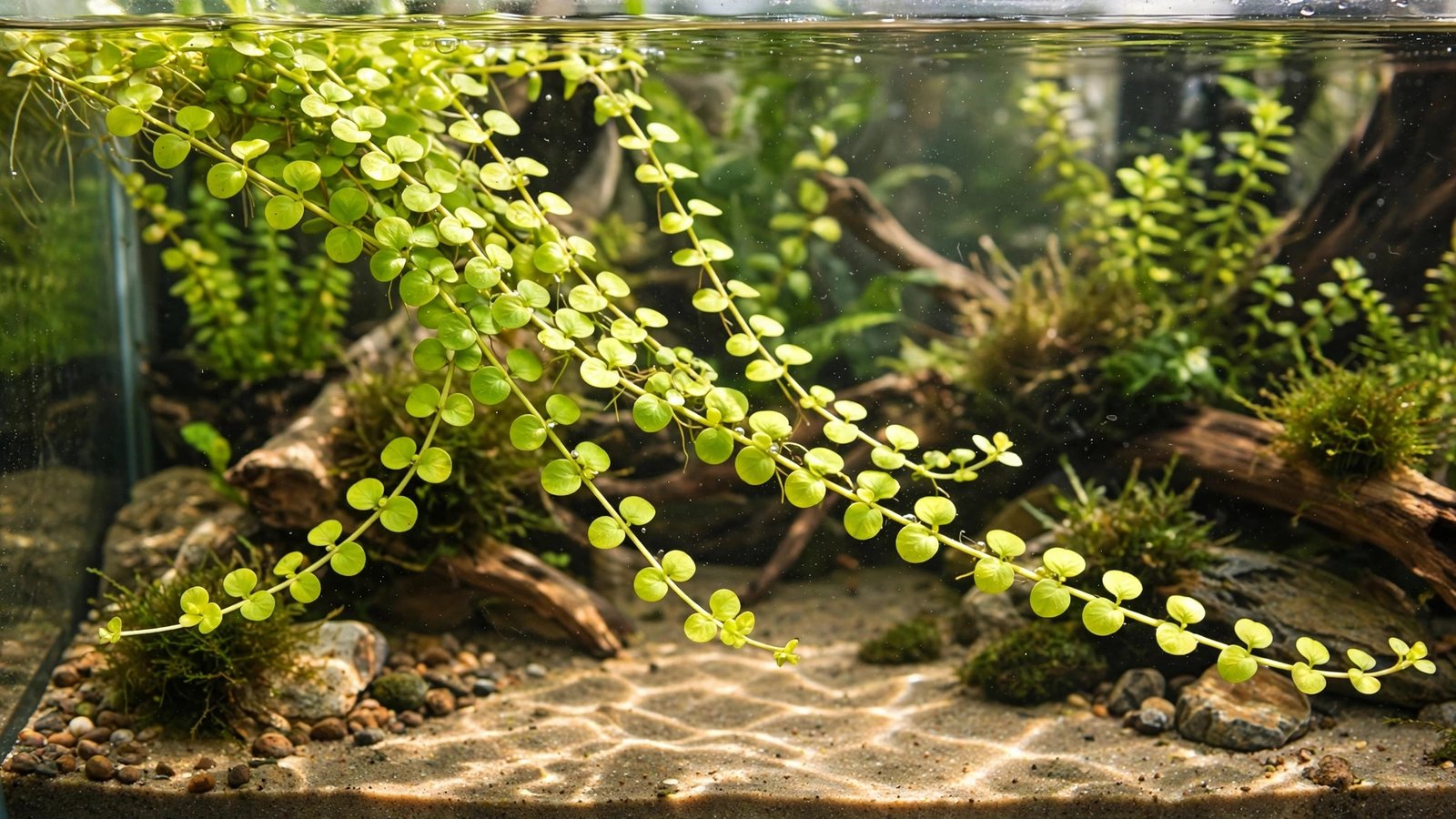
It was already an aquarium staple when your grandfather bought his first tank. Creeping jenny — the plant sold for decades as moneywort — carpeted fish tanks long before aquascaping had a name, and a lysimachia nummularia aquarium survives what melts trendier plants: no CO2, plain gravel, room-temperature water, weeks of neglect. The honest story: amphibious, not a true aquatic; green and golden ‘Aurea’ forms; invasive in several regions — never let it leave your tank.
The Vintage Beginner Plant: What Creeping Jenny Actually Is
A fish shop that has traded for thirty years still keeps creeping jenny trailing over a pot’s rim — that survival is the point. It entered the hobby when heated, high-tech setups were rare, and it earned its place by asking for almost nothing. If you are planning a first planted tank from a complete guide to freshwater aquarium plants, put creeping jenny in the “forgiving classics” column.
One honesty note first: shops sometimes sell it as a fully aquatic stem. It is not. Lysimachia nummularia is a European and temperate-Asian bog plant of pond margins and damp meadows. Submerged, it adapts — stems trail, round coin-shaped leaves hold, growth continues — but it never becomes a true aquatic. A stem that reaches the surface may throw a small yellow cup-shaped flower. That is its land heritage showing through, and a sign the plant is genuinely content.
Lysimachia nummularia aquarium Care: Parameters and Placement
The numbers read like a beginner’s wish list: wide pH band, soft or hard water, and light levels that would starve a carpeting plant. Its one real preference hides below the substrate — it feeds through its roots more than its leaves, so enriched substrate or a few root tabs under each clump make a visible difference within two weeks.
| Parameter | Range | Notes |
|---|---|---|
| Light | Low–medium | ‘Aurea’ needs medium light to stay golden |
| CO2 | None required | Slight benefit from liquid carbon |
| pH | 6.0–8.0 | Very adaptable |
| Hardness | 4–18 dGH | Soft or hard water both fine |
| Temperature | 4–28°C (39–82°F) | Unheated tanks fine; goldfish-safe |
| Placement | Midground–background | Trim tops to keep it trailing |
Placement decides how it reads in your layout. In the midground, creeping stems fill gaps between hardscape and background stems. Left alone it climbs toward the light, so pinch the upright tips regularly — it branches sideways.
Green vs Golden ‘Aurea’: Which Form to Buy
Shops sell two forms, different enough that the choice matters. The green form is the hardier, cheaper, faster grower — the workhorse. ‘Aurea’ is the golden form, prized for warm chartreuse-to-brassy contrast against green neighbors. The catch: ‘Aurea’ does not stay golden on autopilot. Under medium light it glows; in dim tanks new leaves emerge plain green and you have paid a premium for a look that never arrives.
| Form | Color underwater | Light needs | Vigor | Best for |
|---|---|---|---|---|
| Green (wild type) | Mid-green coins | Low is fine | Fastest | Unheated tanks, fillers |
| ‘Aurea’ (golden) | Gold to lime-green | Medium to hold gold | Moderate | Midground color accent |
Planting, Trimming, and Propagation
Potted creeping jenny arrives in rockwool with emersed-grown stems. Rinse the roots, pull the stems apart, and plant each one 2–3 cm apart. Burying the whole pot as one clump is the classic mistake: the inner stems rot and the clump melts within a fortnight. Individual planting lets light reach every node and encourages runners to root. For a budget round-leaf carpet, compare the dwarf sagittaria beginner carpet — both are cheap and forgiving, but creeping jenny’s coins give a softer, meadow-like texture.
Press two or three root tabs into the substrate under each cluster at planting, and replace them every two to three months. On the leaves, the plant asks for little beyond stable conditions — so with liquid fertilizer, start low and observe your livestock before increasing the dose.
The Unheated-Tank Advantage
This is where creeping jenny leaves nearly every tropical beginner plant behind. Most easy aquarium plants sulk below 20°C; creeping jenny keeps growing at 10°C and merely pauses near freezing. That makes it one of the only true options for cool-climate room-temperature tanks, goldfish setups, and outdoor tubs. If your shortlist came from an easy plants for a beginner community tank roundup, check which of those actually tolerate your winter room — creeping jenny almost certainly does. The vallisneria nana cold-water profile is its natural partner: Vallisneria’s straps against creeping jenny’s coins make a cold tank look deliberately designed.
The Dry-Start Carpet Experiment: An Honest Verdict
Every few years someone tries creeping jenny as a dry-start carpet, lured by its land habits. It works — for a while. Grown emersed under a cling-film lid, it carpets fast and looks superb. Flood the tank and the honesty comes in: the emersed leaves soften and the plant reverts to its trailing habit within weeks, sending stems upward instead of outward. The verdict: dry-start it only if you enjoy the experiment itself, not as a shortcut to a permanent carpet. For one that survives the flood, hydrocotyle tripartita’s creeping-carpet technique is the proven alternative.
Invasive Risk: Keep It a Tank-Only Plant
The vigor that makes creeping jenny bulletproof indoors makes it a problem outdoors. Naturalized across North America and classified as a restricted invasive species in Wisconsin, it roots at every node, forms dense mats, and outcompetes native wetland plants.
The NC State Extension profile of Lysimachia nummularia documents its naturalized spread and invasive impact, while the Aqua-Fish database entry for ‘Aurea’ confirms its semi-aquatic habits and midground aquarium placement. Enjoy the plant fully — just keep it behind glass.
Frequently Asked Questions
Is creeping jenny a true aquarium plant?
No — it is amphibious, a bog and pond-margin plant that adapts underwater rather than a true aquatic. That is why it keeps coin-shaped leaves submerged, may flower at the surface, and tolerates cool water and wet-to-dry transitions true aquatics cannot.
Can creeping jenny grow in an unheated tank?
Yes — it tolerates 4–28°C (39–82°F), one of the best plants for the job. It keeps growing through cool room temperatures and survives near-freezing water that melts most tropical plants. Goldfish tanks, unheated bedrooms, and outdoor tubs in mild climates all suit it. Growth slows in the cold, so trim less often and allow extra recovery time.
How do I stop creeping jenny melting after planting?
Melt almost always comes from planting the whole pot as one clump — buried inner stems rot. Split the pot into individual stems, plant each 2–3 cm apart, and remove the rockwool completely. Some leaf transition is normal in the first two weeks; if new nodes keep appearing, the plant is establishing. Feed the roots, not the water column.
Is it safe to put creeping jenny in my pond?
No. It is invasive in several regions — a restricted species in Wisconsin — and escapes ponds easily as fragments root downstream. Keep it as a tank-only plant, bag all trimmings for the bin, and check your local invasive-species regulations first.
Is Creeping Jenny Worth Growing?
If your tank is unheated, your budget is small, or your patience for melt-prone newcomers is gone — yes. Feed its roots, trim the tops, keep it behind glass, and creeping jenny will outlast the trends.