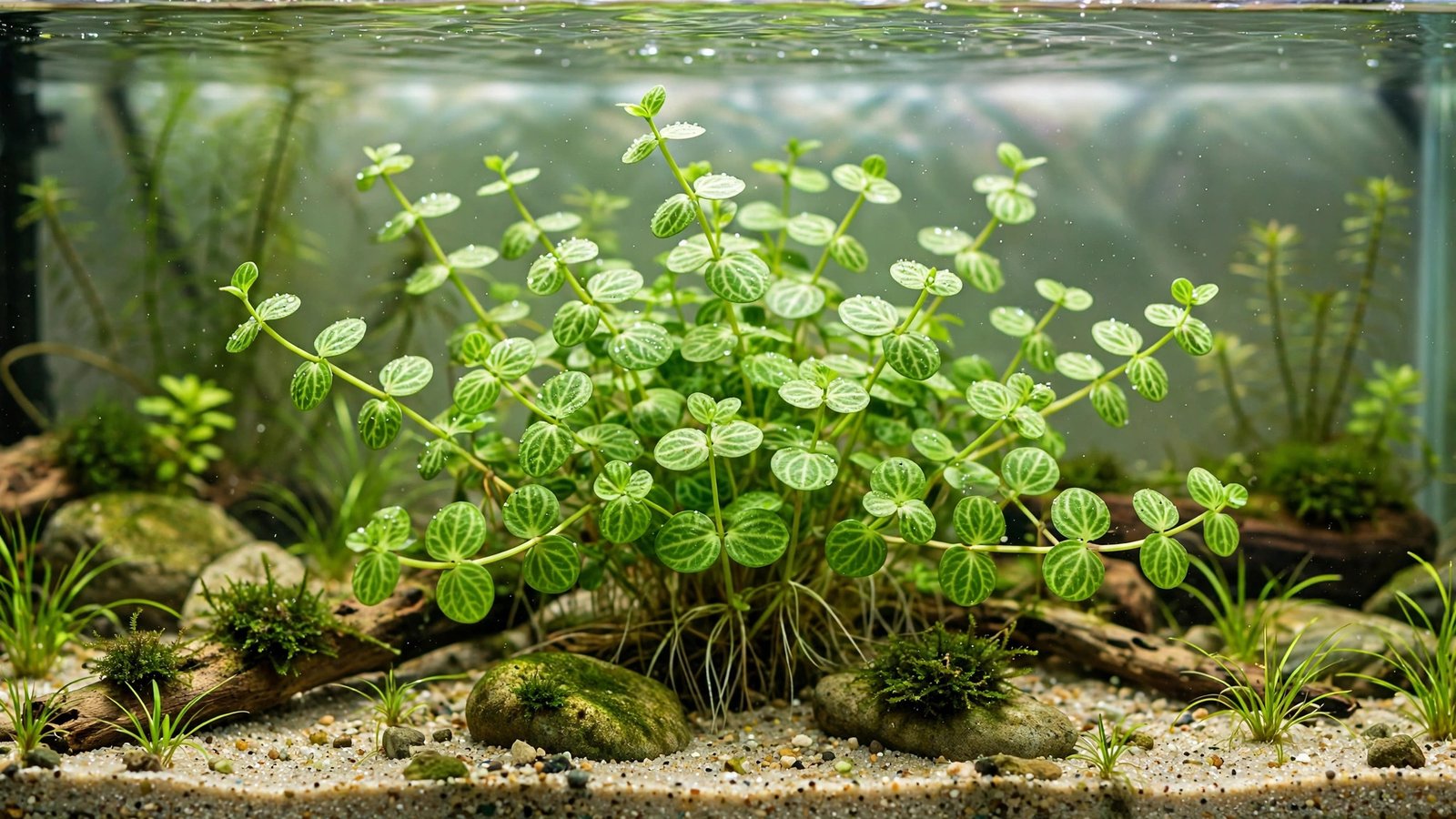
Most beginner stem plants earn the recommendation "easy" by being boring: tough, fast, and relentlessly green. Every now and then, one breaks that rule. Lindernia rotundifolia care is genuinely beginner-friendly, but the variegated 'Watermelon' form looks anything but plain — its small rounded leaves carry pink-and-cream marbling that makes people ask which expensive, high-tech plant you're running. Retailers have noticed too: Aquarium Co-Op recently called the 'Watermelon' Lindernia a standout new addition to its plant catalog, and the buzz around nano and low-tech keepers is real.
By the end of this guide you'll know exactly how to keep the variegation vivid, how much light and CO2 it actually needs, and the trim-and-replant routine that turns one pot into a full midground bush.
Why Beginners Are Obsessed with the 'Watermelon' Lindernia
Walk into any well-stocked fish store and you'll see the same wall of green stems. Then there's the Lindernia pot — oval leaves, each one splashed with pink, cream, and mint-green in patterns no two plants share. It's the kind of plant that makes a guest point at your tank and ask about it.
The plant behind the look is Lindernia rotundifolia, a marsh plant from tropical Asia (family Linderniaceae) that happily adapts to life fully underwater. The standard green form has been in the hobby for years, but the variegated 'Watermelon' cultivar — sometimes sold as Variegated Lindernia — is what's driving the current wave of attention. It stays compact (5–15 cm tall), branches readily when trimmed, and its leaves grow to about 1–2 cm across, giving midground groups a delicate, patterned texture that contrasts with big broad leaves and fine feathery stems alike.
Lindernia Rotundifolia Plant Profile
Here's the full rundown in one place. These are the forgiving ranges that make it a beginner plant:
| Parameter | Value |
|---|---|
| Scientific name | Lindernia rotundifolia (variegated 'Watermelon' cultivar) |
| Family | Linderniaceae |
| Origin | Tropical Asia (marsh / wetland habitats) |
| Difficulty | Easy |
| Light | Low–medium, 20–40 PAR |
| CO2 | Optional; helps growth and compactness |
| Temperature | 20–28°C (68–82°F) |
| pH | 6.0–7.5 |
| Hardness | Soft–moderately hard water |
| Height | 5–15 cm (2–6 in) |
| Leaf size | 1–2 cm, oval with serrated edges |
| Placement | Midground; foreground edge in small tanks |
| Growth rate | Moderate (roughly 1–2 cm per week in good conditions) |
| Propagation | Stem cuttings |
| Emersed growth | Yes — also suitable for ripariums and shallow bowls |
One note on the Latin: Lindernia rotundifolia is sometimes confused with Rotala rotundifolia because of the shared "rotundifolia" (round-leaved) epithet. They are completely different plants from different genera — check the genus name on the label. If you're comparing the two, our Rotala rotundifolia care guide covers the classic red-pink stem, and the growing conditions differ enough that mixing them up leads to wrong expectations.
Lindernia Rotundifolia Care: Light and CO2 Requirements
How much light it really needs
Low to medium light — roughly 20–40 PAR at the plant — is the sweet spot. That's the range of a standard LED fixture on most beginner setups running 7–8 hours a day. Lindernia will survive in dimmer corners, but survival isn't the goal: under weak light it stretches upward with long bare internodes, the leaves shrink, and the pink variegation fades toward plain green.
If you want the boldest marbling, err toward the medium end. The pink tones are the plant's way of showing healthy growth, and they strengthen when the plant has enough light to photosynthesize comfortably without stress. You don't need a high-light setup or a blinding fixture — just avoid burying it under floaters or in the shade of a large hardscape. Tropica's official Lindernia rotundifolia plant profile agrees, rating the species' light demand as low and calling it a good starter plant for most conditions.
CO2: helpful, not required
This is where Lindernia earns its beginner status. It grows perfectly well without injected CO2, drawing carbon from the water column like most easy stems. Adding CO2 — pressurized or even a modest DIY setup — accelerates growth and produces denser, more compact bushes with tighter leaf spacing. But leaving it out doesn't doom the plant; it just grows a bit slower and a touch leggier. If you're running low-tech, spend your budget on a good light and a consistent fertilizer routine instead of CO2.
Substrate and Fertilizer
Lindernia is a modest rooter — it feeds from both roots and leaves — so it adapts to almost any substrate. In inert substrates, push a root tab near each planting cluster every 2–3 months; in aqua soil, the substrate covers the root-feeding side for the first 6–12 months.
The leaf-feeding side matters just as much. A standard all-in-one liquid fertilizer dosed per the bottle's weekly schedule covers it: 1 mL per 40 liters per day (or the equivalent weekly dose) is a common starting point for easy stems. Look for these signs to tune dosing:
- New leaves pale or yellowish → increase overall fertilizer, especially nitrogen and micros.
- Pinholes in older leaves → likely potassium shortfall; step up the all-in-one or add a potassium supplement.
- Algae colonizing leaf surfaces → usually too much light or inconsistent CO2, not a nutrient problem; reduce the photoperiod to 7 hours before changing fertilizer.
Keep changes gradual — adjust one variable at a time and give the plant two weeks to respond before judging.
How to Plant and Propagate Lindernia
Planting your first bunch
Lindernia arrives as a tissue-culture cup, a potted bunch, or a weighted store bunch. However it arrives, the planting method is the same:
- Rinse off any potting media (rockwool or gel) gently — tease it away rather than scrubbing, so the delicate roots stay intact.
- Separate the stems. A single pot usually yields 8–15 individual stems; planting them crowded in one clump guarantees the inner ones rot.
- Strip the lowest 1–2 cm of leaves so the buried portion is bare stem. Buried leaves melt and rot, and rot spreads.
- Plant each stem 1–2 cm apart with tweezers, pushing them into the substrate at a slight angle until the first remaining leaves sit just above the surface.
- Leave them alone for a week. Some plants float back up in the first 24 hours; replant them — once roots grip, they're set.
Propagation: free plants every few weeks
Lindernia propagates exactly like other easy stems. When a stem reaches the height you want (or starts looking top-heavy), snip it with sharp scissors about 5–7 cm down from the tip, strip the lower leaves from the cutting, and push it back into the substrate. The planted top grows on without missing a beat.
The rooted base doesn't die — it sprouts two new shoots from the cut node within 1–2 weeks. That's the whole engine of a bushy group: every trim multiplies your stem count. In moderate conditions, expect a plantable cutting from each established stem every 3–4 weeks.
Trimming and Shaping
Because Lindernia grows moderately rather than explosively, trimming is a pleasure, not a chore. Let the group grow to your target height, then cut the front stems shorter than the back stems to create a natural slope — this layered look is what separates an aquascaped group from a random patch.
After a heavy trim, the bases look sparse for about a week before new side shoots fill in. Resist the urge to "fix" the bare phase by replanting everything — patience fills it faster. Replant the healthy tops into thin spots; within two trims you'll have a dense, self-sustaining bush.
Save the trimmings. Healthy tops root so reliably that they're worth gifting, trading, or using to start a second group. Unlike Ludwigia Super Red, which demands strong light and CO2 to keep its color after a move, Lindernia cuttings settle into a new tank with minimal fuss.
Common Problems and Fixes
Lindernia has few real enemies, but beginners do hit the same handful of issues. Work through this table before reaching for new equipment:
| Symptom | Likely cause | Fix |
|---|---|---|
| Melting within days of planting | Transition shock, especially from emersed/tissue-culture form | Trim away melted tissue, leave the healthy stems; new submerged leaves emerge in 1–2 weeks |
| Long bare stems, small leaves | Too little light | Raise light intensity or move plants out of shade; trim and replant the healthy tops |
| Variegation fading to green | Low light and/or inconsistent nutrition | Increase light to the medium range, dose micros steadily; new growth shows the pattern first |
| Pinholes in older leaves | Potassium deficiency | Increase all-in-one dosing or add potassium supplement |
| Algae film on leaves | Excess light or unstable CO2 relative to growth | Cut photoperiod to 7 hours, improve flow and consistency before adding nutrients |
| Stems rotting at the base | Planted too densely; buried leaves rotting | Separate stems, strip buried leaves, replant with 1–2 cm spacing |
One reassurance: melting new arrivals is normal, not a failure. Plants grown emersed at the nursery shed their air-adapted leaves and grow submerged-adapted ones. If at least the stem tips look firm and green, the plant is fine — clear the mush, keep conditions stable, and wait. This is one case where a plant like Cryptocoryne wendtii, which melts dramatically and famously, teaches the same lesson: stable water beats frantic intervention.
Where It Fits in Your Scape
Lindernia's small leaves and 5–15 cm height make it a natural midground plant in tanks of 60 liters and up, and a foreground-edge accent in nano tanks. Its pink-and-cream variegation does two jobs: it contrasts with solid greens (Java fern, anubias) and echoes red plants without demanding their high-tech care.
How it compares to other beginner stems you're likely considering:
| Plant | Color interest | Light demand | CO2 needed? | Growth speed |
|---|---|---|---|---|
| Lindernia rotundifolia 'Watermelon' | Pink/cream variegation | Low–medium | No | Moderate |
| Ludwigia repens | Orange-red tips | Medium | No, helps | Fast |
| Bacopa caroliniana | Lemony scent, slight gold | Low–medium | No | Slow–moderate |
| Rotala H'ra | Hot orange-red | Medium–high | Yes, recommended | Fast |
Practical pairings: plant Lindernia in front of taller, finer stems like Rotala H'ra for a color gradient from pink-variegated to orange-red, or beside the solid oval leaves of Bacopa caroliniana so the marbling reads against plain green. For a low-tech color trio without CO2, combine it with Ludwigia repens — the red-tipped Ludwigia behind the pink-marbled Lindernia is one of the easiest high-impact midground combos in the hobby.
Frequently Asked Questions
Is Lindernia rotundifolia a good beginner plant?
Yes — it's one of the easiest variegated stems you can buy. It tolerates low-to-medium light, needs no CO2, adapts to most substrates, and propagates from simple cuttings. The only real skill involved is trimming, and even sloppy trims recover. Compared to fussy red stems that demand high light and CO2, Lindernia gives beginners visible color with ordinary beginner conditions.
Does the 'Watermelon' keep its pink variegation underwater?
Yes, provided light and nutrition are adequate. The marbling is genetic, not a nursery trick, and submerged growth shows it clearly. If new leaves come in mostly green, the plant is telling you light is too low or dosing is inconsistent — raise light toward the medium range and dose micros steadily, and the pink returns on fresh growth. Old leaves rarely regain lost pattern, so judge by the tips.
How fast does Lindernia rotundifolia grow?
Moderately — roughly 1–2 cm per week under medium light with steady fertilizer, slower in low light and faster with CO2. That's a comfortable pace: quick enough to fill in and give you trimmings within a month, but not so fast that it needs weekly haircuts like aggressive stems. Expect plantable cuttings from each established stem every 3–4 weeks.
Why is my Lindernia melting after planting?
Nursery plants are often grown emersed (in humid air), and those air-adapted leaves can't function underwater — they melt off while the plant grows submerged replacements. This transition takes 1–2 weeks. Trim away the mushy tissue, keep water conditions stable, and don't fertilize extra to "rescue" it. If the stem tips stay firm and green, the plant is on track and new growth will appear soon.
Can Lindernia rotundifolia grow without CO2?
Absolutely. It grows well in low-tech tanks on ambient CO2 alone, as long as light and fertilizer are reasonable. Injected CO2 is a performance upgrade — faster growth, tighter internodes, denser bushes — not a requirement. If you're deciding where to spend money in a new setup, a decent light and a good all-in-one fertilizer will do more for Lindernia than a CO2 kit.
Is Lindernia rotundifolia invasive? Should I worry about it spreading?
There are no major reports of Lindernia rotundifolia becoming invasive in the aquarium trade context, unlike some notorious pond and ditch weeds. Still, practice standard hobby hygiene: never dump trimmings or tank water into local waterways, and compost or trash unwanted cuttings. Conservative disposal keeps a non-problematic plant non-problematic.
The Bottom Line
Lindernia rotundifolia 'Watermelon' is that rare combination: a plant that looks like it needs a high-tech tank but asks for nothing more than medium light, steady fertilizer, and a pair of scissors. Plant the stems with space, trim and replant the tops, and let the cut-and-regrow cycle build your bush. Do that, and you'll have the pink-marbled midground that made this plant a catalog standout — in a tank a total beginner can run.