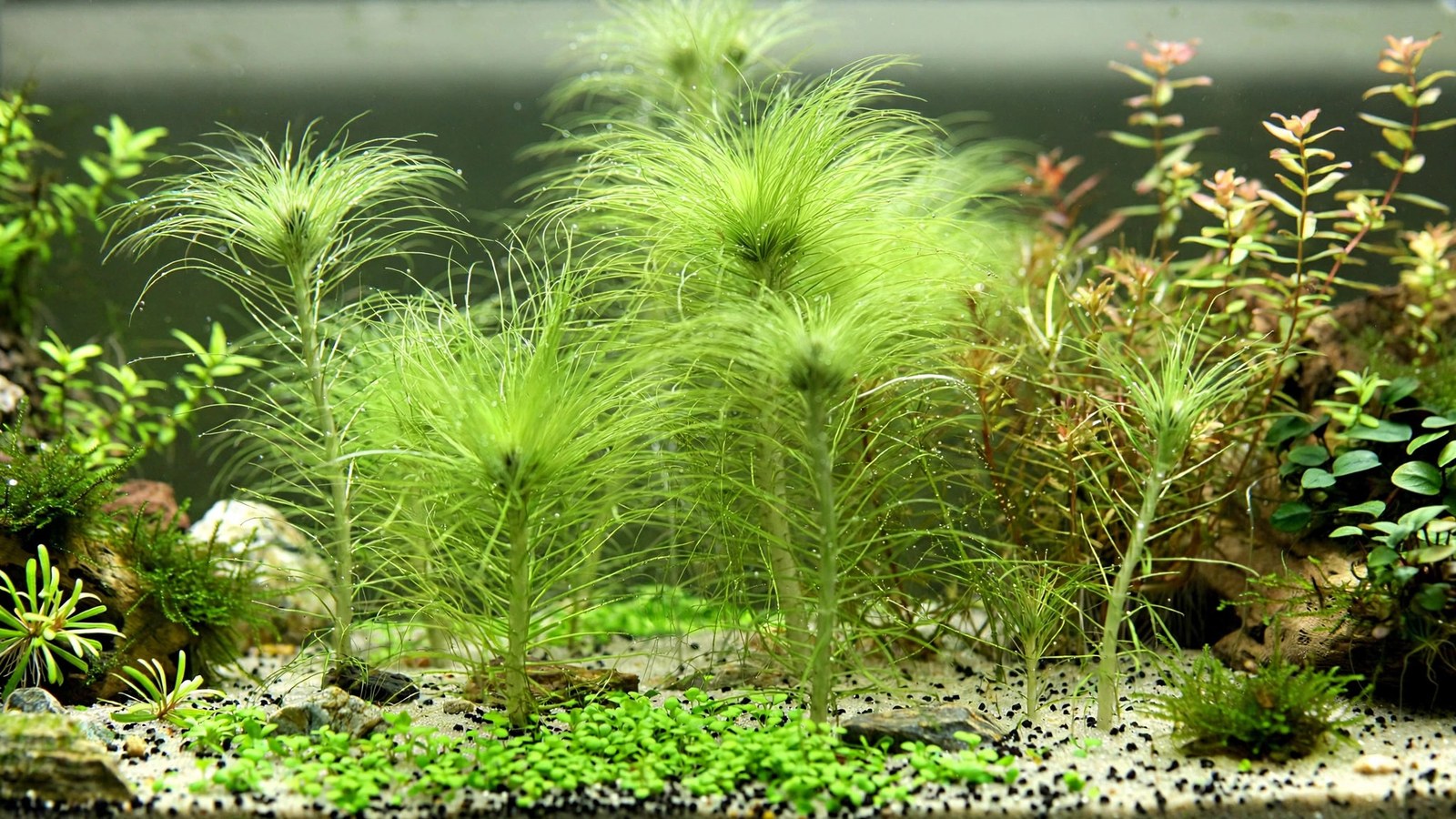
Fine Water Hair is the specialist's plant — and the specialist knows why. Eriocaulon setaceum is the only true stem plant in a genus of rosettes, sending up needle-like leaves in whorled tiers like a bottle brush, and it holds its impossible beauty only under conditions most tanks will never provide. This guide to eriocaulon setaceum care is for aquarists who already run soft, acidic, high-tech tanks and want the honest truth about what this plant demands.
Direct answer: Eriocaulon setaceum care demands specialist conditions: very soft acidic water (pH around 6), high-intensity light, and injected CO2 at 25–40 mg/L over a sand-and-peat substrate, with steady macro/micro dosing. It is a true submerged stem plant with whorled, needle-fine fresh-green leaves. Citable fact: unlike nearly every other Eriocaulon in the hobby, this species rots at the base when nutrient levels are too high — making a leaner substrate the winning choice.
What Makes Eriocaulon Setaceum Different
Almost every Eriocaulon in the aquarium hobby is a rosette — a tight star of leaves radiating from a single crown. Eriocaulon setaceum breaks the pattern entirely: it grows a true stem, clothed in tiers of filiform, fresh-green to whitish leaves so fine they look like strands of hair, and throws bushy lateral shoots from the nodes. A settled stem becomes a small cloud, up to about 30 cm tall.
The confusion matters because care does not transfer. Growers who succeed with the rosette Eriocaulon and assume the same routine will work here are usually disappointed: the stem form is more demanding and far less forgiving. Buy from a source that names the species precisely — AQUAGREEN's fact sheet on Eriocaulon setaceum is a useful reference for confirming identity and native habitat before you order.
Eriocaulon Setaceum Care: Water Parameters
This is where most attempts fail, and there is no shortcut. Eriocaulon setaceum comes from nutrient-poor, very soft waters across Southeast Asia and northern Australia, and it needs something close to that in your tank.
| Parameter | Target |
|---|---|
| pH | Around 6.0, stable |
| General hardness (GH) | Very soft, under 4 dGH |
| Carbonate hardness (KH) | Low, 0–2 dKH |
| Temperature | 22–26°C |
| TDS | Under ~100 ppm |
Use RO or rainwater remineralized lightly, not hard tap water. Large water changes help only if the replacement water is equally soft. Keep flow moderate and even around the stems; dead spots invite base rot.
Light, CO2 and Fertilization
Strong light is non-negotiable — aim for genuinely high PAR at the planting depth, and if your lighting schedule still has room to grow, check how much light aquarium plants actually need before committing. Weak light stalls this plant; it never "adapts down" the way hardy stems do.
CO2 is required, not recommended. The working range is 25–40 mg/L of dissolved CO2, delivered steadily through the photoperiod. If your injection setup is not yet dialed in, read how to set up CO2 in a planted tank first — this plant will not hold its form without it. As with all fertilization here, start low and observe your livestock before increasing anything.
Dose a complete macro and micro routine, but keep it measured. Soft-water tanks have little buffering capacity, so small doses are both safer and sufficient — a Rotala wallichii style softwater routine translates well: lean NPK, steady iron and traces, consistency over intensity.
 ★4.6
NICREW ClassicLED Plus planted aquarium light
Check Price on Amazon ★4.6Substrate and Planting
Here the received wisdom flips. Rich aquasoil loaded with ammonia is a poor choice — a substrate of roughly half sand and half peat is the documented winner, mirroring its natural habitat. The lean substrate keeps nutrients low at the roots while the water column carries the measured dosing you control. Cap the peat well so it does not leach tannins faster than you expect.
Plant stems individually, spaced a couple of centimeters apart, pressing only the lowest nodes into the substrate. Deep planting buries nodes and invites the very base rot you are trying to avoid. Give each stem clear water flow from the filter output — start with tissue-culture or bare-root plants washed free of substrate, which establish fastest.
Pruning and Propagation
Plan the layout as if you will never cut it — because you almost won't. Eriocaulon setaceum does not tolerate pruning well, and cut stems often stall or rot rather than branching. Trim only when strictly necessary: if a stem is shading neighbors or melting, remove it entirely at the base.
Propagation comes from the plant's own habit. Healthy stems produce bushy lateral shoots you can separate and replant once they have a few nodes of their own. Vigorous tops that must be removed can be replanted, but expect a slow recovery. This is a plant you multiply by patience, not by scissors.
Common Problems
| Symptom | Likely cause | Fix |
|---|---|---|
| Base of stem rots, plant floats up | Nutrients too high; poor flow at the base | Cut dosing, space stems wider, improve circulation |
| Growth stalls, leaves stay short | CO2 too low or water too hard | Verify 25–40 mg/L CO2; switch to RO water |
| Leaves turn pale/whitish | Micronutrient gap or excessive light without CO2 | Steady trace dosing; balance light against CO2 |
| Cut stems melt instead of branching | Over-pruning a species that hates it | Remove damaged stems whole; stop topping |
Pairing With Tonina Fluviatilis
The closest companion in the hobby is Tonina fluviatilis — another softwater, high-light, CO2-hungry stem plant with near-identical demands. A tank tuned for one will almost always suit the other, and many of the finest softwater show tanks pair them deliberately: Tonina's denser texture against setaceum's airy needle tiers. Master the water first, then add Eriocaulon setaceum as the centerpiece it deserves to be.
Frequently Asked Questions
Is Eriocaulon setaceum suitable for beginners?
No — honestly, it is one of the least beginner-friendly plants in the hobby. It needs very soft acidic water, strong light, and 25–40 mg/L of injected CO2, plus a lean sand-and-peat substrate. Beginners will get far more joy from hardy stems like Rotala rotundifolia; come back to setaceum once you are running a stable high-tech softwater tank.
How is Eriocaulon setaceum different from other Eriocaulons?
It is the only true stem plant in the genus. Species like E. cinereum and E. sp. Japan grow as tight rosettes from a single crown, while setaceum grows an upright stem clothed in whorled, needle-fine leaves with lateral shoots. The stem form is also more demanding and far less tolerant of pruning, so rosette-Eriocaulon experience does not fully transfer.
Why is my Eriocaulon setaceum rotting at the base?
Base rot is the classic sign of nutrient levels that are too high — this plant evolved in nutrient-poor water and treats excess as a threat. Cut your dosing back, make sure stems are spaced for water flow around the base, and avoid burying stems deeply. A lean sand-and-peat substrate helps enormously compared with rich aquasoil.
Can I grow Eriocaulon setaceum without CO2 injection?
Realistically, no. Liquid carbon supplements cannot reach the 25–40 mg/L dissolved CO2 this species needs, and it will stall and decline without pressurized injection. If you are not ready to run a proper CO2 system, choose a different plant rather than fighting a losing battle.
How do I propagate Eriocaulon setaceum?
Let the plant do the work: healthy stems produce bushy lateral shoots that you separate and replant once they have several nodes. Avoid routine topping — the species tolerates pruning poorly and cut stems often stall. If a stem must be removed, take it out whole at the base and replant only vigorous tops.
The Specialist's Reward
Eriocaulon setaceum will never be a forgiving plant, and that is its appeal. When the water is soft, the light strong, the CO2 steady at 25–40 mg/L, and the substrate lean, its needle-fine tiers form a cloud no other stem plant quite matches. Set the stage correctly, touch it rarely, and it rewards you.