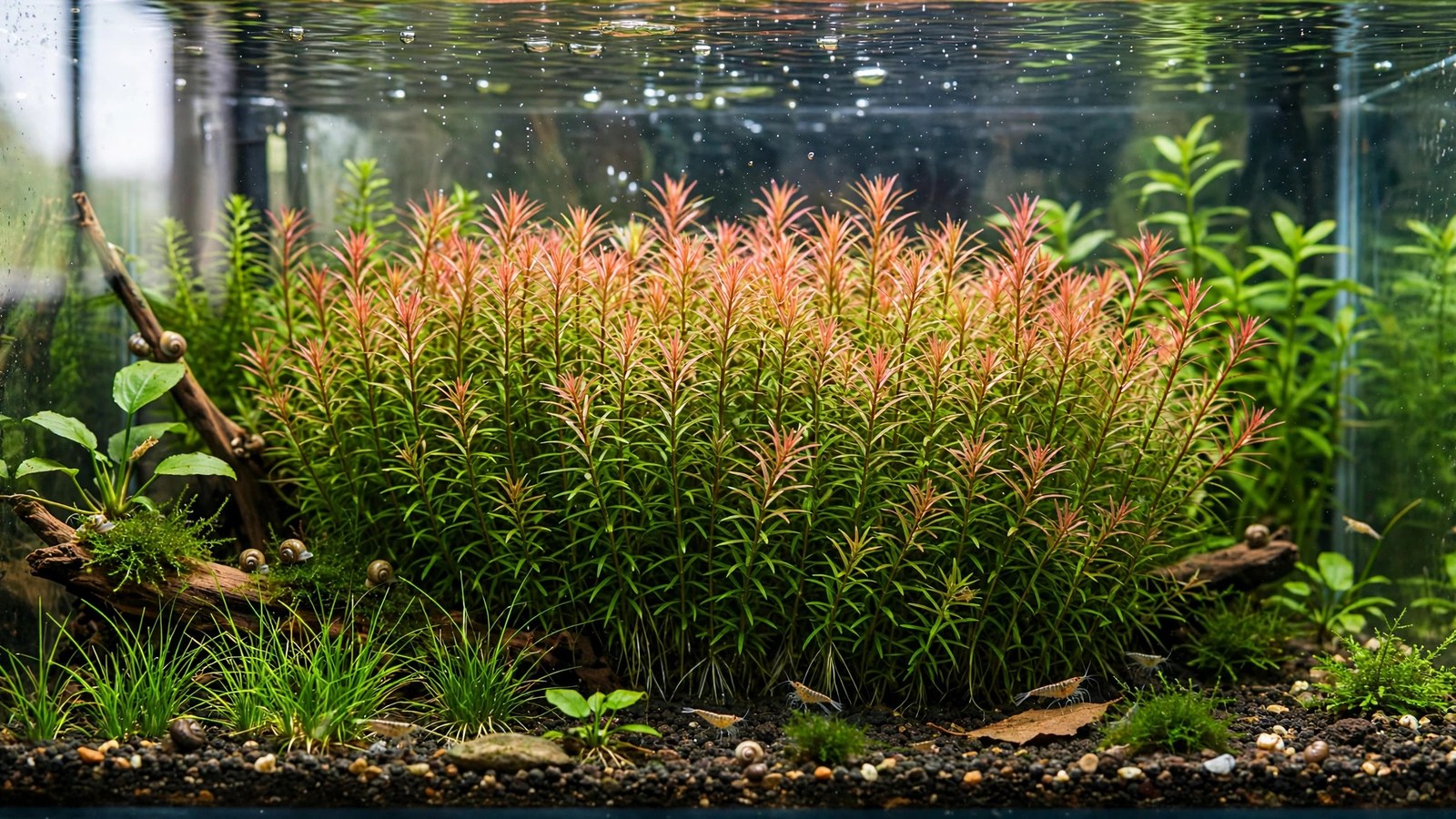
Most stem plants telegraph what they want. Didiplis diandra does not. Give this slender North American native medium light and no CO2 and it will sit there for weeks as a stubby green bottlebrush — then, the day you upgrade your lighting, it explodes into a dense orange-tipped hedge so thick you can hide a canister filter intake behind it. This guide shows you exactly how to grow water hedge from a handful of cuttings to a trimming-worthy stand: the PAR it actually needs, the CO2 and dosing regime that keeps the tips clean, planting technique, the hedge-forming trim, and how to fix legginess and melt.
What Didiplis Diandra Actually Is
Didiplis diandra — sold in the trade as water hedge, and occasionally under the older name Peplis diandra — is a true North American native. It grows wild in shallow ponds, ditches, and slow streams across the eastern United States, rooting in mud and pushing needle-thin stems toward the surface. That origin story matters more than most hobbyists realize, because the plant's split personality — scruffy submersed in one setup, spectacular in another — comes directly from the conditions it evolved in: full sun, soft water, and mud packed with decaying organics.
Identification is easy once you know the signature. Each stem carries whorls of needle-like leaves, four to a node, each leaf 1.5–2.5 cm long and barely 1–2 mm wide. Submersed foliage reads grass-green; under strong light the tips blush copper, orange, and sometimes brick red. In emersed form — how most shops sell it — the leaves are shorter, thicker, and plain green, and this is the form that melts back when flooded.
Know the lookalikes so you don't buy the wrong plant. Rotala wallichii has finer, hair-like leaves and a strict CO2 addiction. Myriophyllum species look similar from a distance but have pinnate, feather-divided leaves. Limnophila sessiliflora carries its whorls in larger, bushier tufts. Water hedge's combination — four-needle whorls, modest leaf width, orange tips under high light — is diagnostic.
Light: The Single Most Important Variable
Here is the mistake most people make with didiplis diandra: they treat it like Ludwigia repens or Hygrophila polysperma and park it under medium light expecting a decent hedge. You will not get one. Water hedge is one of the most light-hungry stem plants commonly sold in the hobby, and under insufficient light it does three ugly things: stretches to 3–4 cm between leaf whorls, drops its lower leaves entirely, and collects algae on the denuded stem tips.
The working target is 100–150 µmol of PAR at the substrate level over a 7–8 hour photoperiod. Below roughly 60 µmol it survives but stays leggy and green; above ~180 µmol you gain nothing except algae risk. No PAR meter? On a standard 40-breeder that means two quality LED fixtures, or one high-light fixture run at full intensity. White-heavy spectrum (6000–7000 K) with a red channel boost flatters the copper tips best.
| PAR at substrate | What to expect | Verdict |
|---|---|---|
| <50 µmol | Stretchy stems, bare lower nodes, no color | Not viable for a hedge |
| 60–90 µmol | Compact-ish growth, tips stay green | Healthy but plain |
| 100–150 µmol | Dense whorls, copper-to-orange tips, strong branching | Sweet spot |
| >180 µmol | Marginal extra color, thread algae risk climbs | Diminishing returns |
 ★4.6
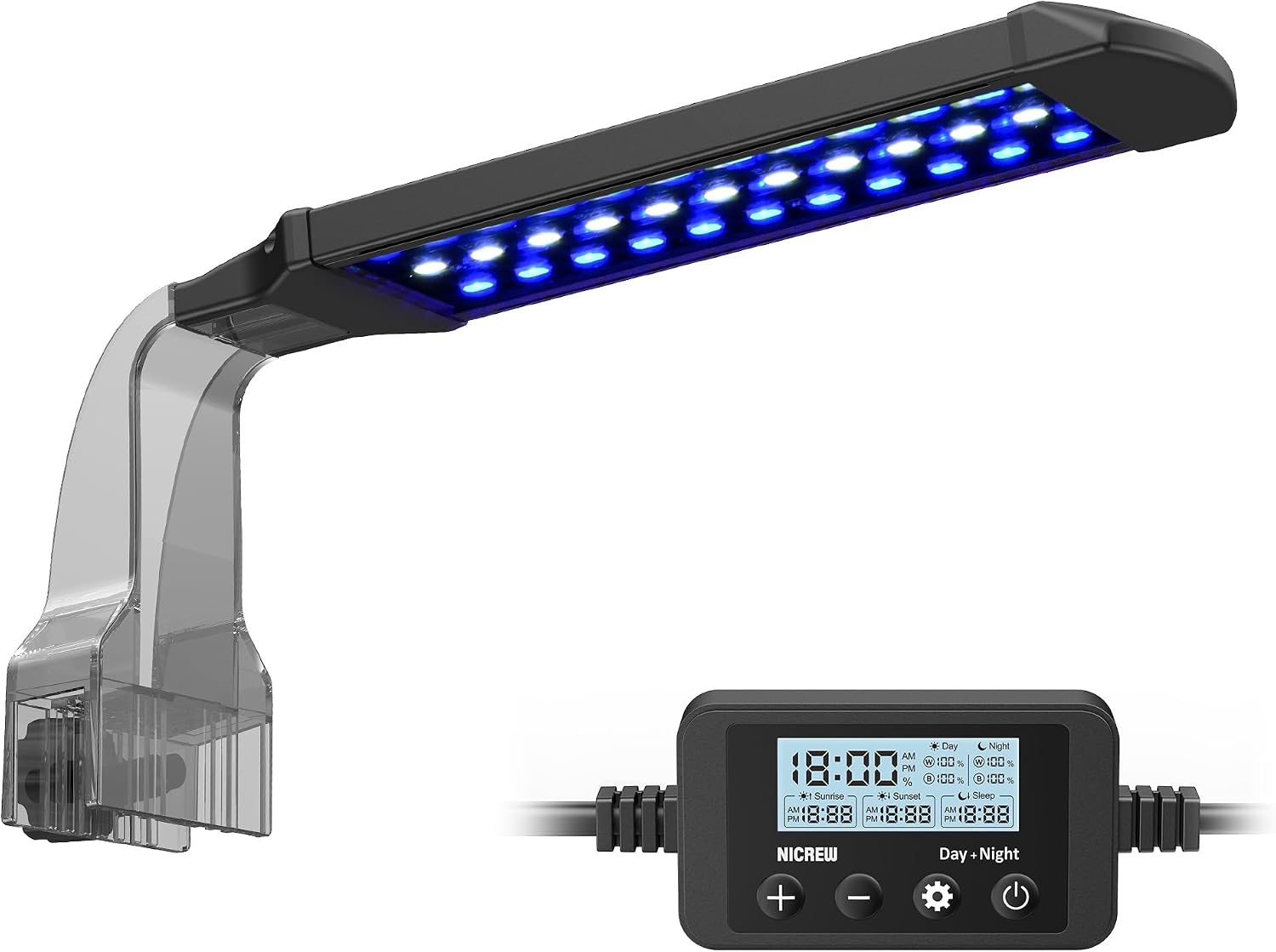
NICREW ClassicLED Plus planted aquarium light
Check Price on Amazon ★4.6CO2 and Fertilization
Water hedge can grow without injected CO2, but the hedge you picture in aquascaping photos — the wall of interlocking orange tips — does not exist without it. CO2 is the difference between a handful of stems and a stand. Aim for 25–30 ppm during the photoperiod, with the gas hitting full concentration a full hour before lights-on. A drop checker sitting a clean lime green 1–2 hours into the photoperiod is your confirmation. Start low (around 1 bubble per second on a 60-liter tank) and raise gradually while watching livestock — if fish hover at the surface or gasp, back the CO2 off before touching anything else.
Nutrition is a steadiness game, not a bulk game. Didiplis pulls hard on iron and potassium — iron drives the red/orange tip coloration, potassium prevents the pinhole-and-yellowing pattern on older whorls. A lean but consistent Estimative Index (EI) style regime works well: dose micros (with iron) 3× weekly and macros 3× weekly on alternating days, with a 40–50% water change weekly to reset. Typical starting doses for a 60 L tank: 2–3 ppm nitrate, 0.5 ppm phosphate, 5–8 ppm potassium per macro dose, plus a chelated-iron micro mix dosed to roughly 0.1–0.2 ppm iron per dose.
| Parameter | Target | Signs you missed it |
|---|---|---|
| CO2 | 25–30 ppm during lights-on | Slow growth, no branching, stems stay thin |
| Nitrate | 5–20 ppm | New growth pale, stunted tips |
| Phosphate | 0.5–2 ppm | Overall growth stall, green spot algae |
| Potassium | 10–20 ppm | Pinholes and yellowing on older whorls |
| Iron | 0.1–0.2 ppm per dose | New leaves green where they should blush orange |
| Temperature | 20–26 °C (68–79 °F) | Above 28 °C: limp growth, melt risk |
Substrate and Planting Technique
Give water hedge fine, nutrient-rich aquasoil at least 4–5 cm deep in the planting zone; the fine grain lets its hair-thin roots penetrate immediately, while coarse gravel slows establishment by weeks. Aim for soft water — pH 6.0–7.0, GH 3–8 dGH — which matches its native habitat and keeps iron bioavailable.
Planting day is where most hedges are won or lost. Follow this sequence:
- Prep the stems. Trim each cutting to 8–12 cm, strip the lowest 2 cm of leaves, and let them rest in tank water for 10 minutes — the stems soften and sink easier.
- Bunch small. Group 3–5 stems per planting hole. Bigger bunches rot in the middle before they root.
- Go deep enough. Push the bunch 2–3 cm into the substrate at a slight angle, stems vertical. In aquasoil, your planting tweezers should reach nearly to the glass before releasing.
- Space the groups 1.5–2 cm apart in a staggered grid across the planting area. This looks sparse on day one — by week three the gaps vanish.
- Leave the tank alone for a week: no rearranging, no gravel vacuuming near the stems. New roots are fragile.
If you bought emersed-grown pots (short, thick leaves), expect them to melt over the first 10–14 days. Plant anyway and leave the melting foliage in place — it anchors the stem while the submersed form emerges from the top nodes.
Growth Rate and the Hedge-Forming Trim
Once rooted — usually 2–3 weeks in — water hedge grows 1–3 cm per week under high light and CO2. This is the rare stem plant whose common name is the aquascaping technique: you trim it like a hedge.
Let the stand grow 2–3 cm past your target height, then cut horizontally across the whole stand with long aquascaping scissors. Every cut stem forks into two or more new shoots just below the cut, so each trim doubles branching. After the second or third trim the stand self-weaves into a solid wall. Trim every 2–3 weeks — roughly 3–4 cm of regrowth is the sweet spot — and keep CO2 and nutrients stable through hard trims.
Two things matter most for a clean hedge line: remove every trimmed fragment (floating bits wedge in, shade the stand, and rot into algae magnets), and replant the healthy tops into thin spots — they root within days, faster than side shoots alone.
Reaching the back of the tank
Because the trim is horizontal, plant the stand where your longest scissors reach flat across it — the back 8–12 cm of the tank floor. Narrow stands (6–10 cm deep) cut straight look twice as dense as wide sloppy ones.
Propagation From Cuttings
You will never need to buy water hedge twice. Every stem is a potential new plant. Cut a healthy stem anywhere — top, middle, or the leafless bottom section — and push the fragment 2 cm into substrate. Fragments as short as 3 cm with no leaves root within a week under high light; the bare lower nodes sprout roots first, then leaves. Let the first stand reach the surface, top it, replant the tops into the gaps, and repeat: three trimming cycles — roughly 8–10 weeks — can turn 10 stems into 60–80. The only cutting that fails is the one left floating: floating fragments rot from the center, so plant within an hour of cutting.
Emersed Form and Terrarium Notes
Above the waterline, didiplis diandra reverts to its swamp personality: compact stems, rounded bright-green leaves, and tiny pink-white flowers if humidity stays above 70%. It creeps attractively in paludariums and wabi-kusa bowls. One caution: in warm-climate outdoor ponds it can naturalize — keep trimmings out of waterways.
Common Problems and Fixes
Legginess (long gaps between whorls)
The classic complaint, and almost always a light problem. Internode gaps longer than 2 cm mean the plant is reaching. Raise light intensity by 10–15% and hold for two weeks; new growth will show tighter whorls while the old leggy section never fixes itself — trim it off and replant the healthy top. Resist the temptation to compensate with fertilizer; more macros under low light just feeds algae. Compare with Cabomba caroliniana and Rotala rotundifolia, which stretch under the exact same light deficit — the fix is identical.
Melting after planting
Freshly planted stems often melt from the base up in week one — transition melt, not death, as long as the stem tissue stays firm. If the stem turns to mush, pull it; if it's firm, leave it, because firm stems almost always resprout from a node within 2–3 weeks. Stable CO2 and unchanged water parameters during the first two weeks are the best insurance. Melting across the whole stand simultaneously, though, means something changed: check for a CO2 interruption, a filter outage, or a temperature spike above 28 °C.
Algae on the dense tips
A trimmed hedge's dense crown traps detritus, inviting thread and staghorn algae. Aim gentle flow across the stand (not at it), siphon above the crown weekly, and keep phosphate stable. If algae establishes, trim the affected tips hard — the hedge regrows in two weeks; algae never leaves on its own.
Stalled growth despite good light
If PAR is right but nothing grows for 3+ weeks, suspect one of two invisible problems: exhausted aquasoil (soil older than 12–18 months with no root tabs) or a CO2 delivery failure (clogged diffuser, empty cylinder). Push a root tab under the stand and verify CO2 hits full strength an hour before lights-on — one of the two almost always explains the stall.
Frequently Asked Questions
Can I grow didiplis diandra without CO2?
Yes, but expect a sparse, slow, green stem rather than the dense orange hedge in photos. With high light and steady fertilization it fills in over 3–4 months instead of 6–8 weeks. DIY yeast CO2 or liquid carbon closes part of the gap, but neither matches pressurized injection here.
Why is my water hedge green instead of orange?
Color comes from light intensity plus iron, in that order. Verify PAR is genuinely 100+ at the substrate — "bright looking" LEDs often measure far lower. Then confirm iron at 0.1–0.2 ppm per micro dose. Nitrate above 20 ppm also suppresses reds; drop it to 5–10 ppm for two weeks and watch the tips.
How deep should I plant didiplis cuttings?
Push cuttings 2–3 cm in — deep enough they can't float loose, shallow enough the lowest leaf whorl sits at the surface. Burying more than 3 cm of bare stem invites rot; planting too shallow is the more common mistake, so err toward the deeper end.
Will didiplis diandra survive in a betta tank?
Absolutely — its 20–26 °C range overlaps betta needs, and bettas appreciate the cover. The caveat is light: a low-light betta setup with a basic lid light won't grow a hedge. Reserve didiplis for a high-tech corner, or pair the betta with easy low-light plants instead.
Is water hedge invasive?
In outdoor ponds in warm regions it can establish and spread, since it roots from fragments — so never dump trimmings into natural waterways. Indoors, in an aquarium, it is completely contained and poses no risk. Within the tank it spreads only by the trimmings you plant; it doesn't send runners or self-seed the way some stem plants do.
Why did my whole stand melt overnight?
Sudden whole-stand melt traces to an environmental shock: an empty CO2 cylinder, a heater failure, or a big water change with different parameters. The stems usually aren't dead — if tissue is firm, restore stable conditions and resprouting starts within 2–3 weeks. Remove only mushy stems to protect water quality.
Growing It Like a Pro
Didiplis diandra rewards exactly one mindset: commit to the light. Give it 100+ PAR, steady CO2 at 25–30 ppm, lean consistent ferts, and a horizontal trim every few weeks, and it repays you with one of the densest, most architecturally useful hedges in the hobby — a living green-orange wall that redder stem plants can accent but rarely match for texture. Start with one pot, trim the tops into the gaps, and let the plant's branching do the aquascaping for you.
External references worth bookmarking: the Tropica plant database entry for Didiplis diandra (cultivation parameters and imagery) and the USDA PLANTS profile for Didiplis diandra for its native range and habitat notes.