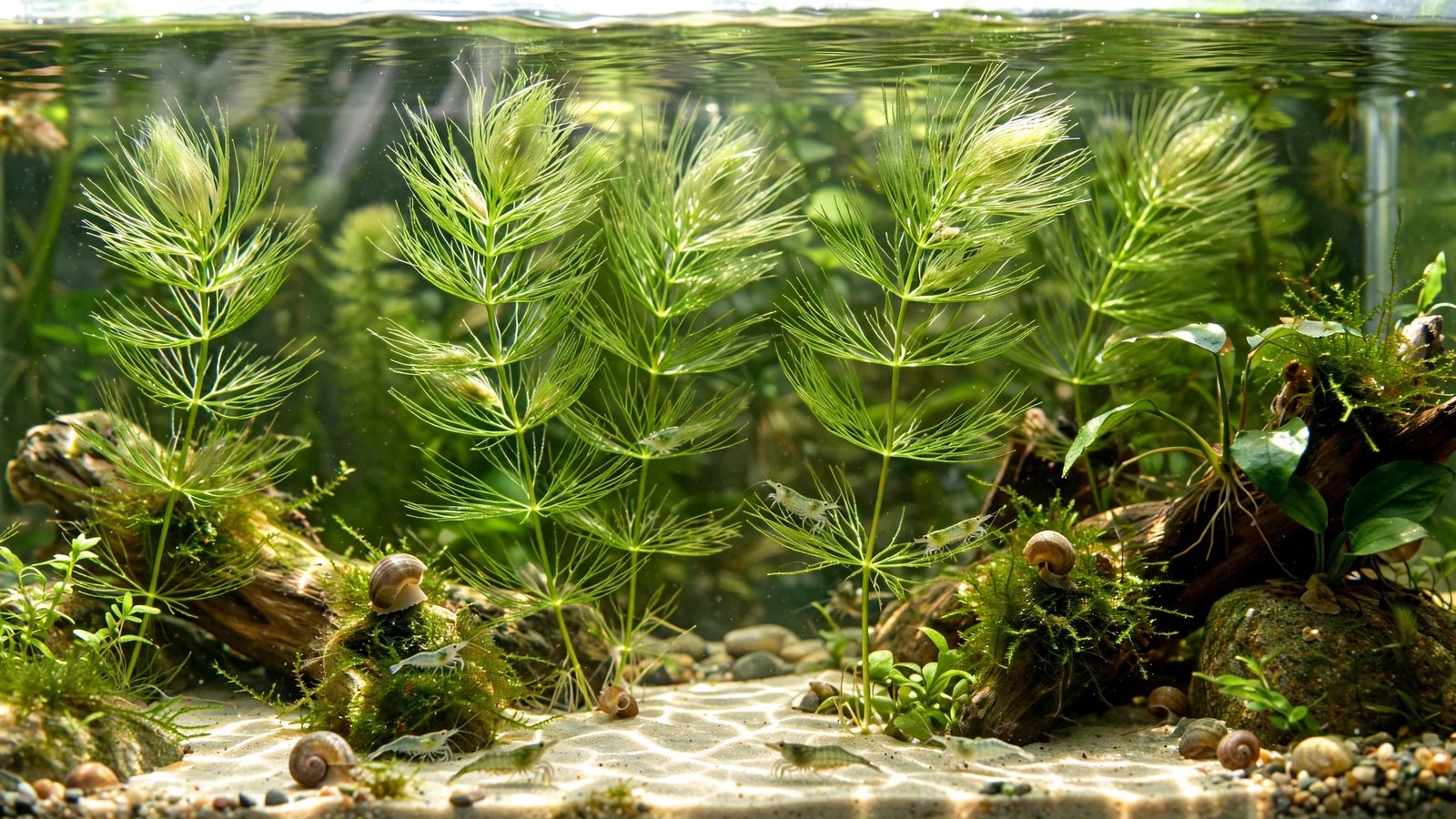
The needle blizzard is the giveaway. When a fresh bunch of so-called tropical hornwort melts into green confetti within days of hitting a new tank, the culprit is almost always a temperature swing — and genuine tropical hornwort care starts with accepting that Ceratophyllum submersum is a soft, warm-water specialist, not the indestructible weed its common cousin pretends to be. Give it steady warmth, gentle current, and low–medium light, and it repays you with fast, feathery growth — a warm-tank floater pick among planted-tank staples.
Tropical hornwort vs common hornwort: how to tell them apart
Stores mislabel these two constantly, which is why half the "tropical hornwort" horror stories are really about C. demersum kept badly. Run the leaf test before you buy: pinch a whorl between your fingers. Common hornwort feels stiff and faintly prickly — its leaves fork only once or twice into coarse segments with tiny teeth you can feel. Tropical hornwort feels like wet silk: the leaves fork two to three times into much finer segments, there are no teeth, and the whorl collapses limp the moment it leaves the water. Color is a second clue — submersum runs bright to yellow-green; demersum is darker and bluer.
Temperature tolerance seals the ID: common hornwort survives near 50°F and overwinters as dormant buds; submersum has no such gear. If the shop tank is feathery but unheated and chilly, you're looking at demersum — see the full common hornwort (Ceratophyllum demersum) care guide and a photo reference of Ceratophyllum demersum to lock in the visual difference.
| Trait | Tropical hornwort (C. submersum) | Common hornwort (C. demersum) |
|---|---|---|
| Leaf texture | Soft, feathery, silk-like | Stiff, coarse, faintly prickly |
| Leaf forking | 2–3 dichotomous forks, fine segments | 1–2 forks, coarser segments, toothed edges |
| Color | Bright to yellow-green | Dark, blue-green |
| Out of water | Collapses limp | Holds its shape |
| Cold tolerance | Dies back below ~68°F | Survives ~50°F; forms winter buds |
The simple tropical hornwort care routine that actually works
Submersum is delicate the way a tropical fish is delicate: easy in the right range, miserable outside it. Nail five things and it grows.
Temperature: steady and warm. Aim for 72–82°F (22–28°C), and treat stability as more important than the exact number. Keep the tank away from drafty windows, and run a heater with a thermostat in any room that drops below 70°F overnight. Above ~86°F growth stalls — in heat waves, increase surface agitation and shorten the photoperiod.
Light: low–medium, 8–10 hours. Around 20–40 PAR is the sweet spot. Too dim and stems go leggy, pale, and drop needles from the base up; too bright and hair algae colonizes the fine needles, which you cannot scrub without snapping them. Keep it to a dimmable LED on a timer.
Flow: gentle. Strong current whips the soft stems and snaps needle whorls. Point filter outputs at the glass or baffle them.
Nutrients: light and liquid. Like all hornworts, submersum feeds from the water column, so root tabs are pointless on a rootless plant. Fish waste sustains it in stocked tanks; in lean setups, dose a half-strength all-in-one liquid fertilizer once a week. Keep nitrates at 10–30 ppm; CO2 is unnecessary.
Needle shedding: the honest truth
The myth to kill first: tropical hornwort sheds. Needles detach under stress — shipping, a new tank, a temperature swing of more than a few degrees, or light too dim to support the existing mass. Shed needles drift into the filter intake and pack the impeller chamber, which is the real cost of the mess.
Read the shed: a scatter of older, lower needles in the first one to two weeks is normal acclimation — the plant is reallocating energy to new growth. Whole stems going bare with soft, translucent tips means the temperature is too low or unstable, and the fix is heat, not fertilizer. Trim mushy tips back to firm green tissue and re-float.
Manage the litter: a prefilter sponge over the intake (rinsed weekly while shedding) stops most impeller-clogging, and a gentle weekly siphon lifts settled needles before they rot. When shedding slows after week two or three, the plant has settled.
Floating it and making more
The best use of tropical hornwort is as a floating canopy: a soft ceiling that shades out algae below, shelters fry and shrimplets, and pulls nitrates fast. Corral it with a loop of airline tubing so one corner stays open for feeding and light — otherwise it carpets the surface within a month. For surface-management tricks, see our beginner's guide to floating aquarium plants.
Propagation is nearly effortless: snip 4–6 inch cuttings just above a whorl, drop them back in the water, and each branches at the cut within days. In warm, stable water you can double your mass every 3–4 weeks — warn recipients about the warmth requirement so they don't repeat the cold-tank melt.
Pair it with fine-textured warm-water companions: Lagarosiphon madagascariensis behind the canopy, with shade-tolerant willow moss or spiky moss tied to hardscape in the dappled light beneath.
Frequently Asked Questions
Is tropical hornwort the same as regular hornwort?
No. Regular hornwort is Ceratophyllum demersum: stiffer, darker, cold-tolerant, and nearly indestructible. Tropical hornwort is C. submersum: softer and finer-needled, brighter green, and strictly warm-water. They are constantly mislabeled in stores, so use the pinch test — limp and silky means submersum, stiff and prickly means demersum.
Why is my tropical hornwort shedding needles everywhere?
Stress, almost always. Shipping, a new tank, a temperature swing, or light below ~20 PAR all trigger needle drop. Hold the tank at 72–82°F, give it 20–40 PAR on an 8–10 hour photoperiod, and fit a prefilter sponge on the filter intake. Some shedding in the first two weeks is normal acclimation; whole stems going bare with mushy tips means the water is too cold.
Can tropical hornwort survive cold water or winter?
No — this is the plant's hard limit. Below about 68°F it stalls, and prolonged cold melts it entirely. Unlike common hornwort, it forms no winter buds and does not bounce back in spring. If your tank sits in an unheated room through winter, run a heater with a thermostat; there is no cold-water workaround for this species.
Does tropical hornwort need CO2 or fertilizer?
Neither is required. It feeds entirely from the water column, so fish waste sustains it in stocked tanks. In lean setups, a half-dose of all-in-one liquid fertilizer once a week keeps growth lush — root tabs are useless on a rootless plant. CO2 gives only a marginal boost and is not worth the complexity for this species.
Can I plant tropical hornwort in the substrate?
You can bury the loose end shallowly, but it grows no roots and buried stem ends usually rot within weeks. Better options: let it float freely, or hold it upright with a loose plant weight or lead strip so the stems stay positioned without being buried. Either way, keep the current gentle so the soft stems are not whipped around.
The bottom line
Tropical hornwort is a soft, warm-water specialist that thrives on stability: 72–82°F, gentle flow, modest light, floated not buried, with a little shedding while it settles. In return it becomes one of the fastest, most useful plants in a warm tank — a nitrate sponge, fry nursery, and living ceiling that asks for almost nothing.