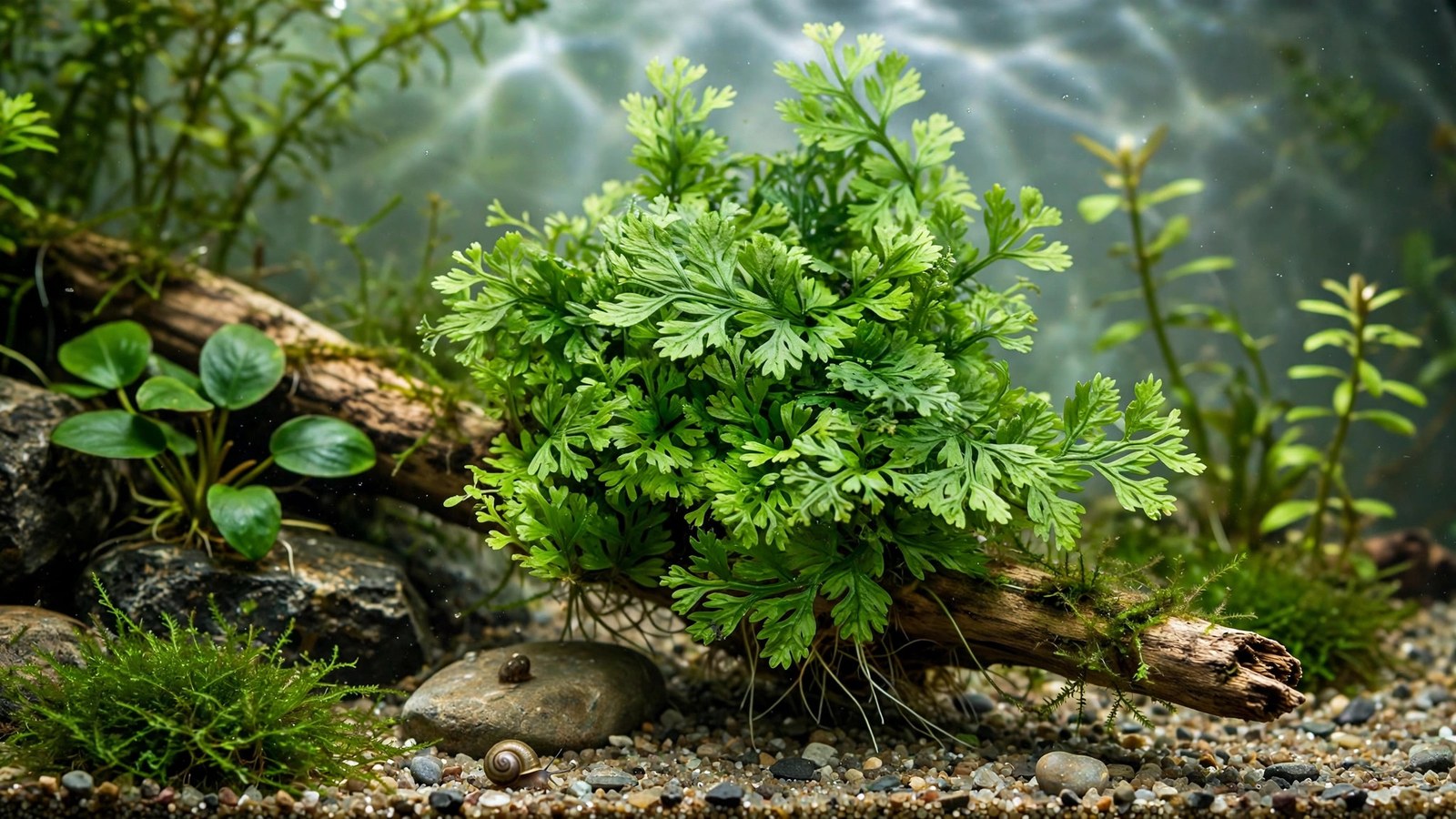
Almost every mini bolbitis that dies in a home tank is killed by a shopping mistake — the trade sells several plants under this name, and some barely grow underwater at all. Buy the true dwarf form, the Philippine Bolbitis heteroclita 'Difformis' with fine, parsley-like baby leaves, and mini bolbitis care is genuinely simple: tie it to hardscape, give it soft water and gentle light, and — the hardest part — wait. This guide untangles the naming mess and gives you the exact parameters.
The Name Problem: What You Actually Bought
Here is the honest part the product pages skip. The plant sold as “mini bolbitis” has travelled under at least four names: Bolbitis difformis, B. heteroclita 'Difformis', “Baby Leaf,” and even Davallia — a different fern genus it has nothing to do with. Botanists treat it as a variety of the Asian B. heteroclita, originally described from the Philippines, and the older difformis label lingers in fern taxonomies, which describe 'Difformis' as a small-leafed Philippine variety. Some shops blur it further as “mini heudelotii,” implying it is a dwarf version of its full-size cousin, the African water fern. It is not. Identify the true dwarf by its traits instead: finely divided, lace-like leaves on a creeping horizontal rhizome, staying under 10 cm underwater.
Mini Bolbitis Care: The Parameters That Matter
Mini bolbitis is forgiving about most things except water chemistry. It wants the soft, slightly acidic water of its native Philippine streams, and that single factor separates thriving plants from stalled ones more reliably than any lighting upgrade.
| Parameter | Target | Notes |
|---|---|---|
| Temperature | 22–26°C (72–79°F) | Resents long stretches above 28°C |
| pH | 6.0–7.0 | Slightly acidic to neutral |
| Hardness | Soft (GH 3–8) | Hard, alkaline water is the top cause of stalled growth |
| Light | Low–medium, 30–50 PAR | More light grows algae on slow fronds, not speed |
| CO₂ | Optional | Steadies growth; never required |
| Flow | Moderate, steady | Keeps detritus from settling in fine leaves |
Unlike stem plants, mini bolbitis feeds from the water column, not the substrate — so substrate choice is irrelevant, but water-column nutrition matters. Dose complete liquid fertilizer at half the bottle's rate weekly; over-dosing a slow plant just feeds algae.
Rhizome-Safe Mounting: Never Bury It
The rhizome is the thick horizontal stem the leaves grow from, and the single rule is that it must stay in open water. Buried rhizomes rot, and the rot spreads. This is the same rhizome logic that governs its relatives, spelled out in our beginner's Anubias care guide.
Mounting takes five minutes. Dab gel super glue on dry driftwood or rock and press the rhizome in for 30 seconds; wrap gently with cotton thread or fishing line that dissolves as roots grip; or wedge it into a crevice. Leave space ahead of the rhizome tip, where new growth extends. Our five proven ways to attach Java fern to driftwood and rocks work identically for mini bolbitis.
Light, CO₂, and Fertilizer
Low–medium light is not a compromise here — it is the preference. At 30–50 PAR, mini bolbitis grows its finest, most compact fronds, and it happily lives in the shadow of taller plants. Push past 70 PAR and you gain almost no speed but invite algae onto the slow fronds. This shade tolerance earns it a place on any list of the easiest aquarium plants for a beginner community tank — it thrives in exactly the dimmer corners beginners already have.
CO₂ is genuinely optional. Without it, expect a few new fronds per month. With steady CO₂ at 20–30 mg/L, expect denser fronds and a faster emersed transition — an upgrade, never a requirement.
Fertilizer should be light and water-column based: a half-dose of complete liquid fertilizer weekly is plenty, and root tabs do nothing for a plant with no buried roots. Like another slow-growing epiphyte, Bucephalandra, it dislikes sudden parameter swings — dose consistently instead of chasing corrections.
The 6–10 Week Transition: Emersed Melt Is Normal
Nearly all shop stock is emersed-grown, and emersed leaves look nothing like underwater ones — broader, paler, often parsley-like. Within 2–4 weeks submerged, they yellow and melt as the plant abandons air-built leaves for water-built ones. The mistake is ripping the rhizome out in week three.
Leave the rhizome mounted, snip away brown fronds, and keep parameters stable. New submersed fronds emerge from the rhizome tip as tiny, dark-green lace, usually by week 6–10. If the rhizome is firm at week 8 with no new growth, check water hardness: hard, alkaline water stalls the transition more than anything else.
Where It Belongs: Nano Placement and Aquascaping
At 5–10 cm, mini bolbitis is one of the few true ferns that fits a nano foreground. Tie it low on driftwood near the front glass, in small stone crevices, or along a hardscape base where its lace texture contrasts with smooth rock. In larger tanks it works as a shaded midground accent under overhanging wood.
It pairs with other tiny epiphytes that share its water preferences: Anubias nana 'Petite' and Bucephalandra mount the same way and stay small, so one driftwood branch can carry all three. In shrimp and betta nano tanks, its fine fronds double as grazing surface and shrimplet shelter — just keep it out of direct filter outflow.
Frequently Asked Questions
Is mini bolbitis the same as African water fern?
No. Mini bolbitis is the dwarf Asian fern Bolbitis heteroclita 'Difformis' from the Philippines, while African water fern is B. heudelotii, a much larger African species. Retailers sometimes blur them by selling the mini form as “mini heudelotii.” See our African water fern care guide for the full-size cousin.
Why is my mini bolbitis melting after I planted it?
Most shop stock is emersed-grown, and its air leaves cannot survive underwater — they yellow and dissolve in 2–4 weeks. Leave the mounted rhizome in place, trim brown fronds, and keep parameters stable. True submersed fronds emerge from the rhizome tip as small, dark-green lace within 6–10 weeks.
Can mini bolbitis grow without CO₂?
Yes — it grows at 30–50 PAR with no injected CO₂, ideal for beginner nano tanks. Growth is simply slow: a few new fronds per month. Steady CO₂ at 20–30 mg/L improves density and speeds the emersed transition, but it is an upgrade, not a requirement. Soft, slightly acidic water matters more for this fern.
Can I plant mini bolbitis in the substrate?
Never bury the rhizome. Mini bolbitis feeds from the water column; a buried rhizome rots within weeks and often kills the plant. Attach it to driftwood or rock with gel super glue, cotton thread, or fishing line, or wedge it into a crevice. Substrate type is irrelevant — inert sand works fine.
How fast does mini bolbitis grow?
Very slowly — among the slowest “easy” aquarium plants. After the 6–10 week transition, expect a few new fronds per month in a low-tech tank, with the rhizome creeping a few millimetres per week. CO₂ and stable, soft water speed it up, but it is never a fast filler.
Is Mini Bolbitis Worth the Wait?
If you want instant impact, no — buy something faster. But if you want a fern that looks like lace, never outgrows a nano tank, forgives dim corners, and asks only for soft water and patience, mini bolbitis is nearly unmatched. Mount it correctly, let it melt, and check back in two months.