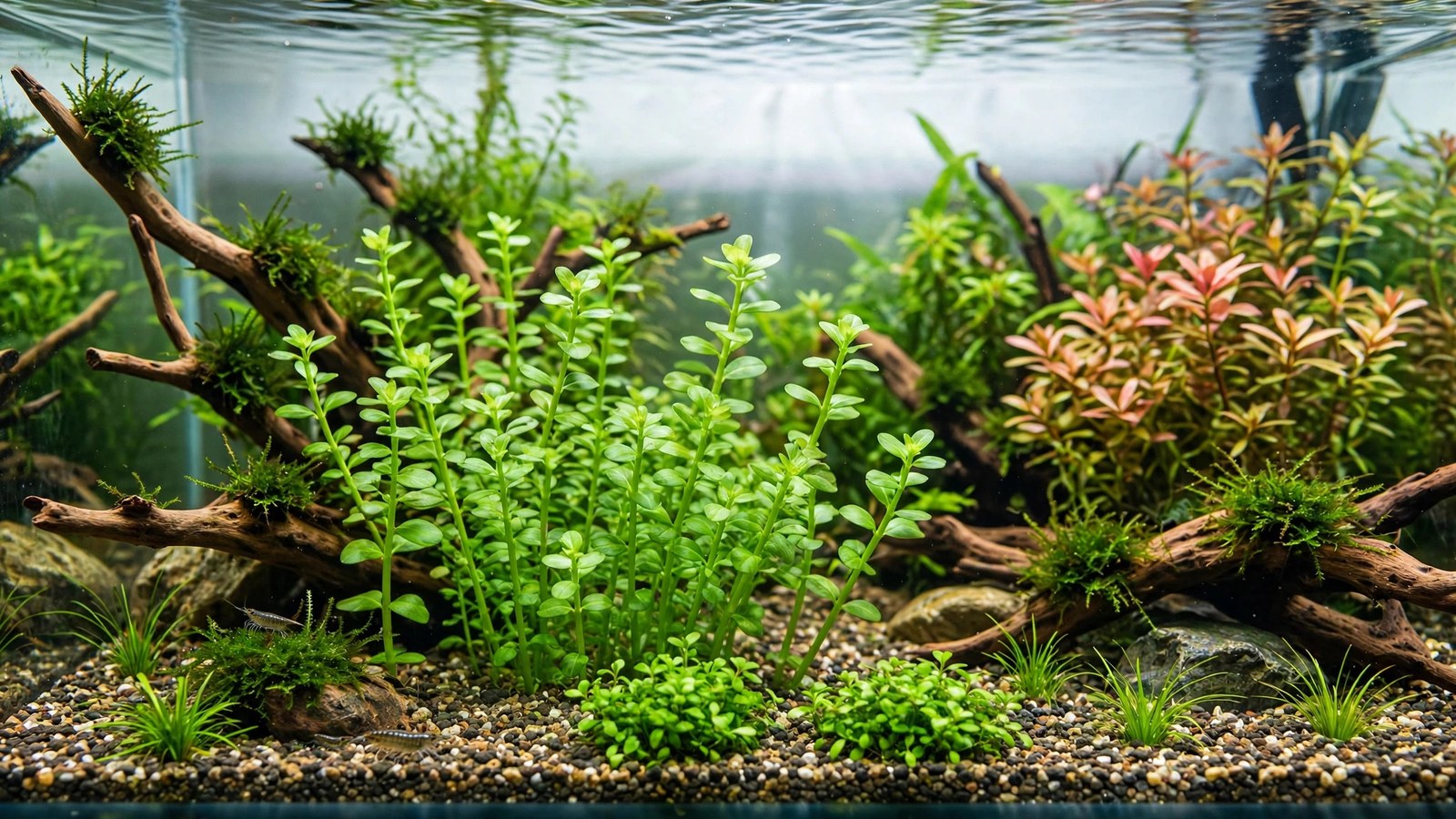
The first rule of bacopa australis care is a naming trap: australis is Latin for "southern," not a nod to Australia. This delicate stem plant is native to Brazil, and aquarists still mix it up with an Australian species so often that aquarium references spell it out — "australis ≠ Australia." Once you know where it actually comes from, its care makes more sense: warm, soft-water river margins where it grows half-emerged and hungry for light.
If you have kept forgiving stem plants such as hornwort, the routine will feel familiar — plant the stems, trim them, replant the tops. But australis is the collector's Bacopa: rarer in the trade than both cousins, bruised by rough handling, and under strong light it crawls along the substrate to form a real carpet — something neither cousin does well.
So, can you keep it? Here is the direct answer: Bacopa australis is a medium-hardy Brazilian stem plant that grows well in pH 6.0–7.5 water at 20–26°C with moderate to strong light (around 30–50 PAR) and no CO2 required, though CO2 and lean, consistent fertilization dramatically improve its density and color. It is unique among aquarium stems for producing small pink-white flowers when grown emersed — a detail that has made it a favorite of riparium and paludarium growers.
Why collectors want this Brazilian stem plant
Bacopa australis looks unremarkable in a shop cup — soft green, roundish leaves on upright stems. What makes it a collector piece is rarity: wholesalers carry monnieri and caroliniana in bulk, while australis arrives in small quantities and sells out.
It also fills a genuine aquascaping niche: most carpeting species demand CO2 and melt at the first sign of neglect, while australis starts as a midground stem and converts to a creeping foreground habit on its own once the light is strong.
The three commonly traded Bacopas get confused constantly — here is the honest comparison:
| Trait | Bacopa australis | B. monnieri | B. caroliniana |
|---|---|---|---|
| Origin | Brazil | Cosmopolitan (Asia, Africa, Americas) | United States (southeastern) |
| Height in tank | 15–25 cm upright; creeps when light is strong | 20–40 cm; reliably tall and straight | 20–40 cm; tall with big leaves |
| Leaf character | Small, rounded, soft and FRAGILE | Small, fleshy, nearly indestructible | Large, thick, with a lemon scent when crushed |
| Hardiness | Medium — punishes rough handling | High — the "unkillable beginner stem" | High — forgives neglect |
| Signature trait | Carpets under high light; pink-white emersed flowers | Slow, steady, survives almost anything | Distinctive lemon fragrance; great background wall |
| Best for | Aquascapers and collectors wanting a dual-purpose stem | First-time planted tank owners | Lush background texture with a scent surprise |
Our guides to Bacopa monnieri and Bacopa caroliniana cover the cousins in full, so this article stays focused on australis.
Bacopa australis care: the parameters that work
Australis is not a parameter diva. The Tropica datasheet (mirrored at azaqua.nl) gives broad, forgiving ranges: 20–26°C, pH 6.0–7.5, soft to medium hardness. Treat these as guardrails, not targets — this plant forgives most of that range but punishes instability, so pick your values and hold them steady.
Use a nutrient-rich substrate or plain gravel with root tabs. Dose a complete fertilizer lightly and consistently — how fertilizer needs differ by plant matters here, because australis stalls under truly lean dosing but burns its tips on excess micros. Pale new leaves with green veins mean add iron; pinholes in old leaves mean raise potassium. No laboratory required — just eyes.
Light, CO2, and the carpeting habit
At medium light (~30 PAR) australis grows as a normal upright stem, needing a trim every few weeks. Push toward 45–50 PAR at the substrate and the stems lean, nodes sprout sideways roots, and the plant creeps. Add CO2 and the transition speeds up — a genuine 3–4 cm foreground carpet within two months.
CO2 is genuinely optional here — but set expectations honestly. No CO2 plus medium light gives a healthy midground stem; CO2 plus high light gives the famous carpet. Choose your goal before planting, because the layout for a carpet differs completely from a midground bush.
Planting and trimming without bruising it
This is where beginners lose their australis. The leaves are genuinely fragile — pinching one ruptures cells that appear as browning patches days later. Never grip a leaf; hold only the stem with fine tweezers and push each stem into the substrate at an angle so it stays put.
Space stems 2–3 cm apart so light reaches the lower leaves; packed too tight, the bottoms drop leaves and go leggy. When stems hit the surface (3–5 weeks in a healthy tank), trim and replant the tops — the base branches from the cut node, doubling your plant within a month. Expect 5–10 days of adjustment melting on emersed-grown leaves; that is normal.
In a scape, a grassy curtain of Cyperus helferi behind it gives excellent contrast, while its carpeting form layers nicely beside a true foreground species like Ranunculus inundatus for a riverbank look.
The emersed form and its pink-white flowers
Here is the fact that sells this plant to riparium growers: given humidity and room to breathe, it produces small pink-white flowers on its emersed stems — readily, even on an ordinary windowsill, which very few aquarium stems manage.
Try it by moving a few stems to a riparium basket or a covered tank with 2–3 cm above the waterline. Keep humidity high and light strong; within weeks the emergent leaves grow smaller and rounder, and buds follow. These emersed stems even propagate well — they re-adapt to submerged life faster than tissue-culture cups.
Frequently Asked Questions
Is Bacopa australis from Australia?
No — it is native to Brazil. The name comes from the Latin australis, meaning "southern," describing its South American range — aquarium references explicitly warn against the Australia mix-up. As a warm Brazilian river-margin plant, it expects 20–26°C water and strong light, not cool outback conditions.
Can Bacopa australis grow without CO2?
Yes. In low-tech tanks it grows as a healthy upright midground stem with no CO2. CO2 only matters for the carpeting habit — with 45+ PAR and injected CO2 it becomes a dense foreground mat in about two months, which most low-tech setups will not achieve on their own.
Why are my Bacopa australis stems melting?
Melting in the first 5–10 days is normal as emersed leaves adapt. Continued melting usually means bruised leaves from handling (use tweezers, grip stems only), shading from too-dense spacing, or swinging parameters. Stable, warm, soft-to-medium water stops most ongoing melt within two weeks.
How do you carpet with Bacopa australis?
Give it high light (45+ PAR at the substrate) and ideally CO2, then lay stems horizontally so each node roots. Or plant upright and let strong light pull stems down naturally — nodes sprout sideways roots on their own. Trim vertical shoots hard to force lateral spread; a carpet typically forms in 6–8 weeks.
Is Bacopa australis good for beginners?
It is beginner-tolerant but not beginner-proof. Parameters are forgiving and it survives without CO2, but fragile leaves punish rough handling and melt-prone starts discourage first-timers. For a first stem plant, start with the nearly unkillable Bacopa monnieri and graduate to australis once your technique is gentle.
Treat it gently, give it light, and Bacopa australis pays you back with a carpet no cousin can match — and, if you let it breathe, a handful of pink-white flowers. For a plant named "southern," it points straight to the heart of Brazil.