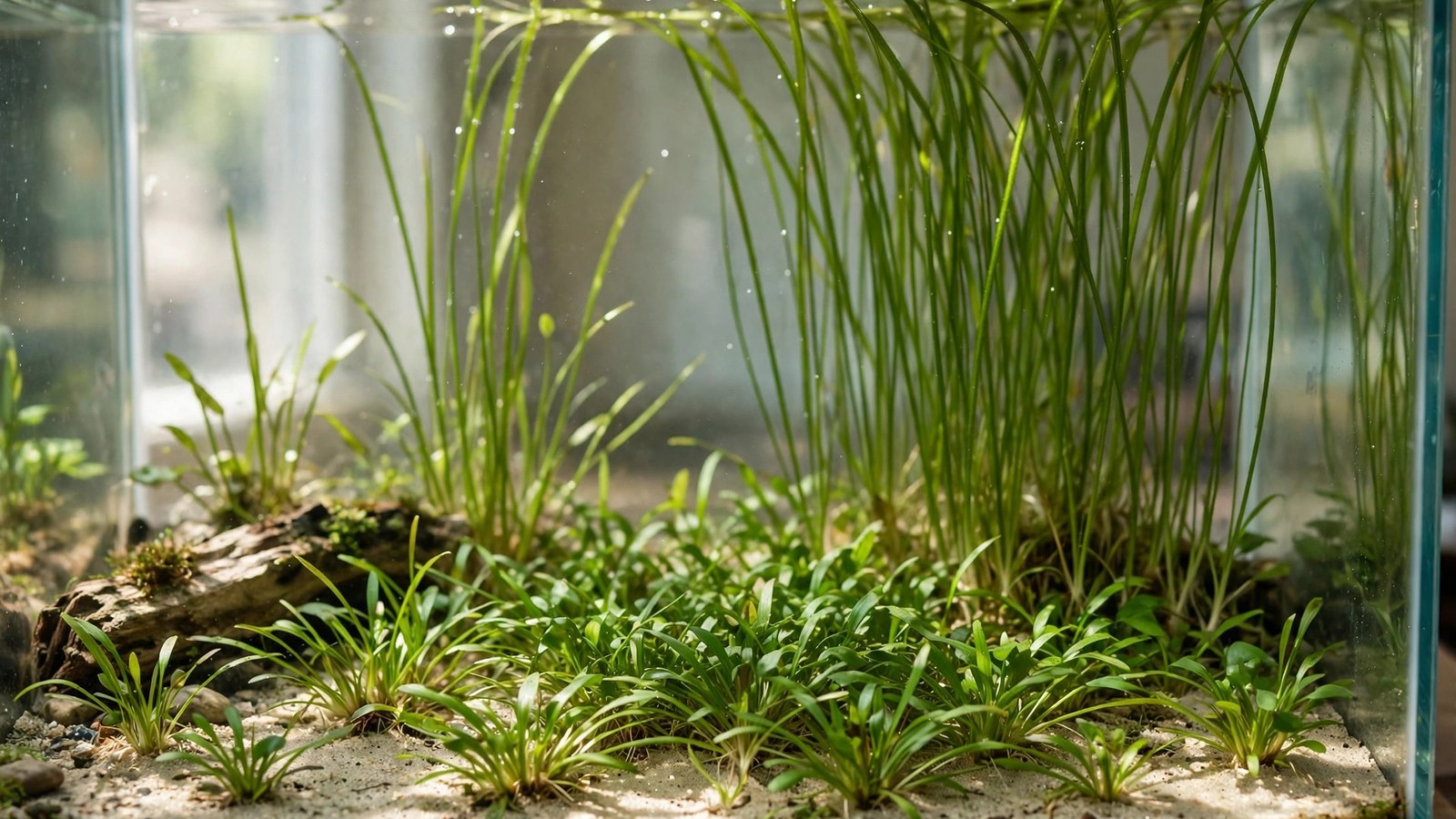
You bought dwarf sagittaria for a tidy, grassy carpet — and it repaid you by shooting skyward like a field of chives. Stretchy growth is the most common complaint about this plant, and it's almost never a dud plant: "dwarf sagittaria growing tall" is its way of asking for more light, different trimming, or — occasionally — telling you it isn't dwarf sagittaria at all. This guide diagnoses it and fixes it in two weeks, mostly for free. For the plant's baseline needs, see the complete dwarf sagittaria care guide before troubleshooting.
Why Is My Dwarf Sagittaria Growing Tall? Causes and Fixes in One Table
Healthy Sagittaria subulata stays 3–6 inches (7–15 cm) and spreads by runners. Leaves stretching past 8 inches mean one of the following. Find your symptom, then read the matching fix.
| What you see | Likely cause | The fix |
|---|---|---|
| Leaves 8–12 in, pale, floppy; no runners after weeks | Too little light at the substrate | Raise intensity to 40–60 PAR; photoperiod 7–9 hours |
| Was short, then suddenly shot upward | Light change (new floaters, dirty lid, aging bulb) | Clear the light path; replace bulbs older than 9–12 months |
| Stays tall even in strong light | Wrong species — a giant sagittaria | Confirm ID below; move it to the background |
| Tall outer leaves, nothing new in the middle | Energy locked in vertical growth | Cut tall leaves at the base, one by one |
| Newly planted, immediately growing straight up | Emersed-grown leaves adapting underwater | Trim off emersed growth; wait 2–3 weeks |
| Clumped plantlets, center leaves yellowing | Planted too densely; crown buried | Space 1–2 in apart; keep crowns above the substrate |
Fix #1: Give it more light (works 80% of the time)
Dwarf sagittaria is sold as "easy" and "low light tolerant" — it will survive in low light. But survival and carpeting differ. In dim conditions it etiolates: leaves stretch upward hunting for light instead of energy going into horizontal runners.
The target: roughly 40–60 µmol·m⁻²·s⁻¹ PAR at the substrate for reliable carpeting. Below about 25–30 PAR, expect lanky growth with sparse runners. Do the free things before spending anything:
- Clear what's blocking the light. A mat of floating plants can halve substrate PAR. Thin them ruthlessly.
- Extend the photoperiod to 7–9 hours. More light duration partly compensates for weak intensity. Use a timer so it's consistent.
- Clean the lid and lower the fixture. Hard-water crust and algae film can eat 10–20% of output; lowering a hanging light 2–3 inches helps too.
- Only then consider a light upgrade. Honest angle: brighter hardware is the real fix for deep tanks and genuinely dim fixtures, but most cases resolve with steps 1–3.
New leaves come in shorter within 7–14 days of fixing light. Existing tall leaves never shrink — that's what the trimming fix is for.
Fix #2: Trim at the base, never mow
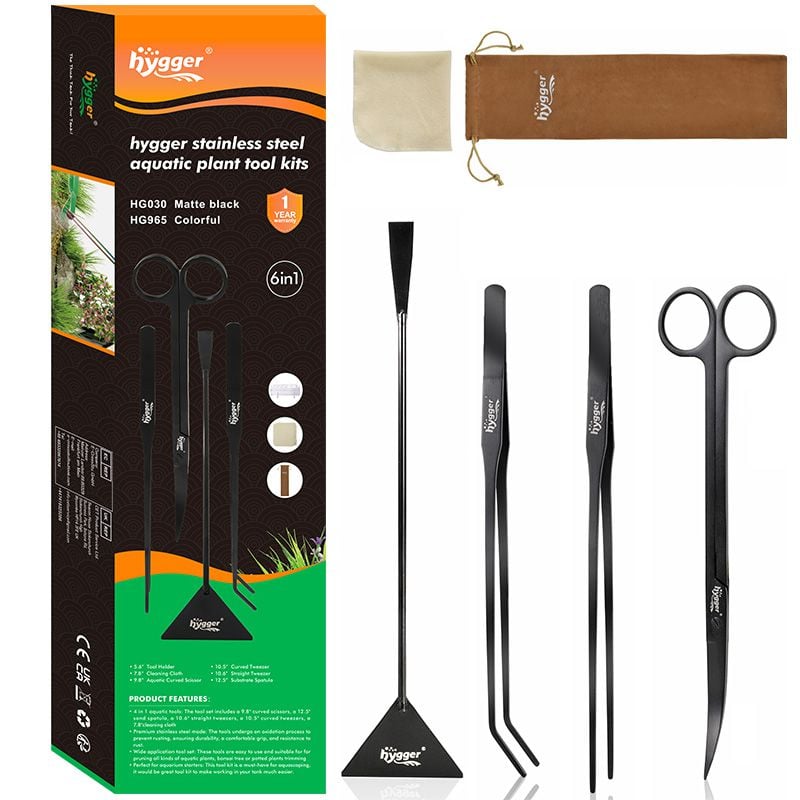
Shearing leaves across the middle is the worst move: cut ends brown, and the plant burns energy healing instead of pushing runners. Instead, use basal trimming: trace each tall leaf to the crown and snip it off at the base. Remove the worst third of leaves per session — never more than half at once. Curved aquascaping scissors work best; the bend reaches the crown without flattening neighbors.
Why it works: removing vertical leaves redirects stored energy into runners. One basal trim after a light fix typically triggers a runner flush within 2–3 weeks. The technique is identical for dwarf hairgrass, which is why the two make such compatible tankmates.
 ★4.6
hygger 6-in-1 Long Aquarium Aquascaping Tools Kit
Check Price on Amazon ★4.6Fix #3: Confirm it's actually dwarf sagittaria
"Dwarf sagittaria" is one of the hobby's most mislabeled plants. Sagittaria subulata has cousins — S. platyphylla, S. sagittifolia, "giant sagittaria" — that look identical as juveniles and reach 18–30 inches. Nothing keeps those short, just as monte carlo lookalikes trip up beginners.
| Trait | True dwarf sag (S. subulata) | Giant sag imposter |
|---|---|---|
| Leaf width | Thin ribbons, 2–4 mm, rounded tips | 8–15 mm wide, sometimes arrow-shaped bases |
| Max height in good light | 3–6 inches (7–15 cm) | 18–30 inches (45–75 cm) |
| Runners | Frequent, plantlets every 1–2 in | Slower, widely spaced |
| Leaf stiffness | Soft, flops when tall | Rigid, upright even at 20 in |
If yours stands ramrod-straight at 18+ inches with broad leaves in bright light, it's an imposter. Move it to the background where the height becomes a feature, and source true S. subulata as tissue culture. Tropica's Sagittaria subulata plant entry shows verified photos of the true species.
Fix #4: Give it room to run
Two planting mistakes force vertical growth even in good light. Crowding: packed plantlets shade their own centers. Space plantlets 1–2 inches apart — runners close the gaps within a month. Buried crowns: the pale base must sit at or just above the substrate, or the plant stresses and pushes survival leaves instead of runners.
Also ease off heavy liquid dosing in low light — excess nitrogen relative to light makes every species leggy. Carpet plants like Staurogyne repens and glossostigma etiolate the same way.
Your 2-week reset plan
- Day 1 — Light audit. Thin floaters, clean the lid, set the timer to 8 hours.
- Day 1 — Basal trim. Remove the worst third of tall leaves at the crown; space clumps 1–2 in; unbury crowns.
- Day 1 — ID check. Broad rigid leaves at 18+ in? It's a giant sag — rehome it to the background now.
- Days 7–14 — Watch new leaves only. Shorter new growth means it's working. Don't touch anything.
- Week 3 — Second trim. Clear another round of the tallest old leaves as runners fill in.
- Weeks 6–10 — Carpet closure. With light fixed and runners spreading, full closure typically takes 6–10 weeks from the reset.
If nothing works: the honest checklist
- Is the photoperiod truly 7–9 hours on a timer, or "whenever I remember"?
- Is anything shading the carpet — hardscape, driftwood, or a canopy of midground plants?
- Try two weeks at half your current liquid fertilizer and watch new leaves.
- Tank over 18 in deep with a low-output light? That's the one case where hardware is the honest answer.
- Did you confirm the species ID with the table above — not just assume?
If every box checks out and it still won't carpet, the plant may just mismatch your setup's light. Switching to a low-light carpet like Marsilea hirsuta is a strategy, not a defeat.
Frequently Asked Questions
Should I trim dwarf sagittaria leaves in half like grass?
No — shearing leaves across the middle browns the cut ends and wastes energy on healing. Cut individual tall leaves at the base near the crown, removing about a third per session. That redirects energy into runner growth, which is what actually builds the carpet.
How tall should dwarf sagittaria be?
True Sagittaria subulata stays 3–6 inches tall in a healthy carpet. Leaves reaching 8–12 inches signal a light or trimming problem. Leaves topping 18 inches with broad, rigid blades almost always mean you were sold a taller Sagittaria species — check leaf width against the ID table in this article.
How long until it carpets after I fix the light?
Expect visibly shorter new leaves within 7–14 days, a runner flush 2–3 weeks after a basal trim, and full carpet closure in 6–10 weeks. Old tall leaves never shrink, so judge only new growth. If nothing changes after three weeks of good light, revisit the species ID and planting depth.
Does dwarf sagittaria need CO2 to stay short?
No — it carpets fine without injected CO2, which isn't what keeps it short. Light intensity controls height; CO2 mainly speeds up how fast the carpet fills in. Plenty of hobbyists get compact dwarf sag carpets in low-tech tanks purely through adequate substrate light and correct trimming.
A carpet, not a meadow
Dwarf sagittaria growing tall is a message, not a malfunction: more light, trim at the base, double-check the pot's label. Run the two-week reset, judge only the new leaves, and within a month you'll know if you've got a carpet coming — or a background plant wearing a carpet's name tag.