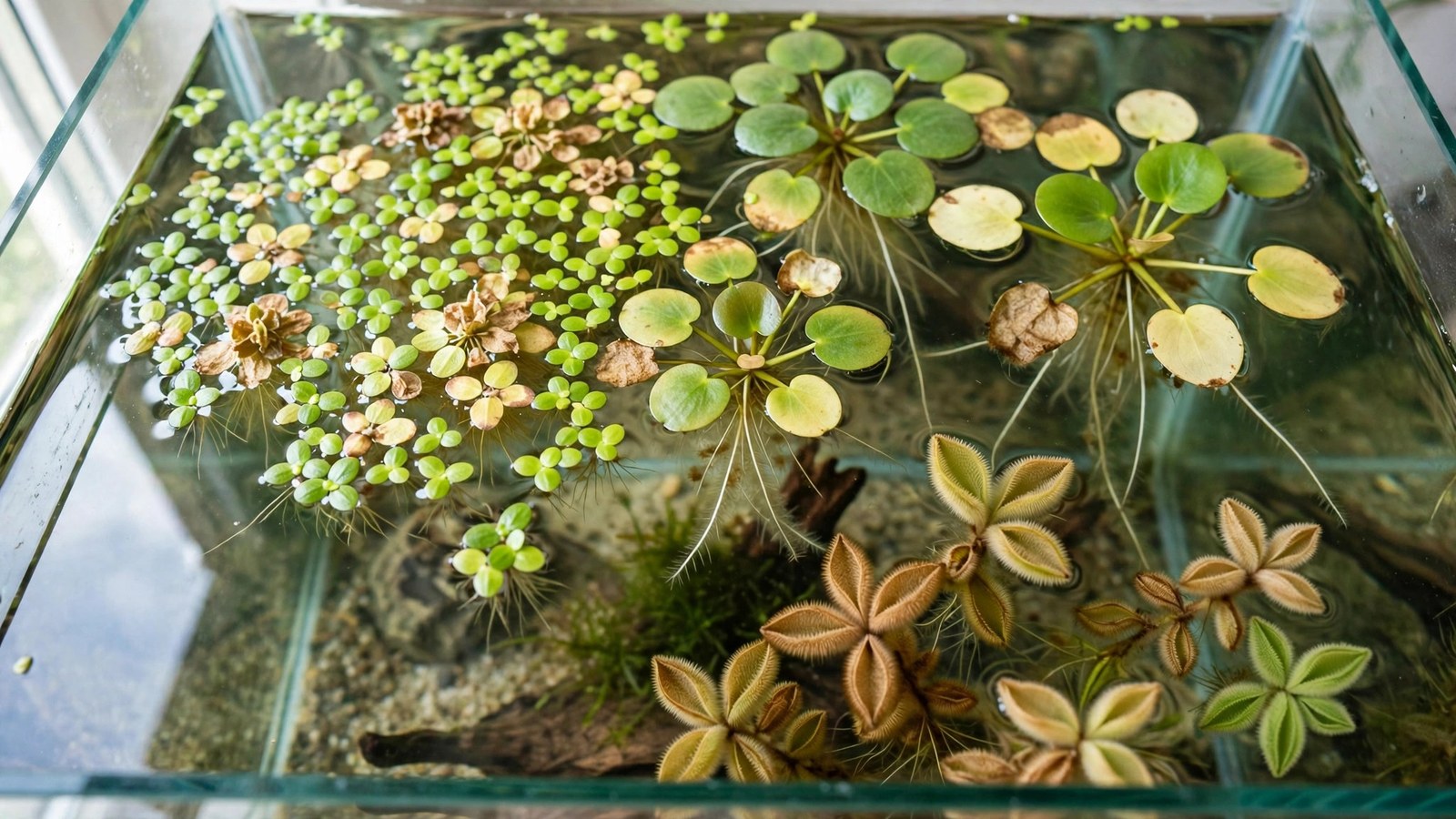
Your frogbit looked perfect last week, and now it's dissolving into wet tissue paper. Before you touch the fertilizer bottle, stop — when you're asking why are my floating plants dying, the answer is rarely a missing nutrient. In most tanks the killer is physics: surface agitation, or condensation raining from the lid onto leaves never meant to stay wet.
Duckweed, frogbit, salvinia, and water lettuce live their whole lives at the air-water boundary, feeling surface conditions rooted plants never notice. Find the real cause and the fix is usually free and fast.
 ★3.9
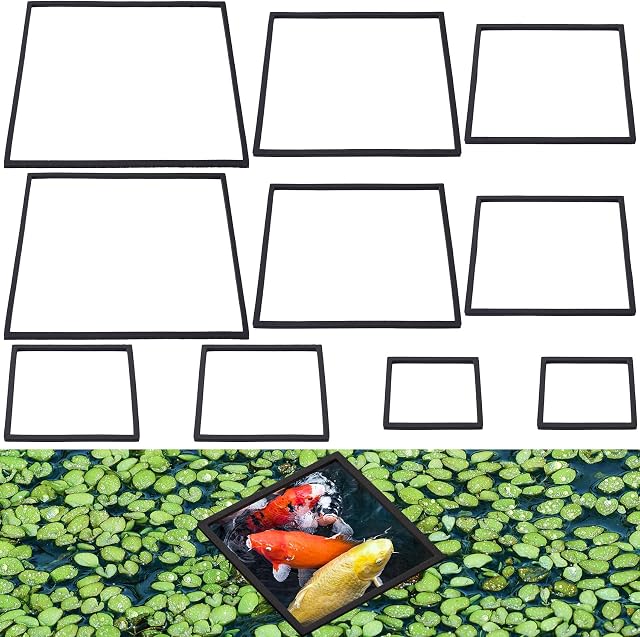
PAGOW Floating Plant Corral Rings
Check Price on Amazon ★3.9Why Are My Floating Plants Dying? Start With the Surface
Diagnosing floaters backwards is the hobby's most common mistake. Rooted plants dying usually means a water-column problem, so people dose fertilizer for floaters too — but floaters drink from the water and breathe from the air, so the top side matters as much as the bottom.
Do a 60-second surface audit: does the filter output ripple the whole surface or just a corner? Is the lid's underside beaded with drips? Are plants trapped in turbulence instead of calm water?
Then use the duckweed index. Duckweed is the hardiest floater — it survives conditions that kill frogbit, salvinia, and water lettuce. Duckweed multiplying while frogbit melts means the water is fine and something mechanical is killing the delicate species. Pale, shrinking duckweed means a nutrient or light problem.
Symptom → Cause Table
| What you see | Most likely cause |
|---|---|
| Frogbit leaves go translucent, then dissolve | Leaves staying wet — agitation or condensation |
| Brown, crispy edges on salvinia or water lettuce | Light burn — LEDs too close |
| Whole colony yellows, oldest leaves first | Nitrogen deficiency or potassium shortage |
| Pale, undersized new growth | Too little light or depleted water column |
| Collapse within two days of a water change | Temperature or parameter shock |
| Sticky residue, curled leaves, insects | Aphids |
| Thick mat; lower layers die and smell | Self-crowding — blocked light, trapped moisture |
Surface Agitation: The #1 Floater Killer
Frogbit and salvinia carry water-repellent hairs on their top leaves — salvinia's egg-beater trichomes are famous — but that defense fails under constant splashing. When a filter or air stone keeps leaves perpetually wet, water sits on the surface, blocks gas exchange, and invites rot.
Baffle the outflow with a sponge pre-filter, move the air stone to the far end, or corral floaters away from turbulence with a floating ring of airline tubing.
Condensation Drip: Death From Above
A tight glass lid on a warm tank is a rain machine: water evaporates, condenses on the cooler lid, and drips onto the leaves — identical to surface agitation, and the most misdiagnosed cause, because the surface can look calm while leaves get rained on. Check at lights-on, when condensation peaks: if droplets bead over the plant zone, slide the lid back half an inch or prop one edge up a pencil-width.
Light Burn vs. Too Little Light
Floaters sit closest to your LEDs — first to burn, and first to starve when you raise the light to "fix" the burn. Too much light shows as scorched, bleached, or brown crispy spots on the top leaves only. Raise the fixture 3–4 inches, or shorten the photoperiod to 7–8 hours.
Too little light shows as uniformly pale, undersized new growth — duckweed fronds with long gaps, frogbit that refuses to spread. Floaters need roughly 20–40 PAR at the surface and decline slowly in dim tanks, which makes this easy to miss. For the wider pattern, see how brown or pale leaves signal lighting problems in other species.
Temperature Swings Hit the Surface First
The top inch of water changes temperature fastest. A heater failure, a cold water change, or a lid left off overnight can swing the surface several degrees while mid-water barely moves — and tropical floaters like frogbit melt within a day or two of a sudden chill below about 68°F (20°C).
Match water-change water to within 2°F of tank temperature. The same shock logic explains plants dying after a water change — stabilize first, then trim.
Aphids: The Pest Nobody Expects
Yes, aquatic tanks get aphids. Tiny green or black insects colonize floater leaves — especially in warm, open-top tanks near houseplants — leaving curled leaves, a sticky film, and slow-moving dots visible under a phone flashlight.
Never use pesticides in a fish tank — trash the worst leaves, rinse survivors in a bucket of tank water, and treat nearby infested houseplants, the usual source.
Crowding: When Success Kills the Colony
The cruelest cause: floaters grew so well they started dying. A thick mat blocks light from its own lower layers and traps humidity until the bottom turns to sludge that poisons the rest.
Scoop out half the mat weekly — floaters are a lawn that needs mowing. Keep coverage to a third to half of the surface so light reaches below and air moves between leaves.
Nutrient Deficiency: Read the Leaves Honestly
Nutrition is a real cause — just not the first suspect. Floaters pull everything from the water column, so a lightly stocked, undosed tank can genuinely starve them. The tell is which leaves suffer: mobile nutrients (nitrogen, potassium, phosphorus) move from old leaves to new growth, so the oldest leaves yellow first.
The duckweed index closes the case: stunted, pale duckweed means a depleted water column. A balanced all-in-one liquid fertilizer, dosed per the label, greens floaters up within a week. Root tabs do nothing for floaters — only water-column dosing counts. For the full picture, read whether aquarium plants really need fertilizer.
Choosing Tougher Floaters After a Crash
Sometimes the honest fix is a species mismatch. Frogbit is gorgeous but finicky about wet leaves; if your filter can't be baffled or your lid can't vent, pick tougher species — red root floaters tolerate moderate movement, salvinia minima is hardier than larger species, and giant duckweed outlasts them all.
If you're restocking, start with the 8 best floating aquarium plants for beginners, ranked by how forgiving they are of real tanks. And if rooted plants are struggling too, why aquarium plants melt covers the shared causes.
Frequently Asked Questions
Why are my frogbit leaves turning clear and mushy?
Clear leaves dissolving into mush mean the tops are staying wet — surface agitation, lid condensation, or a filter outflow submerging them. Calm the surface, vent the lid, remove the mush, and new growth should appear within a week or two.
Why is my duckweed dying when it survived everything before?
Duckweed dying is significant — the hardiest floater, so its collapse points to a systemic problem: depleted nutrients, near-zero light, a major temperature swing, or chemical contamination. Check recent changes first.
Can floating plants recover after melting?
Usually, yes. Remove every mushy leaf — dead tissue spreads decay — and keep only firm, green growth. Fix the actual cause (calm the surface, vent the lid, adjust light, dose if starved), and most colonies rebound within two weeks.
Why do my floating plants die but my other plants are fine?
Floaters live at the air-water boundary, so they face surface-only problems: agitation, lid condensation, and temperature swings that rooted plants never feel. When only floaters fail, the water column is usually fine — audit the surface first.
Start With the Surface, End With a Green Canopy Again
Most dying floaters aren't starving — they're drowning in splashes, rained on by their own lid, burned by a too-close light, or shocked by cold water. Work the diagnosis in order: surface calm, lid dry, light right, temperature stable, pests ruled out, mat thinned — then nutrients.