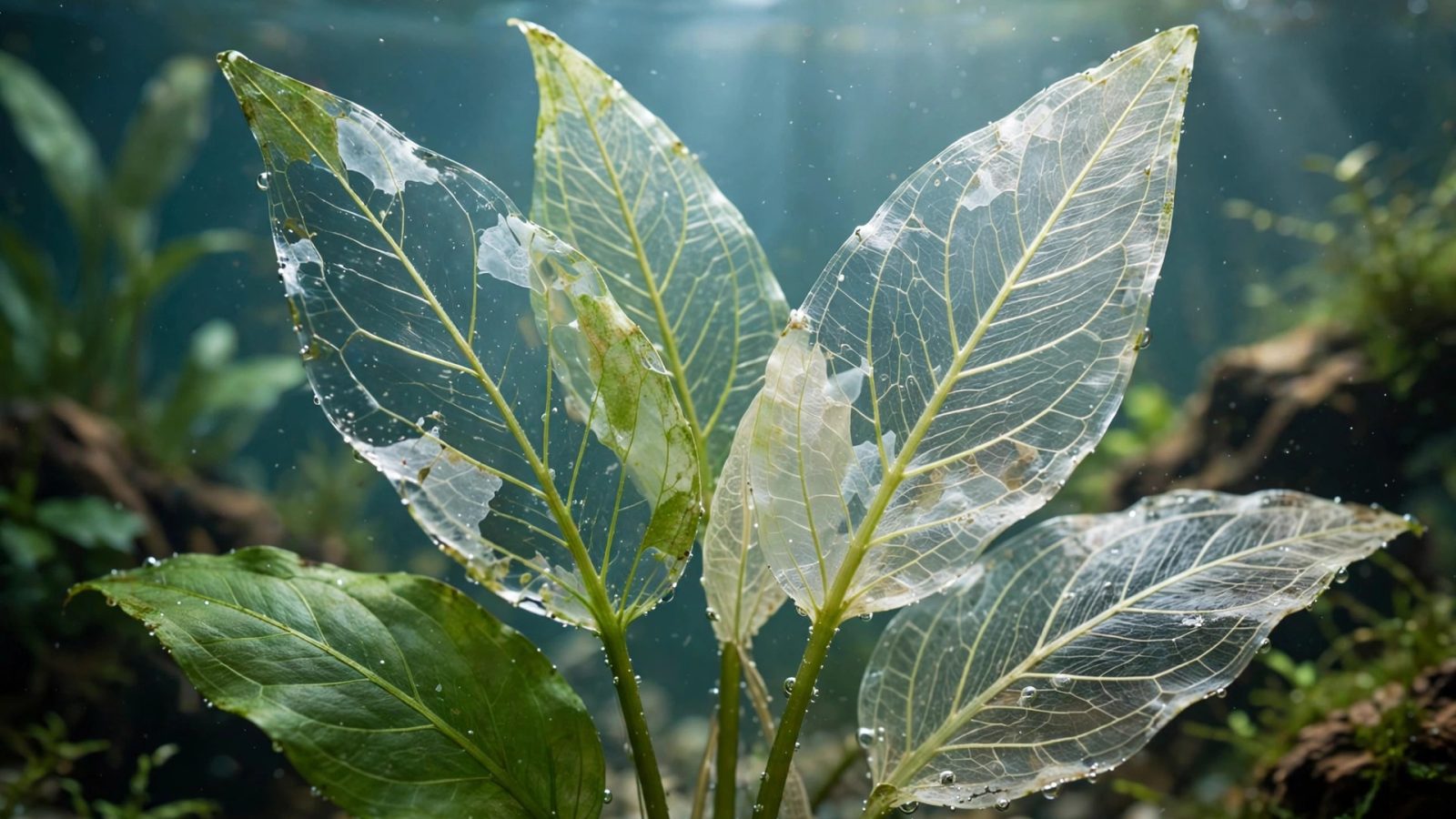
When aquarium plant leaves turn transparent, it looks alarming — healthy green tissue goes glassy and see-through, as if the leaf’s insides have vanished. In a sense, they have: transparency means the cell structure is collapsing. The good news is that transparent leaves have a short list of causes, and most of them are fixable once you identify which one matches your situation.
What Transparency Tells You
A transparent leaf is a leaf whose cells have ruptured or failed to develop properly. Unlike yellowing (a nutrient redistribution) or browning (dead tissue), transparency indicates acute cell damage — something overwhelmed the leaf faster than the plant could adapt. The pattern and timing narrow the cause considerably.
Cause 1: CO2 Fluctuations (Injected Tanks)
The most common cause of sudden transparency in high-tech tanks is unstable CO2. When CO2 levels swing — a cylinder running empty, a solenoid sticking, a diffuser clogging — plants that had adapted to rich carbon suddenly cannot maintain their tissue. Leaves go transparent within days, often starting with the most delicate species.
Diagnosis: you inject CO2; transparency appeared over days; possibly coincided with a cylinder change, equipment issue, or pH controller anomaly.
Fix: stabilize CO2 first — check the cylinder, clean the diffuser, verify the bubble rate against your drop checker. Do not chase it with fertilizer; this is a carbon problem. Trim transparent leaves; they will not recover. New growth under stable CO2 comes in solid.
Cause 2: Nutrient Crash After Heavy Pruning or Rescape
A big trim or rescape suddenly changes the tank’s nutrient demand — fewer plants consuming, disturbed substrate releasing then depleting. Remaining plants can experience a brief nutrient crash, showing as transparent new growth or glassy patches on existing leaves.
Diagnosis: transparency follows a major maintenance event within a week.
Fix: resume your normal fertilizer schedule promptly after big maintenance (many hobbyists skip dosing after a rescape — do not). Stability returns as the plants re-establish.
Cause 3: New Tissue-Culture or Emersed Transitions
Delicate new submerged leaves emerging during transition are thin and vulnerable. If conditions are marginal — low nutrients, fluctuating CO2, or very soft water — the newest leaves may emerge transparent or turn glassy within days.
Diagnosis: plant is new (within a month); transparency affects the newest, smallest leaves while older transition leaves melt normally.
Fix: this usually resolves as the plant establishes. Keep dosing consistent at half to full strength, maintain stable conditions, and give it three to four weeks. See why aquarium plants melt for the full transition picture.
Cause 4: Severe Potassium or Nitrogen Collapse
While mild deficiencies yellow leaves, an acute, severe shortage — rare but possible after months of no fertilization in a heavily planted tank — can push tissue straight past yellowing into structural collapse. The leaves look water-soaked and transparent rather than yellow.
Diagnosis: long-unfertilized tank; transparency across multiple species; older leaves affected first (mobile nutrients).
Fix: restart fertilization gradually — half dose for two weeks, then full dose. A starved tank shocked with full EI dosing can swing into algae; ramp up. Confirm the specific shortage with our nutrient deficiency chart.
Cause 5: Chemical Damage
Algaecides, “liquid CO2” overdoses, medications, and even an over-enthusiastic hydrogen peroxide spot treatment can chemically burn leaves transparent. Vallisneria and other sensitive species are famously vulnerable to liquid carbon products at higher doses.
Diagnosis: transparency appeared within 24–72 hours of adding any chemical; may affect sensitive species first.
Fix: large water change immediately to dilute the chemical, run fresh activated carbon for 48 hours, and discontinue the product. Trim destroyed leaves. Most plants regrow once the chemical is gone.
Cause 6: Temperature Shock
A sudden temperature drop — cold water added during a water change, a heater failure in winter — can rupture leaf cells, which then go transparent as they die. Tropical plants are most vulnerable below about 18°C (64°F).
Diagnosis: transparency follows a known temperature event; may affect the whole tank simultaneously.
Fix: restore temperature gradually (no more than 2–3°C per hour), trim dead tissue, and verify the heater. Prevention is a reliable heater and temperature-matched water changes — see plants dying after water changes.
Cause 7: Osmotic Shock from Rapid Parameter Swings
Leaves can also go transparent when total dissolved solids (TDS) or general hardness shift abruptly — for example, switching from hard tap water to remineralized RO (or the reverse), or a very large water change in a tank whose chemistry had drifted far from the tap. The rapid osmotic shift stresses cell membranes, and the most delicate leaves collapse into glassiness within a day or two.
Diagnosis: transparency follows a water-source change or an unusually large water change; testable as a big TDS or GH jump between old and new water.
Fix: transition water sources gradually — blend old and new water over several changes rather than switching cold. Keep any single water change under 30% when chemistry differs, and test TDS of tap and tank periodically so you know your baseline.
What Transparent Leaves Will Not Do
Set expectations honestly: transparent tissue is dead tissue. It will not turn green again. The plant’s recovery is measured entirely in new growth. Trim glassy leaves promptly — they contribute nothing and their decay feeds algae and ammonia. A plant pushing solid new leaves after you corrected the cause has fully recovered, even if it looks sparse for a few weeks.
Prevention Checklist
- Keep CO2 boring. In injected tanks, consistency matters more than the exact bubble rate. Check the system weekly.
- Dose through transitions. New plants, rescapes, and big trims are when plants need stability most — do not withdraw fertilizer at exactly the wrong moment.
- Respect chemical sensitivity. Dose liquid carbon and algaecides conservatively, never combine them, and know which of your species are sensitive.
- Match water change temperature. A thermometer and a few minutes of adjustment prevent one of the most avoidable causes.
Frequently Asked Questions
Is transparent leaf the same as melting?
They overlap but differ in texture and cause. Melting is soft, jelly-like disintegration typical of transition. Transparency is glassy, structural cell collapse, more often tied to CO2 swings, chemicals, or acute shock. Both end with trimming dead tissue and waiting for new growth.
Can I save a leaf that is only partly transparent?
The transparent portion is gone, but if part of the leaf is still solid green, you can trim just the glassy section and keep the rest photosynthesizing. Use sharp, clean scissors and cut into healthy tissue.
Why only my new leaves and not old ones?
New tissue is thinnest and most vulnerable — it shows damage first from CO2 swings, chemical exposure, and nutrient crashes. Old-first damage points instead to mobile nutrient deficiencies.
How do I tell transparency from other leaf problems?
Use the texture test: transparency is glassy and see-through, like wet tissue paper. Yellowing is opaque color change (nutrient redistribution). Browning is dead, opaque tissue (often old age or potassium issues). Melting is soft, jelly-like disintegration (usually transition). Each texture points to a different cause family, so getting the description right is half the diagnosis.
Should I fertilize more when leaves go transparent?
Only if you have diagnosed an actual nutrient crash — transparency is more often caused by CO2 instability, chemicals, or shock than by underdosing. Adding fertilizer to a CO2 problem just feeds algae. Diagnose first, dose second.
Transparency by Plant Type
- Stem plants: most resilient — transparent lower leaves are often just shading plus transition. Trim and replant healthy tops; the colony recovers fastest of any group.
- Crypts: transparency during crypt melt is normal and not a separate problem. Judge crypts only by the rhizome and roots, never by the leaves during the first two months.
- Swords: transparent new leaves on swords usually mean a sudden change (water parameters, root disturbance). Established swords are tough — stabilize and wait.
- Anubias/Java fern: transparency is rare and always significant — these are tough plants. Check for chemical exposure or rhizome rot first.
- Vallisneria: the canary for chemical sensitivity. Transparent vallisneria within days of any new product is almost certainly chemical damage — water change and carbon immediately.
- Mosses: transparent moss is usually dying moss — it browns rather than going glassy. Brown moss after chemical treatment is often dead; green regrowth from the interior is the recovery sign.
Recovery Timelines: What “Better” Looks Like Week by Week
- Week 1: cause corrected, dead tissue trimmed. Nothing visibly improves — this is normal. The plant is stabilizing internally.
- Week 2–3: stem plants show new submerged growth; crypts may show nothing at all (still normal).
- Week 4–6: new leaves clearly emerging on most species; rosette plants push from the crown.
- Week 8+: slow species (anubias, ferns, crypts) finally show confident new growth. The tank looks sparse but healthy.
The most common mistake is intervening again at week 2 because “nothing is happening.” The second most common is declaring the plant dead at week 4. Plants recover on root time, not internet time.
When Transparency Keeps Recurring
If you fix the cause, get clean new growth, and then transparency returns in cycles, look for the recurring trigger: a CO2 cylinder that runs out every few weeks, water changes with unmatched temperature, or a fertilizer routine that lapses and restarts. Cyclic problems have cyclic causes — chart the episodes against your maintenance log and the pattern usually jumps out. If you are not keeping a log, start one; it is the cheapest diagnostic tool in the hobby.