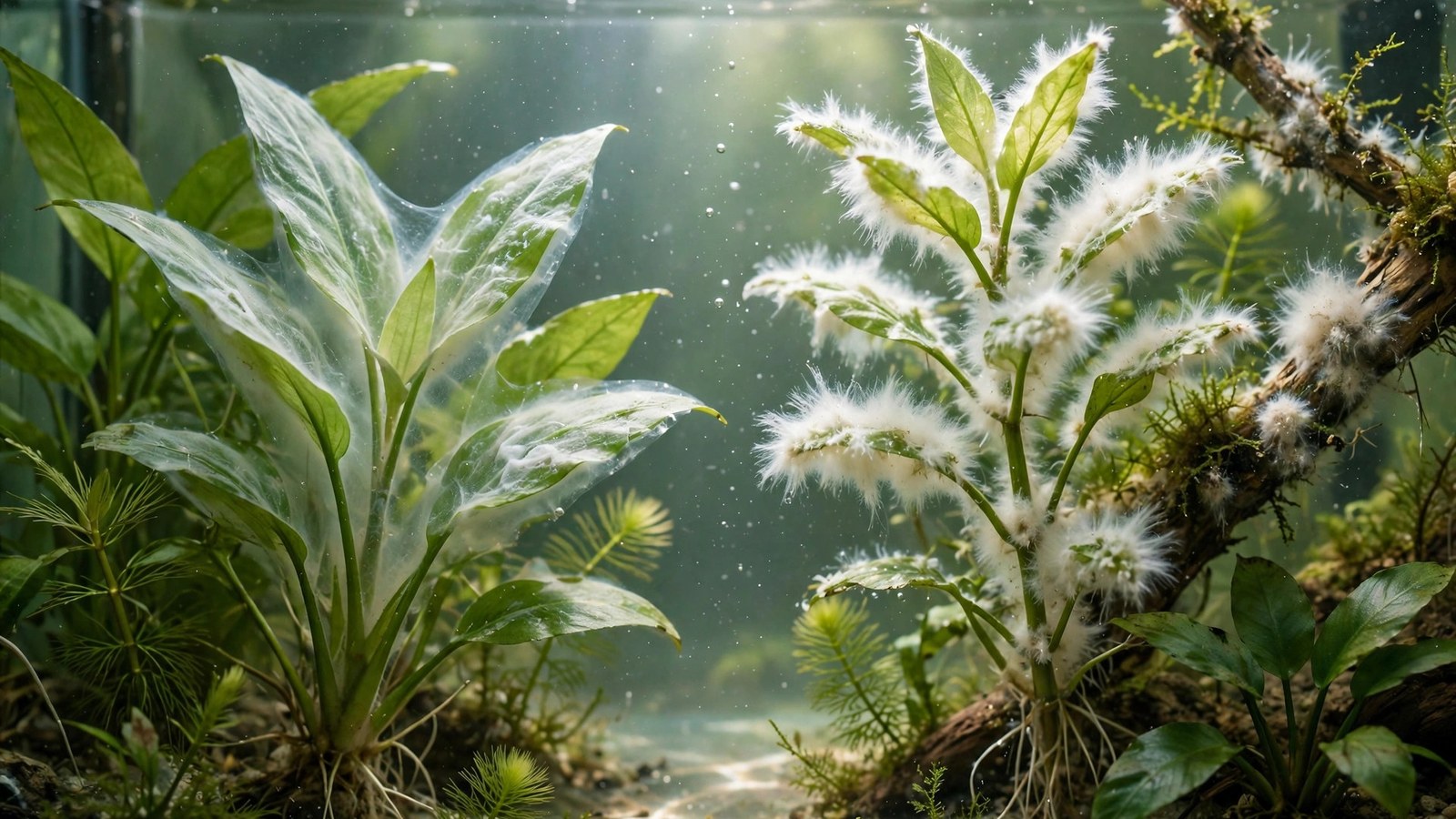
You wake up, glance at your tank, and your brand-new plant is wearing a tiny white wig. Before you reach for chemicals or throw the plant away, read this — because that white fuzz on aquarium plants is harmless and temporary in most cases, and already on its way out the door. Like brown diatom algae in new tanks, this is a classic new-tank scare that resolves itself when handled correctly.
By the end, you'll tell the four culprits apart in seconds and know what each demands.
What Is White Fuzz on Aquarium Plants? An ID Key
Four different organisms create nearly identical white fuzz, and misidentifying them leads to the wrong treatment. Run the five tests below and you'll have your answer in under a minute.
| Test | Bacterial biofilm | Saprolegnia (water mold) | Fuzz algae | Wood fungus |
|---|---|---|---|---|
| Color | Pure white to translucent | White to grayish-white | White with a green tint | Bright white |
| Texture | Slimy, gelatinous coating | Fluffy cotton-wool tufts | Fine hair-like threads | Slimy film |
| Where it grows | Leaves, stems, glass — anywhere | Only on dying, damaged, or wounded tissue | Leaf edges and tips in bright spots | Starts on driftwood, drifts onto nearby leaves |
| Smell | Faintly earthy | Slightly musty | No smell | Earthy |
| Touch | Wipes off easily | Clings firmly; leaf underneath is soft/mushy | Slightly gritty; hard to wipe off | Wipes off in sheets |
Bacterial Biofilm: The Most Common Cause
If your tank is under 4–6 weeks old or the plant went in recently, this is almost certainly your answer. Biofilm is a colony of bacteria feeding on the soluble organics that every new plant and new setup releases. Not a disease, not a parasite — a normal part of aquarium maturation that peaks in weeks 2–3 and then recedes as competing microbes establish.
What to do about biofilm
- Wait. Leaf biofilm typically clears in 5–14 days; wood-born biofilm can take 3–4 weeks, occasionally 6–8 on very fresh bogwood.
- Siphon the worst of it with a turkey baster or your water-change hose — it lifts off leaves in seconds.
- Do 25–30% weekly water changes to starve it of dissolved organics. Skip daily 50% changes; instability slows the maturation that fixes it.
- Deploy the cleanup crew once cycled: Amano shrimp, nerite snails, and otocinclus treat biofilm as a delicacy. Ten Amanos can strip an Anubias overnight.
Biofilm is a close cousin of the oily surface film that sometimes coats the water surface — both are bacterial blooms on the same dissolved organics, and both answer to the same water-change routine.
Saprolegnia: When the Fuzz Is Actually Fungus
Saprolegnia is a water mold whose spores float in every aquarium, but it can only colonize dead, dying, or wounded plant matter — a melting leaf, a snapped stem, an unsealed cut end. Peel the fuzz aside: brown, translucent, or mushy underneath means Saprolegnia; green and firm means biofilm.
What to do about Saprolegnia
- Trim every affected leaf with sterilized scissors, cutting 1–2 cm into healthy tissue. Removing the dead matter removes the fungus's food — this is the entire cure.
- Do a 30–40% water change after trimming to clear the spores and debris you stirred up.
- Fix what killed the tissue — usually transplant melt, light starvation at dense stem bases, or planting damage. Saprolegnia is the symptom, not the cause.
- Spot-treat stubborn spots with 3% hydrogen peroxide: 1–2 ml per 10 gallons squirted onto the fuzz with a syringe, filters off for 10 minutes. One treatment is usually enough.
Saprolegnia often appears alongside plant root rot — both are opportunists that arrive after tissue is already compromised, and both demand you fix the underlying cause rather than the fuzz.
When to quarantine the plant
Quarantine only if the fuzz keeps spreading leaf-to-leaf over 48–72 hours despite trimming — that signals more dying tissue, not an aggressive pathogen — or if it's on fish or eggs, where it means disease. A tub with tank water and a light, 5–7 days of clean growth, then reintroduce. Most cases never need this.
Fuzz Algae Is a Completely Different Organism
Greenish tint at the leaf edges in the brightest parts of the tank? That's not bacteria or fungus — it's fuzz algae, a photosynthetic organism feeding on light and excess nutrients. Antifungal dips do nothing for it.
The fix follows algae logic: cut the photoperiod to 6–8 hours for two weeks, check that CO2 or fertilization is keeping pace with the light, and manually remove what's there — it grows back slower each time once the balance is corrected. The manual-removal and balance-correction techniques in our hair algae removal guide work on fuzz algae too.
The Driftwood Exception
One special case: fuzz that clearly started on driftwood and is now clinging to plants touching the wood. That's wood fungus — a biofilm colony feeding on the sugars inside fresh driftwood. Harmless, devoured by shrimp, and it burns out in 3–8 weeks once the wood's soluble organics are gone.
We cover this separately in a dedicated guide on white fungus on new driftwood (hardscape territory, not plant health), so we won't duplicate it here. Treatment is the same in spirit: toothbrush it off, siphon during water changes, and let the cleanup crew finish the job. Leaves near the wood get the same siphon-and-wait treatment — the fuzz vanishes when the wood's food runs out.
Frequently Asked Questions
Is white fuzz on aquarium plants harmful to fish?
No. Bacterial biofilm — the usual cause — is harmless to fish, and many fish eat it. It can even improve water quality slightly by consuming dissolved organics. Saprolegnia on dying leaves also poses no threat to fish. The one scenario that matters is fuzz on a fish's body or gills, which indicates disease and needs separate treatment.
How long does white biofilm take to go away on its own?
On plant leaves in a new tank, expect 5–14 days from first appearance. On freshly submerged driftwood, allow 3–8 weeks — thicker pieces with more trapped sugars take longer. Adding Amano shrimp or nerite snails after cycling can shrink the timeline to days. If the fuzz persists past 10 weeks unchanged, reassess the diagnosis with the ID table above.
Should I remove a plant that has white fuzz on it?
Only trim the dead parts when the fuzz is Saprolegnia on tissue that's already dead — never throw away the whole plant, and never discard a plant for biofilm. The fuzz clears and the plant underneath is perfectly healthy. Quarantine is reserved for fuzz that keeps spreading despite trimming, which almost always traces back to more dying tissue.
Can I use hydrogen peroxide to kill the fuzz?
It only makes sense for Saprolegnia: a 3% dip for 30–60 seconds, or a spot treatment of 1–2 ml per 10 gallons with filters off for 10 minutes. For biofilm, dipping is pointless — bacteria recolonize within hours because the underlying organics remain. Patience and water changes beat chemicals for biofilm every time.
Why does the fuzz keep coming back after I clean it?
You're removing the colony but not its food source. Biofilm returns while the tank still leaches organics and stops permanently once the tank matures — typically within 2–4 weeks. Saprolegnia returns when dying tissue remains: re-check for melting leaves, rotting stems, or shaded bases you missed, and cut further into healthy tissue.
Keep Calm and Carry On
White fuzz on aquarium plants is a case where doing less is the expert move. Identify it with the table above — nine times out of ten it's harmless biofilm — siphon the worst off during your next water change, and let the tank's biology finish the job. Scissors only for dead tissue; the quarantine tub almost never.
Setting up your first tank and powering through the ugly new-tank phase? Fast growers like hornwort and water sprite mature the tank faster, and a mature tank is a fuzz-free tank — new-setup hair algae often fades on its own too.