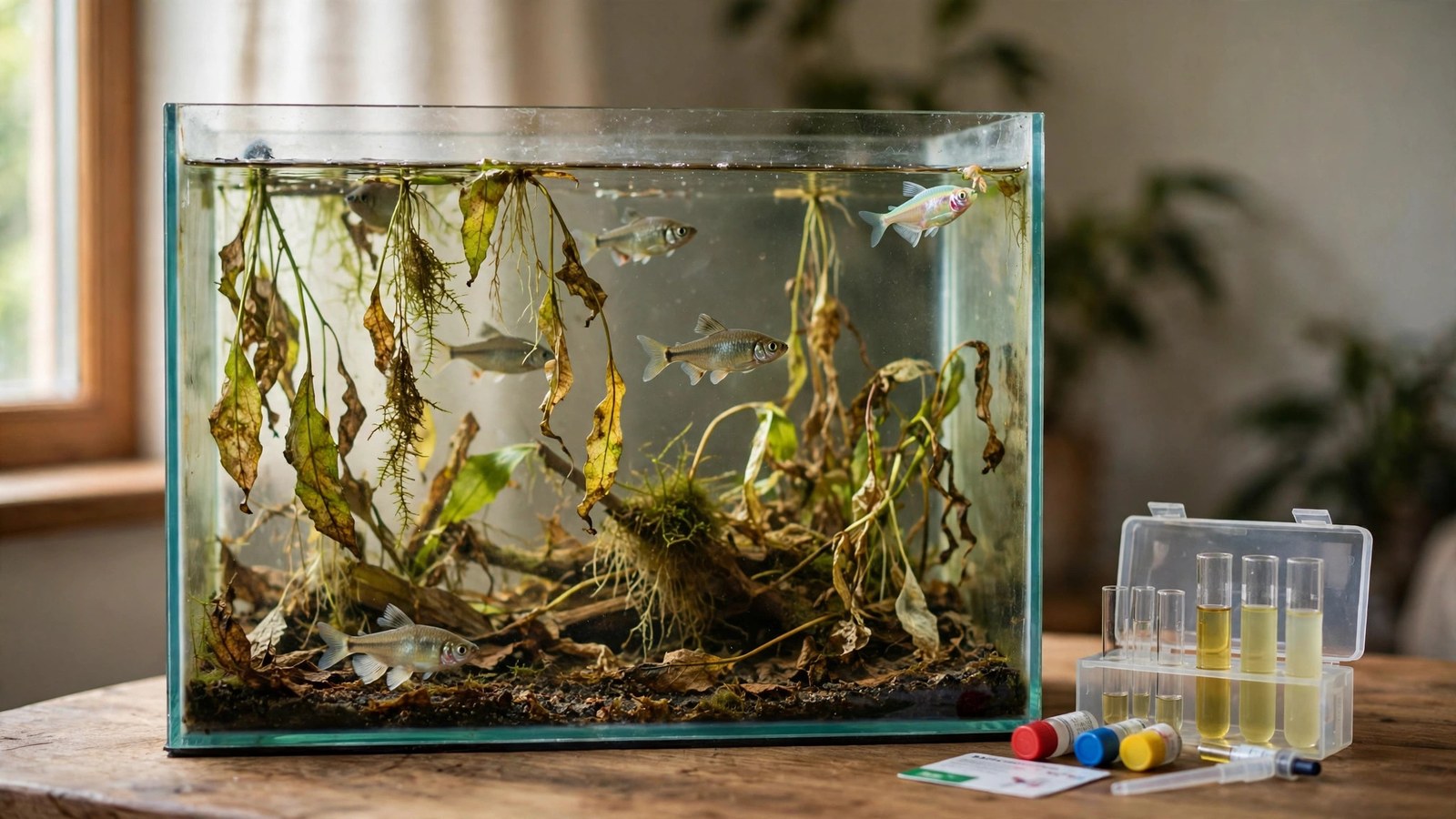
You come home from work, glance at your tank, and your heart stops: fish gasping at the surface, shrimp lying on their sides, and your pH test showing a color you have never seen before. That sudden plunge is a pH crash — the event every aquarium owner dreads — and in planted tanks it rarely comes out of nowhere. It happens when your water's carbonate hardness (KH) is quietly exhausted, the pH buffer collapses, and the pH free-falls — sometimes by two full points in a single day. This guide explains exactly why it happens in planted setups, the emergency protocol that saves livestock, and the simple KH routine that makes a crash nearly impossible.
What a pH crash in your aquarium actually is
KH (carbonate hardness) is your water's shock absorber. It soaks up the acids your tank constantly produces — from fish waste, decomposing plant matter, nitrifying bacteria, and injected CO2 — and keeps pH stable. One dKH equals about 17.8 ppm of alkalinity expressed as calcium carbonate, and a healthy planted tank usually runs somewhere between 3 and 8 dKH.
A pH crash begins when that shock absorber wears down to nothing. With KH at or near zero, there is nothing to neutralize the next batch of acid. The pH does not drift — it plummets, often dropping from 7.0 to 6.0 or lower within hours. Fish struggle to regulate their internal chemistry, gill function suffers, and sensitive livestock like shrimp and small tetras can die within a day.
Counterintuitively, ammonia is not the main danger here: in acidic water it converts almost entirely into ammonium, which is far less toxic. A pH crash kills through the violent pH swing and the exhausted buffer — which tells you exactly what to fix. Restore the buffer, and the pH stabilizes on its own.
It also helps to know what a pH crash is not. A planted tank running at a steady pH of 6.2 is not crashing — that is just soft, acidic water, and many plants and fish thrive in it. A crash is defined by speed and instability: a pH that drops a full point or more in a day, paired with a KH reading at or near zero. If your pH is low but steady and your KH holds week after week, you have nothing to panic about. (Low-pH melt from fluctuating carbon is a different problem — see why aquarium plants melt for that one.)
The 4 Causes of pH Crashes in Planted Tanks
Planted tanks are unusually crash-prone because the hobby's favorite tools — active substrates, CO2 injection, and soft-water aquascaping — all push KH downward. These are the four usual suspects:
1. Depleted aquasoil buffering
Active substrates like ADA Amazonia and similar aquasoils deliberately absorb KH to drag pH down into the 6.5–6.8 range that plants and soft-water livestock love. That buffering is a consumable resource: after 12–18 months it is largely spent. The substrate still grows plants fine — but it no longer protects you. If your tank is over a year old and you have never tested KH, this is the first thing to check.
2. CO2 injection + low KH
Dissolved CO2 forms carbonic acid, which consumes KH continuously. At 4 dKH this is harmless — the buffer absorbs it. At 1–2 dKH, injected CO2 grinds the buffer down over weeks, and the daily pH swing grows wider until the buffer fails completely. Tanks running CO2 without ever testing KH are the most common crash scenario. If you inject CO2, read our guide to too much CO2 in planted tanks to keep the gas side safe.
3. Acidic source water + skipped water changes
RO, rainwater, and very soft tap water arrive with almost no KH. Then your tank's biology eats what little is left: nitrifying bacteria consume roughly 7 mg of alkalinity for every 1 mg of ammonia they process, every single day. Weekly water changes repay the debt with fresh KH from the tap. Skip them for a month or two in a soft-water tank and you are drawing down a bank account you never deposit into — until it hits zero and the pH crashes.
4. Driftwood and peat overload
Driftwood and peat release tannic and humic acids — the amber tint blackwater fans love. In hard, high-KH water these acids are a rounding error. In a soft, low-KH planted tank with a lot of wood and no water changes, they add a steady acid load on top of everything else. Wood is rarely the sole cause, but it is often the final straw in a tank already running on a thin buffer.
| Cause | Warning signs | First fix |
|---|---|---|
| Depleted aquasoil | KH trending to zero in a tank older than 12 months; pH swings wider than before | Restore KH in the water column; plan a substrate refresh or cap with fresh soil |
| CO2 + low KH | Big daily pH swing (1+ point) between morning and evening readings | Stop CO2, aerate, raise KH to 3–4 dKH before restarting gas |
| Soft source water, few water changes | KH dropping steadily between changes; livestock stress after long gaps | Resume weekly 30% changes; remineralize RO water with a KH product |
| Driftwood/peat acids | Amber water, pH drifting down between changes in a low-KH tank | Water changes to export tannins; reduce peat; keep KH topped up |
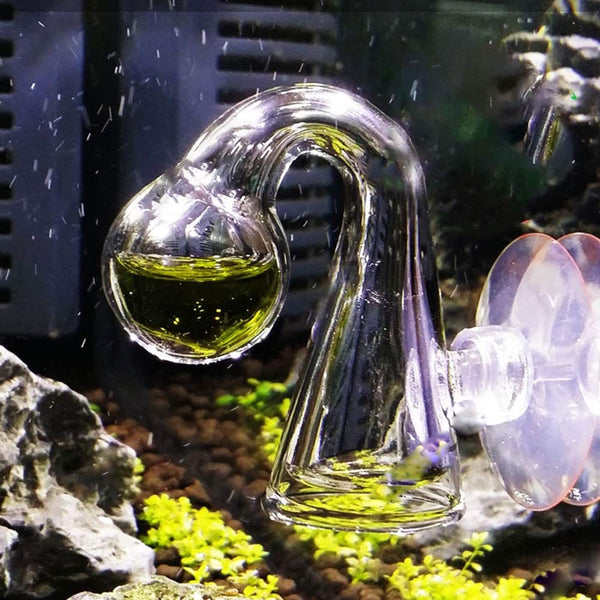 ★4.6
FZONE Glass CO2 Drop Checker Kit
Check Price on Amazon ★4.6How to Spot a Crash Early: Livestock First-Aid Signs
Fish tell you about a pH crash before your test kit does, because they live inside the chemistry. Watch for rapid gill movement and gasping at the surface — the earliest and most reliable sign. Clamped fins, sudden lethargy, hovering near the filter outflow or the surface film, and flashing (rubbing against leaves and hardscape) all follow. Shrimp are even more sensitive: they go still, lie on their sides, or climb out along the glass.
If you see these signs, test KH and pH immediately. A pH reading a full point or more below your tank's normal value with KH at zero confirms it. Do not wait to "see if it stabilizes" — start the emergency protocol below right away.
In severe cases — fish rolling, unable to stay upright — move the worst-affected livestock to a quarantine container with clean, temperature-matched, well-aerated water. Move them gradually: a second violent pH swing from a hasty transfer can finish what the crash started.
Emergency Recovery: The Step-by-Step Protocol
Work through these in order. The goal: stop the acid load, restore oxygen, and rebuild the buffer — gently. Every step that changes water chemistry should be gradual, because a second shock is as dangerous as the first.
- Stop the CO2 immediately. Turn off the solenoid or bubble counter. Injected CO2 is the biggest active acid source, and stopping it halts the pH slide within the hour.
- Maximize surface agitation. Point a filter outlet at the surface or add an airstone. This drives off excess dissolved CO2 and adds oxygen for stressed fish. Keep it running until the tank is fully stable.
- Do small, frequent water changes — 10 to 15% every few hours, or 20% daily. Use water with healthy KH (tap, or remineralized RO). Small changes dilute acids without whipsawing the pH — never do a 50%+ change on a crashed tank. If your tap water is near zero KH, buffer the change water first (step 4). Sudden plant die-off after a big change is a related problem — see plants dying after water changes.
- Restore KH with baking soda — carefully. Dissolve plain sodium bicarbonate (not baking powder) in a cup of tank water first. One level teaspoon per 20 gallons (about 75 liters) raises KH by roughly 2 dKH. Start with half that dose, wait 24 hours, retest, and repeat. Never raise KH by more than 1 dKH per day. Target 3–4 dKH in a CO2 tank, 2–4 dKH in low-tech.
- Retest KH and pH daily for a week. The crisis is over when KH holds steady between tests and the daily pH variation shrinks under half a point.
- Restart CO2 slowly. Once KH holds at 3–4 dKH for several days, restart at half your previous bubble rate and ramp up over a week. If the daily pH swing exceeds one point, your KH still needs work.
When NOT to Chase pH
The most damaging mistake in this whole topic is treating the pH number instead of the buffer. If your KH reads 4 dKH and your pH is 6.4, nothing is wrong — that is a stable, healthy planted tank, and "fixing" it with chemicals will only destabilize it. Stable pH at an unusual value beats a "perfect" 7.0 that swings daily.
Similarly, if a crash has bottomed out and your livestock look stable at pH 6.0, resist the urge to yank the pH back up in one heroic dose. Rapid upward correction is a second crash in reverse. Rebuild KH at the 1-dKH-per-day pace, let the pH climb on its own schedule, and prioritize livestock behavior over test-kit aesthetics.
Prevention: Make a Crash Nearly Impossible
Prevention is simple once you understand the mechanism — it is all about never letting KH reach zero:
- Keep KH at 3–4 dKH in CO2 tanks, 2–4 dKH in low-tech. Treat this as a hard floor. Below 3 dKH with injected CO2, you are one busy month away from a crash.
- Test KH monthly at minimum. Weekly while dialing in a new CO2 setup or in any tank over a year old on aquasoil. A downward trend is your early warning.
- Refresh buffering soil every 12–18 months. Capping old aquasoil with a fresh 1-inch layer of new soil buys another year without a full rescape — add it gently during a water change.
- Keep up weekly 30% water changes. The highest-leverage habit: it exports organic acids and imports fresh KH from your tap in one move.
- Remineralize RO water. Add a KH-specific remineralizer (most GH products add zero carbonate) until the change water reads 3–4 dKH before it touches the tank.
- Go easy on peat and wood in soft-water tanks. A little tannin is fine; a tank stuffed with wood in 1-dKH water is stacking acid sources with no buffer to absorb them.
One last note: plants under chemical stress show familiar distress — pale new growth, stalled tips, sudden leaf loss — which can look like a nutrient deficiency. If your plants melted right around the time your pH went sideways, fix the KH first; dosing fertilizers into a crashed tank treats a symptom while the real problem keeps burning.
Frequently Asked Questions
Will a pH crash kill my fish?
It can, especially shrimp, small tetras, and scaleless fish — the danger is the speed of the swing, not just the low number. Many hardy fish survive if the buffer is rebuilt gradually. Act within hours: stop CO2, aerate, and start small buffered water changes. Fish that survive the first day usually recover fully once KH holds steady.
Does aquasoil cause pH crashes?
Fresh aquasoil does the opposite — it stabilizes pH by absorbing KH. The risk comes 12–18 months later when its buffering capacity is exhausted. The substrate looks and grows plants exactly the same, so the expiration is invisible without a KH test. Test monthly in tanks on old soil, and plan a refresh or cap before the buffer dies.
How fast can I raise KH safely?
No more than 1 dKH per day in a tank with livestock — faster risks a second pH shock. Dose half a level teaspoon of baking soda per 20 gallons (dissolved first), wait 24 hours, retest, and repeat. In an empty, cycling tank you can move faster, but with fish in the water, patience is the treatment.
Can I just use pH Up instead of baking soda?
No — that is the classic trap. pH Up spikes the pH without rebuilding the KH buffer, so the pH crashes back down and you dose again, creating a deadly yo-yo. Baking soda adds actual carbonate alkalinity, which is the buffer your tank is missing. Fix the KH and the pH stabilizes by itself.
My pH is 6.2 but my fish are fine — is that a crash?
Probably not. A crash is a rapid drop with KH at or near zero. If KH holds steady at 2+ dKH week after week and livestock behave normally, pH 6.2 is just stable soft water — many planted tanks run there happily for years. Worry about the trend and the KH reading, not the pH number alone.
Do I need to replace all my aquasoil after a crash?
Not immediately. First rebuild KH in the water column and stabilize the tank — livestock safety comes before substrate projects. Once stable, decide: if the soil is past 18 months and KH keeps sliding to zero between water changes, cap it with a fresh inch of new aquasoil or plan a rescape. If the crash came from skipped water changes, the existing soil may still have life in it.
Stability Beats Perfection
A pH crash feels like an emergency because it is one — but it is also one of the most preventable disasters in the planted-tank hobby. The whole prevention program fits on an index card: keep KH at 3–4 dKH, test it monthly, change 30% of the water weekly, and refresh your aquasoil before its second birthday. Do those four things and your pH will never free-fall again.