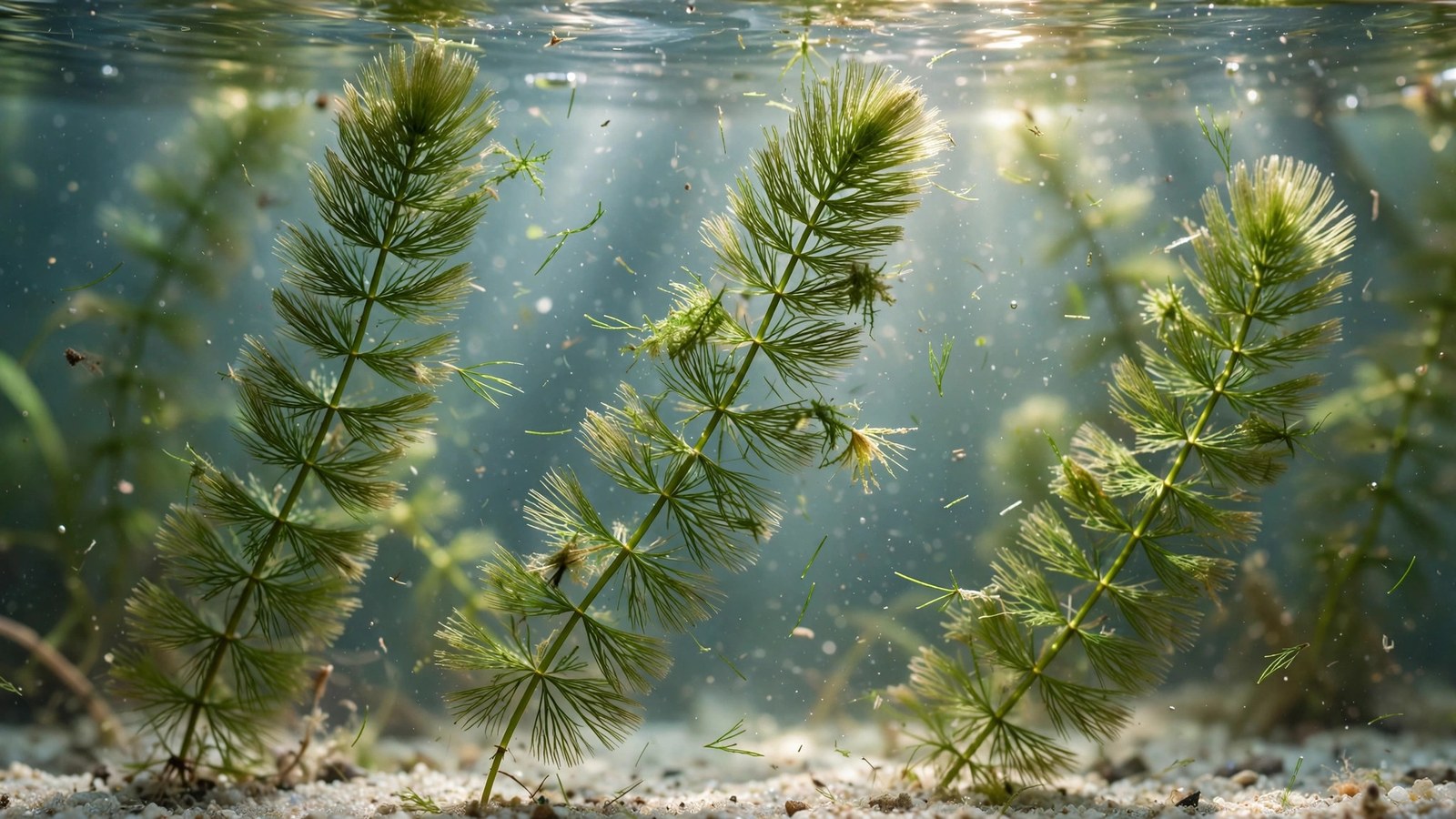
Your tank looks like it's snowing — tiny green needles falling off your hornwort, piling on the substrate while the stems turn limp and bare. That sight is hornwort shedding needles, and it almost never means disease. Hornwort (Ceratophyllum demersum) grows no true leaves; those "needles" are forked leaf whorls, and dropping them is how it complains. New to it? See our hornwort care guide — otherwise match your pattern below for the fix.
Hornwort shedding needles: what's normal (and what isn't)
Hornwort grows new whorls at its tips and sheds the oldest at the base, so a slow drift of needles from the bottom third — while tops stay dense and green — is normal turnover.
Cause #1: transplant shock
Fresh hornwort just endured totally different light, chemistry, and temperature, and responds by dropping needles heavily within days 3–7. Watch the trajectory: shedding peaks, then slows, and by days 10–14 the tips should push fresh whorls. If so, do nothing but keep conditions stable — every water change or "rescue" restarts the clock (the same stress behind plants melting after a water change). Still accelerating at day 14? It's not shock; work through the causes below.
Cause #2: temperature swings
Hornwort tolerates 59–86°F (thriving 68–77°F) but reacts violently to change. A heater failure or cold water change can strip a healthy bunch bare within 24–48 hours. Signature: the whole plant sheds at once; stems stay soft and floppy, not brown or slimy. Firm tips mean likely recovery once temperature stabilizes — expect fresh whorls in 7–10 days. Fix: a reliable heater with a thermostat, replacement water matched within 2–3°F, tank away from windows and AC vents.
Cause #3: not enough light
Shock explains shedding that stops; shedding that never stops is a light problem. In dim or shaded conditions, hornwort can't support its whorls and abandons them from the lowest sections upward. The pattern: slow bottom-up needle loss over weeks, pale stems, sparse stretched growth with long gaps between whorls. Getting leggy too? Same root cause: fixing leggy stem plants. Fix: 8–10 hours of moderate light daily, hornwort in the upper half of the tank. Check for floaters or tall hardscape shading it from above, and replace bulbs older than 12–18 months — aging bulbs dim long before your eyes notice.
Cause #4: nutrient gaps
Rootless hornwort feeds entirely from the water column, — a canary for nutrient gaps: slow shedding over weeks, yellowing whorls or stalled tips, in lean tanks near zero nitrates. It thrives at 10–20 ppm nitrate; at 0–5 ppm with no supplementation, it runs out of building material. Dose a comprehensive liquid fertilizer at the label rate; new growth within 10–14 days confirms it. Double-dosing a light-starved tank won't help — see our aquarium plant nutrient deficiency guide. If only the hornwort suffers while other plants grow fine, look elsewhere.
Cause #5: buried stems
Hornwort has no true roots — pushing stem bases into the substrate rots them within days, and the rot creeps upward: brown mushy base, lowest whorls shedding in clumps, the stem detaching. Same failure as stem plants rotting at the base, except hornwort was never meant to be planted. Let it float freely, or anchor it loosely — never more than an inch deep. Floating is best — richest light and gas exchange at the surface, plus shelter for fry and shrimp in the trailing stems. Already rotting? Snip off everything brown and mushy; float only the firm green cuttings.
Diagnose by pattern
| Shedding pattern | Likely cause | Fix |
|---|---|---|
| Heavy loss in week 1, tips regrowing by day 14 | Transplant shock | Do nothing; keep conditions stable |
| Sudden whole-plant shedding within 48h of a water change | Temperature swing | Stabilize temp; match new water within 2–3°F |
| Slow bottom-up loss, pale sparse stems | Too little light | 8–10h moderate light; clear shading |
| Gradual shedding, yellowing, stalled tips, near-zero nitrates | Nutrient gap | Liquid fertilizer at label rate; recheck in 2 weeks |
| Base brown and mushy, lowest whorls drop in clumps | Buried stem rot | Trim all rot; float healthy cuttings |
| Top-down shedding, tips dead | Severe stress — check all above | Stabilize everything; salvage green tips |
What about allelopathy and flow?
Two forum theories, briefly. Allelopathy: hornwort is the aggressor — its compounds suppress algae, which is why it's prized in new tanks. No solid evidence shows other plants chemically force it to shed. Flow: the whorls are delicate, and a powerhead blasting into a bunch batters needles loose mechanically — redirect the current or move the plant. Rule out the big five first.
Recovery timeline
After the fix — days 1–3: shedding may briefly continue. Days 4–7: shedding slows, tips brighten. Days 7–14: fresh whorls emerge and growth resumes. By day 21 it should look clearly fuller. Siphon fallen needles out every few days — decaying litter feeds algae. Zero new tip growth at day 14? Revisit the table, and compare against plants turning brown to check for rot.
When it's a death spiral
Pull it if all three are true: brown slimy stems, no living tip growth, and 3+ weeks of shedding despite stable temperature, good light, and fertilization. A bare stem with firm green tips is a patient; a brown mushy stem with dead tips is compost — and whatever you pull, never release hornwort into local waterways, drains, or the wild: Ceratophyllum demersum is invasive in several regions (including parts of Australia and New Zealand), so bag pulled trimmings and dispose of them in the trash. Hornwort is cheap and fast — a fresh bunch reaches full size in 3–4 weeks, less time than nursing a doomed one. Species background: UF IFAS Ceratophyllum demersum profile.
Frequently Asked Questions
Is it normal for hornwort to shed needles when first added to a tank?
Yes — most new hornwort drops many needles within its first week. As long as stem tips push fresh green whorls by days 10–14, it's fine — siphon out the fallen needles and keep conditions stable.
Will the bare stems grow needles back?
Rarely where needles fell — hornwort grows from its tips, not old stem. Recovery is fresh dense whorls emerging from the tips while the bare lower stem stays bare. Live green tips mean it fills out top-down within 2–3 weeks.
Can cold water cause hornwort to shed?
Absolutely — it's one of the fastest triggers. A sudden swing over ~4°F (2°C), from a cold water change or heater failure, can strip a bunch within 24–48 hours. It's the sudden change, not the number, that causes shedding.
Should I plant hornwort in the substrate or let it float?
Let it float. Hornwort has no true roots, so buried stems rot within days and shed their needles. Floating is its natural habit and where it grows fastest. To position it, weigh stems down loosely instead of burying.
Does shedding mean an algae problem is coming?
Not directly, but decaying needle litter releases ammonia. Siphon the needles out every few days during recovery. Healthy hornwort suppresses algae through allelopathy, so fixing the shedding helps too.
How long before I know my hornwort is recovering?
Give it 14 days after the fix: shedding slows within a week, fresh tip growth appears by days 7–14, fullness returns by day 21. No new tip growth at day 14 means revisiting the diagnosis.
The bottom line
Hornwort shedding needles looks alarming but is one of the most fixable planted-tank problems: match the pattern, apply the fix, and give it two quiet weeks.