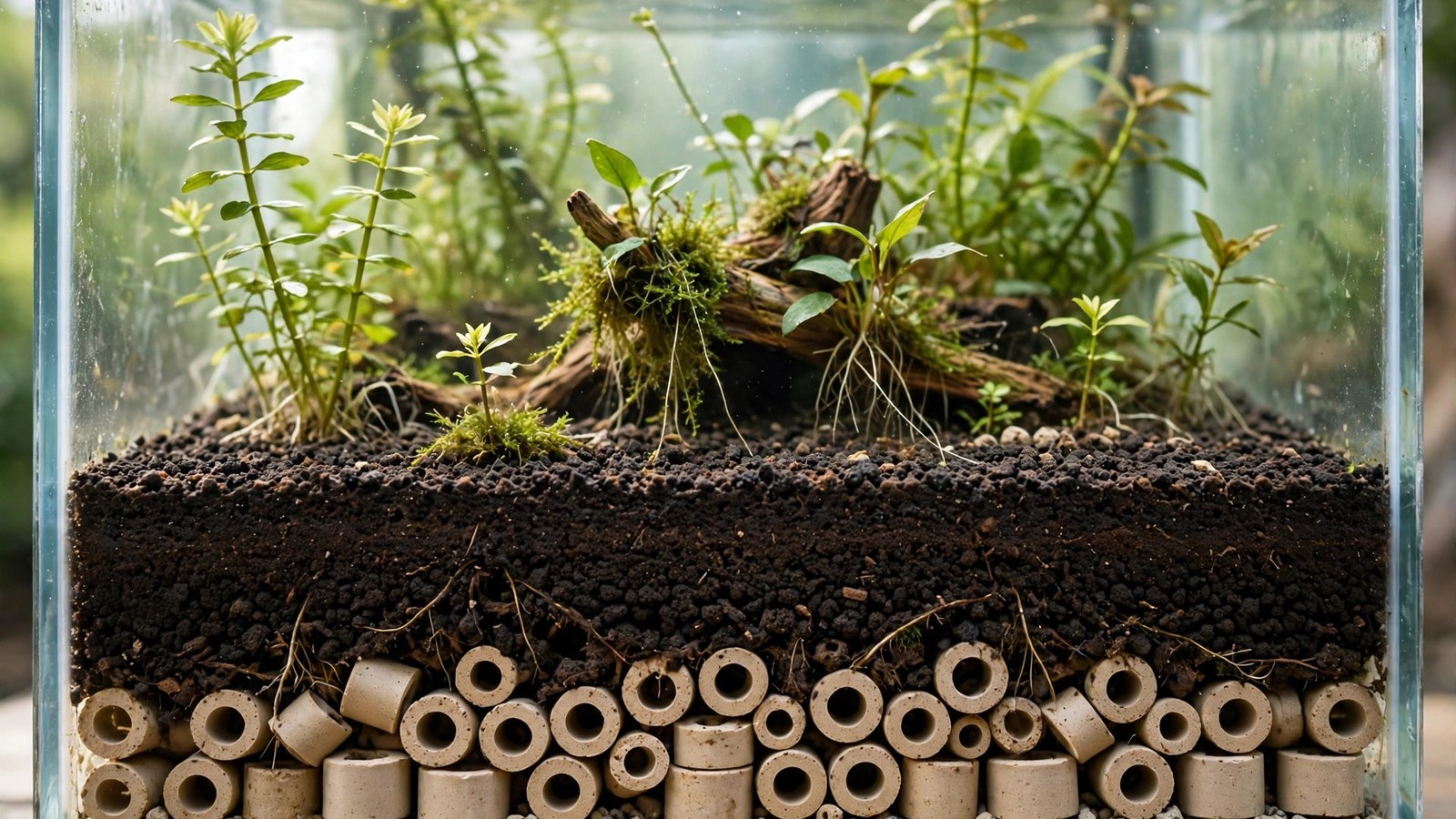
Four months into a new scape, your water should be boring. Instead, the glass wears a fresh brown film every three days, your GH test climbs to 14 no matter how many water changes you do, and TDS sits stubbornly above 500. If GH and TDS are rising in your planted tank while the silicate-loving brown algae party never ends, the culprit may be sitting right under your aquasoil: filter media someone buried as a "smart" base layer.
The Setup That Creates This Mystery
The story almost always starts the same way. Aquasoil is expensive, and filling a deep scape with it can cost more than the tank itself. So a familiar tip circulates: fill the bottom with cheap filter media — lava rock, Alfagrog, ceramic bio-rings — and cap it with a few centimeters of aquasoil. More surface area for beneficial bacteria, money saved, everybody wins.
Except it doesn't quite work that way. What you have actually built is a buried reservoir of highly porous mineral material in permanent contact with water, underneath aquasoil that keeps it dark, damp, and slowly percolating. Aquasoil is acidic, especially in its first months, releasing humic acids that lower substrate pH. That acidic microenvironment is extremely effective at dissolving things — including the silicates and mineral oxides bound up in sintered ceramic foams and volcanic rock.
In a filter, these media are inert enough: water rushes past, contact time is short, and nothing sits and stews. Buried under substrate, the physics change completely. Water moves slowly through the pore spaces, contact time stretches into days and weeks, and the dissolution products — dissolved silica, calcium, magnesium, aluminum compounds — have nowhere to go except up into your water column.
What Filter Media Actually Leaches (And Why Diatoms Strike First)
Sintered ceramic media such as Alfagrog are foamed, high-fired clays — essentially aluminosilicate ceramics. They are marketed as pH-neutral and inert, and in a canister filter they behave that way. But "inert" is relative: a porous ceramic sitting in mildly acidic substrate water for months will slowly release soluble silica. Aquarium silica test kits exist for a reason, and on a tank like this they often show silicate levels far above tap water.
Diatoms — the golden-brown algae that dust glass and leaves — build their cell walls from silica. In most new tanks they bloom for a few weeks, then starve themselves out as silica is consumed. Read how diatoms behave in new tanks to see the normal timeline. When the brown film never leaves and the tank is months old, the question stops being "when will the silicates run out?" and becomes "where is the silicate coming from?" A buried layer of dissolving ceramic is one of the most common hidden answers, and it can feed diatoms indefinitely.
Alongside silica, these materials release hardness-forming minerals. Calcium and magnesium leach steadily, and in a tank where aquasoil is simultaneously trying to soften and acidify the water, you get a slow-motion tug of war: the soil pulls GH and KH down, the buried media pushes them back up. This is why the classic symptom cluster — persistent diatoms, GH climbing toward 14, TDS above 500 despite water changes — points at a leaching source inside the tank rather than at your fertilizer bottle.
Why water changes don't fix it
The cruel part is that water changes look like they should help. You change 50% of the water, GH drops from 14 to 8, TDS falls to 320 — and three days later both are right back. That rebound is the signature of a continuous source. A one-time contaminant dilutes and stays diluted; a buried media bed re-dissolves into every fresh batch of water you add.
Why Your GH and TDS Keep Rising in a Planted Tank
Let's untangle what those two numbers mean, because the fix depends on it. General hardness (GH) measures dissolved calcium and magnesium — the same dissolved calcium and magnesium the USGS uses to define water hardness. In a planted tank, GH around 4–8 degrees suits most community setups; 14 is very hard, stressing soft-water plants and livestock and interfering with nutrient uptake.
TDS (total dissolved solids) is broader: everything dissolved, in ppm — minerals, salts, fertilizer ions, organics, silica. A healthy planted tank typically runs 150–350 ppm depending on source water and dosing. When TDS pushes past 500 with no change in dosing or feeding, something mineral is dissolving into the tank that you didn't put there deliberately.
Work through this elimination checklist before blaming the substrate:
- Test your tap water. Municipal supplies change seasonally. If tap reads 450, the tank is innocent.
- Audit your dosing. Heavy dosing adds TDS gradually and responds to water changes. Rebounding within days points elsewhere.
- Check your hardscape. Seiryu stone and other limestone-type rocks raise GH the same way. Drip vinegar on a rock — fizzing means carbonate.
- Look at the timeline. Did GH start climbing shortly after the scape went in? A source inside the tank announces itself early.
- Mind the aquasoil phase. Fresh aquasoil actually lowers GH and KH. If you're using a new aquasoil that is also melting plants, rising GH is doubly suspicious — the soil should be pulling hardness down, so something else is pushing it up harder.
A handheld TDS meter makes the creep visible in seconds: a TDS meter like HM Digital's TDS-3.
How to Confirm the Diagnosis
You don't have to tear the tank apart on a hunch. Two simple tests, plus the right kit, will confirm a leaching substrate layer.
Test 1: The bucket soak
If you kept any of the media, drop a few pieces into a bucket of distilled or RO water and measure TDS and GH on day one and again after 48–72 hours. A clear jump — TDS climbing by tens of ppm, GH rising a degree or more — is a confession. No leftover media? Push a cup into the substrate, draw off the interstitial water trapped in the lower layer, and test it against the water column. Pore water much higher in GH, KH, or silicate than the tank water above it is the smoking gun.
Test 2: The silicate reading
A dedicated silicate test kit is the single most useful purchase for this mystery. Choosing the right water test kits for a planted tank matters here, because most master kits don't include silica at all. Test tap water first for a baseline, then the tank. Tank silicate far above tap, combined with endless diatoms, means silica is entering the tank from inside it — and the substrate layer is the prime suspect.
Test 3: The water-change rebound curve
Do a 50–60% water change, then measure GH and TDS at 24, 48, and 72 hours. A steady climb back toward the old values within days confirms a continuous source. If the numbers stay put, your problem was one-time accumulation — the water changes were the fix.
One caution: don't confuse this with over-fertilizing symptoms. Heavy dosing raises TDS and stresses plants, but fertilizer doesn't add silicate, doesn't cause the classic brown-film diatom pattern, and responds properly to water changes. If diatoms are the headline act, think silica first.
Confirm the chemistry with a liquid test kit before tearing anything down: API Freshwater Master Test Kit.
The Fix, Step by Step
Once confirmed, the fix has a clear order of operations — from least to most disruptive. Start at the top and only move down when the previous step fails.
Step 1: Stop feeding the problem
Remove any chemical contradiction. If you're adding GH boosters, crushed coral, or mineral stones alongside the buried media, take those out first so your tests show only the media's contribution. Cut fertilizer dosing back to a lean maintenance level temporarily; you need clean diagnostic numbers.
Step 2: Manage symptoms with water changes and absorbers
Large, frequent water changes — 40–50% twice a week — keep GH and TDS tolerable while you decide on the real fix. A phosphate/silicate-absorbing resin in the filter (the aluminum-oxide type sold for reef tanks works in freshwater) strips dissolved silica and starves the diatoms back, buying you time. This is management, not a cure: the media is still dissolving underneath.
Step 3: Consider partial removal
In shallow, unplanted areas — the front glass strip, open foreground zones — you can siphon out the aquasoil cap, scoop out the buried media, and replace it with plain inert sand or more aquasoil. This clouds the water badly and only works where the media layer is thin. Where plants are rooted through it, skip this; you'll destroy root systems for a half-measure.
Step 4: The full rescape
For most tanks, this is where the road ends. A buried dissolving layer cannot be neutralized, capped, or waited out; the leaching continues for many months because the pore structure exposes enormous surface area. If GH is pinned above 10, TDS keeps rebounding past 400–500, and diatoms return within days, the only complete fix is to break the tank down, remove every trace of the media, and rebuild the substrate properly.
When a Full Rescape Is the Only Answer
Here is the decision rule: if the bucket test shows strong leaching, silicate is elevated, and numbers rebound within 72 hours of a big water change, you are not managing this away. Absorbers and water changes become a permanent tax, the plants most sensitive to hard alkaline conditions will keep struggling, and the diatoms will keep their brown grip on every leaf and glass panel.
A rescape sounds dramatic, but it is a weekend project, not a tragedy. Move livestock to a holding tub with the existing filter running, save as much tank water as you can, and pull the substrate in sections. This is also the moment to protect your plants: stems and carpets lifted from a dissolving substrate bed are already stressed, so read up on why aquarium plants melt and how to nurse them through transitions before you start. Rebuild with aquasoil over a genuinely inert base — or no base at all — and within weeks you'll see it: GH that holds steady, TDS that responds to water changes, and diatoms that finally fade like they're supposed to.
Preventing the Next Mystery
Use this comparison when planning your next scape:
| Base-layer material | Safe under aquasoil? | Why |
|---|---|---|
| Plain aquasoil, full depth | Yes | No hidden chemistry; uniform buffering and nutrient profile |
| Inert lava rock (tested) | Usually yes | Truly inert basalt is fine, but test it — some "lava rock" is mineral-rich |
| Coarse pumice | Usually yes | Volcanic glass, generally stable; rinse dust thoroughly |
| Sintered ceramic bio-media (Alfagrog etc.) | No | Porous aluminosilicate ceramic leaches silica and hardness minerals over months |
| Ceramic bio-rings / noodles | No | Same porous-ceramic chemistry; enormous leaching surface area |
| Crushed coral, shells, limestone | No | Deliberately raise GH/KH — the opposite of what aquasoil is for |
| Garden soil, potting mix | No | Unpredictable ammonia, organics, and mineral spikes; algae factory |
Two habits prevent nearly every version of this problem. First, test anything before it goes under your substrate — a week-long bucket soak with TDS and GH readings costs nothing and has saved countless scapes. For reference on what Alfagrog actually is — a sintered ceramic foam marketed as pH-neutral for filters — remember that "inert in a filter" and "inert buried in acidic substrate for a year" are two different claims, and only the first was ever tested. Second, keep the substrate simple: one material, all the way down, or a tested inert base. The money saved on aquasoil is nothing compared to the cost of a rescape six months later.
And if your plants are already showing secondary damage — stalled growth, pale new leaves, or signs that look like calcium deficiency even though your water is hard — remember that excess hardness can lock out other nutrients. Fix the source first; chasing deficiencies in water that's chemically fighting you is a losing game.
Frequently Asked Questions
Can filter media under aquasoil really raise GH to 14?
Yes. Porous sintered ceramics and mineral-rich volcanic media continuously release calcium, magnesium, and silica into the slow-moving water trapped in the substrate. GH can climb into the teens and TDS past 500 even with regular water changes, because every fresh batch of water starts dissolving minerals the moment it's added. Rebound within days of a water change is the telltale sign.
How do I know the diatoms are from the substrate and not just a new tank?
Normal new-tank diatoms peak in the first 4–8 weeks and fade as silicates are consumed. If your tank is past three months, diatoms return within days of wiping, and a silicate test shows tank levels far above your tap water, the silica is coming from inside the tank. A bucket soak of the suspect media, or testing substrate pore water against the water column, confirms it.
Will a silicate-absorbing resin fix the problem permanently?
No — it manages the symptom, not the cause. Absorbers strip dissolved silica and will visibly reduce diatoms, which makes them excellent for buying time. But the buried media keeps dissolving for many months, so you'd be replacing resin indefinitely while GH and TDS keep climbing. Use absorbers as a bridge to a rescape, not as the solution.
Is lava rock under aquasoil safe?
Genuinely inert basaltic lava rock usually is, and many aquascapers use it successfully. The catch is that "lava rock" sold for aquariums isn't always basalt — some batches are mineral-rich enough to leach. Always do the bucket-soak test (RO water, 48–72 hours, check TDS and GH) before burying any rock product under substrate. If numbers move, don't use it.
Do I really have to rescape, or can I wait it out?
Waiting it out is the most expensive option in disguise. Leaching from porous ceramics can persist well beyond a year because the internal pore surface area is enormous. Meanwhile you're fighting diatoms, stressed plants, unsuitable water for soft-water livestock, and endless water changes. If the diagnosis is confirmed and numbers rebound within days, a rescape ends the problem in a weekend instead of dragging it out for a year.
What should I use as a base layer instead?
The safest choice is aquasoil all the way down — no layering at all. If depth makes that too expensive, use a tested inert material: coarse pumice or confirmed-inert lava rock, each verified with a week-long bucket soak first. Never use sintered ceramic filter media, bio-rings, crushed coral, shells, limestone, or garden soil under aquasoil. Simple substrate, tested materials, no mysteries.
The Takeaway
A buried layer of filter media is a slow-release chemistry experiment under your aquascape — feeding diatoms with silica, pushing GH toward 14, and driving TDS past 500 no matter how faithfully you change water. The diagnosis is cheap: a silicate test, a bucket soak, and a 72-hour rebound check will tell you the truth. And the fix, while annoying, is decisive: get the dissolving media out, rebuild on inert foundations, and your chemistry will finally do what water changes are supposed to make it do — stay put.