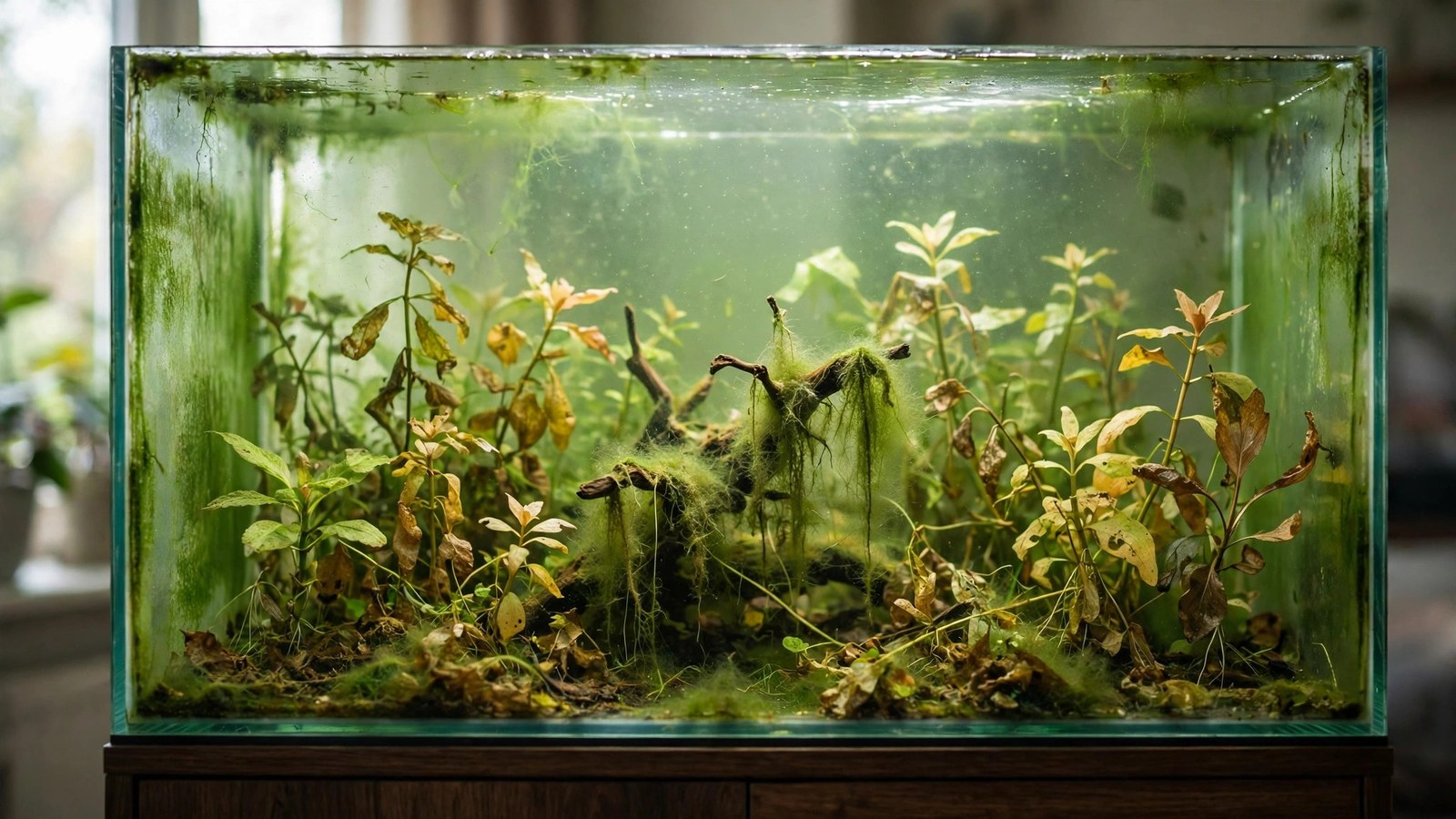
The cap slipped, and six weeks of fertilizer hit the tank in one pour. You have just overdosed aquarium fertilizer — and hoping it was "close enough" is exactly wrong. What you do in the next hour decides whether this becomes a footnote or a week of melting plants, gasping shrimp, and a green-water bloom.
Signs You Overdosed Aquarium Fertilizer
An overdose does not always announce itself with dead fish. The first signs are subtler: fine green dust algae on the glass within 48 hours, hair algae on slow growers, and pale, twisted tips on stem plants.
The surest sign is behavioral: you know you poured too much. Start diluting now: toxicity shows as melted leaf margins a week later — by then you have dosed again. Most nutrient problems in planted tanks are deficiency, not excess, but excess is the one that punishes hesitation.
Emergency Triage: The First Hour
Stop dosing everything — not just the overdosed bottle, but all of them. Check livestock: shrimp climbing the glass or hanging at the surface, snails retracted? If yes, water changes become urgent.
First, a 50% water change with temperature-matched water, plus fresh activated carbon — an exhausted cartridge does nothing today. Second, one hour later, another 50% change: the part people skip, and the one that matters most. It compounds the dilution without a single massive parameter swing. Do not add algaecide and do not tear down the filter: bacteria live on surfaces, so water changes do not crash your cycle, but replacing all the media at once does.
The Water-Change Math That Fixes It
After the first 50% change, 50% of the overdose remains; the second halves that remainder — 25% left, 75% removed. A single 75% change achieves the same arithmetic but shocks fish and shrimp with a sudden swing in TDS, pH, and temperature. For whole-bottle disasters, a third 50% the next day reaches 87.5% removal.
If you own a liquid test kit, test after the changes — nitrate above 40 ppm or phosphate above 3 ppm means keep diluting. Dilution cannot fix everything: copper and other trace metals adsorb to substrate and plant surfaces, releasing back slowly. Water changes handle the dissolved load; carbon handles the bound fraction.
What Each Fertilizer Type Does When Overdosed
| Fertilizer type | Overdose risk | First response |
|---|---|---|
| All-in-one liquids | Moderate — balanced, but algae fuel in bulk | Double 50% changes + carbon |
| Single macros (N, P, K) | High — single-nutrient spikes stall plants | Test, dilute, fix ratios before resuming |
| Micro/trace mixes (with copper) | High for shrimp and snails | Carbon immediately, watch invertebrates |
| Iron gluconate | Low — oxidizes fast | One 50% change; usually self-corrects |
| Dry salts (EI, PPS-Pro) | High — tablespoons are easy to misjudge | Dilute, weigh doses going forward |
| Root tabs | Moderate — localized, slow release | Remove exposed tabs, cap substrate, change water |
One boundary matters: this guide covers nutrient fertilizers only — macros, micros, all-in-one liquids, dry salts, root tabs. Liquid-carbon products like Excel are a different poison with different symptoms; read our guide on Excel plant melt for those.
Livestock First: Shrimp, Snails, and Copper
Plants tolerate nutrient spikes that kill invertebrates outright. Micro and trace mixes contain copper compounds — safe at label doses, dangerous at multiples — and shrimp are highly sensitive to dissolved copper. If shrimp were fine an hour ago and are now lying on their sides, copper is the prime suspect.
Run fresh activated carbon for 48 hours — it adsorbs chelated metals. Do not move shrimp to another tank unless it is fully cycled and matched — netting stressed shrimp into unfamiliar water finishes many of them.
Root-Tab Overdoses and the Jobes Spike Problem
Root tabs overdose differently: the danger is localized and delayed. Push in too many and nothing happens for days — then a tab surfaces, and concentrated nutrients leach straight into the water column. The classic version is the Jobe's plant-spike mistake: terrestrial spikes shoved into aquarium substrate. One surfacing spike can push ammonia lethal overnight.
Rescue is mechanical: Gravel-vac around the tabs, remove visible fragments, cap disturbed substrate with fresh sand, then a 50% water change and an ammonia test the next morning. Above 0.5 ppm, run daily 30% changes until it reads zero.
The Algae Bloom That Follows
Even perfect triage leaves elevated nutrients behind, and algae notices faster than plants do. Expect a 7–14 day window: green dust on glass, hair algae on slow growers, maybe brief green water. Wipe glass every two days, trim algae-covered leaves, and shorten the photoperiod by two hours for a week.
Resume fertilizer only after the bloom recedes, at half dose, stepping back up over two weeks. If hair algae persists past three weeks, check whether you are now under-dosed — review the signs of nitrogen deficiency first. For milky water, our cloudy water guide separates bacterial blooms from nutrient haze.
Prevention: Syringe Dosing and Simple Schedules
Almost every overdose starts the same way: a cap, a guess, or a helper. Measure every dose with a syringe, keep a written schedule, and pre-mix dry salts into stock solutions so you pour milliliters of dilute liquid, not eyeballed tablespoons. If someone else feeds your tank, leave the measured dose in a labeled cup.
Many lightly stocked tanks with aquasoil need no supplemental nitrate or phosphate at all — see whether aquarium plants really need fertilizer. And the best liquid fertilizers for aquarium plants compares all-in-one options whose balanced formulas make overdoses less damaging. The safest overdose is the one that never happens.
Frequently Asked Questions
How much fertilizer is actually too much?
Real trouble starts around 5–10× the label dose, where copper in micro-mixes threatens shrimp and macro spikes stall growth. A double pump by accident needs one water change and a better measuring habit; a whole bottle in a small tank is an emergency.
Can overdosed fertilizer kill my fish?
Directly, rarely — fish tolerate nutrient spikes well. The danger is indirect: panicked 90% water changes cause parameter shock, and surfacing root tabs can release ammonia. Shrimp and snails are the real casualties, killed by copper in trace mixes at doses fish ignore.
How long should I wait before dosing again?
Pause all dosing for 5–7 days, then resume at half dose for two weeks. Plants have stored reserves and will not starve in a week — but algae will exploit any nutrient you add during the bloom window, so patience pays off.
Will activated carbon remove fertilizer from my tank?
Yes for trace metals and chelated compounds — run fresh carbon for 48 hours after an overdose. It is weaker on nitrate and phosphate, so it complements water changes. Replace the carbon before resuming your regular schedule — it strips your normal dose too.
I overdosed dry salts (EI method). Is the fix different?
The triage is identical — sequential 50% changes plus carbon. The lesson is different: weigh dry salts on a gram scale and mix stock solutions so future doses are measured in milliliters, not eyeballed tablespoons. EI dosing assumes weekly 50% resets anyway, so one extra reset just brings your schedule forward.
Recovering and Moving On
An overdose feels like a catastrophe at 9 p.m. and like a story by next month. Do the two water changes, run the carbon, give it a week of quiet — your tank will almost always recover.