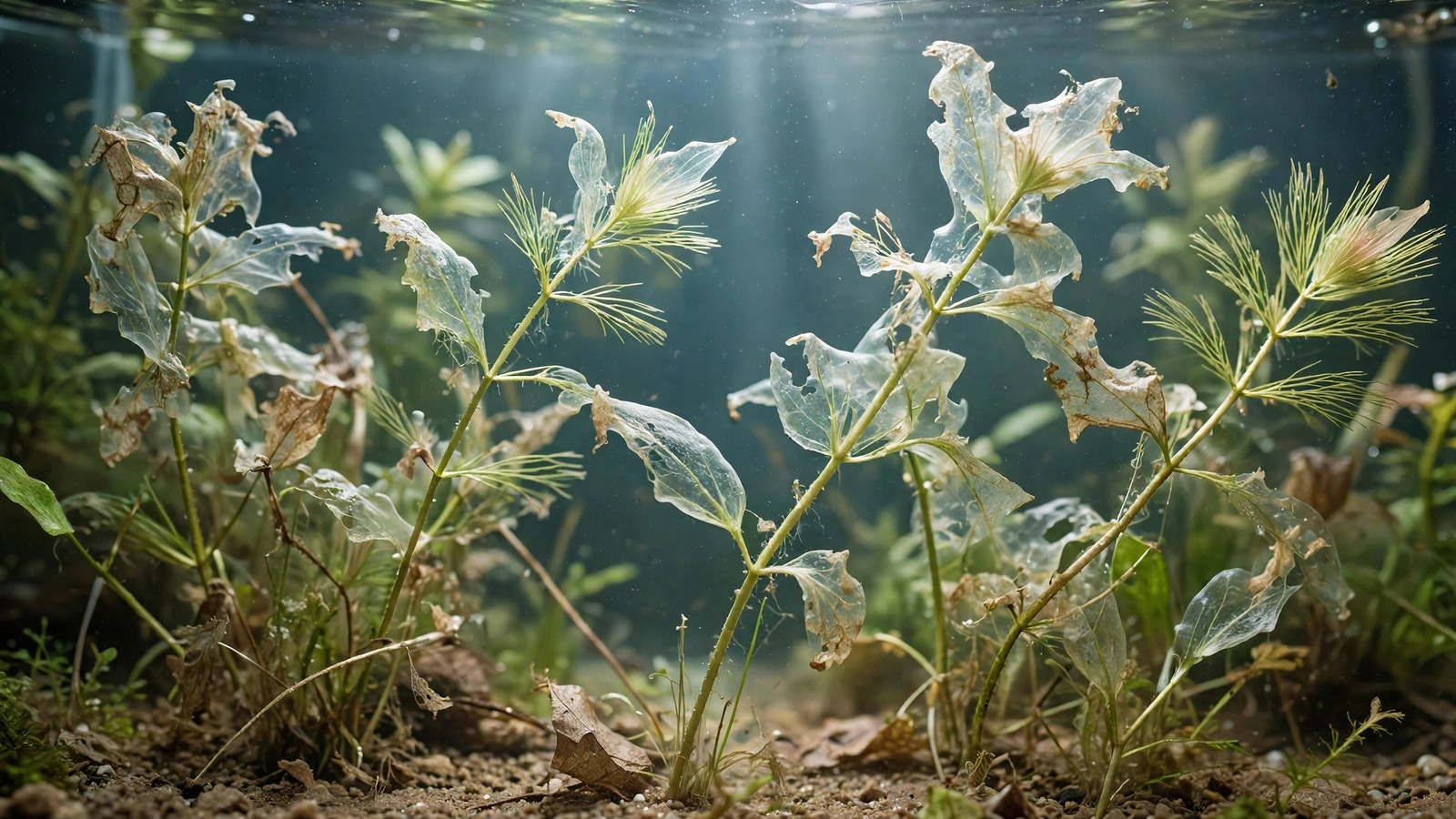
You dosed Flourish Excel last night exactly as the bottle says, and woke up to vallisneria like wet tissue paper. If "excel melted my plants" is in your search history, take a breath: this is one of the hobby's most reported accidents, and it's almost always fixable. Here's what happened in your tank, which plants were at risk from the first drop, and the recovery sequence that gives the survivors their best chance.
Flourish Excel's active ingredient is glutaraldehyde, a disinfectant-grade biocide that kills algae by cross-linking their proteins — and it does the same to thin-leaved plant tissue on contact. Soft-tissued plants like Vallisneria absorb it fastest and can turn translucent within 24–72 hours of a standard dose. Glutaraldehyde breaks down in oxygenated water with a half-life of roughly 10 hours, so one large water change clears most of the residue within a day. Stop dosing, change 40–50% of the water, trim dead leaves, and expect new growth in 1–3 weeks.
Why a plant supplement acts like an algaecide
What's actually in the bottle? Glutaraldehyde — the same chemical hospitals use to sterilize instruments. It hands plants a usable carbon fragment for photosynthesis, so it genuinely grows plants. But it's a biocide first: it kills by cross-linking proteins, destroying cell walls on contact.
Whether a plant survives comes down to absorption speed versus detoxification. Thin-leaved, soft-tissued plants with no protective cuticle — vallisneria is the poster child — soak it up instantly and have no defenses. Cells die from the inside, tissue goes glassy and translucent, and the leaf disintegrates. Tough, waxy-leaved plants like anubias, java fern, and swords barely absorb any. It's not that you overdosed; the product and the plant were never compatible.
This mismatch is also why the melt so often follows algae spot-treatment. People squirt undiluted Excel straight onto a patch of black beard algae with a pipette, and the concentrated plume drifts onto neighboring vals. For safe concentrations and alternatives, read our full liquid carbon dosing guide before you ever dose again.
"excel melted my plants" — the species most at risk
The victim list below comes from years of recurring reports on Fishlore, UKAPS, the Aquarium Co-Op forum, and other hobby boards. If your plant is on it and you dose Excel, the melt is a matter of when, not if.
| Plant | Risk level | What the melt looks like |
|---|---|---|
| Vallisneria (all types) | Very high | The classic victim: leaves turn translucent and mushy, often within 24–72 hours |
| Egeria densa / Anacharis | Very high | Stems dissolve into slime; among the fastest melters reported |
| Cryptocoryne | High | Melts like classic crypt melt, but the rhizome usually survives and re-sprouts |
| Mosses (java, Christmas, weeping) | Moderate–high | Brown patches spread; strands disintegrate under long-term dosing |
| Riccia and other liverworts | High | Floating mats dissolve from the underside upward |
| Utricularia (bladderworts) | High | Delicate carnivorous foliage collapses within days |
| Fine-leafed stems (Cabomba, Myriophyllum) | Moderate | Tips melt first; bushy regrowth usually recovers once dosing stops |
The pattern is simple: thinner tissue, higher risk. Planning a tank around vallisneria or a moss wall? Liquid carbon is the wrong tool — use pressurized CO2 or no carbon at all.
The recovery protocol: what to do tonight
Act in this order: get the chemical out first, then deal with the damage, then wait.
- Stop dosing immediately. Not "use less" — stop entirely, including algae spot-treatment. The melt came from a standard dose; more will finish the job. The published Excel directions confirm the label dose is 5 mL per 10 gallons initially, then 5 mL per 50 gallons daily.
- Do a 40–50% water change today. Glutaraldehyde's roughly 10-hour half-life in oxygenated water means one large change clears most of the residue within a day. If leaves are still turning glassy tomorrow, do a second 30% change.
- Trim every dead leaf. Cut translucent, mushy tissue at the base. Rotting leaves spike ammonia, which finishes weakened plants faster than the Excel did. Test ammonia and nitrite 24 hours after a big melt — a liquid test kit earns its keep here.
- Don't rip out the plants. Vallisneria re-sprouts from runners if the crown is firm; for crypts, the rhizome is the lifeboat — see our crypt melt recovery guide. If new leaves emerge pale, check for iron deficiency: regrowing plants are hungry plants.
- Wait, and don't re-dose. New leaves appear in 1–3 weeks; a full stand takes 4–8 weeks. Brown diatom algae may dust the stressed leaves meanwhile — normal on weakened foliage, not a new crisis.
Should you ever use Excel again?
If your plant list includes vallisneria, mosses, or crypts, the honest answer is no — match your carbon strategy to your plants. If your tank is all tough-leaved species and you're targeting algae like hair algae, Excel can still work: start at half the label dose every other day and watch your most sensitive plant for a week before increasing.
Frequently Asked Questions
Will my plants grow back after Excel melted them?
Usually yes, if roots, crowns, or rhizomes are firm. Stop dosing, change 40–50% of the water, and trim all translucent tissue so it can't rot and spike ammonia. Vallisneria re-sprouts from runners, crypts from rhizomes, stems from any living node. Expect new leaves in 1–3 weeks and a full stand in 4–8 weeks.
How long does vallisneria take to recover after melting from Excel?
Vallisneria melts fastest — and recovers fastest. Once dosing stops and a large water change clears the chemical, surviving crowns push new leaves within 7–14 days, runners spreading by week three or four. Leave every firm crown in place even if all its leaves melted.
Is Flourish Excel safe for fish and shrimp at the label dose?
At the label dose, Excel is generally safe for fish and invertebrates — plants melt at concentrations far below what harms livestock. The real fish risk is indirect: a large melt rots and spikes ammonia, which is genuinely dangerous. That's why trimming dead tissue and testing ammonia after a melt matters more for your fish than the Excel itself did.
Can I spot-treat algae with Excel if I keep vallisneria in the same tank?
This is how most vals get melted: an undiluted pipette blast meant for algae drifts onto neighboring leaves. If vallisneria shares the tank, don't spot-treat with Excel at all — the concentration gradient is uncontrollable. Treat the algae's cause instead (light duration, nutrients, CO2 balance) or remove the vals temporarily first.
Should I do a water change after accidentally overdosing Excel?
Yes, immediately — a 50% change, before damage even shows. Glutaraldehyde's roughly 10-hour half-life in oxygenated water means each large change removes the bulk of the excess fast. Run extra surface agitation for a few hours, skip feeding for a day, and watch plants and livestock closely for 48 hours.
Are other brands of liquid carbon safer for sensitive plants than Excel?
Not meaningfully — nearly all liquid carbon products use glutaraldehyde or a close chemical cousin, so they carry the same risk for vallisneria, mosses, and liverworts. "Gentler" marketing doesn't change the chemistry. If your scape depends on sensitive species, use pressurized CO2 or low-tech no-carbon growth instead.
The bottom line
Excel didn't betray you, and you probably did nothing wrong — glutaraldehyde chemistry and soft-tissued plants are simply incompatible, and the label never tells you which plants those are. Now you know: stop the dosing, clear the chemical, trim the damage, and let the runners and rhizomes do what they evolved to do.