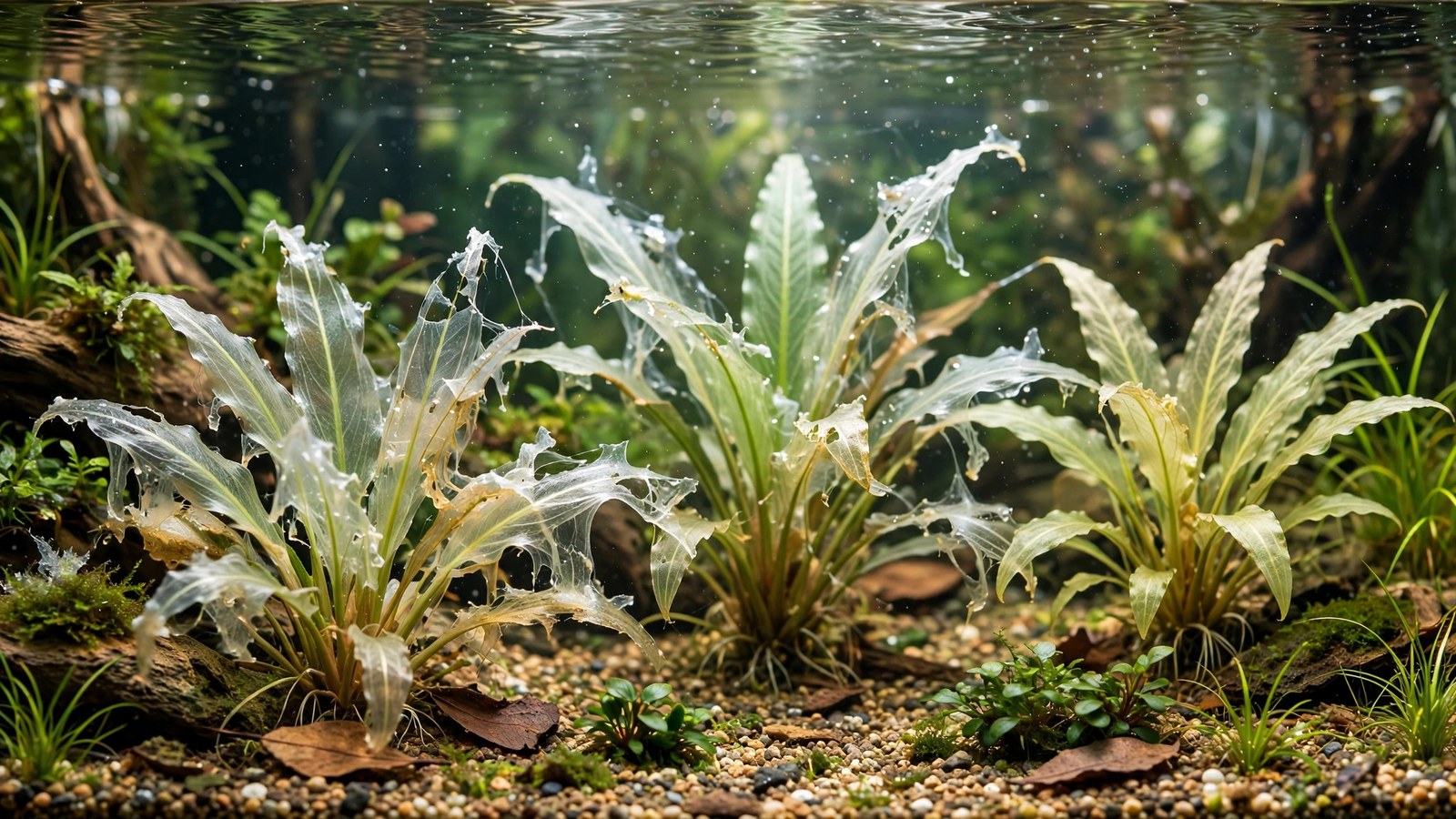
You bought a lush, deep-green Cryptocoryne, planted it carefully, and within a week the leaves have turned to translucent mush. That is the costly mistake almost every new crypt keeper makes: assuming the plant is dead and ripping it out. It isn't dead. What you're seeing is crypt melt — a dramatic but entirely normal stress response — and if you leave the roots alone, most Cryptocorynes grow back stronger within a few weeks.
What Crypt Melt Actually Looks Like
Crypt melt has a very distinctive signature. Healthy green leaves go translucent first — glassy and limp, almost like wet tissue paper. Within days they break down into soft, jelly-like mush. Crucially, melt usually starts at the outer leaves and works inward, and it almost never smells bad the way true rot does. If your crypt's leaves are turning transparent and glassy, that translucency is the earliest visible stage of melt, and catching it then gives you the best recovery odds.
This matters because melt gets confused with several genuinely lethal problems. True root rot produces foul-smelling, black, mushy rhizomes — if the rootstock smells sour or rotten and crumbles in your fingers, that's not melt, that's dead. Brown, algae-covered, or yellowing-but-intact leaves point instead toward browning problems or nutrient deficiencies, which need feeding fixes rather than patience. With melt, the giveaway is speed: melt can take down a whole plant in 3–7 days, while deficiencies progress over weeks. In crypt melt, the crown and root system stay firm, white-ish, and alive even when every visible leaf is gone.
Why Cryptocorynes Melt: The Real Causes
Cryptocorynes are famously fussy about one thing above all else: stability. In the wild they grow in Sri Lankan and Southeast Asian streams that change slowly, so they've evolved to shed their leaves and regrow when conditions shift sharply — a survival strategy, not a failure. Here's what typically triggers it.
Cause 1: New tank or new planting (the classic trigger)
This is the cause behind the vast majority of crypt melt. Your crypt was grown in a nursery — often emersed (above water), which is why the leaves look perfect in the shop — and then planted into your tank's different water chemistry. The plant's response is to dump its old leaves and grow new ones adapted to your water. Many experienced keepers simply expect a 1–2 week melt period after planting crypts and plan around it.
Cause 2: Sudden parameter swings in an established tank
A crypt that has been thriving for months can melt overnight if its environment shifts abruptly. The classic culprits: a water change over 30–40% with differently-tempered water, adding CO2 to a tank that never had it, a pH crash from a CO2 malfunction, or medication dosed at full strength. A shift of 0.5 pH units or 3–4°C in a single day is enough to trigger a melt in many species.
Cause 3: Uprooting and replanting
Every time you pull a Cryptocoryne up and move it, you reset its acclimation clock. The roots are disturbed, the rhizome is exposed, and the leaves have to re-adapt to whatever changed. This is the single most avoidable cause of melt: crypts reward you for picking a spot and leaving them there permanently. If you must move one, expect a partial melt: stable water, low light for a week, no other changes.
Cause 4: Lighting and nutrient shock
Less famous but real: moving a crypt from a dim shop tank into high light, or suddenly dosing heavy fertilizers, can trigger melt in stressed plants. The leaves grown under old conditions aren't built for the new ones. Note that this is not the same as a calcium deficiency — deficiencies show deformed new growth, while melt dissolves existing leaves wholesale.
| Melt cause | Typical symptom pattern | What to do |
|---|---|---|
| New planting / nursery-to-tank transition | Outer leaves go glassy within days, whole plant may dissolve in 1–2 weeks | Trim mushy leaves, leave roots alone, wait 1–3 weeks for new shoots |
| Large water change with different parameters | Established plant melts within 48–72 hours of the change | Stabilize parameters, cap changes at 15–20% weekly, reduce light temporarily |
| Uprooting and replanting | Partial to full melt within a week of the move | Don't move it again; trim and let it re-establish in place |
| pH or temperature crash | Rapid, whole-tank-plant melt, sometimes overnight | Find and fix the cause (CO2 issue, heater failure, exhausted buffer); then stabilize |
| True rhizome rot (not melt) | Black, foul-smelling base that crumbles; melt from the roots up, not leaves down | Remove the dead plant, trim to firm white tissue if any survives, disinfect tools |
How to Save a Melting Cryptocoryne: Step by Step
Recovery is simple, but it demands one thing most aquarists find hard: restraint. Follow these steps in order.
Step 1: Trim, don't pull
Using sharp, clean scissors, cut away every leaf that has gone fully translucent or mushy, cutting close to the base. Leave any leaves that are still green and firm — they feed the plant while it rebuilds. Resist the urge to tug on the plant to "check the roots"; pulling disturbs exactly the part that needs to stay settled. This is the step where people go wrong, because a crown with a few stubs left looks dead, and it takes confidence to leave it alone. Don't confuse lingering melt with the separate problem of carpets not spreading or slow growth — melted crypts aren't growing at all yet; give them time.
Step 2: Stabilize everything for 2–3 weeks
Your only job during recovery is boring consistency. Keep water changes to 15–20% weekly with temperature-matched, dechlorinated water. Don't add CO2 to a tank that didn't have it, don't start a new fertilizer regime, don't move hardscape, don't add medications. Aim for pH and GH values that match what the plant melted into, not "ideal" values from a care sheet; acclimation is about stability, not perfection.
Step 3: Reduce light intensity temporarily
A weakened crypt with few leaves can't use strong light, and excess light on a recovering plant just feeds algae — particularly brown diatom algae that colonizes stressed leaves in newer tanks. Drop your photoperiod to 6–7 hours and, if your light is dimmable, cut intensity by about 30% for two weeks. Once you see firm new leaves emerging, raise light back to normal over the following week. This single adjustment prevents the common cascade where a melted crypt gets smothered in algae and never recovers.
Step 4: Feed the roots, gently
Cryptocorynes are heavy root feeders, and a recovering plant needs root-zone nutrition to push new leaves. If your substrate is older than 6–8 months or is inert gravel/sand, press one root tab into the substrate 3–5 cm from the crown (not touching it). Don't dose liquid fertilizers aggressively during recovery — a half-dose of an all-in-one is plenty. Full recovery usually takes 4–8 weeks: expect the first firm green shoots at 1–3 weeks, a few leaves by week 4, and a full crown by weeks 6–8. Mark the date you trimmed so you can measure progress honestly instead of fretting on day 5.
Species Notes: Not All Crypts Melt Equally
The genus covers dozens of species with noticeably different temperaments. Cryptocoryne wendtii — the classic green, brown, and red varieties — is one of the most forgiving; it melts readily when planted but almost always comes back, making it the best crypt for beginners (see Tropica's Cryptocoryne wendtii profile for its care parameters). Cryptocoryne parva, the tiny foreground species, melts slowly and recovers slowly — give it 6–10 weeks before judging it, and don't mistake its glacial pace for failure. Cryptocoryne crispatula and C. balansae, the tall background species, tend to melt their longest leaves first while the crown survives.
The more demanding end — C. usteriana, C. aponogetifolia, and the prized C. flamingo (pink flamingo) — melts harder and recovers slower, and flamingo in particular is notorious for melting if water parameters wobble. If you're growing these, the tissue-culture route is worth the extra cost: lab-grown plants arrive free of nursery emersed growth and generally skip the worst of the melt. Regardless of species, the recovery protocol is the same; only your patience needs adjusting.
Preventing Crypt Melt in the First Place
You can't eliminate melt entirely — it's in the plant's DNA — but you can shrink it to a non-event. Buy tissue-culture cups when available; they transition far more smoothly than potted, emersed-grown plants. Match your tank's temperature and pH to the shop's water before planting, then plant and walk away. Place crypts where you intend them to stay permanently — plan the scape so crypts never need moving. Keep water changes modest and consistent (20% weekly is the sweet spot), and make changes to CO2, lighting, or fertilization one at a time, at least two weeks apart.
Finally, quarantine big changes away from new crypts. If you're starting CO2 or rescaping, do it before planting crypts or after they're established — never in the same week. A crypt planted into an already-stable tank and left undisturbed will stay with you for years, spreading by runners into a colony.
Frequently Asked Questions
Is my Cryptocoryne dead if all the leaves melted?
Almost certainly not. Crypt melt destroys leaves but the rhizome and root system underneath usually survive — that's the whole evolutionary point of the strategy. If the base is firm and odorless, the plant is alive and dormant. Leave it planted, trim the mush, keep conditions stable, and watch for new shoots within 1–3 weeks. Only declare it dead if the crown itself is black, squishy, and foul-smelling.
How long does it take for a melted crypt to grow back?
Expect the first new shoots in 1–3 weeks, a few firm leaves by week 4, and a full crown in 6–8 weeks for common species like C. wendtii. Slow growers like C. parva can take 8–10 weeks. If nothing has appeared after 4 weeks, gently check the crown with the squeeze test — firm means keep waiting, mushy means it's gone. Patience is the actual treatment here.
Should I remove melting leaves or leave them?
Remove leaves that are fully translucent or mushy — they rot, foul the water, and feed algae. Cut them at the base with clean scissors. Leave any leaves that are still green and firm, since they're photosynthesizing and feeding recovery. The critical part is to do this without disturbing the roots or moving the plant at all.
Will crypt melt spread to my other aquarium plants?
No. Crypt melt is a stress response, not an infection, so it can't spread to other plants the way a true disease or algae could. That said, whatever triggered the melt — a parameter swing, a pH crash — may stress other plants too, which is why it's worth testing your water when melt appears. Interestingly, anubias melt is a separate phenomenon with its own causes, though it responds to similar stabilization treatment.
Can I prevent crypt melt when planting new crypts?
You can minimize it but rarely eliminate it. Tissue-culture plants melt the least since they carry no nursery emersed growth. Beyond that: plant into stable, mature water, keep the first two weeks boring (small water changes, modest light, no other changes), and never uproot the plant to check on it. Most experienced keepers simply budget a 1–2 week melt period into their plans.
Why did my crypt melt months after planting?
Late melt almost always means something changed: a big water change with different parameters, a CO2 malfunction, a heater failure, new fertilizer, or even seasonal temperature swings in the room. Treat it exactly like new-plant melt — trim, stabilize, wait. Then investigate what shifted, because a crypt that melted once can melt again if the underlying instability isn't fixed. Yellowing that develops slowly without dissolving points more toward a feeding issue than melt.
Crypt melt looks like a disaster and feels like a failure, but it's really just your Cryptocoryne doing what it evolved to do: shedding leaves that no longer suit its environment and rebuilding for the new one. Trim the mush, keep the water boring and stable, dim the lights a little, and give it a month. The plant that grows back is tougher, fully adapted to your water, and unlikely to melt again.