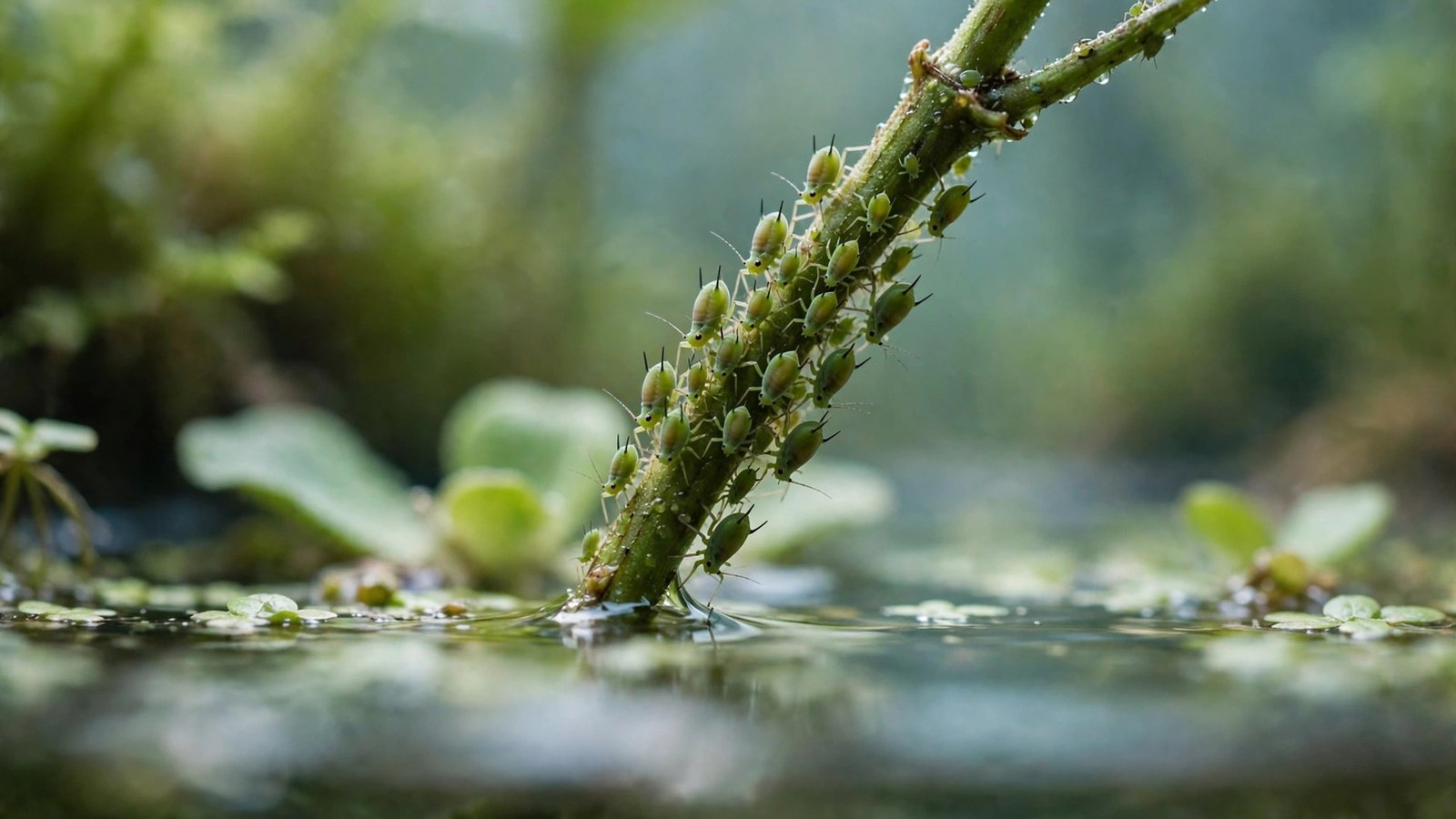
You lift the lid to feed your fish and spot the problem on the frogbit: the undersides of the leaves are crawling with tiny green specks — not on the glass, not in the water, on the leaves themselves. Those are aphids on aquarium plants, and they arrive precisely because your tank is thriving: lush floating foliage plus open, humid air is exactly what they want. They cannot survive underwater, they rarely harm fish, and you can wipe them out without a single chemical.
Aphids target the above-water growth, so open-top tanks with floating aquarium plants like frogbit, water lettuce, and red root floaters get hit hardest. If that is your setup, this guide covers identification, why they keep reappearing, and the aquarium-safe removal order that actually works.
What the clusters look like (and what they are not)
On floaters they are usually pale green or yellow-green, sometimes black. Colonies gather along stems and leaf undersides, most often on the newest, tenderest growth.
Three field marks confirm the ID: honeydew (a clear, sticky film on leaves below the colony — aphid waste that dulls the water surface if it drips), tiny white flakes (shed skins from growing nymphs), and ants farming the colony along emergent stems. The University of Maryland Extension's aphid page has clear photos of the cluster pattern and cast skins for confirmation.
Do not confuse them with the other usual suspects: springtails live on the water surface and jump when disturbed — they never cling to leaves; spider mites leave fine webbing and stippled, bleached tissue. If your colony matches green specks + sticky film + shed skins, the guide to tiny white bugs in planted tanks has the full differential. Damage is cosmetic for weeks, but a heavy colony on emergent growth is a classic trigger for curled aquarium plant leaves, so do not ignore it.
Why aphids on aquarium plants keep appearing
Aphids are land insects. They cannot establish underwater, which is why they always show up on the parts of your plants that touch air: the tops of floating leaves, stems poking through the surface, emersed growth in dry-start setups, and the roots and stems of riparium plants like pothos or peace lily growing out of the tank.
Open-top tanks and riparium setups are the obvious entry point — winged females fly in from houseplants, gardens, or a nearby windowsill, especially in spring and early summer. But the most common source is the plants themselves. Most aquarium plants are grown emerged (in humid air, not submerged) at commercial nurseries, and aphids or their eggs can hitch a ride on new purchases. This is the same reason the complete guide to freshwater aquarium plants recommends treating new stock before planting: pests arrive with the plants, not the water.
Once a single female lands, you are dealing with exponential math: aphids reproduce parthenogenetically, giving birth to live, pregnant daughters without mating, so one unnoticed colonist becomes a visible colony in under two weeks. And no aphid predators patrol above your waterline.
Aquarium-safe removal: the order that works
Start with the gentlest effective method and escalate only if needed — aphids drown in water within minutes, so every method below exploits that weakness.
| Method | Best for | Caveat |
|---|---|---|
| Dunk and swirl: submerge floaters in a bucket of tank water for 5–10 minutes, swish gently, lift out | Floating plants with heavy colonies | Do not soak delicate blooms past 15 minutes |
| Knock and feed: tap stems over the tank so aphids fall in; surface-feeding fish eat the drowned bodies | Emergent stems and riparium growth | Fish only eat aphids knocked into the water |
| Water jet: strong spray to blast colonies off removable items | Lids, rims, hardscape | Avoid blasting into the tank and stressing livestock |
| Manual squish: finger or damp cloth along stems | Small, early colonies | Slow for large infestations |
| Prune: cut and discard the worst leaves | Colonies covering whole leaves | Keep at least two-thirds of the foliage |
On biological control, be honest: some tankmates eat drowned aphids — guppies, endlers, bettas, and small killifish will pick them off the surface. But no fish eats aphids off leaves, so fish are cleanup crew, not control. Shrimp, snails, and otocinclus ignore aphids completely. And do not release ladybirds into your fish room — they wander, die in the water, and do nothing for the colony.
Keeping them from coming back
Prevention is a quarantine habit, not a product. Inspect every new plant under good light — check the undersides of floating leaves and crowns of emerged growth for green specks, sticky film, or shed skins. Hold new purchases in a separate container for one to two weeks; colonies become obvious in that window. This is the same discipline that keeps pest snails out of planted tanks — inspection and quarantine stop most hitchhikers, insect or mollusk.
For open-top setups, a fine mesh cover is the single most effective barrier: it blocks winged females while barely changing light or evaporation. And do a weekly thirty-second check of your floaters' undersides — catching a colony at twenty aphids instead of two thousand is the whole game. Floaters are a landing pad for other above-water hitchhikers too, so glance at the guide to freshwater limpets in aquariums while you are there — they arrive the same way and like the same plants.
Frequently Asked Questions
Can aphids live underwater and eat my submerged plants?
No. Aphids breathe air and drown within minutes of full submersion, which is why they only colonize the above-water parts of your setup — floating leaf tops, emergent stems, and riparium growth. Fully submerged plants are safe; damage there comes from something else.
Can I spray my usual houseplant insecticide on the tank plants?
No — this is the one genuinely dangerous mistake. Spray drift from neem oil, insecticidal soap, pyrethrins, or systemic insecticides lands on the water surface, where even small amounts can kill shrimp, snails, and fish. Treat nearby houseplants in a different room, and rely on physical removal for tank plants.
Will my fish eat the aphids?
Small surface-feeding fish like guppies, endlers, bettas, and killifish will eat aphids that fall into the water — knocking colonies off stems above the tank is a legitimate removal method for this reason. But no fish eats aphids off the leaves above the waterline, so fish alone never clear an infestation. Shrimp, snails, and otos ignore aphids entirely.
How did aphids get into my lidded tank?
Three routes: winged females slip in while the lid is open for feeding, they hitchhike on new plants grown emerged at nurseries, or they walk over from an infested houseplant on the same shelf or windowsill. If the tank sits near houseplants or a garden window, check those plants too.
Are aphids harmful to my fish or shrimp?
Not directly — aphids do not bite fish or attack shrimp. The indirect risks are honeydew dripping into the water (it can leave a dull surface film) and colony die-off fouling the surface. Neither is an emergency; remove the colony, skim or water-change as usual, and the tank recovers on its own.
A manageable pest, not an emergency
Aphids look alarming on a plant you are proud of, but they are one of the easiest tank pests to beat: they cannot live underwater, they only colonize leaves you can reach, and a bucket of old tank water plus two minutes of patience removes most of a colony. Inspect your floaters, dunk what is infested, quarantine new plants, and save the chemicals for the houseplants in the other room.